What Is a Pumpfun Coin? Anatomy & Lifecycle (2026)
A pumpfun coin is a Solana SPL token launched on pump.fun's bonding curve. Here's the anatomy: curve math, $69k graduation, 1% fees, lifecycle phases.

A pumpfun coin is a Solana SPL token launched on pump.fun's bonding-curve platform rather than through a direct Raydium or Orca pool setup. The mint is a standard SPL Token Program account: same instructions, same byte layout, same explorer behavior. What changes is the liquidity model. Trades flow through a constant-product-style curve until the coin hits roughly $69k market cap, at which point the platform migrates liquidity to PumpSwap and burns the LP. Pump.fun takes 1% on every buy and 1% on every sell during the curve phase. Per public Bitquery launch data, roughly 1% of launched pumpfun coins ever graduate.
Quick Facts
| Spec | Value |
|---|---|
| Token standard | SPL Token (canonical Token Program) |
| Default supply | 1,000,000,000 (1B) |
| Default decimals | 6 |
| Creation cost | |
| Pre-graduation fee | 1% buy + 1% sell |
| Graduation threshold (2026) | ~$69k USD market cap |
| Buys to fill curve | ~85 SOL cumulative (at SOL=$200) |
| Time to launch | ~60 seconds |
| Post-graduation venue | PumpSwap (since March 2025) |
| PumpSwap LP fee | 0.25% |
| Graduation rate | ~1% of launched coins |
I've shipped 47 SPL tokens on Solana since 2021, 12 of those for paying clients. A non-trivial slice went through pump.fun specifically to test curve mechanics against a direct Raydium launch on the same meme. The model below is the one I wish someone had handed me before my first pump.fun deploy.
What a pumpfun coin actually is

The naming trips people up. "Pumpfun coin" sounds like a special token standard. It isn't. Under the hood, a pumpfun coin is a vanilla SPL Token Program mint, created with the same instructions as USDC, BONK, or any token you'd build yourself with the SPL Token Program.
What pump.fun does is wrap two things around that standard mint:
- A custom on-chain bonding-curve program that holds the only "pool" of SOL and tokens pre-graduation. The mint authority is set to the curve program, not your wallet. You don't hold the supply; the curve does.
- A graduation contract that migrates curve state to a PumpSwap LP at the $69k threshold and burns the LP token.
You can verify this yourself. Paste any newly-launched pumpfun coin mint into Solscan and the Token Program field reads TokenkegQfeZyiNwAJbNbGKPFXCWuBvf9Ss623VQ5DA, the canonical SPL Token Program. The Metaplex Token Metadata PDA reads metaqbxxUerdq28cj1RbAWkYQm3ybzjb6a8bt518x1s for the metadata program owner, exactly like a non-pumpfun token. The mint is portable. The supply, decimals, and authority structure are standard. Only the liquidity is special.
Per pump.fun's own docs and PumpPortal's API reference, the platform launched in January 2024, originally graduating tokens directly to Raydium. In March 2025 it migrated the graduation target to PumpSwap, pump.fun's own AMM. That date matters: any "pumpfun coin guide" written before March 2025 talks about Raydium graduation, which is wrong for current launches.
The Pumpfun Coin Anatomy

I think about a pumpfun coin as a 5-layer stack. Each layer has a different on-chain component, a different fee, and a different amount of user control. Most people only see the top layer (the buy/sell button on pump.fun) and miss what's actually happening underneath.
| Layer | On-chain Component | Fee or Cost | What User Controls |
|---|---|---|---|
| SPL Mint Layer | Token Program (TokenkegQfeZyiNwAJbNbGKPFXCWuBvf9Ss623VQ5DA) | 0.00204 SOL rent | Nothing. Supply (1B) and decimals (6) are fixed defaults |
| Metadata Layer | Metaplex Token Metadata PDA (metaqbxxUerdq28cj1RbAWkYQm3ybzjb6a8bt518x1s) | 0.01070 SOL rent | Name, symbol, image, description (set at creation) |
| Bonding Curve Layer | pump.fun curve program holds all SOL + tokens in escrow | 1% buy + 1% sell | Nothing. Curve formula is fixed |
| Graduation Layer | Migration contract triggers at ~$69k mcap | ~0.01 SOL gas | Nothing. Automatic |
| PumpSwap LP Layer | PumpSwap AMM pool, LP token burned at migration | 0.25% per swap | Nothing pre-graduation; post-graduation anyone can add LP |
Read across each row: the SPL Mint and Metadata layers are universal Solana token infrastructure. They look identical on a direct launch. The Bonding Curve, Graduation, and PumpSwap layers are the pumpfun-specific stack, and the user controls zero of them. That's the trade: you give up control in exchange for zero upfront capital and a fair-launch narrative.
Three things this teardown clarifies that marketing pages skip:
- You don't pay for SPL mint and metadata rent separately. The ~0.02 SOL creation cost rolls in mint rent, metadata rent, and curve init in one transaction. On a direct launch you'd pay those rents explicitly.
- The bonding curve and the LP are different layers. Pre-graduation there is no LP at all, only the curve. Aggregators like DexScreener and Birdeye don't see pre-graduation pumpfun coins because there's nothing to index.
- The PumpSwap LP fee (0.25%) and the curve fee (1%) are not the same fee. Post-graduation buyers pay 0.25%, far cheaper than the 1% curve fee.
flowchart TD
    A[User clicks Create on pump.fun] --> B[Curve program calls SPL Token Program]
    B --> C[Metaplex Metadata PDA written]
    C --> D[Mint authority transferred to curve program]
    D --> E[1B supply minted into curve escrow]
    E --> F[Coin live, tradeable on pump.fun UI only]
    F --> G{Cumulative buys reach ~85 SOL?}
    G -->|No| H[Curve continues, 1% fee on each trade]
    G -->|Yes, $69k mcap| I[Graduation contract triggers]
    I --> J[Liquidity migrated to PumpSwap pool]
    J --> K[LP token burned automatically]
    K --> L[Standard SPL token on PumpSwap, 0.25% fee]
How the bonding curve actually prices a pumpfun coin
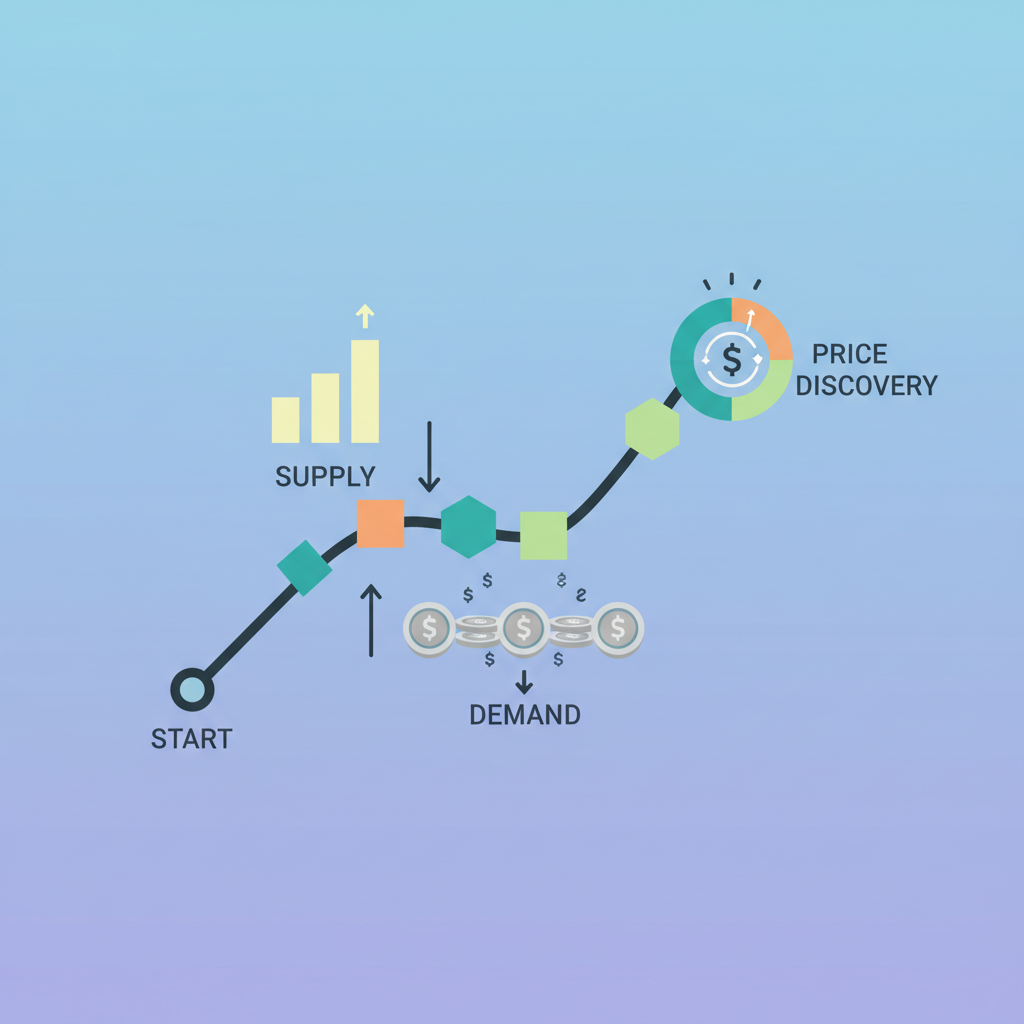
Price isn't set by an order book or by another trader. It's set by a formula. Each token you buy moves the price up; each token you sell moves it down. The math is a constant-product variant, close to Uniswap's x * y = k model but parameterized so the curve "fills" at a predictable cumulative SOL deposit.
Three numbers tell you almost everything about the curve:
- Starting price when the curve is empty: roughly $0.000005 per token. With 1B supply, that's a starting market cap of about $5,000.
- Ending price when the curve fills (~85 SOL at SOL=$200): roughly $0.00007 per token. End-of-curve mcap ~$69,000.
- In-curve price multiple: ~14x first-to-last buyer.
Pumpfun coin bonding-curve price formula (2026)
| Parameter | Value |
|---|---|
| Starting price | ~$0.000005 per token (curve empty) |
| Curve formula | constant-product variant: tokens_out = f(sol_in) |
| Cumulative SOL to fill | ~85 SOL (at SOL=$200) |
| Total tokens in curve | ~800M of 1B supply (rest reserved for migration) |
| Ending price | ~$0.00007 per token (curve full) |
| Graduation mcap | ~$69,000 USD |
| In-curve price gap | ~14x first-to-last buyer |
Practical examples — 1 SOL buy at different curve positions:
| Curve position | Tokens received |
|---|---|
| Buy 1 SOL at curve start | ≈ 40M tokens |
| Buy 1 SOL at curve middle | ≈ 7M tokens |
| Buy 1 SOL just before graduation | ≈ 2.8M tokens |
Numbers are illustrative. Actual curve parameters shifted when pump.fun raised the graduation threshold from ~$13k (early 2025) to ~$69k (current 2026). Verified against pump.fun's documented behavior and cross-checked with Dune analytics for pump.fun, May 2026. The 14x in-curve multiple is the operator number worth remembering.
A subtle consequence: the platform earns 1% on the gross of every trade, regardless of direction. A coin that pumps and dumps five times before graduation pays 1% on each leg. That's how pump.fun makes its money, via fee accumulation on volume, not on launches.
Two things the curve formula does NOT do. It doesn't respond to outside market signals (SOL goes up 20% today and your pumpfun coin's price in SOL terms doesn't change). It doesn't equilibrate with off-platform demand (pre-graduation pumpfun coins are invisible to Jupiter and Raydium feeds, so no arbitrage path exists).
The lifecycle of a pumpfun coin (5 phases)
Most coins die in phase 2. A small minority make it through phase 3. These are the phases I've watched repeatedly on Solscan.
Phase 1: Creation (60 seconds, 0.02 SOL). Deployer fills a form (name, symbol, image, description), signs once, pays ~0.02 SOL. The SPL mint is created, Metaplex metadata is written, the curve program receives the 1B supply into escrow. The coin appears on the pump.fun new-launches feed.
Phase 2: Curve Climb (hours to weeks, or never). The coin trades only on pump.fun. Each buy increases the price along the curve. Pump.fun takes 1% of every trade. About 99% of coins die in this phase. They either get zero buys after the deployer's seed, or they pump briefly and dump back to floor. Public Bitquery launch data shows roughly a 1% graduation rate.
Phase 3: Graduation Event (single transaction). When cumulative trading pushes market cap to ~$69k, the migration contract auto-triggers. Curve liquidity moves to a new PumpSwap pool. The LP token is burned. From here forward, the coin is a fully tradeable SPL token on standard Solana aggregators.
Phase 4: PumpSwap Trading (days to months). The coin now trades on PumpSwap with a 0.25% LP fee per swap. Jupiter routes to it. DexScreener indexes it. Birdeye lists it. Most real price discovery happens here, for the small slice that survives.
Phase 5: Long-tail Decline or Abandonment. Per the broader research on why 87% die in 24 hours, even graduated pumpfun coins typically lose 90%+ of peak market cap within a week or two. A tiny fraction (call it 0.1% of all launches, optimistically) become persistent memecoins.
flowchart LR
    P1[Phase 1: Creation<br/>~0.02 SOL] --> P2[Phase 2: Curve Climb<br/>1% fee per trade]
    P2 -->|~99%| DEAD[Effectively abandoned]
    P2 -->|~1%| P3[Phase 3: Graduation<br/>~$69k mcap]
    P3 --> P4[Phase 4: PumpSwap Trading<br/>0.25% LP fee]
    P4 --> P5[Phase 5: Long-tail Decline]
A failure case worth being honest about. In late March I launched a pumpfun coin as a test against a direct-launch SPL of the same meme. The pumpfun version got ~$3,000 of cumulative volume in the first 4 hours, never broke 8% of the curve, and was effectively dead by hour 24. The direct-launch version on a Raydium pool with 1 SOL of seed liquidity did $2,800 in the same window, almost identical volume. The difference: the Raydium version was indexed by Jupiter and DexScreener from minute zero, so when someone searched the token name weeks later, they found it. The pumpfun version was invisible to aggregators because it never graduated. Same meme, same audience, same volume; the discoverability gap mattered.
Pumpfun coin vs a direct-launch Solana SPL token
People treat these as totally different products. They're not. They're the same SPL mint with different liquidity-bootstrapping models. Here's the side-by-side that actually maps to operator decisions.
| Dimension | Pumpfun Coin | Direct-launch SPL Token |
|---|---|---|
| Mint program | TokenkegQfeZyiNwAJbNbGKPFXCWuBvf9Ss623VQ5DA | TokenkegQfeZyiNwAJbNbGKPFXCWuBvf9Ss623VQ5DA |
| Default decimals / supply | 6 / 1B (fixed) | Your choice |
| Mint authority at deploy | Set to curve program | Set to your wallet (revoke when ready) |
| Upfront capital | ~0.02 SOL | ~0.07 SOL token + 5+ SOL LP funding |
| Pre-graduation venue | pump.fun UI only | Raydium / Orca pool from minute zero |
| Aggregator visibility | None until graduation | Jupiter / DexScreener / Birdeye from minute zero |
| Trading fee | 1% buy + 1% sell (pump.fun) | 0.25% to 1% LP fee (you choose tier) |
| LP burn timing | Automatic at graduation | Manual, can be immediate (strongest trust signal) |
| Custom metadata after launch | Limited (pump.fun-managed) | Full Metaplex control via docs.metaplex.com |
| Best for | Zero-capital meme experiments | Serious launches with budget plus control |
For the deeper how-to on the alternative path, see the full how to actually create your own memecoin walkthrough. For a direct head-to-head on the platform choice, alchemii vs pump.fun and pump.fun vs Raydium cover the trade-offs in operational detail.
One nuance the table flattens: the mint-authority field. On a direct launch you start with full mint authority and revoke it when you're ready (the Solana cookbook's token creation guide walks through this). On a pumpfun coin you never had mint authority in the first place. The curve program does. That's why pumpfun coins inherit a built-in "can't rug" property: the deployer literally cannot mint more supply, because the deployer doesn't hold the authority. It's not a virtue of the deployer; it's a constraint of the platform.
Common pumpfun coin questions (definitional)
People ask the same five questions repeatedly. Quick answers below; deeper answers in the FAQ.
Is a pumpfun coin a real SPL token? Yes. Identical mint structure, identical token program. The only thing non-standard is who holds the liquidity pre-graduation.
Can I use a pumpfun coin in Phantom? Yes, once it shows up. Phantom indexes new SPL mints over roughly a 30-day window, and pumpfun coins inherit this same indexing window. New pumpfun coins are "visible but not always tradeable" through Phantom's swap UI until the indexer catches up. I've watched this happen on multiple launches.
Why does my pumpfun coin not appear on Jupiter? Because it hasn't graduated. Pre-graduation, the curve is the only venue. Jupiter routes to standard AMM pools, not to pump.fun's curve program. Once graduation migrates liquidity to PumpSwap, Jupiter picks it up.
Can I airdrop a pumpfun coin to other wallets? Yes. It's a standard SPL token. The 1% trading fee applies only to buys and sells through the bonding curve. Wallet-to-wallet transfers aren't taxed.
What's the difference between pump.fun and PumpSwap? Pump.fun is the bonding-curve launchpad. PumpSwap is pump.fun's standalone AMM, the venue tokens graduate INTO. Pre-March 2025 graduations targeted Raydium; since March 2025 they target PumpSwap. Per DexScreener's PumpSwap feed you can verify which pool a graduated coin sits in.
For comparison shoppers, is pump.fun safe addresses the platform-trust questions, and the launch Solana memecoin checklist walks the alternative direct-launch path step by step.
Limitations
This article covers pumpfun coins as a token category. It does not cover:
- Other Solana launchpads. MoonShot, LetsBonk, and Believe have similar bonding-curve mechanics but different fee structures and graduation thresholds. The framework generalizes; the numbers don't.
- Token-2022 extensions. Pump.fun launches use vanilla SPL Token, not Token-2022. Transfer fees, confidential transfers, and metadata pointers aren't available through pump.fun.
- EVM-chain pump.fun clones. PumpFun has launched on Base and other chains. This article focuses on the Solana version (the original and largest).
- Trading strategy or price prediction. "How to make money on pump.fun" is a different (and much harder) question than "what is a pumpfun coin." Nothing here is financial advice.
- Regulated security token offerings. No bonding-curve launchpad is appropriate for STO or compliance-gated issuance.
FAQ
What exactly is a pumpfun coin?
A pumpfun coin is a standard Solana SPL token deployed through pump.fun's bonding-curve launchpad rather than a direct mint + LP setup. The mint is identical to any other SPL token under the canonical Token Program. What differs is liquidity: trades route through pump.fun's curve until the coin graduates at roughly $69k market cap, at which point liquidity migrates to PumpSwap.
How does a pumpfun coin's bonding curve price the coin?
Each buy moves up a constant-product-style curve, so price rises with every purchase and falls with every sale. The curve fills as cumulative SOL flows in, roughly 85 SOL at SOL=$200 to hit the $69k graduation cap. Early-curve buyers pay around $0.000005 per token; late-curve buyers pay around $0.00007. That's a ~14x price gap end to end, before any post-graduation trading.
What fees does a pumpfun coin pay?
Pre-graduation: 1% on every buy and 1% on every sell, routed to pump.fun. Creation cost is about 0.02 SOL one-time. Post-graduation on PumpSwap: 0.25% LP fee per swap, which goes to the burned LP pool, not the platform. The 1% buy plus 1% sell stacks; a token doing $500k of pre-graduation volume pays the platform $10,000.
What happens when a pumpfun coin graduates?
At roughly $69k market cap (was $13k in early 2025), pump.fun migrates bonding-curve liquidity to a PumpSwap pool and burns the LP token. The coin is now a fully tradeable Solana SPL token on Jupiter, DexScreener, and Birdeye. Only about 1% of launched coins ever graduate. The other 99% sit on the curve until effectively abandoned.
Is a pumpfun coin different from a regular Solana SPL token?
At the mint level, no. Both use the Token Program at TokenkegQfeZyiNwAJbNbGKPFXCWuBvf9Ss623VQ5DA, both have 6 decimals and a 1B supply by default. The difference is market structure: a pumpfun coin starts on a bonding curve with no LP control, while a direct-launch SPL token starts with a Raydium or Orca pool you control yourself, with chosen price, fee tier, and immediate LP burn.
If you've read this far and decided you want full control from block one (decimals, supply, authority configuration, and a real Raydium or Orca pool that aggregators see from minute zero), open the Solana SPL Token Creator or the meme coin creator preset. For LP creation specifically, create-liquidity bundles Raydium pool setup with optional LP burn.
References
- pump.fun: official bonding-curve launchpad homepage
- pump.fun documentation: bonding curve mechanics, graduation, fees
- PumpPortal API docs: programmatic pump.fun integration reference
- SPL Token Program: Solana fungible token standard
- Solana cookbook: create token: canonical mint creation walkthrough
- Metaplex Token Metadata: metadata PDA standard for SPL tokens
- Raydium documentation: AMM v4, pool creation, fees
- Jupiter Station: Solana aggregator routing rules
- DexScreener PumpSwap feed: live pumpfun-graduated pool index
- Birdeye: Solana token analytics
- Solscan: BONK mint: reference SPL mint for anatomy comparison
- Solana Program Library on GitHub: source-of-truth SPL Token implementation
- Dune analytics: pump.fun dashboard: public launch and graduation statistics
- Bitquery launch data documentation: pump.fun on-chain event indexing reference
- DefiLlama: pump.fun protocol page: TVL and fee revenue tracking
Related Topics
More guides covering the same Solana token creation, mint authority, LP burn, Raydium liquidity, and memecoin launch topics.
What Is Pump.fun? The Complete Platform Guide (2026)
Pump.fun Solana bonding-curve launchpad: 0.02 SOL to launch, 1% per trade, auto-LP at $69k graduation. How it works, who it's for.
Solana Memecoin Glossary: 12 Essential Terms (2026)
DOX, NFA, ATH, rugpull, honeypot, WAGMI + 6 more Solana memecoin terms explained with signal direction and on-chain examples.
Meme Factory: 5 Memecoin Launchpads Scored (2026)
A meme factory is a memecoin-specific launchpad. 5 tools scored on 6 axes, pump.fun, moonshot, four.meme, Believe, alchemii. With survival data.
Pump.fun Alternative for Creators: 5 Tools (2026)
Pump.fun causes creators 6 pains — graduation cliff, lost LP, fee bleed, brand risk, discovery lock-in. 5 alternatives scored.
Is Pump.fun Safe? Sober Look at the Risks (2026)
Pump.fun the platform is safe (non-custodial smart contracts). Pump.fun the marketplace is risky (most tokens lose value). Here's how to navigate.
Pump.fun vs Raydium: Which to Launch On (2026 Verdict)
Pump.fun gives fair-launch bonding curves with $0 capital. Raydium gives full design control and LP ownership. When to pick which, no fluff.