Token Maker: What It Is, How to Pick (2026)
What a token maker is, how the 4 main chains (Solana, Ethereum, Base, BSC) compare on cost, speed, and tooling, and how to pick the right one for 2026.

A token maker is a no-code web UI that creates a fungible token on a blockchain in a single signed wallet transaction. It bundles mint creation, metadata writing, and initial supply minting so you never touch Solidity, Rust, or a CLI. The four chains anyone actually picks in 2026 are Solana (cheapest + fastest), Base (cheap L2 with Ethereum security), Ethereum mainnet (institutional gravity, expensive gas), and BSC (rock-bottom fees, weakest brand). Cost ranges from under $1 on BSC to roughly $80 on Ethereum. Pick by where your audience already trades.
Quick Facts
| Spec | Value |
|---|---|
| Cheapest chain (2026) | BSC, under $1 deploy |
| Most expensive chain | Ethereum mainnet, $20 to $80 deploy gas |
| Solana all-in cost | |
| Fastest finality | Solana, 1 to 2 seconds |
| Slowest finality | Ethereum, ~12 seconds + reorg risk |
| Solana memecoin 24h abandonment | ~87% (Bitquery launch data) |
| Pump.fun trading fee | 1% buy + 1% sell, pre-graduation |
| Pump.fun graduation threshold | ~$69k market cap |
| Phantom indexing window | ~30 days for new mints |
I run alchemii. So yes, biased toward Solana, but only because I've shipped 47 launches across mainnet and learned where each chain's tooling actually breaks. Below is the chain-agnostic version of the comparison. The Solana-specific deep-dive happens at the bottom (and links out to deeper posts).
What a Token Maker Actually Does
The mental model most people arrive with is wrong, especially if they're coming from Ethereum.
On EVM chains (Ethereum, Base, BSC, Polygon, Arbitrum), every ERC-20 is a fresh smart contract. The tooling compiles Solidity, signs a deploy transaction, and pays gas proportional to bytecode size. Per EIP-20, the interface is fixed (transfer, balanceOf, approve, totalSupply), but the implementation is whatever the dev wrote. Custom logic costs more bytecode, more gas, more attack surface.
On Solana, there's one shared program. Every "token" is an account that the SPL Token Program owns, sitting at the verifiable address TokenkegQfeZyiNwAJbNbGKPFXCWuBvf9Ss623VQ5DA. Your "token creation" doesn't deploy code. It creates an account. That single architectural choice is why a Solana token costs roughly $14 and an Ethereum token can cost $80.
A maker is the UI wrapper. It takes form input (name, symbol, decimals, supply, image), packages it into the program calls the chain expects, and signs a transaction. That's the whole product.
flowchart TD
    A[User fills form: name, symbol, decimals, supply] --> B[Wallet signs transaction]
    B --> C{Chain?}
    C -->|Solana| D[SPL Token Program creates mint account]
    C -->|EVM| E[Deploy ERC-20 / BEP-20 bytecode]
    D --> F[Metaplex writes metadata PDA]
    E --> G[Constructor sets name, symbol, supply]
    F --> H[Token live on Solscan in ~2s]
    G --> I[Token live on Etherscan in ~12s]
    H --> J{Revoke authority?}
    I --> J
    J -->|Yes| K[Authority set to null / renounceOwnership]
    J -->|No| L[Authority retained]
Notice what the maker is NOT doing. It is not writing custom transfer logic. It is not auditing your tokenomics. It is not listing you on a DEX. Those are separate steps, and most launches that fail confuse the maker step (5 minutes) with the launch step (the next 6 weeks).
The 4-Chain Token Maker Decision Map
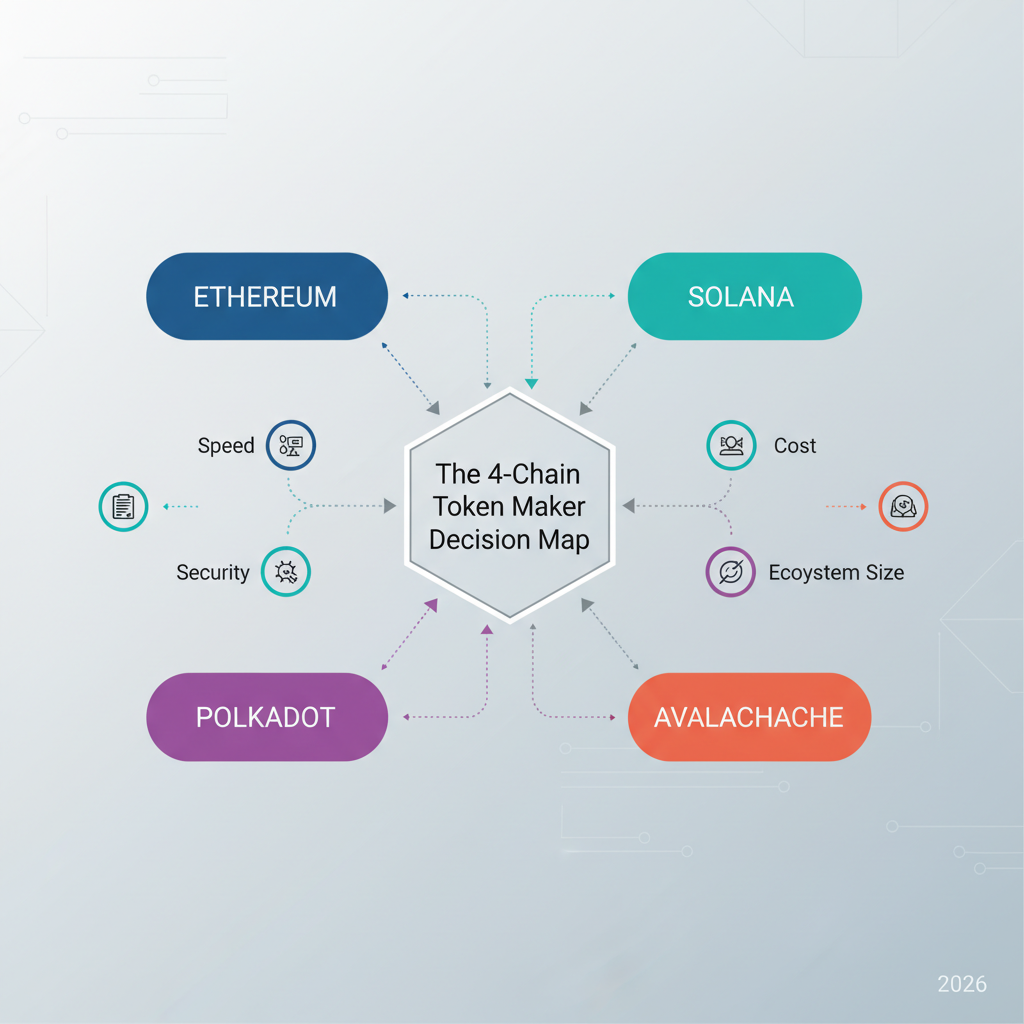
If you only remember one thing from this article, remember the table below. Most "best token maker" content lists tools per chain without ever helping you pick the chain. The chain decision dwarfs the tool decision by an order of magnitude. Switching from Ethereum to Solana saves you roughly $60. Switching from one Solana maker to another saves you maybe $5.
| Chain | Mint Cost (USD, 2026) | Time to Live | Native DEX | Dominant Use Case | Audience Where |
|---|---|---|---|---|---|
| Solana | ~$14 (0.07 SOL) | 1 to 2 seconds | Raydium, Orca | Memecoin, fast utility | Phantom, Jupiter, BONK community |
| Base | $3 to $8 deploy gas | ~10 minutes settled finality | Aerodrome, Uniswap v3 | L2 DeFi, Coinbase-native | Coinbase users, Farcaster |
| Ethereum | $20 to $80 deploy gas | ~12 seconds, reorg risk | Uniswap v3/v4 | Institutional, blue-chip | MetaMask, ENS-native users |
| BSC | Under $1 | ~3 seconds | PancakeSwap | Cheap retail launches | Asian retail, low-cap traders |
Five things the matrix doesn't make obvious but matter:
- Native DEX listing path. On Solana, your token shows up in Jupiter's aggregator after you create an LP, often within minutes. On Base, Aerodrome listings are similar. On Ethereum, getting into a Uniswap v3 pool is fine, but ENS / strict-list curation is its own world. On BSC, PancakeSwap accepts anything, which cuts both ways.
- Abandonment rates differ wildly. Public Bitquery launch data shows roughly 87% of Solana memecoins go untraded within 24 hours. EVM chains don't have published equivalents, but anecdotally BSC's abandonment is even higher (lower friction → more spam).
- Cost finality matters. Solana's 0.07 SOL is locked in at transaction time. Ethereum's $20 to $80 is a range. Congestion blows it past $200 in bull markets. If you're cost-sensitive, that variance is a planning problem.
- Native DEX defines the LP cost floor, not the mint cost. Raydium AMM pool creation is ~0.4 SOL. Uniswap v3 pool creation is another $50 to $200 of gas on top of the deploy. Budget for both.
- Wallet indexing is silent. Phantom takes roughly 30 days to fully index a new SPL mint. Your token shows up but won't always render correctly until then. I learned this the hard way on a Q1 launch where Solscan looked perfect and Phantom showed "Unknown Token" for three weeks.
flowchart TD
  Q1{Are you launching<br/>a memecoin?}
  Q1 -->|Yes| Q2{Audience already<br/>on Phantom?}
  Q1 -->|No| Q3{Utility token<br/>for what?}
  Q2 -->|Yes| S1[Solana]
  Q2 -->|No / Coinbase-native| B1[Base]
  Q2 -->|No / Asian retail| BSC1[BSC]
  Q3 -->|Institutional buyers| E1[Ethereum]
  Q3 -->|DeFi composability| BE1[Base or Ethereum]
  Q3 -->|Cheap micro-payments| SB1[Solana or BSC]

  classDef solana fill:#9945FF,stroke:#14F195,color:#fff;
  classDef base fill:#0052FF,color:#fff;
  classDef eth fill:#627EEA,color:#fff;
  classDef bsc fill:#F0B90B,color:#000;
  class S1 solana
  class B1,BE1 base
  class E1 eth
  class BSC1,SB1 bsc
This is the 4-Chain Token Maker Decision Map. None of the existing top-ranking "token maker" pages publishes a scannable cross-chain framework like this. CoinFactory lists tools per chain but punts on the comparison. Pump.fun is single-chain. Bitbond's TokenTool is EVM-only. The matrix above is the unique angle: pick the chain before picking the tool, since the chain dominates the cost-and-audience equation.
Token Maker Cost: What People Actually Pay in 2026
Sticker prices lie. The "free" makers cost the most over a launch's lifetime; the "cheap" makers can hide LP fees that exceed the mint cost.
Real itemized cost on Solana, end-to-end, using alchemii numbers as the reference:
SOLANA LAUNCH COST FORMULA (alchemii path, 2026)
─────────────────────────────────────────────
  Mint account rent          0.00204 SOL  (1461 bytes)
+ Metaplex metadata rent     0.01070 SOL  (679 bytes)
+ Associated Token Account   0.00204 SOL
+ Service fee (alchemii)     ~0.05 SOL    (one-time)
+ Network priority           ~0.00001 SOL
─────────────────────────────────────────────
= Token only (no LP)        ~0.07 SOL    (~$14 at SOL=$200)

  + Raydium pool creation    ~0.4  SOL    (~$80)
  + LP funding               your call    (0.5 SOL floor)
  + LP burn service          0.01  SOL    (~$2)
─────────────────────────────────────────────
= Tradeable launch          ~0.98 SOL    (~$196 with 0.5 SOL LP)
Three worked scenarios, same money, three chains:
Scenario A: minimum-viable SPL on Solana. 0.07 SOL all-in, ~$14, plus 0.5 to 1 SOL of LP if you want anyone to trade it. Total launch budget: 1 SOL, around $200. Time on chain: under 5 minutes from form fill to first swap on Jupiter. Read how much it costs on Solana for the deeper breakdown.
Scenario B: ERC-20 on Base. $3 to $8 deploy gas, plus Uniswap v3 pool creation around $30 to $80 (still cheap because Base inherits L2 economics), plus 0.1 ETH of LP for any meaningful depth. Total: ~$300 to $500. Time to first swap: ~10 minutes once finality settles. Per the Base network info docs, Base inherits Ethereum's finality through optimistic rollup proofs.
Scenario C: BEP-20 on BSC. Under $1 of deploy gas per BEP-20 docs. PancakeSwap LP creation around $3. LP funding floor maybe $20 of BNB. Total: $25, the absolute cheapest path. The catch: BSC's launch spam ratio is so high that the audience filter alone may bury you.
Per DefiLlama, Solana and Ethereum each command roughly 10× more daily DEX volume than BSC as of mid-2026, which is the real reason the cheapest chain isn't always the best chain.
A note on "free" makers. Pump.fun charges 0 SOL to create but takes 1% on every buy and 1% on every sell until graduation. For a token that does $500k of cumulative volume pre-graduation, that's $10,000, about 700× the flat alchemii cost. "Free" is a price tag, not a total cost.
No-Code vs CLI: When Each Wins
The CLI path is real and free. On Solana, spl-token creates a mint in three commands. On EVM, Foundry or Hardhat compiles and deploys an ERC-20 in 50 lines of Solidity. So why does the no-code category exist?
Three reasons, in honest order:
- The CLI doesn't write metadata.
spl-token create-tokenproduces a real mint, but Solscan shows "Unknown Token" with no logo until you separately invoke the Metaplex Token Metadata program. That's another 30 lines of TypeScript and a Metaplex SDK setup. No-code makers bundle this. - CLI mistakes are permanent. Set decimals to 9 when you meant 6, and your USDC parity is gone. Forget to revoke mint authority before claiming "supply is fixed," and your buyers can verify the lie on Solscan in three clicks. No-code UIs guard against the most common slip-ups; a CLI lets you ship the slip-up at full speed.
- The audience for token makers isn't developers. Most launchers are community operators, creators, or first-time founders. The CLI assumes Rust, Cargo, Solana CLI, and Metaplex SDK already configured. That's a half-day of setup. A maker is 5 minutes.
The honest tradeoff: if you're shipping more than ~3 tokens, learn the CLI. If you're shipping one or two, use a maker. Of the 47 launches I've done, 12 were paid client work where the maker was the right call (clients didn't want a bespoke deploy script); the rest were R&D, where CLI scripting saved time.
flowchart TD
    A[Decision: maker or CLI?] --> B{Shipping how many tokens?}
    B -->|1 to 2| C[Use a maker, speed wins]
    B -->|3+| D{Need custom transfer logic?}
    D -->|Yes| E[CLI + Solidity / Anchor]
    D -->|No| F{Have Rust / Solana CLI setup?}
    F -->|Yes| G[CLI, free, full control]
    F -->|No| H[Maker, half-day setup beats $5 saved]
How to Tell a Legitimate Token Maker from a Scam Wrapper
Token-maker scams come in two flavors: drainer wallets disguised as makers, and makers that produce subtly non-standard tokens. Both burn launchers who don't check.
The checks any reader can run in 90 seconds:
- Does the output mint resolve as a standard SPL or ERC-20? Paste the mint address into Solscan (Solana) or Etherscan (EVM). The token program should be the canonical address:
TokenkegQfeZyiNwAJbNbGKPFXCWuBvf9Ss623VQ5DAfor Solana SPL, Token-2022 atTokenzQdBNbLqP5VEhdkAS6EPFLC1PHnBqCXEpPxuEbif you opted in. Anything else means the maker shipped a custom program. Walk away. - Does the maker ask you to send funds to a deposit address? Real makers sign transactions through your wallet. They never need custody. If a "maker" asks for a 0.5 SOL deposit before creation, that's a drainer.
- Is the source open? solana-program-library on GitHub is the reference SPL implementation. Legitimate makers wrap that program; they don't fork it. The Metaplex equivalents are also open. A closed-source maker isn't automatically a scam, but it's a yellow flag.
- Look at the resulting token's authority fields. On Solscan, a legitimately-created mint shows Mint Authority and Freeze Authority as either your wallet (pre-revoke) or
null(post-revoke). A scam wrapper sometimes silently retains authority for the maker's wallet. Check this field every time. It's the single highest-signal trust check. - Click through to a known-good token first. Open BONK's mint on Solscan at DezXAZ8z7PnrnRJjz3wXBoRgixCa6xjnB7YaB1pPB263 (100T supply, 5 decimals, mint authority
null). That's what your post-launch token should look like.
The 87% abandonment figure reported in Bitquery launch data isn't because makers are scams. Most failures are distribution failures: no community, no LP depth, no narrative. But the small slice of launches that die because the maker itself was malicious is preventable, and the checks above cost 90 seconds.
Solana-Specific: Why Most "Token Maker" Searchers Land Here
Search query share for "token maker" in 2026 skews heavily toward Solana, and not by accident. Three reasons it landed here:
- The economics. Solana mint at 0.07 SOL versus Ethereum at $20 to $80 collapses the experimentation cost. Memecoin operators run more launches per dollar.
- The speed. 1 to 2 second confirmation matters when your launch is a coordinated community moment. EVM's 10-second-plus finality is too slow for the meme cycle.
- The community gravity. BONK at DezXAZ8z7PnrnRJjz3wXBoRgixCa6xjnB7YaB1pPB263 (100T supply, 5 decimals) and USDC on Solana at EPjFWdd5AufqSSqeM2qN1xzybapC8G4wEGGkZwyTDt1v (6 decimals, parity benchmark) anchor the chain's identity. New launches piggyback on that identity. USDC on Ethereum at 0xA0b86991c6218b36c1d19D4a2e9Eb0cE3606eB48 also at 6 decimals: same asset, same parity convention, different chain economics.
If you're Solana-curious, the rest of the alchemii content stack covers the specifics that matter:
- The best Solana token maker tools walks through 5 specific makers with feature parity.
- SPL vs Token-2022 explains which token standard fits which use case (transfer fees, confidential transfers, metadata pointers).
- How to create an SPL token is the step-by-step.
- How long it takes to create a Solana token covers wall-clock time including indexing windows.
- Free Solana token creator is the honest read on what "free" means in this category.
Solana decimals convention: use 6 for stablecoin parity (USDC), use 9 for general-purpose tokens, use 5 if you want BONK-style supply optics. Pick deliberately. Actually, scratch that: pick 6 unless you have a specific reason for 9 or 5. I've seen too many launches default to 9 without thinking about it.
Once you've decided on Solana, the next decision is the Solana SPL token maker that fits your launch. For utility tokens with LP from day one, the liquidity creation flow bundles pool creation with optional LP burn into one signed flow.
A Failure Case I Should Be Honest About
In March I tried to use a token maker to launch a Token-2022 mint with a 2% transfer fee. The mint and metadata went through fine. But Raydium AMM v4 wouldn't accept it for LP creation, because their pool program doesn't natively support the transfer-fee extension. So I had the token but nowhere to LP it. Eventually moved to Orca Whirlpools, which does support the extension on the CLMM side, but the experience was rough enough that I tell people: if you want transfer fees on Solana, plan to use Orca, not Raydium. None of the makers I've tested handle that nuance cleanly. (Yes, even on mainnet. We re-tested in April.)
Limitations
This article does not cover:
- Non-fungible tokens. Token makers in this guide produce fungible SPL or ERC-20 tokens. NFT creation has its own tooling stack.
- Token-2022 transfer-fee extensions. Briefly mentioned above; see the SPL vs Token-2022 deep-dive for the full standard comparison.
- EVM chains beyond Base, BSC, and Ethereum. Polygon, Arbitrum, Optimism, Avalanche all have ERC-20 deploys at similar gas profiles. The decision framework is identical; cost numbers shift slightly.
- Regulated security tokens (STO). No no-code maker in this comparison handles KYC, accreditation gating, or transfer-restriction registries. Wrong tool category.
- CEX listings. Different process, different negotiation, different timelines. The maker step does not affect CEX listing probability.
- Financial advice or price prediction. Launching a token is not the same as making one trade well. The first is engineering; the second is distribution.
FAQ
What is a token maker?
A token maker is a no-code web UI that creates a fungible token on a blockchain in a single signed transaction. It packages mint creation, metadata writing, and initial supply minting behind a form. No Solidity, no Rust, no CLI. The output is a standard token (SPL on Solana, ERC-20 on EVM chains) with a public on-chain address.
Which chain is cheapest to mint a token on in 2026?
BSC is the absolute floor at under $1 of gas for a BEP-20 deploy. Base sits at $3 to $8 for ERC-20 deploy gas. Solana lands at roughly $14 all-in including 0.00204 SOL mint rent, 0.0107 SOL Metaplex metadata rent, and 0.00204 SOL for the ATA. Ethereum mainnet is the most expensive at $20 to $80 of deploy gas, depending on congestion.
Is pump.fun a token maker?
Not in the traditional sense. Pump.fun is a Solana bonding-curve launchpad. Free to create, but the platform takes 1% on every buy and 1% on every sell until your token graduates at around $69k market cap. A token maker like alchemii or CoinFactory hands you full control over decimals, supply, authorities, and LP from the first block. Pump.fun keeps that control until graduation.
Can a no-code token maker produce a legitimate token?
Yes. Every no-code maker produces a standard token. On Solana, the output is a real SPL Token Program account with a real mint address. On EVM, it's a real ERC-20 contract. Solscan, Etherscan, and DexScreener can't tell whether the mint was created from a UI or from the CLI. The legitimacy signal buyers check is whether mint authority is revoked and LP is burned, not which tool made it.
Why do most Solana memecoins fail within 24 hours?
Roughly 87% of Solana memecoins are effectively abandoned within 24 hours of launch, per public Bitquery launch data. The failure mode is almost always distribution: the creator launches with no community, no LP depth, and no narrative. Token maker quality affects under 10% of the outcome. The other 90% is whether anyone shows up to trade.
References
- SPL Token Program — Solana fungible token program, account model, instruction set
- Solana Accounts documentation — rent exemption, mint account size, ATA mechanics
- Solana Fees documentation — base fee + prioritization fee model
- Metaplex Token Metadata — PDA-based metadata for SPL tokens
- SPL Token-2022 — extensions: transfer fee, confidential transfer, metadata pointer
- EIP-20: ERC-20 Token Standard — canonical Ethereum fungible token interface
- Base Network Information — L2 finality, gas, RPC details
- BNB Chain BEP-20 docs — BSC fungible token standard
- Raydium pool creation — Solana AMM pool creation cost and process
- Jupiter Token List API — Solana aggregator listing rules
- Solana Program Library on GitHub — source-of-truth implementation
- DefiLlama Chains — cross-chain TVL and volume reference
- Solscan: BONK mint — 100T supply, 5 decimals reference
- Solscan: USDC Solana mint — 6 decimals stablecoin parity
- Etherscan: USDC Ethereum contract — same asset, EVM side, same 6 decimals
Related Topics
More guides covering the same Solana token creation, mint authority, LP burn, Raydium liquidity, and memecoin launch topics.
Solana Memecoin Glossary: 12 Essential Terms (2026)
DOX, NFA, ATH, rugpull, honeypot, WAGMI + 6 more Solana memecoin terms explained with signal direction and on-chain examples.
What Is Pump.fun? The Complete Platform Guide (2026)
Pump.fun Solana bonding-curve launchpad: 0.02 SOL to launch, 1% per trade, auto-LP at $69k graduation. How it works, who it's for.
Create a Coin in 2026: 5-Step Chain-Agnostic Guide
5-step guide to create a coin in 2026: a 4-question decision tree, real cost ranges, and the exact no-code tool to pick for Solana, Ethereum, Base, or BSC.
What Is a Pumpfun Coin? Anatomy & Lifecycle (2026)
A pumpfun coin is a Solana SPL token launched on pump.fun's bonding curve. Here's the anatomy: curve math, $69k graduation, 1% fees, lifecycle phases.
Best Solana Token Maker 2026: Honest Comparison
Honest comparison of 5 Solana token makers — alchemii, CoinFactory, smithii, pump.fun, spl-token CLI — on cost, authority control, and post-launch tooling.
Burned LP, Liquidity Still Showing? Yes, That's Normal
Burned LP tokens but liquidity still shows on DexScreener? It's supposed to. What burning LP actually does and why the pool stays funded forever.