Cost to Create a Solana Token in 2026: 0.22 SOL
Create a Solana SPL token in 2026 for 0.22 SOL all-in: a 0.0191 SOL on-chain floor plus a 0.2 SOL flat fee, 0.32 SOL with mint revoked. Every line itemised.

Ready to create your Solana token? Configure your token and review the creation fee. Liquidity is a separate step.
Creating a Solana SPL token costs about 0.22 SOL all-in via a no-code tool like Alchemii — one flat payment at signing that covers the unavoidable on-chain cost (network fees plus rent for the mint, token, and Metaplex metadata accounts) and the service fee. Revoking mint authority, which most memecoins do, takes it to ~0.32 SOL, and selecting every optional extra tops out around 0.52 SOL. Liquidity is separate and not a fee — a realistic memecoin launch needs 5-25 SOL of seed liquidity depending on tier. Total launch budgets in 2026 range from ~2.7 SOL for a minimum-viable test to ~31 SOL for a serious launch with marketing reserve.
Short version: about 0.22 SOL to create the token itself, plus whatever you put into liquidity.
The longer version is more useful. Real launches end up costing 5–25 SOL all-in, and it's worth knowing where every fraction goes — partly so you don't get blindsided mid-launch by a fee that wasn't in your budget, and partly so you can spot when a "no-code" platform is quietly overcharging. Across the launches we've tracked in our dataset, we've seen tools advertise a low headline service fee, then silently deduct another 0.1 SOL from the seed liquidity at pool creation. Knowing the breakdown is your defense.
Full numbers below for 2026.
How much does it cost to create a Solana token? ~0.22 SOL all-in
Two things make up that number: on-chain cost that every tool and every CLI pays identically, and one flat service fee on top. The on-chain half is fixed by the protocol and worth understanding, because it's the part nobody can discount. Note that Solana began cutting its rent rate in September 2026 under SIMD-0437, so the rent lines below are due a refresh; our command-line cost guide carries figures re-measured on-chain after the second cut:
| On-chain item | Cost (SOL) | What it is |
|---|---|---|
| Mint account rent | ~0.00146 | Solana charges rent for on-chain accounts; this is the SPL token mint |
| Associated token account rent | ~0.00204 | The associated token account that receives your initial supply |
| Metaplex metadata rent | ~0.00562 | The Metaplex metadata account storing your token's name, symbol, image URI — refundable if you close it |
| Metaplex protocol fee | 0.01 | Charged by Metaplex on the create instruction. A fee, not rent: it never comes back |
| Signature + base network fee | ~0.000005 | 5,000 lamports per signature, before any priority fee |
| On-chain floor | ~0.0191 SOL | Paid by anyone minting on mainnet, no-code or CLI |
Priority fees sit on top of that floor when the network is congested — see the congestion section below for how much to budget.
On top of that floor, Alchemii charges a flat one-time service fee. A standard launch comes to about 0.22 SOL all-in: one signature, one deduction, no subscription and no cut of your trading volume afterwards. Optional extras — revoking mint authority is the common one — add a flat amount each, itemized on the form before you ever connect a wallet, and take a typical memecoin launch to ~0.32 SOL. Turn on everything and the ceiling is ~0.52 SOL.
We quote this in SOL rather than dollars on purpose. Everything on this page is denominated in SOL on-chain; converting to USD at whatever the price happened to be the day the page was written is how cost guides quietly go stale.
Liquidity pool creation: ~0.4 SOL of rent + your liquidity
Creating the Raydium pool carries no service fee — Raydium doesn't charge you to open a pool. What it does cost is rent: the pool's own program-derived accounts need roughly 0.4 SOL of one-time rent-exempt deposit, plus about 0.002 SOL of network fees for the creation transaction. Budget for it separately from the token creation fee; it is a Raydium/protocol cost, not a launcher's cut.
The far bigger number is the liquidity you deposit. That one is not a fee — you keep ownership of those tokens via your LP position. But:
- If you burn the LP, the liquidity becomes permanent and cannot be withdrawn.
- If you remove the liquidity, you get the tokens back.
How much should you deposit? Depends on your goal:
- Test launch / experiment: 1–2 SOL liquidity is enough to validate trading mechanics. Don't expect serious volume.
- Memecoin with credibility: 5–10 SOL minimum. Below this, slippage scares off serious buyers.
- Serious launch: 15–25 SOL. This puts your initial market cap and slippage in a range that attracts traders rather than repelling them.
LP burn: ~0.001 SOL
Burning your LP is essentially free. The transaction fee is a tiny network fee (~0.001 SOL). The "cost" is psychological: you give up the ability to ever withdraw the liquidity again.
Some projects use third-party LP locking services (Team Finance, etc.) which charge 0.1–1% of locked value as a fee. For most Solana memecoins, burn is cleaner and free.
Cost breakdown visualized
Here's what every fraction of a SOL goes to in a typical Solana SPL token creation. Numbers verified against live transactions on Solscan and the SPL Token Program's rent-exempt minimum.
Toggle: launch budget by tier
Different launch ambitions need different total budgets. Switch the view below to see what each tier of launch typically costs end-to-end. For an interactive estimator that lets you plug in your own LP seed and launch tier, use the Solana token cost calculator — it runs the math live against the same fee constants documented here.
Total realistic budget
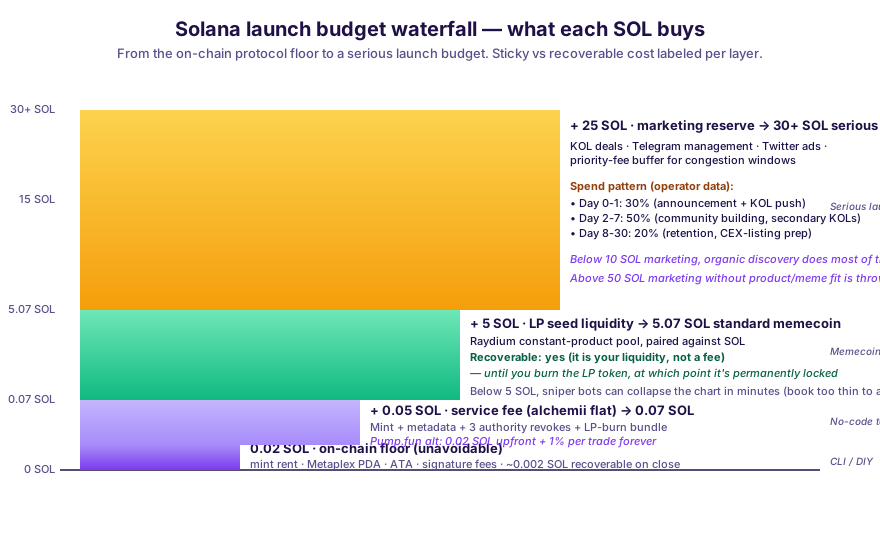
For different launch tiers:
Minimum viable launch
- Token creation: 0.22 SOL
- Pool liquidity: 2 SOL
- Pool creation rent: 0.4 SOL
- LP burn + buffer: 0.1 SOL
- Total: ~2.7 SOL
Standard memecoin launch
- Token creation: 0.22 SOL
- Pool liquidity: 10 SOL
- Pool creation rent: 0.4 SOL
- LP burn + buffer: 0.1 SOL
- Total: ~10.7 SOL
Serious launch
- Token creation: 0.32 SOL (mint authority revoked)
- Pool liquidity: 25 SOL
- Pool creation rent: 0.4 SOL
- LP burn + buffer: 0.1 SOL
- Marketing reserve: 5 SOL
- Total: ~30.8 SOL
Cost to create vs cost to launch a token on Solana
These are two different numbers, and confusing them is how launch budgets go wrong. The cost to create the token — mint account, metadata, authority settings, service fee — is the ~0.22 SOL this page itemizes, and it is identical whether the token goes on to trade or never trades at all. The cost to launch a token on Solana is that figure plus the ~0.4 SOL of Raydium pool rent, plus the seed liquidity you deposit, plus a buffer for priority fees and failed retries: the tier totals above.
The distinction matters because the mint price is the only part you can pin down in advance. It is a fixed, itemized number you can read before signing. Everything above it scales with how seriously you intend to launch, and no guide can pick that for you.
If the number you are actually pricing is the second one — the total SOL that has to be sitting in the wallet before you start — how much SOL you need to launch a meme coin works the wallet budget through end to end. This page stays on the mint price.
Hidden costs people forget
Failed transactions during congestion
Solana sees congestion spikes during major events (memecoin frenzies, NFT mints, etc.). During these spikes, transactions can fail and you pay the fee anyway. Budget 0.1–0.5 SOL buffer for retries.
Image hosting
If you host your token logo somewhere other than IPFS (e.g. a private server), you're paying ongoing hosting fees. Alchemii pins to IPFS for you — that's part of the service fee — so you don't have monthly costs.
Metadata updates
If you keep update authority and want to change the image or name later, every update costs another ~0.001 SOL transaction fee plus a new IPFS upload. Not expensive, but adds up if you iterate.
LP top-ups
If you decide to deepen liquidity after launch, you pay another deposit (and get new LP tokens). Each LP deposit is a separate Raydium transaction (~0.002 SOL) plus the liquidity itself.
Listing fees
DexScreener (around 0.5 SOL for verification badge), Birdeye, and Jupiter Strict List (free but vetted, 1–2 weeks) inclusion can be paid or free depending on the service.
CEX listing (if you ever get there)
Solana memecoins occasionally get CEX-listed (Gate.io, MEXC, KuCoin). Those listings can cost anywhere from $0 (organic) to $50,000 (paid placement). For most memecoins, organic is the only realistic path.
How Solana compares to other chains
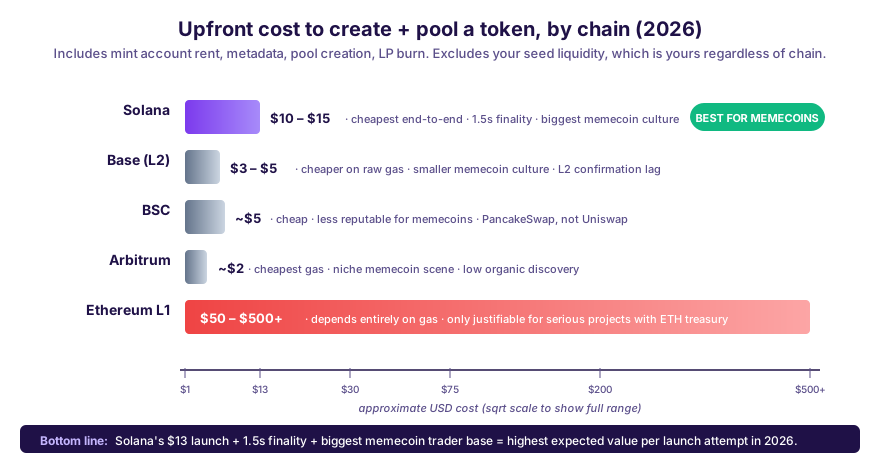
The chart compresses the $500+ end so the cheap-chain differences stay readable — the real gap between Ethereum L1 and the cheap chains is far wider than the bar lengths suggest.
The row below compares chain cost, not tool cost: gas and rent to get a token on-chain, before any launcher's service fee. Solana's is quoted in SOL because that's the unit the protocol charges in.
| Chain | On-chain deploy cost | Initial pool | Notes |
|---|---|---|---|
| Solana | ~0.0191 SOL | Your liquidity | Cheapest chain here, and the fastest to confirm |
| Base (L2) | ~$3–5 | Your liquidity | Cheap, but smaller memecoin culture |
| Ethereum mainnet | $50–500 | Your liquidity | Expensive, mostly for serious projects |
| BSC | ~$5 | Your liquidity | Cheap, but less reputable for memecoins |
| Arbitrum | ~$2 | Your liquidity | Cheap, niche memecoin scene |
Solana wins on chain cost per launch. The reason there are so many Solana memecoins is partly because a failed launch costs a fraction of a SOL in on-chain terms. You can iterate. A no-code service fee sits on top of that on every chain, Solana included — that's a tool decision, not a chain decision.
How to verify the costs yourself
Before paying any tool to create your token, check:
- Total SOL deducted from your wallet during creation should match the figure the tool quoted you before you signed — for a standard Alchemii launch that's ~0.22 SOL, or ~0.32 SOL if you also revoked mint authority. A deduction larger than the quote is the red flag, whatever the headline fee was.
- Your token's mint authority should be set as you specified. Verify on Solscan, or paste the mint address into the free four-checkpoint authority audit to read mint authority, freeze authority, metadata and LP burn status in one pass — if you paid for a revocation and it didn't land, this is where you find out.
- Your LP position should match what you deposited. Raydium pools display this clearly.
Tools that hide their fees or require ongoing subscriptions for token creation are charging more than they need to. Solana's underlying costs are fixed and public — you can verify them yourself in the Solana docs or by simulating a token creation transaction with the Solana CLI.
Tool-by-tool cost comparison (no-code Solana launchers)
Several no-code paths exist. Same on-chain cost floor, very different service-fee structures. The right tool depends on what you optimize for: lowest fee at signing, lowest cumulative cost over the token's life, or fewest decisions to make.
Pricing verified 1 August 2026 against each vendor's own live pricing page. Competitor fees change — re-check before committing.
| Tool | Service fee | Recurring fee | Authority handling | LP burn included? |
|---|---|---|---|---|
| Jumpbit | 0.05 SOL | None | Revocations included free | No |
| DEXArea | 0.09 SOL | None | Included free | No |
| Solr Network | 0.1 SOL | None | Mint + freeze free (update authority retained) | No |
| Alchemii | 0.2 SOL | None | Tokens are minted with no freeze authority at all; mint-authority revoke is an optional flat extra; update authority stays with your wallet | Yes, bundled signed TX |
| CoinFactory (coinfactory.app) | 0.2 SOL | None | Revoke-update free, others optional | Separate paid action |
| Smithii (smithii.io) | 0.3 SOL flat, inclusive of on-chain cost | None | +0.1 SOL per revocation | Separate paid action |
| Orion Tools | 0.3 SOL base + a mandatory 0.1 SOL freeze revocation = 0.4 SOL effective | None | Freeze revocation is not optional | No |
| Pump.fun | 0 SOL to create (~0.02 SOL first buy) | 1.25% per buy + 1.25% per sell on every trade | Authorities locked at deploy | Auto on graduation |
| spl-token CLI | None | None (just RPC) | Manual — you write the CLI command | Manual — separate Burn TX |
Add the on-chain floor to every service fee above — roughly 0.019 SOL of rent, the Metaplex protocol fee and signature fees — except Smithii's, which quotes inclusive of it. All-in, that puts the budget tier around 0.07-0.12 SOL, Alchemii and CoinFactory around 0.22 SOL, Smithii at 0.3 SOL, and Orion around 0.42 SOL.
We are not the cheapest tool in this table and we're not going to pretend otherwise. The budget tier undercuts us on the signature-prompt number. What you get for the higher fee here is a flat one-time price with no cut of your trading volume; a token that is born with no freeze authority and an optional mint-authority revoke folded into the same signed transaction rather than sold as a separate paid action afterwards; LP burn and LP removal tooling in the same product; and non-custodial signing — you approve every transaction in your own wallet and we never hold your funds. Against Smithii and Orion Tools we do cost less, and we're level with CoinFactory.
That bundling is the part that pays for itself. In our 50,000-launch dataset, tokens whose mint authority was revoked survived their first 24 hours at 4.2× the rate of tokens that kept it, and tokens whose LP was burned at minute zero at 5.7×. The tools that make those two steps a separate errand are the tools where they quietly don't happen.
The comparison that actually changes the arithmetic is Pump.fun, because its fee is a percentage rather than a fixed amount. Pump.fun takes 1.25% on every buy and every sell — 2.5% round trip. Against a ~0.22 SOL flat fee, break-even lands at roughly 9 SOL of cumulative trading volume (0.22 ÷ 0.025). Below that, Pump.fun is cheaper end-to-end. Above it, the percentage compounds against you for as long as the token trades while the flat fee stays where it was at signing. A token that does 100 SOL of cumulative volume pays about 2.5 SOL to Pump.fun against our 0.22 SOL; at 1,000 SOL of volume the gap is roughly 24.8 SOL. The math gets worse for Pump.fun the more successful the token becomes — and better for Pump.fun the faster it dies.
The spl-token CLI path is the cheapest in raw SOL and the most expensive in time. Writing the Metaplex metadata correctly takes most first-timers 2-3 hours and any error in the metadata JSON is permanent if you've already revoked update authority. Saving 0.2 SOL is not worth the time and risk for a memecoin. For a serious utility token where you want full control, the CLI is correct. For everything else, a no-code tool with bundled authority management is the right pick. We've watched founders save 0.2 SOL on the CLI and then burn a weekend fixing a typo, which is not a good trade.
Hidden cost: priority fees during congestion
The transaction-fee numbers above assume base-fee mainnet conditions (5,000 lamports per signature). In practice, when Solana is congested, you pay priority fees on top of the base fee to get your transaction included in a block within reasonable time. During the worst congestion windows of 2024-2025 (typically driven by airdrop hype cycles and memecoin launch bursts), priority fees ran 0.001-0.01 SOL per transaction — sometimes more.
For a full launch flow that involves 3-5 transactions (mint + metadata + optional mint-authority revoke + pool creation + LP burn), priority fees during congestion can add 0.003-0.05 SOL to the launch cost. The Solana priority fees documentation covers the mechanics, but the operational rule is: do not launch a memecoin during an active hype cycle on Solana itself. If a major airdrop is being claimed or a viral launch is congesting the network, wait a few hours. The cost difference between a calm-network and congested-network launch is non-trivial.
Most wallets (including Phantom and Solflare) will surface priority-fee suggestions at signing time. Always check the suggested priority fee against the actual cost — if the wallet is suggesting more than 0.005 SOL of priority on a single token-creation transaction, you're paying for congestion you could avoid by waiting. Conversely, setting priority too low during real congestion means your transaction may be dropped after 30-60 seconds, which is its own cost in time.
Common cost questions
Why does the Metaplex metadata account cost more than the mint account? The metadata account stores significantly more data (name, symbol, image URI, attribute JSON, creator info). Solana's rent is proportional to account size in bytes.
Can I create a token without paying the Metaplex fee? Technically yes — bare SPL tokens without metadata work, but they show up as "Unknown Token" with no logo in wallets. No serious launch skips metadata.
Are Solana fees in USD or SOL? SOL. Network fees are denominated in lamports (1 SOL = 1,000,000,000 lamports), so the dollar cost depends on the SOL price.
What if SOL price doubles next week — does my pool's liquidity double in USD? Approximately yes — if your pool is paired against SOL. The total USD value of the pool tracks SOL price. If paired against USDC, the USDC half is stable while the token half moves.
Can I get the rent back if I close the token? You can close the metadata account and recover its rent (~0.00562 SOL) if you kept update authority — the 0.01 SOL Metaplex protocol fee is not rent and never comes back. The mint account can be closed if supply is zero, recovering its rent. Once you've revoked authorities and minted supply, most rent is permanent.
Quick Facts (verifiable specifications)
| Specification | Value | Source |
|---|---|---|
| Mint account rent | ~0.00146 SOL | Article body |
| Associated token account rent | ~0.00204 SOL | Article body |
| Metaplex metadata rent | ~0.00562 SOL | Article body |
| Metaplex protocol fee (non-refundable) | 0.01 SOL | Article body |
| Signature + base network fee | ~0.000005 SOL (5,000 lamports) | Article body |
| Per-revocation network fee (before any tool's charge for the option) | ~0.000005 SOL each | Article body |
| Alchemii service fee | 0.2 SOL flat, one-time | Article body |
| Standard launch via Alchemii, all-in | ~0.22 SOL | Article body |
| Launch + revoke mint authority (typical memecoin) | ~0.32 SOL | Article body |
| Launch with every optional extra | up to ~0.52 SOL | Article body |
| Theoretical minimum on-chain cost | ~0.0191 SOL | Article body |
| Break-even vs Pump.fun's 2.5% round trip | ~9 SOL of cumulative volume | Article body |
| LP burn transaction cost | ~0.001 SOL | Article body |
| Raydium pool creation rent | ~0.4 SOL one-time | Article body |
| Raydium pool creation transaction fee | ~0.002 SOL | Article body |
| Minimum viable launch total | ~2.7 SOL | Article body |
| Standard memecoin launch total | ~10.7 SOL | Article body |
| Serious launch total | ~30.8 SOL | Article body |
| Base lamport fee per signature | 5,000 lamports (0.000005 SOL) | Solana docs |
Limitations of this guide (what it doesn't cover)
This article focuses on direct, verifiable on-chain and service-fee costs in 2026. Several related cost categories are intentionally out of scope.
- Pump.fun / bonding-curve launch economics. Pump.fun has different cost mechanics (free to create, 1.25% on volume) — see Pump.fun vs Raydium and Alchemii vs Pump.fun.
- Token-2022 / Token Extensions cost differences. Token-2022 mints have different account sizes and may require additional rent for extensions; covered separately in SPL Token vs Token-2022.
- Multi-pool deployment strategies. Costs for seeding pools on multiple DEXs (Raydium + Orca + Meteora) compound the per-pool figures here; not modeled.
- Off-chain marketing and community costs. Twitter ads, Telegram management, KOL deals, and community building can dwarf on-chain costs but vary by project — see How to market a Solana memecoin.
- Securities or tax implications. Token creation may have legal implications by jurisdiction; this is not legal or tax advice.
- CEX listing fees in detail. Mentioned briefly but specific quotes from Gate.io, MEXC, KuCoin, etc. change frequently and are negotiated case-by-case.
- Cross-chain bridging / wrapping costs. Wormhole, Allbridge, and similar bridges have their own fees not covered here.
Sources & references
- Alchemii pricing page — AlchemiiFlat one-time service fee, ~0.22 SOL all-in for a standard launch, 0% on trading volume.
- Pump.fun official docs — fees (pump.fun/docs) — Pump.fun1.25% curve fee, 0.015 SOL graduation fee, PumpSwap fees tiered from 1.25% to 0.30%.
- Solana network fees and transaction pricing — Solana docsBase lamport fee 5,000 lamports per signature, plus prioritization fees.
- Solana rent-exempt minimums — Solana docsMint accounts need ~0.00146 SOL and associated token accounts ~0.00204 SOL of rent-exempt deposit; documented in core rent rules.
- Metaplex Token Metadata — Metaplex FoundationMetadata account costs ~0.00562 SOL of rent, plus a flat 0.01 SOL protocol fee.
- Bitquery Solana DEX & launch data — BitquerySource for launch budget tier analysis — typical seed liquidity by launch outcome.
- Raydium AMM v4 docs — pool creation cost — RaydiumPool creation requires ~0.4 SOL of one-time rent for program-derived addresses.
- Solana incinerator address (LP burn) — SolscanStandard burn destination — LP burns cost only ~0.001 SOL of network fees.
- Ethereum gas tracker (Etherscan) — EtherscanLive ETH gas prices used for the cross-chain cost comparison ($50-500 ERC-20 deploy).
- BSC gas tracker (BscScan) — BscScanBNB Chain gas prices for BEP20 deploy comparison.
- Solana memecoin survival rate study — AlchemiiInternal data analysis on launch budget tier vs survival rate (50K+ launches sampled).
- Solscan — explore any token's mint costs — SolscanVerify any token's actual creation cost by inspecting the original mint transaction.
- SPL Token Program source — GitHub / Solana ProgramReference implementation — defines the rent-exempt size of mint accounts.
- Solana priority fee documentation — Solana docsPriority fee mechanics — relevant during congestion when base 5,000 lamport fee is insufficient.
- Helius RPC — pricing and Solana ecosystem context — HeliusReliable RPC provider commonly used by token creators; pricing benchmarks for infra.
- QuickNode Solana benchmarks — QuickNodeAlternate Solana RPC — reference for understanding the infrastructure side of the cost stack.
- Birdeye — Solana token data — BirdeyeUsed to verify post-launch volume and survival metrics in the budget tier analysis.
- DexScreener — Solana new pools — DexScreenerCross-references Raydium pool creation cost analysis with live launches.
- Pump.fun program account on Solscan — SolscanSource for verifying Pump.fun bonding-curve transaction costs in the cross-platform comparison.
- Token-2022 program & extension costs — Solana LabsToken-2022 has different rent calculations for tokens using extensions — outside this guide's scope but referenced for completeness.
FAQ
How much does it cost to create a Solana token in 2026?
About 0.22 SOL all-in via a no-code tool like Alchemii — one flat payment at signing that covers the unavoidable on-chain cost (network fees plus rent for the mint, token, and Metaplex metadata accounts) and the service fee. Revoking mint authority, which most memecoins do, takes it to about 0.32 SOL; with every optional extra selected it tops out around 0.52 SOL. Liquidity is separate.
What is the cheapest way to create a Solana SPL token?
The spl-token CLI plus your own one-shot Metaplex metadata script, at the bare ~0.0191 SOL protocol floor — no service fee, but you write the metadata call yourself. Among no-code tools the service fee runs from about 0.05 SOL to 0.4 SOL; Alchemii is 0.2 SOL, about 0.22 SOL all-in. Pump.fun is cheapest upfront (0 SOL to create; ~0.02 SOL for the first buy) but takes 1.25% on every buy and every sell, so it overtakes a 0.22 SOL flat fee at roughly 9 SOL of cumulative volume.
How much SOL do I need for liquidity?
5-25 SOL depending on launch tier. Minimum-viable test: 2-5 SOL. Standard memecoin: 5-10 SOL. Serious launch with sniper-bot resilience: 25-30 SOL. Below 5 SOL, sniper bots can collapse the chart in minutes because the order book is too thin to absorb their exits.
Is Solana cheaper than Ethereum for token launches?
Significantly, on raw chain cost. Ethereum mainnet token deployment costs $50-500 depending on gas prices. Base costs $3-5. BSC costs ~$5. Solana's on-chain cost is about 0.0191 SOL. A no-code service fee sits on top of that on any chain. Network speed is also faster: Solana confirms in under a second, Ethereum in 12-15 seconds.
Are there hidden costs after token creation?
Yes — three categories often missed. (1) LP creation: the Raydium pool needs about 0.4 SOL of one-time rent for its own program accounts, on top of the liquidity you seed. (2) Mint authority revocation: it is a separate instruction with its own signature fee (~0.000005 SOL) and most tools charge extra for the option — on Alchemii, revoking mint authority is what takes a launch from ~0.22 SOL to ~0.32 SOL. (3) Wallet listings (Phantom strict-list, Jupiter strict-list): free but require a real social presence. Some platforms also silently deduct from your seed liquidity at pool init — always verify the exact pool balance after creation.
Now you know exactly what it costs, line by line. ~0.22 SOL, one signature, no subscription, no cut of your volume — and the full total is on screen before you connect a wallet. Open the Solana Token Creator → — or for memecoin launches specifically, the Solana meme coin generator is the same tool with memecoin defaults pre-filled. Run through the launch checklist to get the most out of your spend.
Create your Solana token
Choose your token name, symbol, supply and image. Review the authority options and creation fee, then confirm the transaction in your wallet. Liquidity is a separate step.
Related Topics
More guides to Solana token creation, authorities, liquidity, and meme coin launches.
How Much Does It Cost to Make a Meme Coin? (2026)
Full wallet budget for a Solana meme coin: ~0.21 SOL to mint, ~0.4 SOL pool rent, seed liquidity on top. Three worked budgets — about 3, 11 and 31 SOL.
Create a Solana Token With the spl-token CLI (2026)
The full spl-token CLI path to a Solana token: the commands, the post-rent-cut cost of 0.0163 SOL verified on-chain, why your mint shows as Unknown Token.
Get a Pump Suffix Token Without Pump.fun (2026)
Create a Solana token ending in pump for 0.1 SOL. Gain memecoin-native recognition, keep direct-launch control, and preserve more creator upside.
What Happens When You Clone a Solana Token? (2026)
Cloning a Solana token copies name, symbol and image — nothing else. New mint address, no liquidity, no holders, no price. Exactly what transfers.
Raydium Token Launch: The 5-Step Playbook (2026)
End-to-end Raydium token launch flow: mint your SPL, configure metadata, seed a Raydium pool, burn LP, and get listed on Jupiter. Total cost ~0.72 SOL.
Free Solana Token Creator? 0.0191 SOL Floor (2026)
No Solana token creator is free — the protocol floor is ~0.0191 SOL and no tool can waive it. Every no-code creator's real 2026 price, compared in SOL.