What Happens When You Clone a Solana Token? (2026)
Cloning a Solana token copies name, symbol and image — nothing else. New mint address, no liquidity, no holders, no price. Exactly what transfers.

Ready to create your Solana token? Enter your token details, choose your authority options, and confirm in your wallet.
Cloning a Solana token creates a brand-new SPL token that reuses the original's name, symbol, description and image, and inherits nothing else. The clone gets a randomly generated mint address with no on-chain relationship to the original, no liquidity pool, no price, no trade history, no social accounts and exactly one holder at launch — you, holding 100% of supply. There is no code to fork on Solana, because every standard SPL token is already governed by the same Token Program; what you copy is metadata, which is data. Cloning compresses the time between spotting a working format and signing your own mint. It does not transfer demand, and nothing in a metadata copy changes the base rate on whether a launch survives.
Quick facts
| Property | What a clone gets |
|---|---|
| Mint address | Brand new, randomly generated, no link to the original |
| Steerable part of the address | A short vanity tail only — e.g. ending in pump, a 0.1 SOL option verified before the transaction is built |
| On-chain relationship to original | None — explorers show two unrelated accounts |
| Program that owns it | The same one as every SPL token: TokenkegQfeZyiNwAJbNbGKPFXCWuBvf9Ss623VQ5DA |
| Liquidity at t=0 | 0 SOL |
| Price at t=0 | Undefined — there is no pool to price against |
| Holders at t=0 | 1 (you, with 100% of supply) |
| Trade history | Empty |
| DexScreener / Birdeye / Jupiter presence | None until a pool exists |
| Time to sign, from a prefilled form | Under a minute of active work |
| Cost | ~0.22 SOL all-in standard, ~0.32 SOL with mint authority revoked, up to ~0.52 SOL fully loaded |
| On-chain protocol floor if you did it by hand | ~0.0191 SOL |
Search this question and you get vendor help pages, most of them machine-translated, all of them describing which buttons to press and none of them describing what you end up holding. That gap is why people spend SOL on a clone and then message us four hours later asking why the chart is flat. The chart is flat because there is no chart. This piece is the expectation-setting version: what actually moves, what provably does not, and where cloning is still the right call.
What "cloning" means on Solana (and what it cannot mean)
On Ethereum, "cloning a token" usually means forking Solidity source and redeploying it. That mental model does not port. On Solana, a standard token has no bespoke contract to fork — every SPL token on the network is an account owned by one shared program, the Token Program at TokenkegQfeZyiNwAJbNbGKPFXCWuBvf9Ss623VQ5DA. BONK, WIF, the coin at the top of the Pump.fun board right now, and the token you are about to mint all run the exact same code. There is nothing to copy there, because you already have it.
What differs between two tokens is account data: a mint account holding supply, decimals and two authority fields, plus a Metaplex metadata account holding name, symbol and a URI pointing at a JSON file with the image. That is the entire surface a clone can touch. Cloning a Solana token means re-entering the same values into a new set of accounts. It is closer to copying a product listing than to forking a repository.
The mint address is generated, not derived
This is the part that surprises people most. The mint address is the public key of an ed25519 keypair generated at creation time — 32 random bytes, base58-encoded into the string you paste into Solscan. There is no derivation path, no namespace, no registry entry connecting your mint to the one you copied. Two tokens with identical names and identical images are, as far as the chain is concerned, two strangers.
The only part of the address you can steer is a short tail. Vanity grinding generates candidate keypairs in a loop and keeps one whose base58 encoding ends in the characters you asked for — the pump suffix being the common request on Solana, since traders associate it with the Pump.fun format. The remaining characters stay random. If a tool promises you an address that "matches" the original beyond a cosmetic suffix, it is describing something the key space does not allow.
Even the metadata account address is derived from your mint, not theirs: the Metaplex PDA uses the seeds metadata, the metadata program ID, and your new mint's public key. Your token's identity is computed from your token.
How a pump tail is actually produced, and how to know you got one
Grinding a four-character base58 tail is not hard, but it is nowhere near instant, and the arithmetic is why nobody sane runs it at the moment you click launch. A case-insensitive four-character suffix hits about once every 707,281 keypairs, and keypair generation measured on this codebase runs about 11,300 per second per core, so the median grind is roughly 62 seconds. That is a fine background job and a terrible thing to do inside a live request. So the practical implementation is the only one that works: grind ahead of time, keep a pool of pre-mined keypairs, and hand exactly one out when a launch asks for it. There is no on-demand fallback in the request path, by design — if the pool is dry, the request fails cleanly and the launch aborts before a transaction is ever built.
That is exactly what happens when you tick Pumpfun Token on Alchemii's create form, for a flat 0.1 SOL. Your launch requests a mint keypair, gets one back, and — this is the part worth caring about — the flow then asserts that the public key it received actually ends in pump before it builds a single instruction. If the assertion fails, the launch stops with an error and no transaction is assembled, which means there is no path where you pay 0.1 SOL for a vanity tail that did not materialise.
The reason to state that so precisely is that it is the one claim in this whole category you cannot verify after the fact by looking at the chain. Every other assertion a token tool makes — authorities, supply, mutability — is readable on Solscan once the mint exists. "You were not charged for something you did not receive" is a claim about a transaction that was never built, so the only useful version of it is a description specific enough to falsify: the check runs client-side, before the build, on the base58 encoding of the returned public key, and it is case-insensitive.
Two consequences follow from the tail being a property of the keypair rather than of the original token. The coin you cloned does not need a pump address for yours to have one — copy anything off the trending board and the suffix is an independent checkbox. And the reverse: a pump tail on your mint is not evidence that Pump.fun launched your token, because it did not. It signals the format. Anyone who wants the actual provenance reads the mint's first transaction, which takes one click. The full economics of choosing the suffix over the curve are in how to get a pump-suffix token without Pump.fun.
What transfers and what does not
Here is the whole thing in one table. Print it before you spend anything.
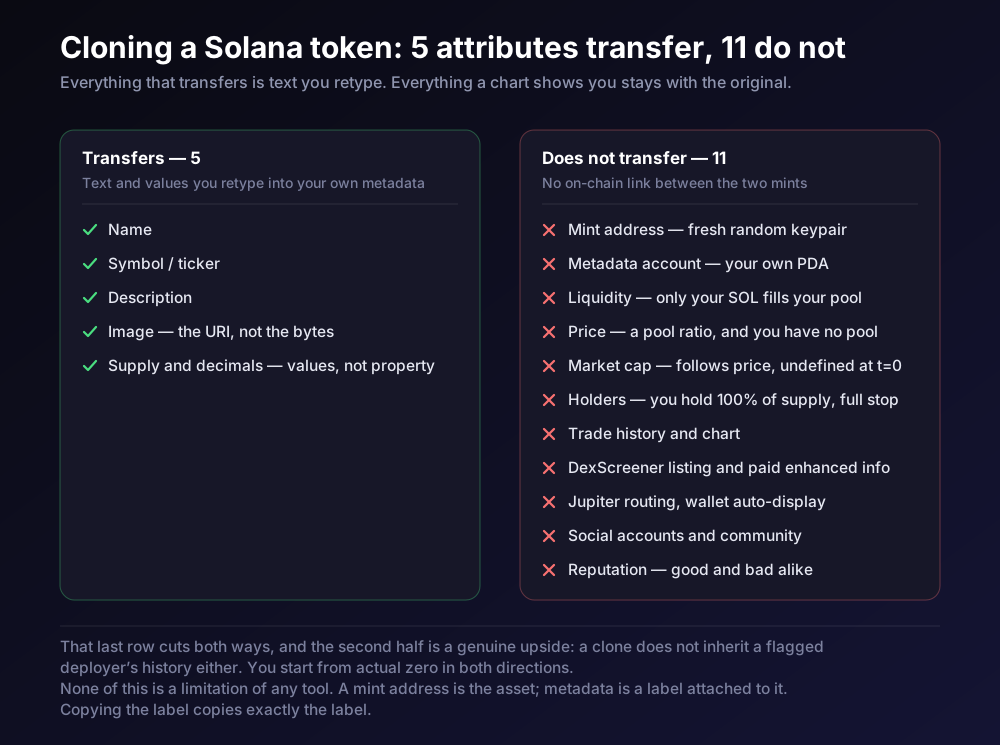
| Attribute | Transfers to the clone? | Why |
|---|---|---|
| Name | Yes | Plain text, re-entered into your metadata account |
| Symbol / ticker | Yes | Same — text you type |
| Description | Yes | Same |
| Image | Yes, with a caveat | The URI is reused; the bytes still live on the original's host |
| Supply and decimals | Yes | Values, not property — anyone can set 1B / 6 |
| Mint address | No | Fresh random keypair |
| Metadata account | No | PDA derived from your mint |
| Liquidity | No | Pool accounts hold real SOL. Only your SOL can fill yours |
| Price | No | Price is a pool ratio. No pool, no price |
| Market cap | No | Follows price, so also undefined at t=0 |
| Holders | No | You hold 100% of supply, full stop |
| Trade history / chart | No | The chart belongs to the pair, and the pair is new |
| DexScreener listing or paid enhanced info | No | Per-pair, and per-token for enhanced info |
| Jupiter routing, wallet auto-display | No | Indexers key on your mint address, which is new |
| Social accounts and community | No | Off-chain and owned by someone else |
| Reputation — good or bad | No | Cuts both ways, and the second half is a genuine upside |
That last row is worth a beat. Because there is no on-chain link, a clone does not inherit a bad reputation either. If the format you liked was attached to a mint whose deployer got flagged, none of that follows you. You start from actual zero in both directions.
The image caveat, precisely
When you copy a coin from a live board, the flow hands the creator an already-hosted image URL rather than a file. Alchemii then uploads a fresh metadata JSON of your own to IPFS — your name, your symbol, your description, your socials — with the image field pointing at that existing URL. So the metadata document is yours and permanent; the image bytes are still served from wherever the original's image lives.
Practical consequence: if that host rotates, rate-limits or removes the file, your token's icon breaks everywhere at once and you get to explain it in your Telegram. Re-uploading your own copy of the image takes about ten seconds in the same form and removes the dependency entirely. If you plan to keep the token past day one, do it.
What you actually own 60 seconds after signing
The transaction lands in one to two seconds, and here is the complete inventory of what exists afterwards:
- One mint account — supply, decimals, mint authority, freeze authority.
- One associated token account owned by your wallet, holding 100% of supply.
- One Metaplex metadata account pointing at your metadata JSON.
- Zero pools. No Raydium pair, no PumpSwap pair, nothing.
That last item is the one that catches people. With no pool, your token does not have a low price — it has no price. Price on an AMM is a ratio between two reserves, and one side of the ratio does not exist yet. DexScreener will show nothing, Birdeye will show nothing, Jupiter cannot route a swap, and your market cap is not zero so much as undefined. Nobody can buy your token at any price until you deposit real SOL against it, and the moment you do, you have set the launch valuation by hand.
A clone, in other words, starts exactly where a from-scratch launch starts. Same starting line, less typing.
The holder-list myth
Both of the vendor help pages that currently dominate this query repeat the same suggestion: export the original's holder list and batch-airdrop to those wallets so your token "mirrors" the original's distribution. It is the single most expensive piece of advice in the cluster, so here is the arithmetic.
Every recipient wallet that does not already hold your mint needs an associated token account created for it, and that costs 0.002039 SOL in rent, paid by you. Solana's transaction size cap fits roughly 20-25 SPL transfers per transaction. So mirroring a mid-sized 3,000-holder token looks like this:
- ATA rent: 3,000 × 0.002039 = ~6.1 SOL
- Signed batches: 3,000 ÷ 25 = 120 transactions (140-150 if your batches run smaller)
- Base fees: negligible next to the rent
- Elapsed time: a good chunk of an evening, hand on the wallet approve button
Six SOL is roughly twenty standard token launches. And what it buys is dust sitting in 3,000 wallets that never asked for it. Holder count is an output of demand, not an input to it. The predictable results, in the order they happen: a few hundred recipients notice an unknown token in Phantom and sell it the second there is a pool to sell into, wallet software starts flagging your mint as spam, and any trader who opens your holder distribution sees thousands of identical-balance wallets funded in one window — which reads as manufactured, because it is.
There is a real version of this play. Airdrops work on warm lists, with meaningful amounts, to people who already know why they are getting tokens, and they are much cheaper because existing holders already have ATAs. The full Solana airdrop guide has the cost formula, the batching limits and the honest section on when an airdrop helps versus hurts a launch. Do not use it to fake a holder chart.
What cloning does buy: elapsed time
Everything above is the disillusionment. Here is the part that survives it.
The scarce resource in a memecoin launch is not creativity and it is not SOL — it is the twenty minutes between noticing that a format is working and having something live. Formats decay fast. If you spot a runner at 14:05 and your mint is signed at 14:09, you are inside the window. If you spend that time picking a font for a logo and reading a fee table, you are not.
Trending Coins renders Pump.fun's live trending and newest boards inside Alchemii, refreshing on its own, with a Copy Coin button on every card. One click opens the token creator already filled in with:
- the coin's name and symbol
- its description
- its image
- 1,000,000,000 supply and 6 decimals — the standard memecoin config
- mint-authority revoke already selected, so the supply gets frozen inside the same signature that mints it
- the
pumpvanity address left unticked at 0.1 SOL — a paid extra the template deliberately does not decide for you
What is left for you is the part that requires judgement: run the ticker collision check, decide whether to re-upload the image, connect a wallet, and sign. The mint-authority revoke ships in that same transaction rather than as an errand you mean to get to later — which matters more than it sounds, because in our launch data the tokens that skipped the revoke almost never skipped it on purpose. They ran out of attention between deploy and announcement.
Cost is flat and one-time: around 0.22 SOL all-in for a standard launch, ~0.32 SOL with mint authority revoked, and up to ~0.52 SOL fully loaded. Every optional extra is itemized on the create form before you connect a wallet, so nothing about the total is a surprise at the signature screen. For reference, the unavoidable on-chain protocol floor for any SPL token with Metaplex metadata is about 0.0191 SOL — mint rent 0.00146, metadata account rent 0.00562, the Metaplex protocol fee 0.01, ATA rent 0.00204, plus the signature.
The structural difference from curve platforms is that this fee is charged once. Pump.fun's 1.25% on every buy and every sell runs forever, so past roughly 9 SOL of cumulative volume a direct mint costs less in total — and if the token goes nowhere, you spent a fraction of a SOL either way. We are not the cheapest option on Solana and will not pretend to be: Jumpbit, DEXArea and Solr all undercut us on headline price. We are cheaper than Smithii and Orion Tools, level with CoinFactory, and the whole point of the Copy Coin flow is the minutes, not the lamports.
If your motive here is specifically money rather than speed, read how meme coin creators actually make money before you spend anything. It is the least flattering page on this site and the most useful one for that question.
The authority claims, in verifiable form
Competitors in this category advertise that their creator "locks everything." That claim is checkable on-chain in under a minute, for any tool, so here is exactly what Alchemii's create transaction does — stated plainly so you can go falsify it.
Freeze authority is null from the start. The initializeMint instruction is built with the freeze authority argument set to null, which means a token minted through this flow never has one. There is no freeze revocation step because there is nothing to revoke. On Solscan, the Freeze Authority field will be empty from block one.
Mint authority is the one authority that gets revoked. The transaction builder contains exactly one createSetAuthorityInstruction, and its authority type is MintTokens. When you select the revoke, that instruction sets the mint authority to null in the same signature that created the token — supply is permanently frozen at what you minted, and nobody can ever dilute it.
Metadata stays mutable, and update authority stays on your wallet. The Metaplex metadata account is created with isMutable: true, and update authority is the signing wallet. Nothing in the flow revokes it. Your name, symbol and image remain editable by the key that signed the transaction.
That third point is the one to actually think about, because for a clone it is a feature. If you copy a format at speed and later want to differentiate the branding — because the ticker collides, or because you want to apply for listings — you can, and the mechanics of doing so are in can you edit a Solana token after launch. The trade is that a mutable token is a token whose deployer could rebrand it, and sophisticated traders read that field.
How to verify all of this on any token from any vendor, in 20 seconds:
- Open the mint address on Solscan.
- Read Mint Authority —
nullmeans supply is capped forever. - Read Freeze Authority —
nullmeans no one can freeze your account. - Open the metadata account and read the mutability flag — mutable means the update authority can still change name, symbol and image.
If a tool's marketing and those three fields disagree, believe the fields.
Where clones get penalized
Copying metadata verbatim has real, documented costs, and no vendor help doc will tell you about them.
DexScreener enhanced token info. Sharing a name and symbol with an already-verified token is a standard rejection reason. The fix is to differentiate your metadata meaningfully before you apply — the DexScreener verification guide covers what "meaningfully" means in practice.
CoinGecko and CoinMarketCap listing review. Copycat metadata sits on the standard rejection list alongside thin liquidity and one-wallet-holds-half distributions. Reviewers are human and they look.
Trader confusion. Two tokens with the same ticker on DexScreener is a support burden you carry forever, and the confused party is usually your own buyer. Search the ticker on X and DexScreener before you sign, not after.
The line that matters. Starting from a format that is demonstrably getting attention is ordinary product work — the entire memecoin category is iterative remixing. Presenting your token as the original, or letting people believe the original's team is behind it, is a different thing and it ends badly for everyone including you. A copy gets its own mint, its own liquidity and its own holders, and it trades on its own merits from block one. Say so publicly and you will get further than pretending otherwise.
The numbers a clone does not inherit
Our observational sample of roughly 50,000 Solana memecoin launches puts the base rate plainly: 87% of Solana memecoins die within 24 hours, where "die" means losing more than 90% of peak market cap. Copying a trending format does not move that number. Nothing in the metadata layer does.
What correlates with survival in that sample is configuration and timing:
- LP burned at minute zero — 5.7× higher 24-hour survival
- Mint authority revoked — 4.2×
- 5+ SOL of seed liquidity — 3.4×
These are correlations from an observational sample, not causal effects from a controlled experiment. Tokens whose deployers burn LP in the first minute differ from tokens whose deployers do not in a dozen ways we cannot observe. The sample definitions, the selection criteria and what we deliberately do not measure are all documented on the launch data methodology page, and the deeper breakdown of failure modes is in why 87% of Solana memecoins die in 24 hours.
The honest synthesis: cloning changes your elapsed time, and elapsed time is the enemy of doing the three things above properly. That is the entire mechanism by which a fast copy helps. It is not magic and it is not demand.
The ten minutes after your clone lands
- Verify on Solscan. Mint authority
nullif you selected the revoke, supply matches what you set, metadata renders with the right image. - Differentiate if you plan to apply for anything. Update authority is still yours, so adjusting name or symbol now is cheap. After a rejection it is expensive.
- Re-upload the image to your own storage if you kept the original's URL.
- Create the pool. 5+ SOL of seed liquidity is where the survival correlation kicks in; below 3 SOL the book is thin enough that sniper exits collapse the chart on their own.
- Burn the LP immediately. Strongest signal in the dataset, and it costs one transaction.
- Announce with the mint address and a Solscan link. Do not tell people to buy — traders detect it instantly and in most jurisdictions it is a legal problem.
Limitations of this guide
- This is not a Pump.fun bonding-curve guide. Cloning into a curve launch has different mechanics; this piece assumes a direct mint you control.
- Token-2022 extensions are out of scope. Transfer fees and confidential transfers behave differently and almost no memecoin uses them.
- No legal analysis. Trademark, passing-off and securities questions depend entirely on your jurisdiction and your specific facts. Talk to a lawyer for anything real; this is not legal advice.
- The survival multipliers are correlational. They describe an observational sample, not a controlled experiment, and market conditions shift.
- Third-party rejection criteria change. DexScreener and CoinGecko update review standards without notice; treat the rejection reasons above as strong patterns rather than published policy.
Ready to start from a format that is already moving? Open Trending Coins →, hit Copy Coin on any card, and the token creator opens prefilled — name, symbol, image, 1B supply, 6 decimals, mint-authority revoke ready to sign, and the pump address one checkbox away. One signature, one to two seconds to mainnet.
Would rather build the format yourself? Launch a meme coin with the defaults set →, or open the full Solana token creator → and configure every field. Flat fee charged once, nothing taken from your trading volume afterwards.
FAQ
What happens when you clone a Solana token?
You mint a brand-new SPL token that reuses the original's display layer — name, symbol, description, image — and inherits nothing else. The clone gets its own randomly generated mint address with no on-chain link to the original, zero liquidity, no price, no trade history, and exactly one holder at t=0: you, with 100% of supply. Everything that made the original worth copying (its pool, its buyers, its chart, its community) stays with the original.
Does a cloned Solana token have the same mint address as the original?
No, and it cannot. The mint address is the public key of a freshly generated ed25519 keypair — 32 random bytes, base58-encoded. There is no derivation path from the original's address to yours. The only part you can influence is a short vanity tail, produced by grinding candidate keypairs until one ends in the characters you want, such as the pump suffix. Every other character is random, and any explorer will show the two mints as unrelated accounts.
Can you copy a Solana token's holders or liquidity?
No. Liquidity lives in a pool account funded with real SOL, so the only way to have liquidity is to deposit your own. Holders cannot be copied either. Two popular vendor guides suggest exporting the original's holder list and batch-airdropping to it to mirror the distribution — that is a spam airdrop. Mirroring a 3,000-holder token means roughly 6.1 SOL in ATA rent at 0.002039 SOL per new recipient and 120-150 signed batches, and it buys you dust in 3,000 wallets that never asked for it plus a distribution chart that reads as manufactured.
Does cloning a token lock its metadata or revoke its authorities?
No. Authorities are set by the mint transaction, not by the fact that you copied someone's metadata. In Alchemii's build the freeze authority is null from the initializeMint instruction, so there is never a freeze authority to revoke; there is exactly one setAuthority instruction and it targets mint authority; and the Metaplex metadata account is created with isMutable set to true, with update authority staying on the wallet that signed. Check any tool's claims yourself by opening the mint on Solscan and reading the mint authority, freeze authority, and the metadata account's mutability flag.
Can a cloned token have a mint address ending in pump?
Yes, and it does not depend on what you cloned. The suffix is a property of the keypair your token is minted to, not something inherited from the original, so a coin that has no pump address can be cloned into a mint that does. On Alchemii it is a 0.1 SOL checkbox on the create form, taking a launch to roughly 0.32 SOL, or 0.42 SOL with mint authority revoked. The flow asserts the returned public key actually ends in pump before it builds any instruction, so a failed grind aborts the launch rather than charging for a tail you did not get. What the suffix is not is provenance: your token did not come off Pump.fun's bonding curve, the mint's first transaction shows that in one click, and claiming otherwise is fraud.
How long does it take to clone a Solana token?
Under a minute of active work through a prefilled flow. On Alchemii's Trending Coins board, Copy Coin loads the creator with the coin's name, symbol, description, image, 1,000,000,000 supply, 6 decimals and the mint-authority revoke already selected — what is left is a ticker collision check, a wallet connection, and one signature that lands in 1-2 seconds. A standard launch is around 0.22 SOL all-in, roughly 0.32 SOL with mint authority revoked, and up to about 0.52 SOL fully loaded.
Is a cloned token treated differently by DexScreener and CoinGecko?
Yes, and this is the real cost of copying metadata verbatim. Sharing a name and symbol with an already-verified token is a documented reason for DexScreener enhanced token info to be rejected, and copycat metadata is one of the standard rejection causes on CoinGecko listing review. Because update authority stays with your wallet, you can differentiate the name, symbol and image after launch — do it before you apply, not after you get declined.
References
- SPL Token Program — spl.solana.com — mint account structure, authority model, transfer instruction
- Token Program account on Solscan — TokenkegQfeZyiNwAJbNbGKPFXCWuBvf9Ss623VQ5DA — canonical program address every SPL token shares
- Metaplex Token Metadata — developers.metaplex.com — metadata PDA seeds, mutability flag, update authority semantics
- Solana accounts model — solana.com/docs/core/accounts — why addresses are keypairs and rent applies per account
- Associated Token Accounts — solana.com/docs/core/tokens — the ATA rent that dominates airdrop cost
- Solana rent — solana.com/docs/core/fees — rent-exemption math behind the ~0.0191 SOL protocol floor
- DexScreener token info — enhanced info submission requirements
- Alchemii launch data methodology — the 50,000-launch observational sample behind the survival multipliers
Create your Solana token
Choose your token name, symbol, supply and image. Review the authority options and creation fee, then confirm the transaction in your wallet. Liquidity is a separate step.
Related Topics
More guides to Solana token creation, authorities, liquidity, and meme coin launches.
Pump.fun Callouts Explained: How to Use Them & Check Rewards
What Pump's Callout Rewards terms really say: the Activity Metric is confidential, rewards are discretionary, and only the on-chain transfer counts as payment.
Pump.fun Market Cap vs Replies: Read the Board (2026)
Two numbers sit on every pump.fun trending card. On one board: 14,017 replies at $128.1M, and $245.8M of market cap with zero replies. How to read the gap.
Get a Pump Suffix Token Without Pump.fun (2026)
Create a Solana token ending in pump for 0.1 SOL. Gain memecoin-native recognition, keep direct-launch control, and preserve more creator upside.
What Is Pump.fun? The Complete Platform Guide (2026)
Pump.fun Solana bonding-curve launchpad: free to create, 1.25% per trade, auto-LP at the 85-SOL (~$41K) graduation. How it works, who it's for.
How Many Meme Coins Are Created Every Day? 35,700+ (2026)
We counted 1,048 Solana launches in 42 minutes — a new meme coin every 2.4 seconds, about 35,705 a day. Who makes them, what they earn, and what we got wrong.
Crypto FOMO in Memecoins: The Price of Waiting for Proof
Crypto FOMO has a price you can calculate. The median pump.fun winner graduates in 4.4 minutes — and $2,210 of buying takes 56% of the cheap supply.