How to Make Money on Pump.fun: Creator Rewards
How to make money on pump.fun by creating a coin: creator rewards pay 0.30% to 0.95% of every trade. See Sept 2026 payouts, Holder Rewards, and how to withdraw.

Ready to create your Solana token? Enter your token details, choose your authority options, and confirm in your wallet.
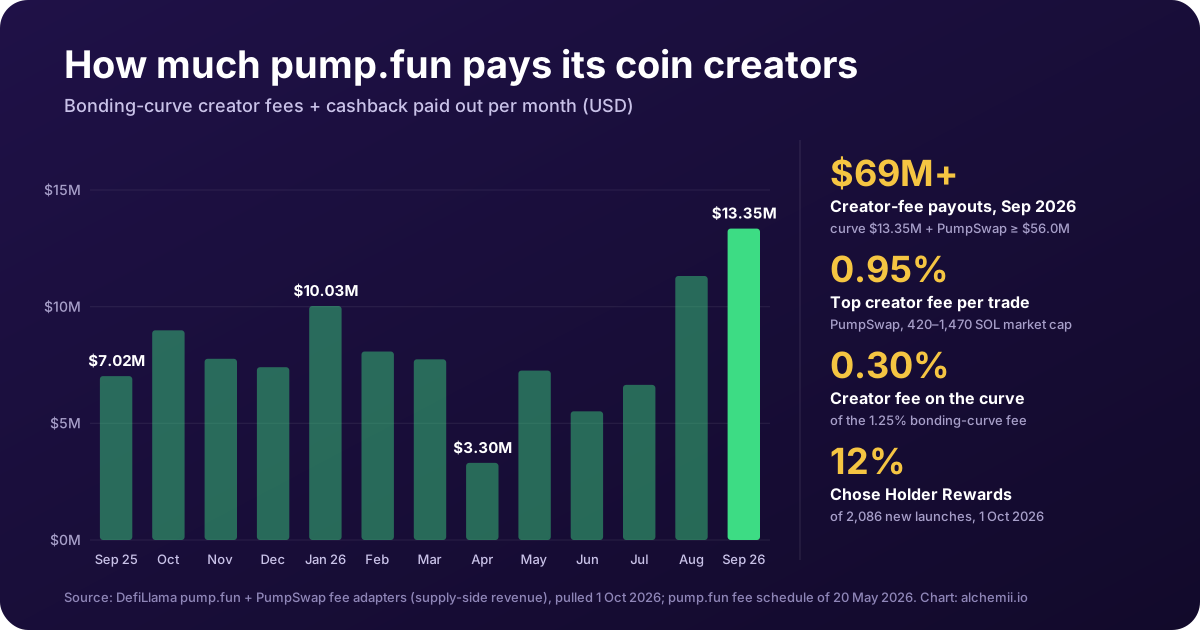
How to make money on pump.fun comes down to one mechanism: you create a coin, other people trade it, and pump.fun pays you a slice of every trade. That slice is called creator rewards. On the bonding curve it is 0.30% of each buy and sell. After the coin graduates to PumpSwap, the slice moves with market cap and peaks at 0.95% in the band between 420 and 1,470 SOL. The pool of money is large and at a record: in September 2026, DefiLlama's adapters show pump.fun's bonding curve paid out $13.35 million in creator fees and cashback, the most in any month on record, and PumpSwap paid coin creators at least another $56.0 million. Most of that goes to a small number of coins. Creating one is free, and it pays only if people trade it. This guide gives the full fee schedule, the September numbers, the Holder Rewards switch, a creator rewards calculator, how to claim and withdraw, and what changes if you launch with your own pool instead.
Disclosure: we build Alchemii, a direct-launch Solana token creator, so we compete with pump.fun for launches. Every rate below links to pump.fun's or Raydium's own documentation, and every dollar figure comes from a public DefiLlama endpoint with its date stated.
Quick facts: pump.fun creator rewards in October 2026
| Fact | Value | Source |
|---|---|---|
| Cost to create a coin on pump.fun | 0 SOL (first buy optional) | pump.fun |
| Bonding-curve trade fee | 1.25% = 0.95% protocol + 0.30% creator | pump.fun fee schedule, 20 May 2026 |
| Highest creator fee after graduation | 0.95%, at 420–1,470 SOL market cap | pump.fun fee schedule |
| Lowest creator fee after graduation | 0.05%, above 98,240 SOL market cap | pump.fun fee schedule |
| Graduation point | 85 SOL collected, about 411 SOL market cap ($48.5K at $118.11) | pump.fun curve constants |
| Curve creator fees + cashback paid, Sep 2026 | $13.35M, a monthly record | DefiLlama, pulled 1 Oct 2026 |
| PumpSwap creator fees, Sep 2026 | at least $56.0M | DefiLlama, derived below |
| Fee modes for new coins | Creator Fee or Holder Rewards (Cashback retired 12 Sep 2026) | Pump.fun announcement |
| New launches choosing Holder Rewards | 12.0% (251 of 2,086) | Our two samples, 1 Oct 2026 |
| Minimum claim | None; network fee only | Pump.fun claim flow |
How to make money on pump.fun: four ways, ranked by who pays you
The Reddit thread that ranks first on Google for "pump fun creator rewards" opens with the question most new creators have: "I see the 'creator rewards' on pump.fun but i don't really get how that works. Like what determines how much money you get from a coin you create?" (r/solana). The short answer is trading volume. On Pump.fun, the launchpad behind about nine in ten new Solana meme coins, there are four ways money reaches a creator, and they differ in who is paying.
- Creator rewards (creator fees). A cut of every trade, paid by traders and routed by the protocol. It needs no capital and no selling, and it keeps paying for as long as the coin trades.
- Holder rewards. If you launch a Holder Rewards coin, or hold a coin that is one, you collect a pro-rata share of its fee stream for as long as you hold more than $20 of it.
- Your dev buy. The tokens you buy at launch are a position like anyone else's. Selling them is income; selling them all into the first spike is what buyers call a rug, and Solscan's Holders tab shows it within minutes.
- Trading other coins. This is the other side of the creator business: traders pay 1.25% per curve trade, and most lose. It is not creator income, and we cover it separately in how to take profits on Solana meme coins.
| Income path | Who pays you | Capital needed | Keeps paying after launch? | Main risk |
|---|---|---|---|---|
| Creator rewards | Every trader, 0.30%–0.95% of each trade | None | Yes, while the coin trades | No volume, no income |
| Holder rewards | The coin's trading fees, pro-rata | Your holding | Yes, while you hold more than $20 | Price falls faster than rewards accrue |
| Dev buy | Buyers of your tokens | Your first buy | No, one-time | Reputation if dumped |
| Trading | Other traders | Your stake | No | Fees on every trade, most lose |
If your goal is to make money creating a meme coin, rows one and three are the business. The rest of this guide is about row one, because it is the part pump.fun's rules decide. For the general creator playbook across every venue, including LP fee share and disclosed allocations, see how meme coin creators make money.
How to make money on pump.fun for free
Creating a coin costs 0 SOL. Name, ticker, image and a description go into pump.fun's create form, and the coin goes live on a bonding curve with no liquidity of your own. Your only hard cost is a few cents of SOL in network fees. The first buy of your own coin is optional.
So the honest version of "how to make money on pump fun for free" is: the launch is free, and the work is not. Creator rewards are a percentage of volume, and volume comes from people who already know the coin exists. The 2.4% of launches that advertise a Telegram group graduate at 1.485%, against 0.166% for those that do not, according to a survival analysis of 832,941 launches (arXiv 2607.02823). That gap is not the Telegram link itself; it is the audience behind it. Be wary of anyone who promises a free coin will pump: nobody can guarantee buyers.
Pump.fun creator fees: the full creator rewards schedule
If you are working out how to make money on pump.fun, this schedule is the part to know by heart. Pump.fun publishes one fee schedule, last updated 20 May 2026 (pump.fun/docs/fees). It has two stages, and the creator's slice behaves differently in each.
Pump fun creator fees on the bonding curve: 0.30% and the 85 SOL finish line
Every buy and sell on the curve pays 1.25%: 0.95% to the protocol and 0.30% to the creator. The curve completes when it has collected 85 SOL, at a market cap of about 411 SOL, which is roughly $48.5K at SOL's $118.11 price on 1 October 2026. The coin then graduates to a canonical PumpSwap pool.
Do the arithmetic on that finish line and it explains why the curve alone rarely pays much. Reaching 85 SOL takes at least 85 SOL of net buying. At 0.30%, a coin that graduates with no selling at all has earned its creator 0.255 SOL, about $30. Real coins see plenty of selling, so curve volume runs higher than 85 SOL, but the curve is a qualifying round. The better-paying bands come after it.
PumpSwap creator fee tiers after graduation: why 420–1,470 SOL pays most
After graduation the total fee and the creator's slice both depend on the coin's SOL market cap. These rows are taken from pump.fun's schedule; dollar values use $118.11 SOL.
| Market cap (SOL) | Approx. market cap (USD) | Creator fee | Protocol fee | LP fee | Total fee |
|---|---|---|---|---|---|
| 0–420 | up to $49.6K | 0.300% | 0.930% | 0.020% | 1.250% |
| 420–1,470 | $49.6K–$173.6K | 0.950% | 0.050% | 0.200% | 1.200% |
| 1,470–2,460 | $173.6K–$290.6K | 0.900% | 0.050% | 0.200% | 1.150% |
| 4,420–9,820 | $522K–$1.16M | 0.750% | 0.050% | 0.200% | 1.000% |
| 9,820–14,740 | $1.16M–$1.74M | 0.700% | 0.050% | 0.200% | 0.950% |
| 29,470–34,380 | $3.48M–$4.06M | 0.500% | 0.050% | 0.200% | 0.750% |
| 49,120–54,030 | $5.80M–$6.38M | 0.300% | 0.050% | 0.200% | 0.550% |
| 98,240 and up | $11.6M and up | 0.050% | 0.050% | 0.200% | 0.300% |
The full table has 25 bands; the rows skipped here step down by 0.05 or 0.025 percentage points each. Two things follow from it:
- The best rate in the schedule is just after graduation. A coin trading between about $50K and $174K of market cap pays its creator 0.95% of every trade, more than three times the curve rate. That makes the stretch right after graduation the best-paying part of the schedule.
- Bigger coins pay a smaller percentage of a bigger number. Above $11.6M of market cap the rate is 0.05%, but a coin that size typically trades far more volume. The schedule is built to pay small creators more per trade; when its dynamic version launched in September 2025, creators earned about $2M on the first day, according to CoinMarketCap.
For how the curve and PumpSwap work underneath these fees, see how pump.fun works and what PumpSwap is.
Creator Fee vs Holder Rewards: what changed on 12 September 2026
Pump.fun has changed who receives the creator slot three times in twelve months. In January 2026 the company said its first dynamic schedule "succeeded in driving activity but failed to produce sustainable market behavior", and co-founder Alon Cohen wrote that "creator fees need change" (Cointelegraph). It then let creators split fees across up to 10 wallets. In February 2026 it added Cashback Coins, which sent the creator fee back to traders (crypto.news). On 12 September 2026 it removed Cashback and introduced Holder Rewards (Pump.fun on X).
| Creator Fee coin | Holder Rewards coin | Cashback coin (retired) | |
|---|---|---|---|
| Who gets the creator slot | The creator, or a split of up to 10 wallets | Holders with more than $20 of the coin, pro-rata | Traders, as a rebate |
| When it pays | Accrues per trade; claim any time | Several times an hour | Per trade |
| Creator's direct income | 0.30%–0.95% of volume | 0%; only as a holder | 0% |
| Available for new launches | Yes | Yes | No, Custom Pairs only |
| Can switch later | Can apply to move to Holder Rewards | Never back | Can apply to move to Holder Rewards |
Pump.fun's announcement says Holder Rewards coins pay out "just by holding: for longer hold times, higher ceilings", so larger and longer-held positions collect more. Switching an existing coin to Holder Rewards is a one-way door (AirdropAlert).
For a creator who wants income, the choice is simple: keep Creator Fee. A creator holding 5% of a Holder Rewards coin collects roughly 5% of the stream that a Creator Fee coin would have paid them in full. Holder Rewards makes sense when the goal is to give buyers a reason to stay, for example a community coin where the creator is paid some other way.
The market agrees. We pulled pump.fun's public listing of new coins twice on 1 October 2026, in two separate windows: 1,042 launches between 20:40 and 21:01 UTC and 1,044 between 21:09 and 21:31 UTC, about 48 a minute and roughly twice the pace we measured in September. 251 of the 2,086, or 12.0%, launched as Holder Rewards coins (8.8% in the first window, 15.2% in the second). None launched with Cashback. Seven in eight creators are still choosing to get paid, though the share opting for Holder Rewards is clearly still moving.
Is pump.fun cashback gone?
For standard launches, yes. Cashback is no longer a launch option and lives on only for Custom Pairs, the coins quoted in assets such as tokenized stocks rather than SOL. In our samples, about one launch in eight (266 of 2,086) used a non-SOL quote asset. Existing Cashback coins keep working until their owners apply to switch.
How much do pump.fun creators make? The September 2026 numbers
DefiLlama tracks pump.fun's payouts in its published fee adapter, where "supply-side revenue" is defined as "creator fees paid out to coin creators and cashback returned to traders/holders of the coin." Here is that figure for the bonding curve, month by month.
| Month | Curve creator fees + cashback | Curve fees, total | Creator share of curve fees |
|---|---|---|---|
| Sep 2025 | $7.02M | $49.81M | 14.1% |
| Oct 2025 | $8.99M | $37.45M | 24.0% |
| Jan 2026 | $10.03M | $41.88M | 23.9% |
| Apr 2026 | $3.30M | $24.66M | 13.4% |
| Jun 2026 | $5.51M | $23.60M | 23.4% |
| Aug 2026 | $11.31M | $47.98M | 23.6% |
| Sep 2026 | $13.35M | $46.41M | 28.8% |
September 2026 was the largest month on record: an average of $444,866 a day, with a peak day of $787,878. All time, the curve has paid out $108.63M, $73.24M of it in 2026 alone.
PumpSwap is bigger. In September its pools traded $14.57B and collected $106.10M in fees. The protocol kept $13.68M; the other $92.41M went to liquidity providers and coin creators. DefiLlama's public API does not split those two, but the fee schedule bounds the split: no PumpSwap pool pays its LPs more than 0.25% of volume, so LPs received at most $36.42M, and coin creators received at least $56.0M. Add the curve and the floor is $69.3M in a month, about $2.3M a day.
Pump fun creator rewards calculator: what your volume pays
The formula is volume × rate. This table runs it for each stage, plus the two own-pool routes covered further down, assuming you hold 100% of the LP. Figures are SOL earned; at $118.11, 1 SOL is $118.
| Trading volume | Curve (0.30%) | PumpSwap 420–1,470 SOL band (0.95%) | PumpSwap 4,420–9,820 SOL band (0.75%) | PumpSwap above 98,240 SOL (0.05%) | Own PumpSwap pool, LP fee (0.25%) | Own Raydium 0.25% pool, LP share (0.21%) |
|---|---|---|---|---|---|---|
| 100 SOL | 0.30 | 0.95 | 0.75 | 0.05 | 0.25 | 0.21 |
| 1,000 SOL | 3.0 | 9.5 | 7.5 | 0.5 | 2.5 | 2.1 |
| 10,000 SOL | 30 ($3,543) | 95 ($11,220) | 75 ($8,858) | 5 ($591) | 25 ($2,953) | 21 ($2,480) |
| 100,000 SOL | 300 | 950 | 750 | 50 | 250 | 210 |
Two reality checks belong next to the table. A Holder Rewards coin pays its creator 0% in every column. And LP fees on your own pool accrue inside the pool; you collect them when you withdraw liquidity, and the position moves with the price.
Are people making money on pump.fun? The median says no
Divide the pot by the launches and the average looks fine: $2.3M a day across roughly 70,000 launches a day at our measured pace is about $33 per coin. That average describes almost nobody. In our September census, 72% of new coins never attracted a single net buy, and pump.fun's lifetime graduation rate is about 1.4% (arXiv 2607.02823). In our first 1 October window, 522 wallets made the 1,042 launches, and the busiest wallet made 44 of them in 21 minutes. So is pump.fun profitable? For the protocol, yes. For a coin creator, it pays the few coins that get traded. The creator business is a distribution business, and the marketing work comes before the create button.
How to claim creator rewards on pump.fun and withdraw the money
Creator rewards accrue to the wallet that signed the coin's creation, not to whichever wallet you happen to be using. Claiming takes one transaction:
- Sign in to pump.fun with the account linked to the creator wallet. Since 25 September 2026, pump.fun signs users in through email or social accounts instead of browser wallets; an existing wallet address carries over if it was linked (pump.fun).
- Open your profile, choose More, then Creator rewards. The page lists what each of your coins has earned.
- Press Claim all and approve. The SOL lands in the creator wallet. There is no minimum and no waiting period; you pay only the Solana network fee.
- If you set up fee sharing, each wallet on the split claims its own share.
How to withdraw money from pump.fun to a bank
Pump.fun does not hold a balance for you. Your SOL and your coins sit in the Solana wallet tied to your account, so "withdrawing from pump.fun" really means moving SOL out of that wallet:
- Sell any coin position you want to cash out. On the curve or on PumpSwap, the sale pays SOL.
- Send the SOL to a deposit address at an exchange such as Coinbase or Kraken. Choose the Solana network on the exchange's deposit screen, and send a small test amount first.
- Sell the SOL for dollars on the exchange and withdraw to your bank.
Taxes apply in most countries. Creator rewards are usually income when received, and selling the SOL later can be a separate taxable event. See whether it is legal to create a meme coin for the rules creators most often ask about.
Pump.fun or your own pool: where a creator keeps more per trade
On a pump.fun curve, traders pay 1.25% per trade and the creator gets 0.30%. That is 24% of every fee dollar; the protocol takes the other 76%. Mint the token yourself and open your own pool, and the split flips.
| Pump.fun curve | Your own PumpSwap pool (via Alchemii) | Your own Raydium pool (via Alchemii) | |
|---|---|---|---|
| Cost to start | 0 SOL | About 0.22 SOL to create, plus the SOL you seed | About 0.22 SOL to create, plus about 0.3 SOL of pool cost and your seed |
| Who holds the supply at launch | The curve; you get only what you buy | You, 100% | You, 100% |
| What traders pay per trade | 1.25% | 0.30% | 0.25% |
| What reaches the creator per trade | 0.30% (creator fee) | 0.25% LP fee, while you hold the LP | 0.21% LP share, while you hold the LP |
| Graduation needed | Yes, for the 0.95% band | No, pays from the first trade | No, pays from the first trade |
| Discovery | Pump.fun's feeds | DexScreener, Jupiter and wallets | DexScreener, Jupiter and wallets |
Rates come from pump.fun's schedule for non-canonical PumpSwap pools (0.05% protocol, 0.25% LP, 0% creator) and from Raydium's CPMM fee docs, where a standard 0.25% pool sends 0.210% to LPs, 0.030% to the protocol and 0.010% to its fund.
The own-pool route has real costs, and it is not the better choice for everyone:
- It needs SOL. A curve starts at zero; a pool needs liquidity you put in.
- Holding LP for fees means not burning it. Burned LP is the strongest trust signal a meme coin has, and it permanently ends the fee stream. You can also burn part of the LP and keep the rest.
- No pump.fun front page. You bring your own traders.
What you get in return: the full supply in your wallet, a 0.30% trading cost that is a quarter of the curve's, and income from the first trade instead of after graduation. If you already have an audience and some SOL, that is usually the better deal. If you have neither, start on the curve.
To set up the pool after minting, use create a liquidity pool on Solana, and when you are ready to lock in trust, burn your LP tokens. For the full side-by-side, see pump.fun vs Raydium.
Limitations
- The curve figure includes cashback. DefiLlama reports creator fees and trader cashback as one series, so the $13.35M overstates pure creator income by the share of volume on Cashback coins, which we cannot separate.
- The PumpSwap figure is a floor, not a measurement. "At least $56.0M" assumes every pool paid LPs the maximum 0.25%; canonical pools pay LPs 0.20% or less, so the true creator figure is higher.
- Our launch samples cover one evening. Two contiguous windows of about 21 minutes each on 1 October 2026, 2,086 launches in total. The Holder Rewards share moved from 8.8% to 15.2% between them, so read 12% as a snapshot of a setting that is three weeks old and still being adopted.
- Fee schedules change. Pump.fun changed the creator slot three times in twelve months. Check the live schedule (pump.fun) before you plan around any rate here.
- Nothing here is financial or tax advice. Rates are mechanics, not forecasts.
Summary
How to make money on pump.fun in 2026 comes down to three moves: create a coin people trade, keep the Creator Fee setting, and collect 0.30% on the curve and up to 0.95% after graduation. Curve payouts hit a record $13.35M in September 2026, pump.fun creator rewards across the curve and PumpSwap came to at least $69.3M that month, and almost all of it went to the few coins that had an audience. Claim from Profile → More → Creator rewards, and withdraw by sending SOL to an exchange on the Solana network.
If you would rather own the supply and the pool, create a meme coin with Alchemii and open your own PumpSwap or Raydium pool: traders pay 0.30% instead of 1.25%, and the LP fee is yours while you hold the LP. For every other creator income path, read how meme coin creators make money; for the odds, read how many meme coins are created every day.
FAQ
Can you make money on pump.fun?
Yes. Pump.fun paid at least $69M in creator-fee payouts in September 2026: $13.35M from the bonding curve and at least $56.0M from PumpSwap, per DefiLlama. A creator earns 0.30% of every trade on the curve and up to 0.95% after graduation. The money is real but concentrated: most launches never attract a single buyer, and only about 1.4% ever graduate, so the median creator earns close to nothing.
How do I calculate my pump.fun creator rewards?
Multiply your coin's trading volume by the creator rate for its stage. On the bonding curve the rate is 0.30%, so 1,000 SOL of volume pays 3 SOL. After graduation the rate depends on market cap: 0.30% below 420 SOL, 0.95% between 420 and 1,470 SOL, then stepping down to 0.05% above 98,240 SOL. A Holder Rewards coin pays its creator 0% because the fee stream goes to holders.
How do I claim creator rewards on pump.fun?
Sign in to pump.fun with the account linked to the wallet that created the coin, open your profile, choose More, then Creator rewards, and press Claim all. The SOL arrives in that wallet in one transaction. There is no minimum and no waiting period; you pay only the Solana network fee. If you set up fee sharing, each wallet on the split claims its own share.
How do you withdraw money from pump.fun?
Pump.fun does not hold a separate balance; your SOL sits in the Solana wallet linked to your account. To cash out, sell your coin for SOL, then send the SOL to a deposit address at an exchange such as Coinbase or Kraken, choosing the Solana network, and sell it for dollars there. Since 25 September 2026 that wallet is reached through email or social sign-in rather than a browser wallet.
What are pump.fun Holder Rewards, and should a creator choose them?
Holder Rewards, launched on 12 September 2026, is a coin setting that pays the fee stream to holders instead of the creator: anyone holding more than $20 of the coin gets a pro-rata payout several times an hour. A creator who picks it gives up the creator fee and earns only as a holder. Choose Creator Fee if you want income; choose Holder Rewards if you want a reason for buyers to hold.
Is pump.fun cashback still available?
Not for standard launches. Pump.fun added Cashback Coins in February 2026, letting a creator send the 0.30% creator fee back to traders, and removed Cashback as a launch option on 12 September 2026 when Holder Rewards arrived. It survives only on Custom Pairs. Existing Cashback coins keep running and can apply to switch to Holder Rewards, a change that cannot be reversed.
How can I make money on pump.fun for free?
Creating a coin on pump.fun costs 0 SOL; you need only a few cents of SOL for network fees, and the first buy of your own coin is optional. Creator rewards then come out of other people's trades. Free to launch is not free to win, though: the coins that earn have an audience before launch, and building one costs time. Be wary of anyone who promises a free coin will pump.
Should I launch on pump.fun or open my own liquidity pool?
Launch on pump.fun if you have no SOL to spare and want the curve's discovery feed; it costs nothing to start. Mint your own token and open your own pool if you can seed liquidity: traders pay 0.30% per trade on your own PumpSwap pool instead of 1.25% on the curve, and the 0.25% LP fee goes to whoever holds the LP tokens. You keep the full supply, but burning LP for trust ends that income.
References
- Pump.fun: fee schedule, last updated 20 May 2026
- Pump.fun on X: introducing Holder Rewards and removing Cashback mode, 12 Sep 2026
- Pump.fun: wallet login changes, effective 25 Sep 2026
- DefiLlama: pump.fun fees and revenue
- DefiLlama: PumpSwap fees, revenue and volume
- DefiLlama dimension-adapters: pump.fun fee adapter and methodology
- Raydium docs: CPMM trade fees and distribution
- Raydium API: live CPMM fee configs
- Cointelegraph via TradingView: Pump.fun says creator fees "may have skewed" incentives, plans revamp, Jan 2026
- crypto.news: Pump.fun flips creator fees, launches trader cashback, 18 Feb 2026
- AirdropAlert: Pump.fun Holder Rewards and Custom Pairs
- CoinMarketCap Academy: Pump.fun creators earn $2M in first day under new fee structure
- arXiv 2607.02823: Pump.fun graduation regime windows, survival analysis of 832,941 token launches
- Reddit r/solana: How do coin creators make money without rug pulling?
- Wikipedia: Pump.fun
- Alchemii launch census script (public, no API key)
Create your Solana token
Choose your token name, symbol, supply and image. Review the authority options and creation fee, then confirm the transaction in your wallet. Liquidity is a separate step.
Related Topics
More guides to Solana token creation, authorities, liquidity, and meme coin launches.
How Many Meme Coins Are Created Every Day? 35,700+ (2026)
We counted 1,048 Solana launches in 42 minutes — a new meme coin every 2.4 seconds, about 35,705 a day. Who makes them, what they earn, and what we got wrong.
Crypto FOMO in Memecoins: The Price of Waiting for Proof
Crypto FOMO has a price you can calculate. The median pump.fun winner graduates in 4.4 minutes — and $2,210 of buying takes 56% of the cheap supply.
Solana Memecoin Narrative Clusters: How Theme Waves Form (2026)
Seven of nine cards on one live pump.fun board were one narrative. How memecoin theme waves form, what a cluster's cap curve means, and when it's spent.
How Do Meme Coin Creators Make Money? 4 Real Ways (2026)
How meme coin creators can make money through creator fees, Raydium LP fee share, disclosed allocation, and appreciation — with current 2026 fee math.
How Much Does Pump.fun Make? Revenue Data (2026)
Pump.fun revenue reverse-engineered from on-chain data: daily trading fees, graduation revenue, total earnings since launch, plus methodology to verify.
Meme Coin Market Cap 2026: $36B by Coin & Chain
The meme coin market cap is $36.45B, 76% below its record, yet launchpad fees just hit $10.3M a day. See the data by coin and chain, then launch your own.