What is Mint Authority on Solana? Plain English (2026)
Mint authority is the wallet that can create new Solana tokens. What it does, why it matters, and what null mint authority means.

Ready to create your Solana token? Enter your token details, choose your authority options, and confirm in your wallet.
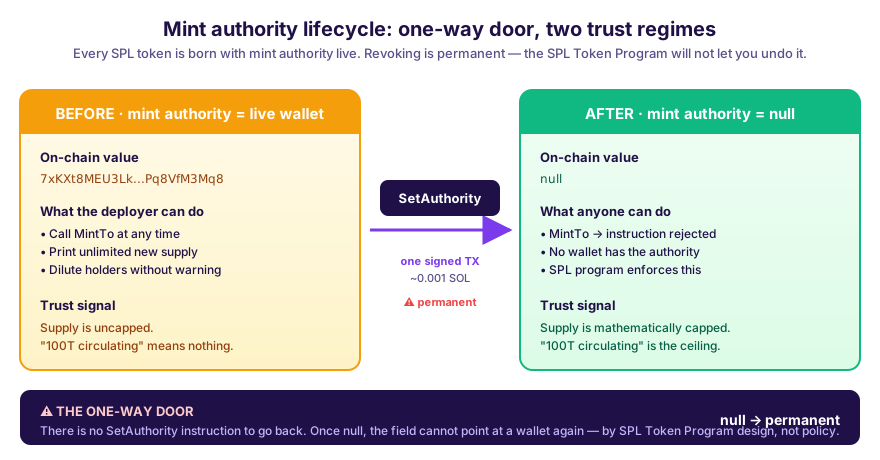
Mint authority on Solana is the wallet address with permission to call the mintTo instruction on a specific SPL token, creating new supply at any time. If mint authority is set to null (revoked), no one — not the original creator, not a hacker who steals their seed phrase — can ever increase the supply. Revocation is permanent; Solana's SPL Token Program has no recovery mechanism. For memecoins, revoking mint authority is the single most important trust signal because active mint authority is the most common rug-pull pattern (a developer mints additional supply, dumps on holders). For utility tokens with planned inflation (game rewards, staking emissions), mint authority typically stays active but on a multisig like Squads.
"Mint Authority" is one of those Solscan fields everyone checks but very few people can clearly explain. Short version: it's a permission slip naming the wallet that's allowed to print new tokens of this mint. Long version — including why every memecoin trader checks this field before they ape, and why "revoked" is the answer they want to see — is below.
The plain-English definition
Every SPL token on Solana is governed by a special on-chain account called the mint account. The mint account stores a few key fields, including:
- The token's total current supply
- The decimals (how divisible the token is)
- The mint authority (the wallet allowed to call the
mintToinstruction to create new tokens) - The freeze authority (the wallet allowed to freeze any holder's balance)
Mint authority is just a wallet address. Whoever controls that wallet can mint new tokens of this specific SPL token whenever they sign a transaction.
If the mint authority is set to null (sometimes shown as "None" or absent), the SPL Token Program rejects any attempt to mint more. No one can override this — Solana doesn't have a "recover lost authority" mechanism. It's a permanent state.
Why it matters
Mint authority is the single biggest trust signal for a Solana token. Here's why:
Active mint authority = unlimited dilution risk
If a memecoin has 1B supply today and the dev wallet still holds mint authority, the dev can wake up tomorrow and mint another 100B. Existing holders' percentages get crushed. The price tanks. This has happened thousands of times — it's the most basic rug-pull pattern. The fastest pre-trade check is the token audit checker — paste a mint address, get mint + freeze + supply + LP-burn state on a single page. For the action layer (after you've decided "yes, this is the token I'm launching"), the LP burn tool handles the liquidity-side trust signal in one signed transaction.
What the correct state looks like on Solscan: BONK's mint account shows mint authority as null. WIF's mint account shows the same. Both tokens hit the top 50 by market cap with revoked mint authority — proof that the trust signal does not constrain growth, it enables it. The counter-pattern: any token where the mint-authority field on Solscan resolves to a clickable 32-byte wallet address (an EOA, not a program-derived address from Squads or Realms) has the rug vector live. A dev tweet promising to revoke "soon" is not the same on-chain state as null; the SPL Token Program reads the field, not the promise.
Revoked mint authority = trustless supply
Once mint authority is null, no one can change the supply. Not the original creator, not a hacker who steals the dev's seed phrase, not the platform that hosts the token. The supply is now a property of the protocol, not a property of any wallet.
This is why "is mint authority revoked?" is the first question serious memecoin traders ask. It's a binary trust filter.
How to check mint authority on a Solana token
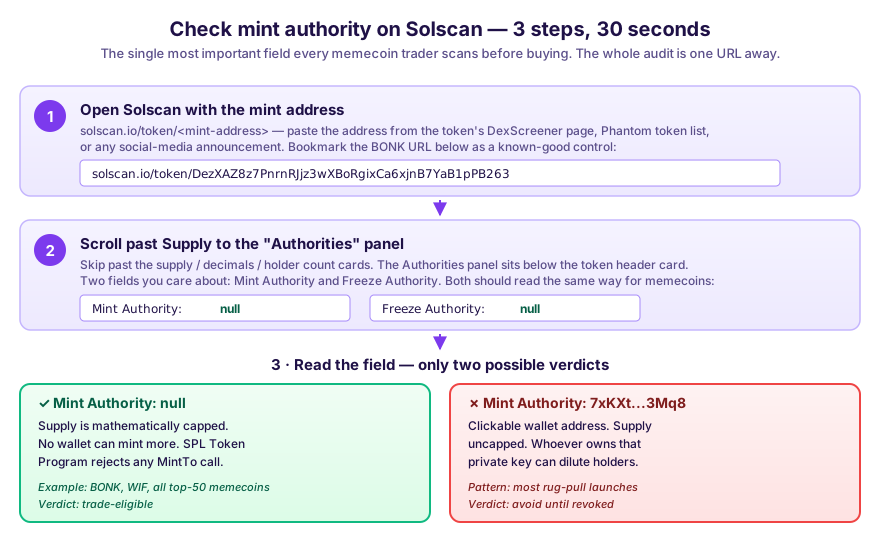
Three options, easiest first:
Option 1: Solscan
Visit solscan.io, paste the token's mint address. Look at the "Authorities" section on the token detail page.
- If "Mint Authority" shows a wallet address → active
- If "Mint Authority" shows
nullor is missing → revoked
Real examples:
Option 2: Solana Explorer
Same data via explorer.solana.com. Some traders prefer it for the cleaner display.
Option 3: DexScreener
DexScreener shows mint authority status as a flag on the token's pair page. If the dev hasn't revoked, you'll see a warning indicator.
Mint authority vs freeze authority vs update authority
These three SPL token authorities are often confused. Here's what each does:
| Authority | What the holder can do | When to revoke (memecoin) |
|---|---|---|
| Mint authority | Create new tokens (increase supply) | Always |
| Freeze authority | Freeze any holder's balance | Always |
| Update authority | Change name, symbol, image (Metaplex metadata) | Optional, after final branding |
The first two are about the SPL Token Program. The third is about the Metaplex Token Metadata Program — different on-chain program, different account, different authority key.
For a deeper breakdown read What is freeze authority? (coming soon) or our SPL token creation guide.
Who holds mint authority by default?
The wallet that creates the SPL token is automatically assigned as both mint authority and freeze authority. There's no opt-in — it's the SPL Token Program default. After creation, the creator can:
- Keep both (default — risky for memecoins)
- Transfer to another wallet (e.g., a multisig)
- Revoke by setting to
null
Most legitimate memecoin launches do option 3 immediately, often as part of the same transaction that mints the supply. Tools like Alchemii's Token Creator automate this — there's a checkbox in the form labeled "Revoke Mint" that adds the revocation instruction to your creation transaction.
"Mint authority is null" — is that good?
For memecoins: yes, that's what you want. It means supply is fixed forever and no one can dilute holders.
For utility tokens with planned inflation (game rewards, governance, staking): no, that's bad. The token can never be expanded for legitimate use cases.
Context matters. Don't blindly assume null = good or active = bad — match against the token's stated economics.
Mint authority by token category (the data)
What share of tokens in each category have revoked mint authority? The answer tells you what traders expect at minimum.
Toggle: should you revoke?
Delegating mint authority to a multisig (the middle ground)
For tokens that need continued minting — staking-reward emissions, game economies, validator-incentive programs — revoking authority is the wrong move. The right move is transferring authority to a multisig program-derived address (PDA) so no single key can mint unilaterally. Two production options on Solana, both worth understanding before you sign.
Squads (squads.so) is the most-used Solana multisig. You set a threshold (e.g., 3-of-5), the multisig becomes a PDA owned by the Squads program, and the SPL Token Program treats that PDA as the mint authority. Any MintTo instruction now requires the threshold signatures across however many transactions Squads needs to assemble. This buys you two things at once: the authority is still alive (you can mint), but a single compromised key can no longer drain unlimited supply onto holders. The cost is operational — every emission becomes a coordination problem instead of a single signature. For tokens with weekly or monthly emission schedules that tradeoff is usually correct; for tokens that emit per block (rare on Solana) it is not.
Realms (realms.today) is the SPL Governance program's UI. Functionally similar to Squads (multisig wrapped around a PDA), but with on-chain voting and proposal queues built in — designed for DAO governance rather than founding-team key management. Realms is the right answer when the entity holding mint authority is supposed to be the token community, not the founding team. The same security profile applies: a hacked individual key can propose a MintTo but cannot execute it without the quorum.
There is a third option you should specifically avoid: multisig wallets you cobbled together yourself, like off-chain Gnosis-Safe-style designs or "we'll just keep the keys split between three people." Without an on-chain multisig program enforcing threshold-signing in protocol, those designs degrade to "trust three humans not to collude." Auditors and aggregators don't credit social agreements as multisig in any meaningful way. On Solscan, a real multisig shows the PDA as authority and the Squads / Realms program ID as the owning program. If neither shows, it's a single key dressed up to look multisig — same risk profile as a fully active authority for a holder's purposes.
The trade-off matrix is short. Revoked authority gives you maximum trust signal but zero flexibility (you can never mint again). Multisig gives you ~80% of the trust signal — most aggregators won't flag it, most traders won't avoid it — while preserving the ability to execute scheduled emissions. Active single-key authority gives you 100% flexibility and effectively zero trust signal for a memecoin context. For utility tokens with real emission schedules, multisig is almost always the right pick. For memecoins, revoke. If your authority is still active and you need to execute a scheduled supply emission, the mint tokens tool bundles the MintTo instruction with destination ATA creation in one signed transaction.
Token-2022 mint extensions change the authority semantics
The SPL Token Program is the original; Token-2022 (program ID TokenzQdBNbLqP5VEhdkAS6EPFLC1PHnBqCXEpPxuEb, documented at spl.solana.com/token-2022) is the newer, extension-bearing successor. Any token minted under Token-2022 still has a mint authority field that behaves exactly as described above — but it can also have additional authority surfaces that classic "revoke everything" walkthroughs miss.
The two that matter for trust assessment:
- Transfer Hook authority. A Token-2022 mint can attach a transfer hook — a program that runs on every transfer and can reject the transfer based on arbitrary logic (allowlist, blocklist, fee diversion, KYC check). The Transfer Hook authority is the wallet allowed to update or remove this hook. Even if mint authority is revoked, an active Transfer Hook authority can introduce new transfer restrictions retroactively. A holder verifying "mint authority is null, so supply is capped" while the Transfer Hook authority remains active is missing half the picture.
- Permanent Delegate. A Token-2022 mint can designate a permanent delegate — an address with the perpetual ability to transfer or burn tokens from any holder's wallet, regardless of consent. Strictly more powerful than freeze authority, since the delegate can move funds, not just lock them. If you're checking authority state on a Token-2022 token, this field is the one to scan first; an active permanent delegate is a stronger rug signal than an active mint authority.
The practical effect: when you're auditing a Token-2022 token on Solscan, do not stop at the three classic authority fields (mint, freeze, update). Scroll through the full extensions list. A "fully revoked" Token-2022 mint with an active Transfer Hook or Permanent Delegate is functionally less safe than a classic SPL token with active mint authority — because the latter can only inflate supply, while the former can confiscate. Most no-code creators (alchemii included) default to classic SPL precisely because the audit surface is narrower and the trust signal is easier to read on-chain.
The SPL Token-2022 documentation lists the full extension matrix. If you're launching a memecoin, ignore Token-2022; use classic SPL. The reason for using Token-2022 is when you specifically need one of its extensions (interest-bearing tokens, confidential transfers, transfer fees), in which case authority audit becomes a multi-field problem and a single line on Solscan no longer answers the question.
Quick Facts (verifiable specifications)
| Specification | Value | Source |
|---|---|---|
| SPL Token Program ID | TokenkegQfeZyiNwAJbNbGKPFXCWuBvf9Ss623VQ5DA | Solana SPL docs |
| Authority field type | Option<Pubkey> (32 bytes or null) | solana-program-library source |
| Revocation cost | ~0.000005 SOL network fee + small service fee | Per Solana network |
| Revocation reversibility | None — permanent | Protocol-enforced |
| Instruction used to revoke | SetAuthority with new_authority = None | SPL Token instruction reference |
| BONK mint authority | null (revoked) | Solscan |
| WIF mint authority | null (revoked) | Solscan |
| USDC mint authority | Active (held by Circle for legitimate issuance) | Solscan |
Limitations of this guide (what it doesn't cover)
- Token-2022 (Token Extensions) authorities behave similarly but introduce additional authority types (transfer-fee config authority, confidential-transfer auditor, etc.). See SPL Token vs Token-2022 for that broader picture.
- Multisig-held mint authority via Squads or similar. This guide treats authority as either a single wallet or null. Multisigs add a separate signing layer that we don't cover in detail.
- Programmatic mint authorities (mint authority held by a smart contract / Anchor program). Used for advanced DeFi tokens; outside the scope of memecoin / utility token guidance.
- Recovery scenarios. This guide doesn't speculate on hypothetical "what if Solana adds an authority recovery upgrade" — none is planned per public roadmap.
- Legal/regulatory implications. Whether revoking authority affects your token's regulatory status (e.g., as a security under U.S. law) is jurisdiction-specific and outside this article's scope.
Sources & references
- SPL Token Program — setAuthority instruction — Solana LabsOfficial spec: setAuthority to null is irreversible by design.
- SPL Token Program source — GitHub / Solana ProgramOpen-source reference — verify there is no recovery path.
- Why most Solana memecoins die in 24 hours — AlchemiiSource for the 4.2× survival multiplier and 18.4% vs 4.4% comparison.
- Bitquery Solana DEX & token data — BitqueryUsed to derive 'mint revoked by category' percentages.
- Jupiter strict list (jup-ag/token-list) — Jupiter / GitHub100% of strict-list memecoins have mint authority revoked.
- Solscan token explorer — SolscanWhere every Solana wallet/trader checks mint authority status before buying.
- Birdeye Solana data — BirdeyeAlternative explorer also surfaces mint authority status prominently.
- Phantom wallet — token security display — PhantomPhantom flags tokens with active mint authority via Blowfish security partner.
- Squads multisig — Squads ProtocolStandard multisig solution for utility tokens that retain mint authority.
- Realms governance — RealmsDAO governance framework — alternative for governance tokens that keep mint authority.
- USDC on Solana — SolscanReal-world example: token with active mint authority (Circle issues against deposits).
- BONK token — SolscanMemecoin example — mint authority revoked, supply locked at 100T.
- Alchemii revoke mint tool — AlchemiiNo-code tool to revoke mint authority on an existing Solana token.
- How to revoke mint authority — AlchemiiStep-by-step companion guide.
- What is freeze authority — AlchemiiThe other major SPL Token authority — both should be revoked for memecoins.
FAQ
What is mint authority on Solana?
Mint authority is the wallet address with permission to call the mintTo instruction on a specific SPL token, creating new supply at any time. The wallet holding mint authority can effectively print unlimited new tokens. If mint authority is set to null (revoked), no one can ever increase the supply, including the original creator.
What does null mint authority mean on Solana?
Null mint authority means the mint authority field on the token's mint account is set to None on-chain. After this, the SPL Token Program rejects any mintTo instruction for that token — supply becomes mathematically immutable. Solscan and other explorers display this as 'Mint Authority: null' or 'Revoked'. Revocation is permanent; there is no recovery mechanism.
Why should memecoins revoke mint authority?
Active mint authority is the most common rug-pull pattern: a developer waits for the token to gain price, mints a large additional supply, and dumps it on holders. In our 50,000-launch dataset, tokens with revoked mint authority survive 24 hours at 4.2× the rate of tokens with active mint authority. Memecoin traders treat unrevoked mint authority as an immediate red flag.
Can mint authority be transferred to another wallet?
Yes, before revocation. The setAuthority instruction can transfer mint authority to a new wallet (commonly a multisig like Squads for utility tokens with planned inflation). Once revoked to null, however, no further transfers are possible. Multi-signature mint authority is the standard middle-ground for tokens that need controlled inflation but want to limit single-key risk.
Is mint authority the same as freeze authority?
No, they are separate fields with separate permissions. Mint authority controls supply creation. Freeze authority controls whether individual token accounts can be frozen, blocking transfers from that wallet. A well-launched memecoin revokes both. See our companion explainer on freeze authority for the full distinction.
Want to launch a Solana token with mint authority revoked from minute one? Alchemii's Token Creator handles it in a single transaction. Building a memecoin specifically? Use our no-code Solana meme coin launcher — every authority is revoked by default. For the full launch playbook see the Solana memecoin launch checklist.
Can mint authority be transferred to a smart contract / multisig?
Yes. Set the authority to a Squads multisig or a Realms governance account. Minting then requires multiple signatures or a passed proposal.
What happens if mint authority is on a wallet whose private key is lost?
Effectively the same as revoked — no one can sign mint transactions. But there's a difference: a lost-key authority is theoretically recoverable if the key resurfaces, while a null authority can never be re-enabled. Sophisticated traders prefer formally revoked over lost-key.
Can I tell from the chain that someone "intended" to revoke vs accidentally lost the key?
On-chain there's only one signal: is the mint authority field null? Both intentional revocation and key-loss-into-null look identical. The difference is off-chain narrative — projects publicly announce revocation.
Does mint authority affect token price directly?
Not directly. The action is administrative, not market-moving. But the announcement of revocation tends to move price upward because it removes a major risk factor.
How do I revoke if my wallet is the mint authority?
Either via Alchemii's revoke flow at token creation, via the standalone revoke-mint tool if the token is already live, via your wallet UI's authority section, or via the spl-token authorize CLI. Full instructions in our revoke mint authority guide.
Create your Solana token
Choose your token name, symbol, supply and image. Review the authority options and creation fee, then confirm the transaction in your wallet. Liquidity is a separate step.
Related Topics
More guides to Solana token creation, authorities, liquidity, and meme coin launches.
What Happens When You Clone a Solana Token? (2026)
Cloning a Solana token copies name, symbol and image — nothing else. New mint address, no liquidity, no holders, no price. Exactly what transfers.
Transfer Mint Authority on Solana: Move vs Revoke
Transfer Solana SPL mint authority to a multisig instead of revoking — when each is right, SetAuthority mechanics, common pitfalls.
Can You Edit a Solana Token After Launch? (2026)
What you can change post-launch (name, image, links), what you can't (mint, decimals), and how authority revocation locks specific changes forever.
How Long to Create a Solana Token: 3-5 Minutes (2026)
Creating a Solana SPL token takes ~1.5 seconds on-chain, but the full launch flow (form, sign, verify) is 3-5 minutes. Exact timing per phase inside.
How to Revoke Mint Authority on a Solana Token (2026)
Revoke mint authority on Solana: `spl-token authorize <mint> mint --disable`, no-code via Alchemii, or wallet UI. Verify on Solscan. Cost ~0.001 SOL.
SPL Token vs Token-2022: When to Pick Each (2026)
SPL Token vs Token-2022: differences, transfer fees, confidential transfers, when each makes sense, and which memecoins should pick (2026 guide).