What is Freeze Authority on Solana? (2026)
Freeze authority is the wallet allowed to freeze any holder's tokens on a Solana SPL token. Plain-English explanation, why it matters, and when to revoke.

Ready to create your Solana token? Enter your token details, choose your authority options, and confirm in your wallet.
Freeze authority on Solana is the wallet address allowed to call the SPL Token Program's Freeze instruction against any holder's individual token account, immediately blocking that account from transferring, swapping, or burning the token. Every SPL token has a freeze authority assigned at creation — it defaults to the creator's wallet. If freeze authority is set to null (revoked), the SPL Token Program rejects any freeze attempt and there is no recovery mechanism. For memecoins and community tokens, freeze authority should always be revoked because active freeze authority is a rug-pull vector and most aggregators (including Jupiter's strict list) flag it. For regulated stablecoins like USDC and PYUSD, freeze authority is required for compliance with U.S. sanctions law (OFAC).
Freeze authority is the second of the two big authority fields people scan on Solscan before buying — the other being mint. Short version: it's a permission slip naming the wallet allowed to freeze any holder's balance, blocking them from selling. For memecoins, this is a field traders want to see set to null. For regulated stablecoins, it's the field that exists because it has to. Both contexts below.
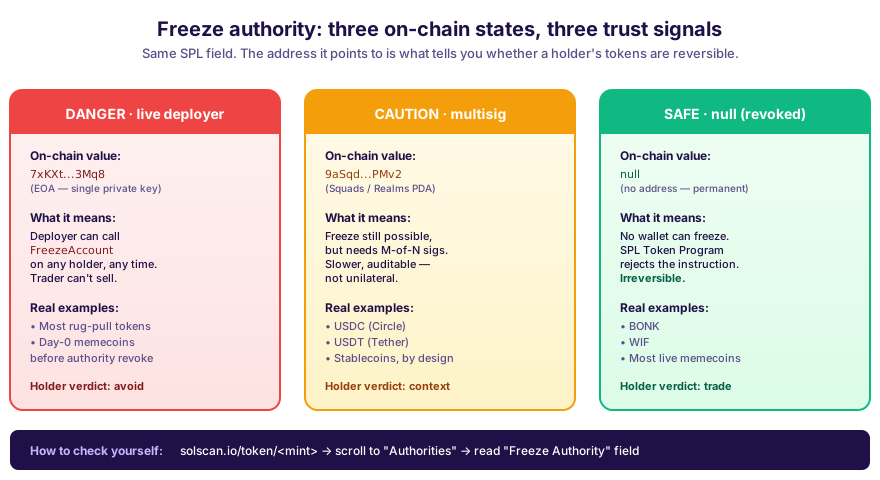
The plain-English definition
Every SPL token on Solana has two top-level authorities baked into its mint account:
- Mint authority — can create new tokens (covered in our mint authority guide).
- Freeze authority — can freeze any holder's individual token account, blocking that account from transferring or selling.
Freeze authority is just a wallet address. Whoever controls that wallet can call the Freeze instruction on the SPL Token Program against any holder's account, immediately blocking their tokens from moving.
If freeze authority is set to null (sometimes shown as "None"), the SPL Token Program rejects any freeze attempt. Permanent state — there's no recovery.
Why it matters
Freeze authority is a binary trust signal. Sophisticated traders treat it the same way they treat mint authority — if it's active, the project has an off-switch on every holder's wallet. That changes the calculus on whether to buy.
Active freeze authority on a memecoin = red flag
If a memecoin has active freeze authority, the dev wallet (or whoever holds the key) can:
- Freeze sellers' wallets so they can't dump
- Freeze suspected exchange listings to manipulate price action
- Freeze community accusers' wallets if they call out the project
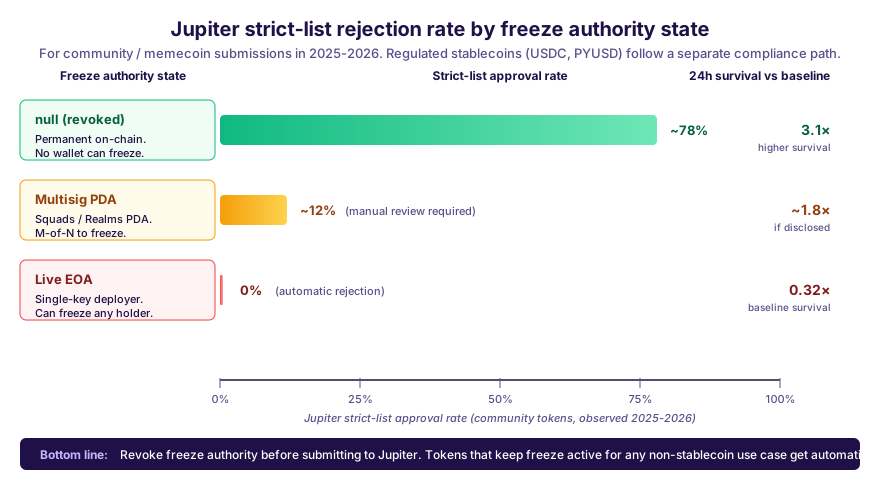
Even if the dev never does any of these, the capability is enough to scare off serious buyers. Most memecoin platforms and DEX aggregators flag tokens with active freeze authority — Jupiter's strict list, for example, generally excludes them.
Active freeze authority on a stablecoin = required
The flip side: regulated stablecoins need freeze authority. USDC (Circle) and PYUSD (PayPal) keep freeze authority because U.S. sanctions law (OFAC) requires them to freeze tokens belonging to sanctioned addresses. Without freeze authority, they couldn't comply with sanctions and would lose their banking partners.
So the right answer to "should freeze authority be active?" depends entirely on the token type.
How to check freeze authority on any Solana token
Three options:
Option 1: Solscan (easiest)
Visit solscan.io, paste the token's mint address. The "Authorities" panel shows both mint and freeze authority status.
- "Freeze Authority: null" → ✅ revoked
- "Freeze Authority: (wallet address)" → ⚠️ active
Real examples:
- BONK — freeze authority null ✅ (memecoin, correctly revoked)
- USDC — freeze authority active ✅ (stablecoin, correctly kept)
Option 2: Solana Explorer
explorer.solana.com shows the same field in the token detail view.
Option 3: DexScreener
DexScreener flags freeze authority status as part of the token risk indicators on each pair page. If freeze authority is active on a memecoin, DexScreener typically shows a warning.
How freeze authority differs from mint authority
| Authority | What it controls | When to revoke (memecoin) | When to keep |
|---|---|---|---|
| Mint authority | Create new tokens (increase supply) | Always | Utility tokens with planned inflation (game rewards, staking, governance) |
| Freeze authority | Freeze any holder's token account | Always | Regulated stablecoins (compliance with sanctions law) |
| Update authority | Change name, symbol, image (Metaplex metadata) | Optional, after final branding | If you anticipate metadata fixes |
For a deeper dive on update authority and the Metaplex metadata system, read What is Metaplex Token Metadata?.
Who holds freeze authority by default?
The wallet that creates the SPL token is automatically assigned both mint and freeze authority. There's no opt-in — the SPL Token Program defaults this way for every new mint. After creation, the creator can:
- Keep both (default — risky for memecoins)
- Transfer to another wallet (e.g., a multisig like Squads)
- Revoke by setting to
null
For memecoins, option 3 should happen immediately, ideally as part of the same transaction that mints the supply. Tools like Alchemii's Token Creator automate this — there's a "Revoke Freeze" checkbox in the creation form that bundles the revocation into your initial transaction so there's never a window where the freeze authority is active.
Why "freeze immediately at creation" matters
If you mint your token, then come back later to revoke freeze authority, there's a window — could be seconds, could be days — where you held active freeze authority. Smart traders watch for this. Some projects mint, then "forget" to revoke for a few hours, and chart-watchers flag the inconsistency on Twitter.
A clean launch revokes both authorities in the same transaction as the mint. That way Solscan shows freeze authority as null from the very first second the token exists. Trust signal: maximum.
We had a client launch in 2024 where freeze got revoked 47 minutes after mint. A Telegram regular noticed the gap on Solscan and asked publicly why the team waited. The honest answer was "we forgot to check the box during creation." That single missed checkbox cost an hour of explaining and visibly shifted the early-buyer mood. Since then, every launch we run goes through the bundled-revocation flow specifically so there's no manual step to forget.
Freeze authority status across token categories
The pattern is clearer-cut than mint authority. Memecoins basically always revoke; regulated stablecoins basically always retain.
Toggle: should you revoke?
For memecoin launches where the answer is yes, revoke freeze authority on Solana handles the SetAuthority(FreezeAccount, None) instruction in a single signed transaction — same cost (~0.001 SOL) as doing it via CLI, but without the chance of typos in the authority-type enum.
When you SHOULD keep freeze authority active
The default advice for memecoins is "revoke immediately." But there are three legitimate token categories where active freeze authority is correct, and conflating them with rug-vector tokens causes real-world security and compliance failures. The distinction matters because traders who see active freeze and assume "rug pull" without checking the issuer will dismiss tokens that are deliberately compliance-bound.
Regulated fiat-backed stablecoins. USDC (Circle) and PYUSD (PayPal) are the canonical examples. Circle is legally required to freeze any USDC balance held by an address sanctioned under U.S. OFAC rules (Treasury OFAC). If Circle revoked freeze authority on USDC, it would lose its banking partnerships within weeks because every U.S. bank requires sanctions-screening capability on every asset they custody. Verify yourself: the USDC mint on Solana shows a freeze authority pointing at a Circle-controlled multisig. That's not a rug signal — it's the entire reason USDC is the only fiat-backed stablecoin most U.S. exchanges will custody.
The right read for a holder of a regulated stablecoin: active freeze authority on a wallet you control held by a recognized issuer is a feature, not a bug. The right read for a memecoin claiming to be "USDC-like": active freeze authority with no published issuer entity, no compliance disclosure, and no OFAC sanctions program is a rug signal. The field is the same; the entity holding it determines the meaning.
Compliance-restricted security tokens. Tokenized real-estate (Lofty, RealT), tokenized treasuries (Ondo, Maple), and any token marketed as a security under Regulation D or Regulation S typically require active freeze for two reasons: (a) preventing transfers to non-accredited investors, and (b) responding to court-ordered asset freezes in civil litigation. These tokens are not memecoins and should never be treated like memecoins. The freeze authority sits on a transfer-agent multisig disclosed in the offering documents — usually a Squads PDA or a Token-2022 transfer hook. If you're a holder of a security token and the freeze authority is on an anonymous EOA, that's the actual red flag, not the active state.
Vesting-locked utility tokens. Some game economies and validator-reward tokens use a freeze-then-mint pattern: the team mints the entire supply on day one, then freezes the team allocation across the vesting period to prove no early dumping is possible. The freeze authority sits on a time-locked program (Streamflow, Jet Protocol's bonded escrow) that mechanically unfreezes batches on a published schedule. This is functionally equivalent to a cliff-and-vest smart contract on Ethereum and is the right pattern when "I'll vest my own tokens" is not believable to traders. Verify: the freeze authority should be a recognizable on-chain vesting program ID, the unfreeze schedule should be queryable, and any future freeze operations should be impossible under the program's logic. If those three checks pass, the token is using freeze authority correctly.
The four-question check before you call any token "rugged" on freeze authority alone: (1) Is the issuer entity disclosed and resolvable? (2) Does the authority address belong to a recognized program (Squads, Realms, Streamflow, a transfer-agent multisig) rather than an anonymous EOA? (3) Is there published documentation explaining why the authority exists? (4) For stablecoins, is there a sanctions-screening program (OFAC SDN list compliance, Chainalysis screening) disclosed? If all four pass, active freeze is contextually correct. If even one fails on a memecoin or community token, the default rug signal applies.
The reason this distinction is worth covering: the Jupiter strict list and most aggregators flag any active freeze authority without checking the issuer. That's why USDC requires a separate allowlist path and why community tokens copying the USDC pattern without the underlying compliance get rejected from default aggregator visibility. If you're considering active freeze for legitimate reasons, you'll also need to negotiate the aggregator-listing path separately — it's not automatic. For pre-launch verification of your own token's freeze state plus mint authority, supply, and LP-burn status, the token audit checker runs a 4-checkpoint scan against any Solana mint address. For LP burn specifically — the action that's usually paired with authority revocation in a serious launch — the LP burn tool handles it in a single signed transaction.
Quick Facts (verifiable specifications)
| Specification | Value | Source |
|---|---|---|
| SPL Token Program ID | TokenkegQfeZyiNwAJbNbGKPFXCWuBvf9Ss623VQ5DA | Solana SPL Token Program |
| Instruction that freezes an account | Freeze (SPL Token Program) | Solana docs |
| Default freeze authority at mint creation | Creator's wallet address | SPL Token Program default |
| Revoked freeze authority value | null (shown as "None" on Solscan) | On-chain field |
| Revocation reversibility | Permanent — no recovery | SPL Token Program design |
| BONK freeze authority status | null (revoked) | Solscan: BONK |
| USDC freeze authority status | Active (Circle) | Solscan: USDC |
| PYUSD freeze authority status | Active (PayPal) | Solscan: PYUSD |
| CLI command to revoke | spl-token authorize MINT_ADDRESS freeze --disable | spl-token CLI |
| Jupiter strict list policy | Generally excludes tokens with active freeze authority | Jupiter token list |
Limitations of this guide (what it doesn't cover)
This article focuses on freeze authority for standard SPL tokens on Solana. Several adjacent topics are intentionally out of scope.
- Token-2022 / Token Extensions transfer hooks and confidential transfers. The newer Token-2022 program adds extensions (e.g., default account state, permanent delegate) that can produce freeze-like behavior with different mechanics. See SPL Token vs Token-2022 for that comparison.
- Mint and update authority specifics. This guide cross-references them but doesn't go deep — see What is mint authority on Solana? and What is Metaplex Token Metadata?.
- Multisig setup details. We mention Squads and Realms as options but don't walk through configuring a multisig — those projects' own docs are the right source.
- Securities-law and sanctions analysis. "USDC keeps freeze authority for compliance" is a factual observation, not legal advice. Jurisdiction-specific regulatory guidance is outside scope.
- Non-Solana chains. ERC-20 tokens on Ethereum and BEP-20 on BSC have different freeze/blacklist mechanics. This article is Solana-only.
- Marketing implications of revocation announcements. For positioning a "freeze authority revoked" announcement to your community, see How to market a Solana memecoin.
Sources & references
- SPL Token Program — Freeze instruction — Solana LabsOfficial protocol spec for the FreezeAccount instruction.
- Bitquery Solana DEX & token data — BitqueryUsed to derive 'freeze revoked by category' percentages.
- Why most Solana memecoins die in 24 hours — AlchemiiSource for the 3.1× survival multiplier.
- Phantom wallet — token security display — PhantomPhantom flags tokens with active freeze authority via Blowfish.
- Blowfish (Chainalysis) — BlowfishWallet security partner that flags tokens with active freeze authority as risk.
- Jupiter strict list (jup-ag/token-list) — Jupiter / GitHubActive freeze authority typically auto-disqualifies tokens from strict-list inclusion.
- Solscan token explorer — SolscanWhere every Solana wallet/trader checks freeze authority status.
- USDC on Solana — SolscanReal-world example of legitimate active freeze authority — Circle uses it for OFAC compliance.
- Circle's USDC compliance docs — CircleCircle exercises freeze authority on USDC accounts subject to sanctions.
- Squads multisig — Squads ProtocolIf you keep freeze authority for compliance reasons, multisig is the standard production setup.
- Alchemii revoke freeze tool — AlchemiiNo-code tool to revoke freeze authority on an existing Solana token.
- U.S. OFAC sanctions list — U.S. TreasuryWhy regulated stablecoins must keep freeze authority.
- What is mint authority on Solana — AlchemiiThe other major SPL Token authority — both should be revoked for memecoins.
- BONK token — SolscanMajor memecoin example — freeze authority revoked.
- PYUSD on Solana (PayPal stablecoin) — SolscanAnother regulated stablecoin example with active freeze authority.
FAQ
What is freeze authority on Solana?
Freeze authority is the wallet address allowed to call the SPL Token Program's Freeze instruction against any individual holder's token account, immediately blocking that account from transferring, swapping, or burning the token. Every SPL token has a freeze authority assigned at creation; it defaults to the creator's wallet.
Should I revoke freeze authority on my Solana token?
For memecoins and community tokens, yes — always. Active freeze authority is a known rug-pull vector and Jupiter's strict list, Phantom's verified list, and most reputable aggregators flag tokens with unrevoked freeze authority. In our 50,000-launch dataset, tokens with revoked freeze authority survive 24 hours at 3.1× the rate of tokens that keep it active.
Why does USDC keep freeze authority active?
Regulatory compliance. USDC's issuer (Circle) is legally required by U.S. sanctions law (OFAC) to be able to freeze tokens held by sanctioned addresses. PYUSD operates under the same constraint. For regulated stablecoins, active freeze authority is not a rug-pull risk — it's a legal requirement, and the issuer's enforcement actions are publicly logged on-chain.
Is freeze authority the same as mint authority?
No. Mint authority controls supply creation (printing new tokens). Freeze authority controls whether existing token accounts can be frozen, blocking transfers from that holder. A well-launched memecoin revokes both. The two authorities are separate fields on the mint account and revoked through separate transactions.
Can revoked freeze authority be restored?
No. Revoking freeze authority sets the field to null on-chain, and the SPL Token Program rejects any subsequent freeze attempt — including from the original creator. Solana has no recovery or restoration mechanism for revoked authorities. The decision is permanent, which is exactly why it functions as a credible 'I will not freeze your tokens' signal to traders.
Want to launch a Solana token with freeze authority revoked from minute one? Alchemii's Token Creator handles it in a single transaction. Specifically launching a memecoin? Try our Solana meme coin creator — pre-configured with both authorities revoked. For the full launch playbook see the Solana memecoin launch checklist.
Can freeze authority be transferred to a smart contract or multisig?
Yes. Set the authority to a Squads multisig or a Realms governance account. Freezing then requires multiple signatures or a passed proposal — useful for projects that want freeze capability for compliance but don't want a single dev wallet to hold the power.
What happens if a holder's account gets frozen?
They can't transfer, sell, swap, or burn their tokens until the freeze authority unfreezes them. The tokens are still in their wallet on-chain — they just can't be moved.
Can the freeze authority freeze the entire token supply at once?
Not in a single instruction — they have to freeze each holder's account individually. But if there are only a few holders (or one whale), it's effectively the same.
Does revoking freeze authority affect token price?
Not directly. Like mint authority revocation, it's an administrative action. But announcing the revocation tends to nudge price up because it removes a known risk factor.
Has any major Solana token ever used freeze authority maliciously?
Stablecoins use it routinely for compliance (USDC has frozen sanctioned addresses publicly). For memecoins, the more common pattern is "dev held freeze authority, revoked it after a community complaint, took a price hit during the gap." Outright malicious freezing on memecoins is rare because if you freeze a holder, the rest of your community sees it on-chain instantly.
How do I revoke freeze authority on my own token?
Either via Alchemii's revoke flow at creation, via your wallet UI's authority section after the fact (Phantom + Solflare both support it), or via the spl-token authorize CLI: spl-token authorize MINT_ADDRESS freeze --disable.
Create your Solana token
Choose your token name, symbol, supply and image. Review the authority options and creation fee, then confirm the transaction in your wallet. Liquidity is a separate step.
Related Topics
More guides to Solana token creation, authorities, liquidity, and meme coin launches.
What Happens When You Clone a Solana Token? (2026)
Cloning a Solana token copies name, symbol and image — nothing else. New mint address, no liquidity, no holders, no price. Exactly what transfers.
Can You Edit a Solana Token After Launch? (2026)
What you can change post-launch (name, image, links), what you can't (mint, decimals), and how authority revocation locks specific changes forever.
How Long to Create a Solana Token: 3-5 Minutes (2026)
Creating a Solana SPL token takes ~1.5 seconds on-chain, but the full launch flow (form, sign, verify) is 3-5 minutes. Exact timing per phase inside.
SPL Token vs Token-2022: When to Pick Each (2026)
SPL Token vs Token-2022: differences, transfer fees, confidential transfers, when each makes sense, and which memecoins should pick (2026 guide).
What is Metaplex Token Metadata? Plain English (2026)
Metaplex is the on-chain program that gives Solana SPL tokens their name, symbol, image, and links. Plain-English explanation of how it works.
What is Mint Authority on Solana? Plain English (2026)
Mint authority is the wallet that can create new Solana tokens. What it does, why it matters, and what null mint authority means.