How to Create a Meme Coin on Robinhood Chain (2026 Guide)
Create a meme coin on Robinhood Chain without code: current ETH fees, a shareable meme idea, token setup, liquidity and a practical community launch plan.

Ready to create on Robinhood Chain? Review your ERC-20 settings and fee before signing.
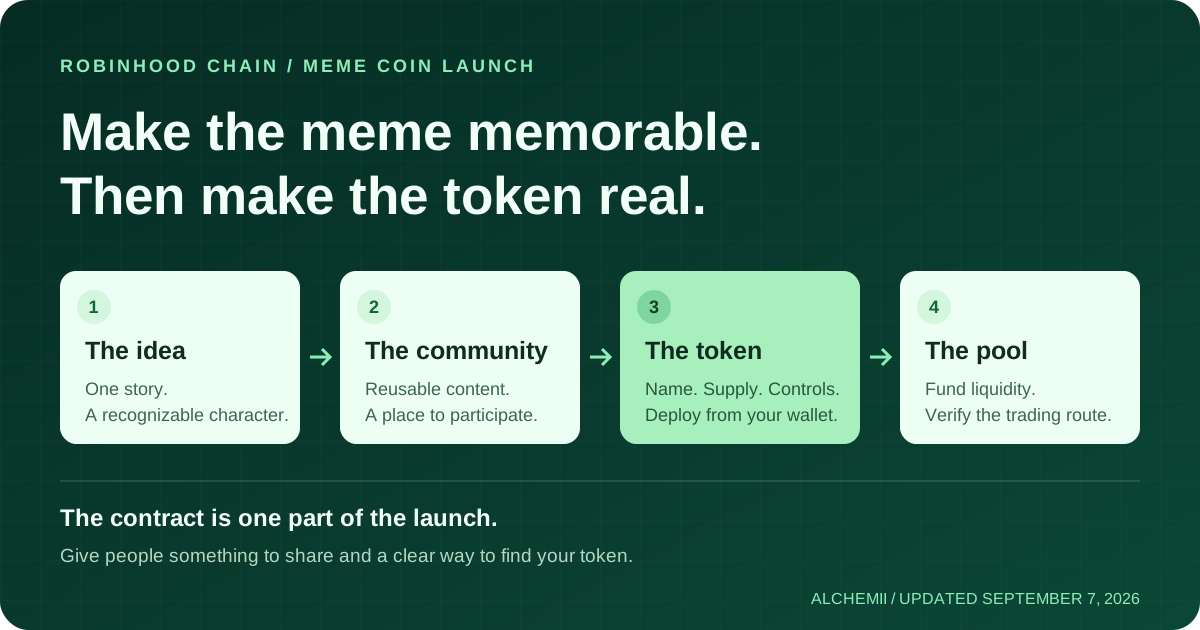
To create a meme coin on Robinhood Chain, fund an EVM wallet with ETH on chain 4663, deploy an ERC-20, and fund a separate liquidity pool if you choose a direct DEX launch. Alchemii's standard creation service fee was 0.015 ETH plus gas at our September 7, 2026 check. The initial supply goes to the wallet that creates the token.
If you want to create a viral meme coin on Robinhood Chain, the contract is one part of the launch. You also need a recognizable idea, content people can reuse, a community that understands the project, and a working route to the token. This guide covers those decisions alongside the no-code creation steps.
Updated September 7, 2026. We build Alchemii. Service fees below were read directly from the deployed factory; market figures are attributed to their publishers. The launch plan is practical guidance, not a claim that any particular coin will attract buyers.
What is happening with Robinhood Chain meme coins?
In research published September 3, Bitquery compared August 4–10 with August 25–31, 2026 and reported Robinhood Chain meme coin weekly volume rising from approximately $1.4 billion to $3.5 billion. Its comparable weekly active-wallet count rose from 403,000 to 797,000. Those figures describe its dataset, not all economic activity or a count of individual people. For launch counts, the study filtered tokens to those reaching three traders and $100 of lifetime volume. Its USD-volume methodology also has limitations discussed in the report. Read Bitquery's study and methodology.
That is evidence of activity worth researching. It does not establish demand for your proposed token. Pick the community and the reason to participate before deciding how much to spend on deployment, liquidity or promotion.
Robinhood's official documentation describes a permissionless EVM network. Creating a token there does not automatically place it in Robinhood's brokerage app or deliver it to the app's customers. Our Robinhood Chain explainer covers the network itself; this article focuses on a meme coin launch.
Plan a meme people can recognize and repeat
Start with one sentence that explains the character or joke. Then make a small set of images, captions or reactions that community members can adapt without asking you to create every post.
A useful test before deployment: show the idea to someone outside your team. Can they explain the joke in their own words and suggest a second meme using it? If the only explanation is that the price might rise, the creative concept still needs work.
A concrete example: CASHCAT's narrative and participation tools
The CASHCAT project site builds its story around the name Robinhood once considered, pairs that story with a consistent cat character, and provides a meme gallery and profile-picture generator. It also presents its contract address and trading links in the same place. These are observable parts of its presentation; they do not prove what caused its market performance.
The useful lesson for a new creator is the combination of a short story, reusable visuals and a clear way to find the actual token. Develop your own character and assets rather than implying an association with an existing project. Robinhood's own CASHCAT information page explicitly says Robinhood is not the token's issuer and has no other affiliation with it.
What to prepare before creating the token
Keep these items together in a launch document:
- Identity: the name, ticker, original artwork and one-sentence premise.
- Token allocation: total supply, any team or treasury allocation, community rewards and tokens intended for liquidity.
- Community entry point: one working website or social profile, with a consistent project name and a way to ask questions.
- Launch content: a pinned introduction, a small pack of reusable images, and a clear explanation of how to find the real contract.
- Budget: token creation and gas, pool fees and deposits, and any separately planned distribution or promotion costs.
Avoid promising a contract address before it exists. After deployment, update every official entry point with the same address and network. The general ERC-20 tutorial covers code versus no-code deployment; the steps below follow Alchemii's no-code route.
How to create a meme coin on Robinhood Chain
1. Fund and connect your wallet
Use a compatible EVM wallet such as MetaMask or Rabby, or the available WalletConnect option. Select Robinhood Chain mainnet, chain ID 4663, which uses ETH for gas. The official network settings distinguish it from testnet, chain ID 46630.
ETH on Ethereum mainnet cannot pay for a transaction on Robinhood Chain. If necessary, use the ETH bridge guide to fund the correct network, then open the Robinhood Chain Token Creator.
2. Enter the name, symbol, supply and decimals
The form defaults to 1,000,000,000 tokens and 18 decimals. These are starting values, not a requirement or a price signal. The form accepts names up to 64 characters, symbols up to 12 characters and decimals from 0 to 18.
Decimals determine divisibility. One billion tokens with 18 decimals still means one billion whole tokens. Enter the supply without thousands separators; do not manually add 18 zeros to the supply field.
Check spelling and your allocation totals before continuing. The name, symbol and decimals in these templates cannot be edited after deployment. Future supply changes depend on whether you enable minting or burning.
3. Choose token controls for the trading route you intend to use
For a simple fixed-supply meme coin, Alchemii's plain template has no owner controls, future mint function, transfer tax or pause switch. Optional features change those properties; choose them for an actual requirement.
| Option | What to understand before selecting it |
|---|---|
| Burnable | Holders can destroy tokens they own; this reduces supply but does not establish demand |
| Mintable | The owner can issue additional tokens, so a fixed initial allocation is not a permanent supply cap |
| Pausable | The owner can stop transfers, which also affects holders trying to trade |
| Transfer fee | Eligible transfers lose a portion to the configured fee mechanism; DEX compatibility needs attention |
| Trading limits | Transaction and wallet caps can interfere with pool deposits and swaps unless configured appropriately |
| Deflation | Burns part of an enabled transfer fee; it depends on that fee mechanism |
For a straightforward Uniswap V3 launch, leave transfer tax off. Uniswap's documentation states that fee-on-transfer tokens do not work with its standard V3 routers. A maximum tax percentage does not make a token compatible. Reflection is a separate template with non-standard balance behavior and also needs integration testing before selecting a pool route. Uniswap V3 token integration documentation.
4. Review the current fee and deploy
The standard base fee and optional surcharges at block 56,564,286, September 7, 2026, 04:54:42 UTC, were:
| Configuration | Service fee | How to read the fee |
|---|---|---|
| Plain token | 0.015 ETH | Standard base creation fee |
| Burnable | +0.01 ETH | Added to the base fee if selected |
| Mintable | +0.01 ETH | Added to the base fee if selected |
| Pausable | +0.01 ETH | Added to the base fee if selected |
| Transfer fee | +0 ETH | No service surcharge; DEX compatibility still matters |
| Trading limits | +0 ETH | No service surcharge; limits can affect pool interactions |
| Deflation | +0.015 ETH | Requires the transfer-fee feature |
The source is the deployed Alchemii factory. The downloadable fee reading records the block, getter values and query method. These were read-only calls; we did not make a new paid deployment for this update.
The form reads the connected wallet's fee, including any applicable discount. Network gas is additional and varies; the old August gas reading is not a current deployment quote. Reflection uses a separate template and quote. Pool creation, liquidity deposits and any later airdrop are separate costs; see the full Robinhood token budget for how those categories fit together.
When the details and wallet quote match your plan, confirm the deployment. The factory transaction creates the token, mints its initial supply to your wallet and settles the creation service fee together. If the transaction reverts, those state changes do not complete; gas may still be spent.
5. Verify the token before announcing it
Open the transaction and new contract on Robinhood Chain Blockscout. Confirm the transaction succeeded, the contract address is correct, and the name, symbol, decimals and initial supply match your inputs. Read any enabled owner controls.
Import the contract address into your wallet and check the balance. Make a small transfer to another wallet you control to check the behavior you configured. Keep that receipt with your launch notes. Neither a successful deployment nor source verification is a security audit.
Create a market for a direct DEX launch
For this route, the standalone token needs a separately funded pool before users can swap against it. Open the Robinhood Chain pool creator, select the token and its ETH pairing, and review the starting price and deposits.
In Alchemii's flow, the token and ETH amounts are used to derive the starting price when initializing a new pool. On an existing pool, the current price is already established. Uniswap V3 also uses price ranges: the amounts actually deposited can differ from your maximum inputs. The position NFT represents your liquidity position and should be delivered to your wallet.
Choose the fee tier and liquidity size deliberately, then verify the pool address and test a small swap. A large fully diluted valuation does not imply deep liquidity or the ability to sell a large allocation at the displayed price. Uniswap's concentrated liquidity documentation explains how price ranges affect a position.
A direct pool and a bonding-curve launchpad are different launch routes:
| Route | When trading starts | Price and liquidity decisions |
|---|---|---|
| Standalone ERC-20 + direct pool | After you create and fund the pool | You configure the new pool and receive its liquidity position |
| Bonding-curve launchpad | On the curve under the launchpad's rules | The protocol sets curve pricing and graduation conditions |
For the curve route, use the Pons explainer for the mechanics and the step-by-step Pons launch for the flow itself, then check its current launch conditions. Do not assume the direct ERC-20 fee or pool-ownership model applies to a launchpad token.
How to give your meme coin a chance to spread
A useful launch gives people something to share and makes the next action easy. The following is an editorial launch plan, not a measured formula for virality.
Before launch: prepare participation
Publish the idea and your own artwork, invite feedback, and prepare a few formats people can remix: captions, reaction images or character variations. Explain any rewards and team allocations plainly. Choose a community channel you can maintain and have someone available to answer launch-day questions.
At launch: publish one complete announcement
Include the premise, chain name, exact contract address, working website or community link, token allocation summary and verified trading link. Link to the actual pool instead of asking people to search by ticker, which another token can reuse.
DEX Screener's listing documentation says tokens appear after a liquidity pool and at least one transaction exist. Verify that it supports your chain and DEX and that your pair is actually indexed before advertising a chart link. Basic indexing does not establish a trending position.
After launch: measure participation rather than impressions alone
Track visits from your announcement to the project page, questions from new participants, community-created content, and the retention of participating wallets over time. Separate team wallets, reward recipients and paid activity when evaluating results. An address count does not measure unique people, and a token allocation does not prove interest in buying.
DEX Screener's trending documentation identifies market activity, community engagement and credibility signals among its inputs, while keeping the full formula private. A deployment tool cannot promise a place in that ranking.
For the distribution side of the launch, the Robinhood Chain marketing playbook covers the bridge-to-buy funnel, launch-week costs and what to measure afterwards. If community allocations are part of the plan, use the Robinhood Chain airdrop guide for CSV preparation and batch verification. Treat it as an execution step after choosing recipients, not a substitute for a community.
Launch checklist
Before publishing your trading link, confirm:
- The meme, name and artwork are consistent across your public pages.
- The deployed token matches your intended supply, decimals and controls.
- Your team, community and liquidity allocations reconcile to the available supply.
- The pool is funded, its address is verified and a small swap behaves as expected.
- Your announcement includes the correct contract and a working trading route.
- Someone is available to answer questions, and you have a plan for the next community update.
When the idea and allocation plan are ready, create your meme coin on Robinhood Chain. Alchemii handles the contract deployment from your wallet; the launch plan gives that token a clear place in your community.
FAQ
Can I create a viral meme coin on Robinhood Chain?
You can create a meme coin on Robinhood Chain, but no creator tool can guarantee that it goes viral. Build a recognizable idea, prepare content people can remix, publish a clear contract address and trading route, and measure real participation after launch.
How much does it cost to create a meme coin on Robinhood Chain?
At the September 7, 2026 mainnet reading, Alchemii's standard token creation service fee was 0.015 ETH plus gas. Burnable, mintable and pausable each added 0.01 ETH; deflation added 0.015 ETH. Wallet discounts may apply. Liquidity fees and deposits are separate, and the current wallet quote takes precedence.
Can I create a Robinhood Chain meme coin without coding?
Yes. Enter the name, symbol, supply and decimals in Alchemii's Robinhood Chain Token Creator, choose any optional controls, and confirm the deployment in your EVM wallet. The transaction creates the token and pays the service fee.
Does creating the token make it tradeable?
Deploying a standalone ERC-20 sends the initial supply to your wallet. For the direct DEX route in this guide, you then create and fund a separate liquidity pool. A bonding-curve launchpad is a different route with its own trading and graduation rules.
Which wallet and network do I need?
Use a compatible EVM wallet such as MetaMask or Rabby, or a wallet supported by the WalletConnect connection option. Select Robinhood Chain mainnet, chain ID 4663, and hold native ETH on that network for fees and gas.
Should I enable transfer tax for a Uniswap V3 meme coin?
For a straightforward Uniswap V3 launch, keep transfer tax off. Uniswap documents that fee-on-transfer tokens do not work with its standard V3 routers. A fee cap does not establish DEX compatibility; custom behavior needs integration testing.
Does deploying on Robinhood Chain list my coin in the Robinhood app?
No. An on-chain deployment does not grant a brokerage listing, access to Robinhood's customers or an endorsement. Robinhood Chain and the Robinhood trading app are separate distribution channels.
Create your token on Robinhood Chain
Set your ERC-20 name, symbol and supply, then review the options and fee in the creator. Confirm deployment in your wallet. Add a liquidity pool separately when you are ready to open trading.
Related Topics
More guides to token creation and liquidity on Robinhood Chain.
How Much Does It Cost to Create a Token on Robinhood Chain?
Every cost of creating a Robinhood Chain token, measured on mainnet: service fees read from live contracts, gas at two dated readings, and the pool.
How to Create a Token on Robinhood Chain (Code or No-Code)
Both routes to a Robinhood Chain ERC-20, tested on mainnet: the no-code factory path and the Foundry deploy, with real costs and the pool step after.
How to Launch a Token on Pons in 30 Seconds (2026)
How to launch a token on Pons in one transaction: the real form fields, the 0.0005 ETH fee, the 99% opening tax, and graduation odds measured today.
How to Market a Robinhood Chain Token (2026 Playbook)
How to market a Robinhood Chain token when buyers hold no ETH on chain 4663 yet: the bridge-to-buy funnel, live launch costs, and what to measure.
How to Airdrop Tokens on Robinhood Chain (Multisender Guide)
Airdrop your ERC-20 to multiple wallets on Robinhood Chain with a token multisender: prepare a CSV, calculate ETH fees, approve batches and verify delivery.
How to Bridge ETH to Robinhood Chain — and What Actually Arrives
Six documented routes onto chain 4663, measured. A 40-quote snapshot of what arrives after fees, the canonical bridge priced at 92,955 gas, and the size below which bridging stops making sense.