How to Bridge ETH to Robinhood Chain — and What Actually Arrives
Six documented routes onto chain 4663, measured. A 40-quote snapshot of what arrives after fees, the canonical bridge priced at 92,955 gas, and the size below which bridging stops making sense.

Ready to create on Robinhood Chain? Review your ERC-20 settings and fee before signing.
Fee update — September 7, 2026: Alchemii’s standard token creation fee is now 0.015 ETH plus gas. Add-on prices are unchanged; pool creation remains 0.01 ETH, with deposits and gas separate. View the on-chain fee update. The older comparisons and gas measurements below retain their stated observation dates.
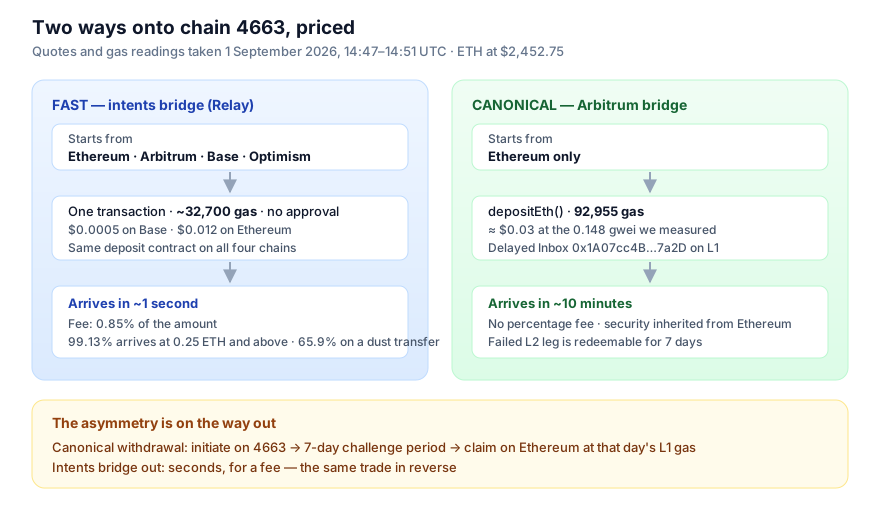
To bridge ETH to Robinhood Chain you send ETH through one of six documented routes to chain 4663, where it arrives as native ETH — the chain's own gas token — so a single transaction takes a wallet from empty to able to deploy. Through a fast intents bridge that transaction is about 32,700 gas on the source chain with no approval step, and the quotes we measured estimated one second to fill. Through the Arbitrum canonical bridge it is a depositEth() call on Ethereum that Robinhood's documentation puts at roughly ten minutes, costs gas rather than a percentage, and is the only route whose security is Ethereum's own.
Everything below is measured. The cost tables come from 40 live Relay quotes taken inside one 34-second window on 1 September 2026 — each size requested twice, once with our 0.85% fee and once without it, so our own cut is isolated rather than asserted. The canonical figure is an eth_estimateGas against the Delayed Inbox contract. Gas prices were read off all four source chains the same minute.
What you are actually moving
Robinhood Chain is an Arbitrum Orbit L2 on chain ID 4663 that uses ETH for gas — the same asset you are bridging. That single fact removes the step most people expect: there is no separate "get some gas token" transaction, no wrapped asset to unwrap, and no token approval, because native ETH has no allowance to grant.
It also creates the one prerequisite worth stating out loud: you need ETH left on the source chain to pay for the deposit transaction. That is why the Max button on our bridge page holds back 0.0005 ETH rather than sending everything — a reserve that covers an L2 send many times over and a normal L1 send at moderate gas prices. Send literally your whole balance and you will not be able to sign the transaction that sends it.
What does not travel is anything else. A token you deployed on another chain does not appear here; a bridge moves value, not contracts. If your plan involves the same ticker on two chains, that is two deployments and two liquidity pools, not a bridge.
The six routes, and the two that matter
Robinhood's own documentation lists the routes onto the chain. Reproduced here with what each is actually good for:
| Route | Type | Speed (per Robinhood's docs) | What it is actually for |
|---|---|---|---|
| Arbitrum canonical bridge | Trustless L1↔L2 | Deposit ~10 min · withdrawal ~7 days | Moving ETH from Ethereum when you can wait, and the only route whose security is Ethereum's |
| Relay | Intents-based | Seconds | Funding the chain from an L2 in one transaction — the route Alchemii's bridge quotes first |
| Across | Intents-based | Seconds | Same shape as Relay; a second quote worth checking if the first looks expensive |
| LayerZero OFT / Stargate | Messaging + omnichain token | Minutes | Moving OFT-registered assets (WBTC, USDG), not plain ETH |
| Chainlink CCIP / Transporter | Messaging + token transfer | Minutes | Bridge-and-then-do-something flows for integrators |
| LiFi / 0x | Aggregators | Seconds–minutes | Swap-and-bridge in one step, and the second quote worth checking against ours |
For funding a launch with ETH, four of the six are noise: the OFT and CCIP routes exist to move registered tokens and to trigger actions on arrival, not to move plain ETH into your deployer wallet. That leaves a genuine choice between the canonical bridge and an intents bridge — and the answer depends almost entirely on which chain your ETH is sitting on right now.
What a fast bridge actually delivers
Here is the snapshot: how much of what you send arrives, including our 0.85% fee.
| Amount bridged | From Ethereum | From Arbitrum | From Base | From Optimism |
|---|---|---|---|---|
| 0.002 ETH | 65.87% | 97.64% | 71.56% | 97.65% |
| 0.01 ETH | 98.84% | 98.84% | 93.48% | 98.83% |
| 0.05 ETH | 99.08% | 99.07% | 97.76% | 99.07% |
| 0.25 ETH | 99.13% | 99.12% | 98.55% | 99.12% |
| 1 ETH | 98.72% | 99.13% | 99.13% | 99.13% |
Three findings, in order of how much they should change your behaviour.
1. Above 0.25 ETH the cost is our fee and nothing else
Every clean row converges on 99.13%. That is not a coincidence — it is 100% minus 85 basis points minus a relayer charge that has become a rounding error at that size. If you are moving a quarter of an ETH or more through a fast bridge, you can predict the outcome from the fee schedule alone.
2. Below 0.01 ETH, bridging destroys a large fraction of the money
The relayer's charge is close to flat in absolute terms — in the quiet part of our snapshot it sat around 0.00003 ETH, and in the noisy part around 0.0005 to 0.00065 ETH. Neither number matters on a 1 ETH transfer. On a 0.002 ETH transfer, the second one is a third of the amount, which is exactly what the table's worst cell shows: 65.87% arriving.
There is no minimum and nothing warns you. The transfer simply is not worth making. If you are funding a launch, bridge once with the whole budget rather than four times as you need it.
3. The quote is a live price, not a fee schedule — re-quote before you sign
The unflattering detail in our own data: the Ethereum 0.002 ETH row above says 65.87%, and a quote for the same size on the same chain taken twenty minutes earlier said 97.67%. Two requests 0.4 seconds apart, one with our fee and one without, priced the relayer 20x apart.
So the number to trust is never a published percentage — including the ones in this article. It is the output amount in the quote in front of you, refreshed. Our bridge re-quotes and shows "you receive" for exactly this reason, and the wallet prompt is the binding figure.
Proving our own fee rather than claiming it
Every bridge aggregator says it takes a small cut. Here is ours, measured by asking the same API the same question twice — once with the 85 bps appFee our code attaches, once without it:
| Amount | Arrives with our fee | Arrives with the fee switched off | Difference |
|---|---|---|---|
| 0.002 ETH | 97.644% | 98.491% | 0.847 pp |
| 0.01 ETH | 98.835% | 99.682% | 0.847 pp |
| 0.05 ETH | 99.072% | 99.922% | 0.850 pp |
| 0.25 ETH | 99.119% | 99.969% | 0.850 pp |
| 1 ETH | 99.128% | 99.978% | 0.850 pp |
0.847 to 0.850 percentage points, every single time. Two things follow, and the second one is the uncomfortable one:
- The fee is exactly what the code says:
BRIDGE_FEE_BPS = 85, sent per transaction to a wallet that is public on chain anyway. There is no spread hidden in the routing. - Above 0.05 ETH, our fee is essentially the entire cost of using our bridge. Relay's own take at 1 ETH was 0.022 percentage points. We are not a thin layer on top of a big cost; we are the cost.
That is a defensible thing to charge for — the page re-quotes immediately before signing, holds back gas on Max, switches the wallet's network, and polls the fill until the destination transaction confirms. It is not defensible to charge it quietly, which is why the number sits in the interface and in this table.
The canonical bridge is far cheaper and far slower
Now the comparison nobody selling a bridge wants to publish. The canonical route is a depositEth() call on Robinhood Chain's Delayed Inbox at 0x1A07cc4B…7a2D on Ethereum. Estimated against the live contract, it costs 92,955 gas:
| Ethereum L1 gas price | Canonical depositEth() cost | Cheaper than 0.85% above | In dollars |
|---|---|---|---|
| 0.148 gwei (measured, 1 Sep 2026) | 0.0000138 ETH ($0.03) | 0.0016 ETH | $4 |
| 1 gwei | 0.0000930 ETH ($0.23) | 0.0109 ETH | $27 |
| 5 gwei | 0.0004648 ETH ($1.14) | 0.0547 ETH | $134 |
| 10 gwei | 0.0009296 ETH ($2.28) | 0.1094 ETH | $268 |
| 30 gwei | 0.0027887 ETH ($6.84) | 0.3281 ETH | $805 |
At the 0.148 gwei Ethereum was running when we measured, that is about three cents, flat, at any size. Our 0.85% on the same 1 ETH transfer is 0.0085 ETH — roughly $21. The canonical bridge is not marginally cheaper; at today's L1 gas it is cheaper by a factor of six hundred.
So when is a fast bridge the right call? Three cases, and they cover most real users:
- Your ETH is on an L2. This is the big one. The canonical route into Robinhood Chain starts on Ethereum. If your ETH is on Base or Arbitrum, using it means first withdrawing from that rollup to L1 — which carries its own multi-day challenge period — and then depositing. Nobody does this. From an L2, an intents bridge is not the expensive option; it is the only fast option, and 0.85% is the price of not waiting a week.
- You need it in seconds, not minutes. Ten minutes is nothing when you are planning. It is a lot when a pool is half-created and a launch window is open.
- L1 gas is expensive. The table's later rows are the honest version of this: at 30 gwei the canonical deposit costs $6.84, and a percentage fee wins on anything under about 0.33 ETH.
And when it is not: if your ETH is already on Ethereum and you are not in a hurry, use the canonical bridge. It is trustless, it costs cents, and Robinhood documents it. We would rather say that here than have you work it out afterwards.
What the transaction looks like
For the intents route, the mechanics are unusually simple, and worth knowing so you can recognise a normal transaction from a strange one:
- One transaction on the source chain, to Relay's deposit contract at
0x4cd00e387622c35bddb9b4c962c136462338bc31— the same address on Ethereum, Arbitrum, Base and Optimism, which is a useful thing to be able to check. - Calldata is a single selector,
0x49290c1c, followed by your recipient address and the quote's request id. Nothing to approve, nothing to configure. - Gas: 32,697–32,713 on Ethereum, Base and Optimism, 33,757–33,772 on Arbitrum across the snapshot's quotes. At the gas prices we measured that is $0.012 on Ethereum, $0.0017 on Arbitrum, $0.0005 on Base and effectively nothing on Optimism.
- The value is the full amount you are bridging — the fee comes out of the delivered side, not as a second payment.
- Fill is confirmed by polling, not by faith:
GET /intents/status?requestId=…returns the destination transaction hash once the relayer has filled it.
If you would rather not trust a UI at all, that shape is reproducible with cast send and a quote from the API.
The exit is the direction that costs you
Everything above is about getting in, because that is what people search for. The asymmetry is on the way out, and it is worth knowing before you have a treasury on the chain:
- Canonical withdrawal is three steps and about seven days: initiate on chain 4663, wait out the challenge period Arbitrum's fraud-proof system requires, then submit a claim transaction on Ethereum — which costs L1 gas at whatever the gas price is on the day you claim, not the day you started.
- An intents bridge exits in seconds for a fee, which is the same trade in reverse and the reason these bridges exist at all.
- One detail from Robinhood's docs worth filing away: an inbound canonical deposit whose L2 leg fails — insufficient gas, typically — is not lost. It uses Arbitrum's retryable-ticket system and can be manually redeemed from the bridge interface within seven days.
How much to bridge for a launch
As of September 7, 2026, plan for 0.015 ETH to create a standard token and 0.01 ETH to create its pool: 0.025 ETH in service fees, plus gas, optional features and the ETH you want to deposit as liquidity.
For illustration, the September 1 bridge snapshot delivered 0.0489 ETH from a 0.05 ETH send. With the updated service fees, that would leave 0.0239 ETH before gas for the pool. A 0.1 ETH send that delivers 0.0978 ETH would leave 0.0728 ETH before gas. These are planning examples using historical bridge quotes; request a fresh quote before sending.
Start with the liquidity deposit you intend to provide, then add the service fees and gas reserve. The bridge's delivered amount needs to cover that total.
Where our bridge is the wrong choice
Stated plainly, because two of these came out of the measurements above:
- Your ETH is on Ethereum and you can wait ten minutes. Use the canonical bridge. Three cents against 0.85%.
- You are moving dust. Under about 0.01 ETH, a large share of the transfer goes to the relayer regardless of who quotes it.
- You want the cheapest fast route at this instant. Our page quotes one provider, Relay, and in the minute we measured it was not the best price available. A LI.FI quote for the same 0.05 ETH from Base routed via Layerswap and returned 99.698%, against 97.764% through our route with our fee — because Base's relayer pricing was spiked in that window. Two notes on that, both dated 1 September 2026. First, it is a real measurement and it stands: if a couple of percentage points matters on your transfer, get a second quote before you sign ours. Second, the LI.FI route used to sit behind our page as an automatic fallback, and we removed it that day — it rejects our fee-carrying quotes with code 1011 ("not configured for collecting fees"), so any transfer that reached it was quietly a different product: different provider, different failure modes, no fee. Substituting that under the same button is worse than showing an error, so now you get the error.
- You are moving a registered token rather than ETH. That is an OFT or CCIP job, per Robinhood's route table.
Checklist
- Check where your ETH already is. On Ethereum and unhurried: canonical. On an L2, or in a hurry: an intents bridge.
- Bridge once, with the whole budget. Fees, pool and seed liquidity in one transfer — repeated small bridges pay the flat relayer charge repeatedly.
- Read the "you receive" number, not a published percentage. Refresh it. The relayer component moves by an order of magnitude within minutes.
- Leave gas on the source chain. Our Max button reserves 0.0005 ETH; if you are doing it by hand, do the same.
- Confirm the fill on the destination, either from the status endpoint or by looking at your balance on chain 4663 — not from the source-chain transaction succeeding, which only means the deposit was accepted.
- Plan the exit now. If the plan is ever to move a treasury back to Ethereum, the canonical route is seven days and the fast route is a percentage. Neither is a surprise if you decided in advance.
FAQ
How do I bridge ETH to Robinhood Chain?
Send ETH through one of the documented routes to chain 4663; it arrives as native ETH, which is also the gas token, so no second funding step is needed. Through an intents bridge it is one ~32,700-gas transaction on the source chain with no approval, quoted at about one second. Through the canonical bridge it is a depositEth() call on Ethereum at roughly ten minutes.
What does bridging to Robinhood Chain cost?
Through Alchemii's bridge, 0.85% plus the relayer's charge plus source-chain gas. Our 1 September 2026 snapshot delivered 99.13% at 0.25 ETH and above, 97.8–99.1% at 0.05 ETH, and as little as 65.87% on a 0.002 ETH transfer. Through the canonical bridge it is gas only — 92,955 gas, about three cents at the 0.148 gwei we measured.
Is the canonical bridge cheaper?
On fees, almost always. At the L1 gas price we measured, a percentage fee only wins below about 0.0016 ETH; at 30 gwei it wins below about 0.33 ETH. What a fast bridge buys is seconds instead of ten minutes and the ability to start from an L2 at all.
How long does it take?
Intents quotes said one second, and the status endpoint confirms the destination transaction. Canonical deposits are about ten minutes. Canonical withdrawals are about seven days plus a claim transaction on Ethereum.
What is the smallest amount worth bridging?
About 0.05 ETH on a fast route. Nothing enforces a minimum; the flat relayer charge simply makes smaller transfers a bad trade, and at dust sizes the loss varies by the minute.
Do I need gas on Robinhood Chain first?
No — the ETH you bridge is the gas. You do need ETH left on the source chain to pay for the deposit transaction, which is what the 0.0005 ETH Max reserve protects.
Can I bridge a token I deployed elsewhere?
Not with this route. Bridges move value; contracts do not travel. Same ticker on two chains means two deployments and two pools — which is a strategy decision, not a bridging one.
How much should I bridge to launch a token on Robinhood Chain?
As of September 7, 2026, a standard Alchemii token costs 0.015 ETH and pool creation costs 0.01 ETH, before gas and liquidity deposits. Choose your intended ETH liquidity deposit, add 0.025 ETH in service fees and a gas reserve, then use the bridge's current delivered-amount quote to calculate how much to send. Add-ons increase that budget.
References
Everything above, and where to re-read it
- Bridging — Robinhood Chain documentation — Robinhood MarketsSource of the six-route table, the ~10-minute deposit and 7-day withdrawal timings, the retryable-ticket recovery window, and the three-step withdrawal. (accessed 1 September 2026)
- Protocol contracts — Robinhood Chain documentation — Robinhood MarketsDelayed Inbox 0x1A07cc4BD17E0118BdB54D70990D2158AbAD7a2D, Bridge 0xDf8755334ce7A73cCF6b581C02eA649AE3E864b3 and Outbox 0xf0ce991ea4A0d2400A4AB49b20ae333f6Dce3DE9 on Ethereum L1. (accessed 1 September 2026)
- Relay quote API (POST /quote) — reference — RelayThe 40 quotes behind the cost tables, taken 14:47:06–14:47:40 UTC on 1 September 2026. Deposit contract 0x4cd00e387622c35bddb9b4c962c136462338bc31, selector 0x49290c1c, identical on Ethereum, Arbitrum, Base and Optimism. (accessed 1 September 2026)
- LI.FI quote API — fee rejection code 1011 — LI.FIRequesting a fee-carrying quote for integrator "alchemii" returns code 1011, "not configured for collecting fees". Fee-free quotes routed via Layerswap and returned 99.698% on 0.05 ETH from Base — better than Alchemii's own route in the same minute. This route ran as an automatic fallback behind Alchemii's bridge until 1 September 2026, when it was removed: a fallback that silently swaps provider, fee and failure modes under one button is worse than an error. (accessed 1 September 2026)
- Gas prices and deposit-gas estimate — First-party readingseth_gasPrice at 14:51 UTC: Ethereum 0.14831 gwei, Arbitrum 0.02003 gwei, Base 0.006 gwei, Optimism 0.001005 gwei. eth_estimateGas for depositEth() on the Delayed Inbox: 92,955 gas. (accessed 1 September 2026)
- ETH-USD spot price — Coinbase$2,452.75 at 14:50 UTC on 1 September 2026. Every dollar figure in this article uses this one reading. (accessed 1 September 2026)
The reason this article exists in a token-creation toolkit is that funding the chain is the step where launches stall — not because it is hard, but because the guidance is usually a screenshot with no numbers on it. If you are about to bridge, the two things worth taking away are: bridge once with the whole budget, and read the output amount rather than the percentage.
Fund Robinhood Chain from Ethereum, Arbitrum, Base or Optimism → — a Relay quote with the 0.85% shown in the breakdown, refreshed immediately before you sign, and a Max button that leaves you enough gas to sign it. Then deploy the token and open the pool in the same sitting.
Create your token on Robinhood Chain
Set your ERC-20 name, symbol and supply, then review the options and fee in the creator. Confirm deployment in your wallet. Add a liquidity pool separately when you are ready to open trading.
Related Topics
More guides to token creation and liquidity on Robinhood Chain.
How Reflection Tokens Work — and What Breaks Them in a Pool
Reflection tokens pay holders by changing one rate, not by looping over wallets. The on-chain mechanics, the permanent 25% ceiling, and a forked-mainnet test showing why an un-exempted DEX pool turns sells into reverts.
How Much Does It Cost to Create a Token on Robinhood Chain?
Every cost of creating a Robinhood Chain token, measured on mainnet: service fees read from live contracts, gas at two dated readings, and the pool.
How to Create a Token on Robinhood Chain (Code or No-Code)
Both routes to a Robinhood Chain ERC-20, tested on mainnet: the no-code factory path and the Foundry deploy, with real costs and the pool step after.
What Is Robinhood Chain? Mainnet, RPC & Token Creation (2026)
Robinhood Chain mainnet explained: chain ID 4663, ETH gas, wallet setup, bridge timing and how to create an ERC-20. Checked September 6, 2026.
How to Create a Meme Coin on Robinhood Chain (2026 Guide)
Create a meme coin on Robinhood Chain without code: current ETH fees, a shareable meme idea, token setup, liquidity and a practical community launch plan.
How to Launch a Token on Pons in 30 Seconds (2026)
How to launch a token on Pons in one transaction: the real form fields, the 0.0005 ETH fee, the 99% opening tax, and graduation odds measured today.