How to Create a Token on Robinhood Chain (Code or No-Code)
Both routes to a Robinhood Chain ERC-20, tested on mainnet: the no-code factory path and the Foundry deploy, with real costs and the pool step after.

Ready to create on Robinhood Chain? Review your ERC-20 settings and fee before signing.

Fee update — September 7, 2026: Alchemii’s standard token creation fee is now 0.015 ETH plus gas. Add-on prices are unchanged; pool creation remains 0.01 ETH, with deposits and gas separate. View the on-chain fee update. The older comparisons and gas measurements below retain their stated observation dates.
"Create Robinhood coin" hides two different intentions, and this guide serves both. If you are building a meme coin — community token, launch-day energy, the whole arc — our meme coin guide covers that path with the memecoin-specific settings explained. This article is the general version: any ERC-20, for any purpose — a community token, a game currency, a points system, a fixed-supply asset — via whichever of the two working routes fits your skills, including the one where you write the contract yourself.
Both routes end on the same chain with the same class of asset. What differs is who wrote the code, who tested it, and what you pay: a service fee for the factory's tested template, or nothing but gas for your own Solidity and your own risk.
Quick Facts
| What | Reading | How we know |
|---|---|---|
| Chain | Arbitrum Orbit L2, settles to Ethereum | Robinhood Chain docs |
| Chain ID / gas token | 4663 / ETH | eth_chainId; Robinhood docs |
| Public RPC | https://rpc.mainnet.chain.robinhood.com | Connection docs |
| Block time, measured | 100.9 ms | Timestamps 10,000 blocks apart, 30 Aug 2026 |
| Gas price when measured | 0.23 gwei | eth_gasPrice, 30 Aug 2026 |
| No-code deploy, total | 0.005–0.01 ETH fee + ~$0.14–$1.20 gas | Live fees, 30 Aug 2026; measured deploys |
| DIY deploy, total | gas only | Foundry against the public RPC |
| Tradeable on creation? | No — pool required, either route | Uniswap V3 mechanics |
What a "Robinhood coin" is — and is not
A token on Robinhood Chain is a standard ERC-20 on an Ethereum Layer 2 that Robinhood Markets built on Arbitrum's Orbit stack. The chain's own documentation makes the two points that matter for a creator: deployment is permissionless — "anyone can interact with the network, build applications, and deploy smart contracts" — and it is fully EVM-compatible, so standard Solidity deploys unchanged.
What it is not: a listing in the Robinhood brokerage app. Deploying on the chain grants no endorsement and no association with Robinhood Markets, Inc., and nothing you create here appears in front of the app's users. Anyone who tells you otherwise is selling something. For the full picture of the chain — architecture, the tokenized-stock caveats, how busy it actually is — see what is Robinhood Chain.
Decide these four things before deploying
Every one of these is permanent once the contract exists. Five minutes here beats a redeploy later.
| Token type | Typical supply | Decimals | Owner powers | Why |
|---|---|---|---|---|
| Meme / community coin | 1,000,000,000 | 18 | None | Convention buyers recognize; no owner = strongest trust signal |
| Game currency | Sized to the economy | 9–18 | Mintable, kept | Rewards need future emissions — disclose where the mint key lives |
| Governance token | 100,000,000 | 18 | None after distribution | Fixed supply keeps vote weight legible |
| Loyalty / points | As issued | 0 | Mintable, kept | Nobody should hold half a point; issuance is the product |
| Creator coin | 10,000,000 | 18 | None | Small supply reads as scarcity; trust matters most here |
| Fixed-supply asset | Your cap table | 18 | None | The whole point is that nothing can change |
Name and ticker are burned into the contract at deployment. Check the ticker is not already in heavy use on the chain — a duplicate ticker is legal on a permissionless chain and confusing everywhere.
Supply is a distribution decision, not a value decision: 1B tokens at $0.001 and 1M tokens at $1 are the same market cap. Pick the number that makes your allocation math clean.
Decimals default to 18 across the EVM world, and 18 is right unless your token's job says otherwise — the classic exception is a points or loyalty system at 0 decimals, so nobody ever holds 0.5 points.
Owner powers — mintable, pausable, transfer fees — are readable on chain by every prospective buyer, and each one is a reason for a careful buyer to hesitate. Enable a power because the token's design needs it, never because it was a checkbox. A token with no owner at all is the strongest trust signal available.
Route one: the no-code factory
The factory route trades a service fee for tested code: the contract template is already written, deployed and verified on mainnet — with inspectable example tokens linked at the end of this guide — and the factory deploys a fresh instance configured to your inputs.
1. Get ETH onto Robinhood Chain. Gas is ETH on chain 4663 — mainnet ETH does not spend here. The bridge page covers moving it over and the route comparison says what actually arrives after fees; budget a few minutes.
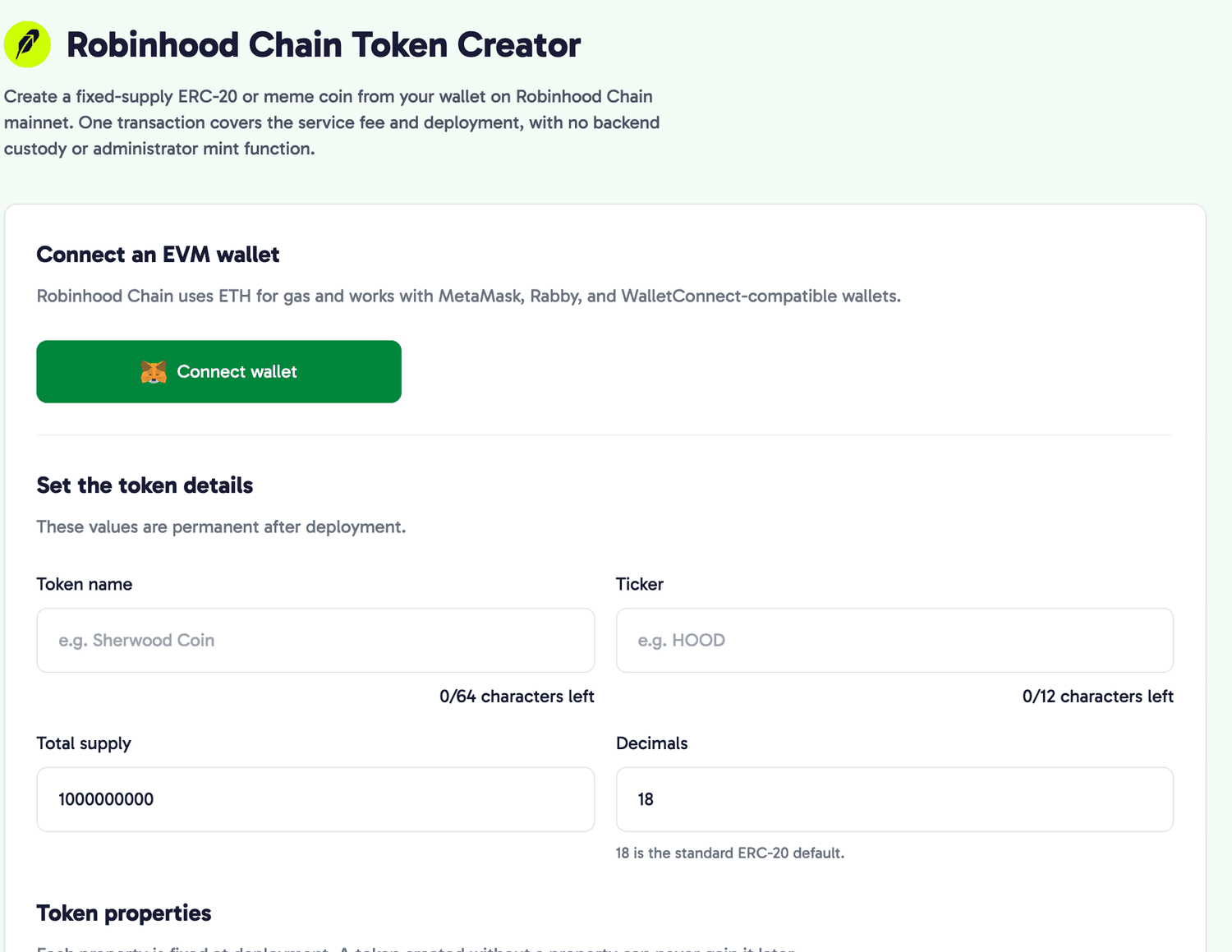
2. Open the Robinhood Chain token creator and connect any EVM wallet — MetaMask, Rabby, anything WalletConnect-compatible. The form reads the current fee from the live contract, so the total you see is the total you sign.
3. Fill in the four fields — name, ticker, supply, decimals — using the defaults table above.
4. Toggle powers only if the design needs them. On the Alchemii template: burnable, mintable, pausable at +0.01 ETH each; a transfer fee capped at 25% permanently and trading limits, both free; deflation at +0.015 ETH. The cost breakdown prices every combination.
5. Sign once. The fee and the deployment settle in the same transaction — it reverts as a unit, so you cannot pay and receive nothing. The full supply mints to your wallet.
6. Rehearse first if this is your first deploy. 10 Coin Lab runs the same flow free on testnet, and its mainnet standard token is 0.005 ETH — the two tools are compared honestly in our creator ranking.
Route two: write and deploy it yourself
On a permissionless EVM chain, no tool is required — and for a developer, the direct route is genuinely cheap: gas is the only cost, and a minimal ERC-20 deploys in the same range as the factory's 564,315-gas fixed-supply create (a configurable factory token used 1,586,188), so budget well under a dollar at our August 30 reading. What you take on instead is the correctness burden: no template, no cap enforced by someone else's tested constructor, and every bug shipped is yours forever.
A minimal fixed-supply token with Foundry and OpenZeppelin:
forge init my-token && cd my-token
forge install OpenZeppelin/openzeppelin-contracts
echo '@openzeppelin/=lib/openzeppelin-contracts/' > remappings.txt
// SPDX-License-Identifier: MIT
pragma solidity ^0.8.24;

import {ERC20} from "@openzeppelin/contracts/token/ERC20/ERC20.sol";

contract MyToken is ERC20 {
    constructor() ERC20("My Token", "MINE") {
        _mint(msg.sender, 1_000_000_000 * 10 ** decimals());
    }
}
# keystore beats a raw key in your shell history:
cast wallet import deployer --interactive

forge create src/MyToken.sol:MyToken \
  --rpc-url https://rpc.mainnet.chain.robinhood.com \
  --account deployer
No owner, no mint function, nothing to pause: the entire supply mints to the deployer and the contract is inert from then on — which, for trust purposes, is a feature.
Verify the source right away so buyers can read what you shipped:
forge verify-contract <address> src/MyToken.sol:MyToken \
  --verifier blockscout \
  --verifier-url https://robinhoodchain.blockscout.com/api
Remix works too if you prefer a browser: compile there, set MetaMask to chain 4663, and deploy via "Injected Provider." Same result, same gas.
Two honest warnings. First, key handling is the actual risk in this route — use a keystore or hardware wallet, never a raw private key pasted into a command. Second, the moment you go past this minimal contract — fees, reflections, limits — you have entered territory where the factory's tested template is probably safer than your first attempt at the same mechanics; an uncapped owner-settable fee is the classic honeypot, and buyers know to look for it.
Which route fits you
| No-code factory | Write it yourself | |
|---|---|---|
| Cost | 0.005–0.01 ETH fee + ~$1 gas | Gas only — about the factory's 564,315-gas fixed-supply create |
| Time to deployed token | Minutes | An hour if Foundry is new to you |
| Code quality burden | Tested template, verified on Blockscout | Entirely yours — bugs ship forever |
| Advanced mechanics | Fee capped 25%, limits, deflation, reflection — pre-built | Anything you can write — and audit |
| Fee-cap guarantees | Enforced in verified constructor + setter | Only if you write and test them |
| Source verification | Inherited from the verified factory | You run forge verify-contract yourself |
| Key handling risk | Wallet signature only | You manage a deployer key — use a keystore |
| Best for | First launches; tokens needing tested mechanics | Developers; custom behaviour no template offers |
Either way, the chain you are deploying to looks like this
The activity numbers deserve a sentence, because they correct something we ourselves published earlier: this chain is young, but it is not quiet. When we scanned the Uniswap V3 factory's raw PoolCreated logs from genesis on August 31 we counted 424,965 pools all-time — 97,562 of them by July 15, two weeks after launch — and 10 Coin Lab's measurements found 21,016 tokens launched in a single day. The pace has since cooled to roughly 550 new pools a day, but competition for attention arrived before month three. A good token still stands out; an unlaunched one does not.
After the deploy: the step both routes still need
Your token now exists and cannot be bought. No pool, no price, no chart, no route for a DEX aggregator to find. That is not a flaw in either route — it is how ERC-20s work everywhere.
Opening the market means creating a Uniswap V3 pool and seeding it: your token on one side, ETH on the other, and the ratio between the deposits is your opening price. The pool creator does this in one flow and mints the position NFT to your wallet — never let a tool keep it, because whoever holds that NFT can withdraw the liquidity. If you are distributing to a team or community first, the multisender handles the airdrop before trading opens. Follow the Robinhood Chain token airdrop guide to prepare a CSV, budget the recipient fees and verify each batch.
Verify what you deployed — the checklist
- Read your own contract on Blockscout. Verified source, correct supply, correct decimals.
- Import the token into your wallet by address and confirm the balance renders as intended — a decimals mistake shows up here first.
- Send a test transfer to a second wallet you control. Cents of gas buys certainty the basic mechanics work.
- If you enabled powers, read them back. The factory template's fee cap, limits and owner settings are all public getters — confirm they say what you configured. Factory-made examples you can compare against:
0x977c27fcb0511B48724332F3FB8617bb8a716893(plain) and0xe709717b350d78da9ce8c53eb2786d0ba19ce3c4(5% fee + limits).
Limitations
- This guide creates tokens; it does not launch them. Distribution, community and liquidity depth decide outcomes, and none of them live in a deploy transaction.
- The DIY snippet is deliberately minimal. It is a safe fixed-supply token, not a starting point for fee or reflection mechanics — those belong in audited templates or in code you have had reviewed.
- Fees and gas are dated snapshots — August 30, 2026 readings throughout, at $2,418.80 per ETH. Getters are owner-adjustable; your wallet prompt is the binding number.
- Chain-activity figures are point-in-time measurements of a chain that is changing fast; the method to re-run them is in the sections above.
- Nothing here is financial or legal advice, and token contracts are permanent — mistakes ship forever, which is the strongest argument for the testnet rehearsal.
FAQ
How do I create a token on Robinhood Chain?
Connect an EVM wallet to Robinhood Chain, enter your token name, symbol, supply and decimals, review the fee and confirm deployment. Alchemii's standard creation fee is 0.015 ETH plus gas as of September 7, 2026. Developers can also deploy their own ERC-20 with Foundry or Remix for network gas only. For a direct DEX launch, create and fund a separate liquidity pool after deployment.
Do I need to know Solidity to create a Robinhood Chain token?
No. The chain is fully EVM-compatible and permissionless, so factory contracts can deploy a standard ERC-20 on your behalf — you fill in four fields and sign. Solidity becomes worth learning when you need custom behaviour no template offers, and at that point the do-it-yourself route costs only gas.
What does it cost to create a token on Robinhood Chain?
Alchemii charges 0.015 ETH plus gas for a standard token as of September 7, 2026. Optional burnable, mintable and pausable features each add 0.01 ETH; deflation adds 0.015 ETH. A liquidity pool costs a separate 0.01 ETH plus gas and deposits. Other creators' prices and gas figures in this report retain their stated observation dates.
What supply and decimals should my token use?
18 decimals unless you have a specific reason — it is the ERC-20 default and every wallet renders it correctly. Supply depends on the token's job: 1,000,000,000 is the memecoin convention, governance tokens often use 100M, loyalty-point systems often want 0 decimals so nobody holds half a point. The supply number itself does not affect value — only the price per token.
Can I create a token on Robinhood Chain for free?
Mainnet always costs at least gas, so not entirely — but close. Writing and deploying your own contract costs only gas — well under a dollar at our August 30 reading. For a free rehearsal of the whole flow, 10 Coin Lab's testnet mode deploys the same token for nothing on the test network.
How do I verify my token's source code on Blockscout?
For a Foundry deploy, run forge verify-contract with the blockscout verifier pointed at https://robinhoodchain.blockscout.com/api, passing your contract address and compiler settings. Factory-deployed tokens inherit the factory's already-verified source. Verified source is worth the five minutes: it is the first thing a careful buyer checks.
Is my new token tradeable as soon as it exists?
No — on either route. Deployment mints the supply to your wallet but creates no market, no price and no chart. Trading starts when you open and seed a Uniswap V3 liquidity pool against ETH, which is its own transaction and its own decision about your opening price.
References
Sources & references
- Robinhood Chain developer documentation — Robinhood MarketsPermissionless deployment and EVM-compatibility statements; ETH as gas token. (accessed 2026-08-30)
- Connecting to Robinhood Chain — Robinhood MarketsChain ID 4663, public RPC endpoints, Blockscout explorer. (accessed 2026-08-30)
- OpenZeppelin ERC-20 documentation — OpenZeppelinThe base contract the DIY snippet extends — and the audit lineage it inherits. (accessed 2026-08-30)
- Foundry Book — Foundryforge init / install / create / verify-contract — the toolchain in route two. (accessed 2026-08-30)
- Remix IDE documentation — RemixThe browser alternative for the DIY deploy via Injected Provider. (accessed 2026-08-30)
- Alchemii ERC-20 factory — verified source — Blockscout (Robinhood Chain)The factory behind route one; fees re-read from its getters 30 Aug 2026. (accessed 2026-08-30)
- What Is Robinhood Chain? Specs, speed and real data — 10 Coin LabIndependent measurements including the 21,016 tokens-in-one-day figure. (accessed 2026-08-30)
- 10 Coin Lab — Robinhood Chain token creator — 10 Coin LabThe 0.005 ETH standard deploy and free testnet mode referenced in route one. (accessed 2026-08-30)
- Uniswap V3 contracts overview — UniswapPool creation mechanics behind the after-the-deploy section. (accessed 2026-08-30)
- Ethereum price, 30 August 2026 — CoinGecko$2,418.80 — the rate behind the dollar figures. (accessed 2026-08-30)
- Robinhood Chain mainnet launch announcement — Robinhood Markets newsroomJuly 1, 2026 launch date.
- Alchemii launch-data methodology — AlchemiiHow the first-party launch sample behind the author's operator history is defined.
- On-chain readings, 30–31 August 2026 — Public Robinhood Chain RPCeth_gasPrice, block timestamps 10,000 apart, and a chunked from-genesis scan of PoolCreated logs on Uniswap V3 factory 0x1f7d7550B1b028f7571E69A784071F0205FD2EfA (424,965 events, head block 50,557,583).
The two routes converge on the same truth: creating the token is the easy hour, on this chain more than most — a dollar of gas or a $12–$24 fee, four decisions, one signature. Spend the saved time on what the deploy cannot do. Open the token creator if the form route fits, take the meme coin flow if that is the shape of the thing, and in either case open the pool in the same sitting — a token nobody can buy is a database entry, not a coin.
Create your token on Robinhood Chain
Set your ERC-20 name, symbol and supply, then review the options and fee in the creator. Confirm deployment in your wallet. Add a liquidity pool separately when you are ready to open trading.
Related Topics
More guides to token creation and liquidity on Robinhood Chain.
How to Create a Meme Coin on Robinhood Chain (2026 Guide)
Create a meme coin on Robinhood Chain without code: current ETH fees, a shareable meme idea, token setup, liquidity and a practical community launch plan.
How to Airdrop Tokens on Robinhood Chain (Multisender Guide)
Airdrop your ERC-20 to multiple wallets on Robinhood Chain with a token multisender: prepare a CSV, calculate ETH fees, approve batches and verify delivery.
How to Bridge ETH to Robinhood Chain — and What Actually Arrives
Six documented routes onto chain 4663, measured. A 40-quote snapshot of what arrives after fees, the canonical bridge priced at 92,955 gas, and the size below which bridging stops making sense.
How Reflection Tokens Work — and What Breaks Them in a Pool
Reflection tokens pay holders by changing one rate, not by looping over wallets. The on-chain mechanics, the permanent 25% ceiling, and a forked-mainnet test showing why an un-exempted DEX pool turns sells into reverts.
Best Robinhood Coin Creator in 2026: Only Two Pass Verification
We checked every Robinhood Chain coin creator we could find against the chain itself. Two are verifiable — here are their live fees, tools and trade-offs.
How Much Does It Cost to Create a Token on Robinhood Chain?
Every cost of creating a Robinhood Chain token, measured on mainnet: service fees read from live contracts, gas at two dated readings, and the pool.