How Reflection Tokens Work — and What Breaks Them in a Pool
Reflection tokens pay holders by changing one rate, not by looping over wallets. The on-chain mechanics, the permanent 25% ceiling, and a forked-mainnet test showing why an un-exempted DEX pool turns sells into reverts.

Ready to create on Robinhood Chain? Review your ERC-20 settings and fee before signing.
A reflection token is an ERC-20 that takes a percentage of each taxed transfer and credits it to every holder at once, by shrinking the total of a second internal accounting unit rather than by sending anyone a transaction. Because balanceOf is computed as a division against that unit, every remaining holder's balance simply reads higher the moment a fee is collected — nothing is minted, nothing is claimed, and the gas cost does not grow with the number of holders. The pattern comes from reflect.finance's RFI contract in late 2020 and the SafeMoon wave that popularised it through 2021, and the two things that decide whether it works in practice are both configuration, not code: the fee ceiling you launch under, and whether your liquidity pool is excluded from the mechanism.
This article uses one reflection token we deployed to Robinhood Chain mainnet on 26 August 2026 and one forked-mainnet experiment against the live Uniswap V3 factory there. Every balance is a getter reading, every gas figure comes off a receipt, and both the transaction hashes and the fork block are printed so you can re-run all of it.
The mechanism: a rate change, not a payment
The naive way to pay every holder is to loop over them. That cannot ship: the loop's gas grows with the holder count, so the token gets more expensive to use as it gets more popular, and eventually transfers stop fitting in a block.
Reflection tokens solve it with two ledgers. Each account has an rOwned balance in a large internal unit, and the contract tracks _rTotal for that unit against _tTotal, the real token supply. The rate is simply _rTotal / _tTotal, and:
balanceOf(account) = rOwned[account] / rate
When a taxed transfer happens, the reflected share is subtracted from _rTotal and never credited to an address. The rate drops, so the same rOwned now divides into more tokens — for everyone, simultaneously, in one storage write. That is the whole trick. The relevant three lines of _transfer read:
if (v.rFee > 0) {
    _rTotal -= v.rFee;
    _tFeeTotal += v.tFee;
}
Two consequences follow immediately, and both are worth knowing before you launch one:
- Balances are derived, not stored. A holder's number moves without any transaction touching their account, which is exactly why block explorers and portfolio trackers sometimes disagree about a reflection token's balance history. There is no
Transferevent for the reflection, because no transfer happened. - Exclusions cost gas. Accounts excluded from rewards (a pool, a locker, a bridge) have to be carved out of both supplies before the rate can be computed, which means walking a list on every
balanceOf. The template caps that list at 50 addresses (MAX_EXCLUDED). That constant is a gas ceiling, not a policy — but it is a hard limit on how many pairs and contracts you can carve out over the token's life.
What one real deployment shows
On 26 August 2026 we deployed a reflection token to Robinhood Chain mainnet — RSMOKE, at 0x4d13fc75…388c5 — with a 5% reflection share and a 2% fee-wallet share. Its whole life is five transactions, and the interesting thing about it is that all of it is still readable.
| Block | Call | What moved | Taxed? | Reading afterwards |
|---|---|---|---|---|
| 46,299,482 | createReflectionToken | 1,000,000 RSMOKE minted to the deployer | — | totalSupply() = 1,000,000 |
| 46,299,595 | transfer | 10,000 to 0x1111…1111 | No — sender is fee-exempt | totalReflected() = 0 |
| 46,299,744 | setFeeExemption(owner, false) | Nothing moves; the deployer loses its exemption | — | isExcludedFromFee(owner) = false |
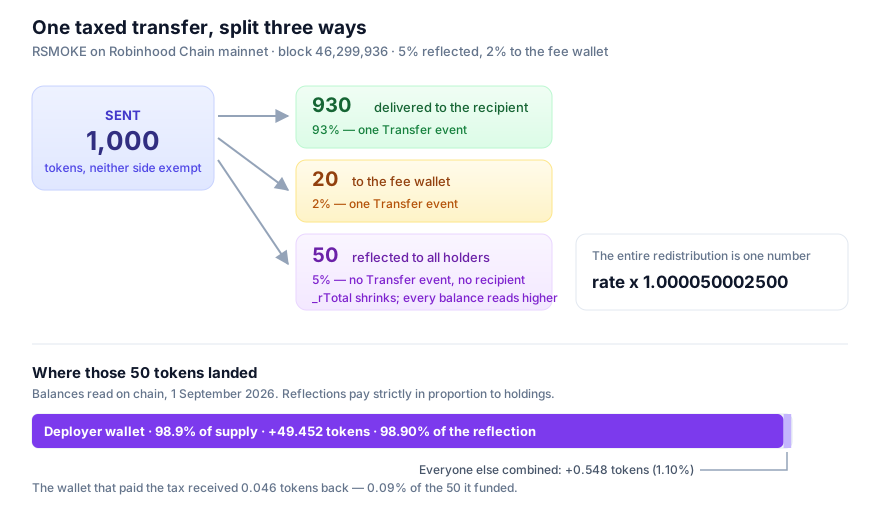
| 46,299,936 | transfer | 1,000 sent → 930 delivered, 20 to the fee wallet, 50 reflected | Yes — neither side exempt | totalReflected() = 50 |
| 46,300,130 | setFeeExemption(owner, true) | Nothing moves; the exemption is restored | — | isExcludedFromFee(owner) = true |
Note the third row. To produce a taxed transfer at all we had to remove the deployer's own fee exemption, because the constructor exempts the creator on purpose: taxing the transfers that seed a pool or fund an airdrop would misprice the launch before anyone has traded. takeFee requires that neither side of a transfer be exempt.
The taxed transfer moved 1,000 tokens and split them into 930 delivered, 20 to the fee wallet, and 50 reflected. totalReflected() on the live token still reads exactly 50 tokens.
Who actually received the 50
The reflection raised the rate by a factor of 1.000050002500 — that is 1,000,000 divided by the 999,950 tokens held by participating accounts at that moment. Multiply every pre-reflection balance by it and you get the current on-chain balances to the last of 18 decimals:
| Holder | Balance before | Balance now (on-chain) | Gained | Share of the 50 reflected |
|---|---|---|---|---|
| Deployer 0x68253486…A2de | 989,000 | 989,049.452472623631181559 | +49.452472624 | 98.90% |
| Holder 0x1111…1111 | 10,000 | 10,000.500025001250062503 | +0.500025001 | 1.00% |
| Buyer 0x2222…2222 | 930 | 930.046502325116255812 | +0.046502325 | 0.09% |
| Fee wallet 0xf05FCB23…5919 | 20 | 20.001000050002500125 | +0.001000050 | 0.00% |
| Total | 999,950 | 1,000,000 | +50 | 100% |
This is the part most reflection-token marketing does not say out loud. Reflections pay in proportion to holdings, so the largest holder collects almost all of them. Our deployer wallet still held 98.9% of supply, so it took 98.90% of the redistribution — 49.45 tokens out of 50 — while the wallet that actually paid the tax received 0.046 tokens, or 0.09% of what it paid.
Nothing here is a flaw in the contract; it is arithmetic, and every reflection token that has ever shipped behaves this way. But it reframes the pitch. "Holders earn on every transaction" is true and describes a mechanism whose payout schedule is identical to holding a percentage of supply. If your token launches with a large team or treasury allocation that stays in the reward set, the reflection is mostly a transfer from traders to that allocation. Excluding your own wallets from rewards is the one-line fix, and it is worth deciding before launch rather than after somebody graphs it.
The pool problem, tested rather than assumed
A reflection token is a fee-on-transfer token, and fee-on-transfer tokens have a long history of not working in AMM pools. Robinhood Chain's DEX liquidity — including the pools our own liquidity tooling creates — runs on Uniswap V3, so I wanted a measurement rather than an opinion.
The experiment: fork chain 4663 at block 51,787,000, deploy a fresh copy of the same reflection contract with the same 5% / 2% split, create a real pool through the live V3 factory at 0x1f7d7550…2EfA against WETH9 0x0Bd7D308…AD73, seed it with full-range liquidity, then trade against it from a wallet that is not fee-exempt.
| Scenario | Pool fee-exempt? | Result | Who ends up with the tax |
|---|---|---|---|
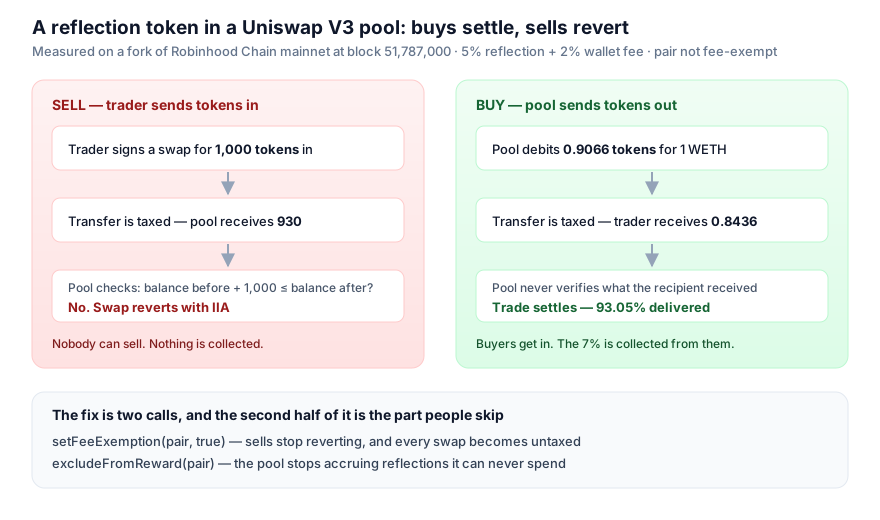
| Sell: trader sends 1,000 tokens into the pool | No | Swap reverts — Uniswap V3 raises `IIA` | Nobody. The trade does not happen |
| Buy: trader sends 1 WETH into the pool | No | Succeeds. Pool debits 0.9066 tokens, trader receives 0.8436 (93.05%) | 5% reflected to holders, 2% to the fee wallet |
| Sell, after excluding the pool from fees | Yes | Succeeds | Nobody — `totalReflected()` does not move |
| Any taxed transfer while the pool still earns rewards | n/a | Pool's token balance grows on its own | The pool, which cannot spend it |
The first two rows are the finding. The sell reverts and the buy does not.
A V3 pool verifies, after calling back to the swapper, that its own balance actually rose by the amount it was promised. A taxed transfer into the pool delivers 93%, the check fails, and the pool raises IIA — insufficient input amount. Meanwhile a buy is a transfer out of the pool, and the pool never verifies what the recipient received, so the trade settles with the buyer quietly receiving 93.05% of what the pool debited. Buys work, sells revert: that is the on-chain signature every trader is taught to read as a honeypot, and here it is produced by nothing more sinister than launching a reflection token and forgetting to configure the pair.
Two switches fix it, and they are separate calls:
setFeeExemption(pair, true)— swaps stop being taxed, so the pool's balance check passes and the token trades normally.excludeFromReward(pair)— the pool stops accruing reflections. Skip this one and, as the last row of the table shows, the pair's token balance grows on its own with every taxed transfer elsewhere in the supply. A pool cannot spend a reflection; the tokens just sit on the reserve side, and every holder who "earned" them earned a slightly smaller share instead.
Both calls are owner-only functions on the token, and — being straight about our own product — neither is in Alchemii's create or pool flow today. You make them from the token's write tab on Blockscout or from cast send against your own contract. That is a gap in our tooling, not a property of reflection tokens, and it is the single most likely way a reflection launch goes wrong: the create flow succeeds, the pool flow succeeds, and the token is one-way until somebody makes a call neither screen mentions.
And then the honest conclusion, which is the thing I would want to know before paying for a reflection deploy: once the pair is fee-exempt, no swap pays the tax. The reflection applies to wallet-to-wallet transfers only. If your economic model assumed a 5% cut of trading volume, on a V3 venue that model does not exist — you get a cut of transfers between holders, which on most memecoins is a small fraction of on-chain activity.
Two limits of this experiment, stated so you can weigh it: we swapped directly against the pool contract, so a production router adds at least one more taxed hop and its own accounting checks, meaning "buys work" is the best case rather than a guarantee. And this is V3 behaviour specifically; the older V2-style routers ship explicit supportingFeeOnTransferTokens paths, which is why fee-on-transfer tokens felt workable in 2021 and feel broken now.
The 25% ceiling: what it guarantees, and what it does not
The template's combined fee is capped at 2,500 basis points, and the cap is enforced in three places: the constructor reverts above it, setFees reverts above it, and there is no setter for the constant itself. Our contract test asserts both halves of that — a constructor above the ceiling fails, setFees(2_400, 101) fails, and setFees(2_300, 200) succeeds.
That last one is the part to read carefully. The ceiling is permanent; the fee underneath it is not. An owner who launches at 5% can move to 25% in one transaction. This is a real and reasonable design choice — a token that needs to lower its tax also needs a setter — but it means the trust question is not "what is the fee?" It is:
taxFeeBps()andwalletFeeBps()— today's split.- The
FeesUpdatedevent log — every change ever made, in order. owner()— whether anyone can still make one. Ownership here isOwnable2Step, so a transfer requires the recipient to accept, and renouncing is what actually retires the risk.
For contrast, the honeypot design this ceiling exists to prevent is an uncapped, owner-mutable transfer fee: launch at 3%, wait for buyers, set it to 99%, and nobody can sell. A permanent ceiling written into the bytecode is the difference between "trust me" and "check it" — which is also why we publish the factory addresses rather than a screenshot of them.
Why it is a separate contract, not a checkbox
On the standard Robinhood Chain token creator, transfer fees, deflation, mint, pause and trading limits are toggles on one configurable template. Reflection is not one of them, for two reasons.
The mechanical one: reflection's balance accounting is incompatible with the limit features. Max-wallet and max-transaction checks compare a stored number against a threshold, but under reflection a wallet's balance grows on its own between transfers — so a holder can cross a max-wallet limit having done nothing at all, and a token that can trap its own holders is worse than a token without limits. The two feature sets are mutually exclusive in the form for the same reason they are separate on chain.
The unglamorous one: the main factory's Feature enum is immutable on chain. Adding reflection as a seventh feature would have meant redeploying the live factory and migrating the addresses every published article cites. A second factory at 0xad440a5a…07071e was the cheaper honest answer.
What we deliberately left out of the template is worth listing too, because in this lineage the omissions are the safety feature:
- No swap-and-liquify. The auto-liquidity machinery that converts collected fees into LP is where most of the audited incidents in the SafeMoon lineage live — reentrancy during the swap, sandwichable internal trades, fee-on-fee recursion. Liquidity belongs in separate tooling you trigger deliberately.
- No mint. Fixed supply, set in the constructor.
- No pause, no burn hook. Both are powers a buyer can read, and neither is needed for reflection to work.
What it costs, with the numbers dated
| Line | Reading | Gas used | Source |
|---|---|---|---|
| Reflection token, service fee | 0.025 ETH (~$61.17) | — | creationFee() on 0xad440a5a…07071e, block 51,783,073 |
| Standard fixed-supply token, service fee | 0.01 ETH (~$24.47) | — | creationFee() on 0x6b6D348F…5c0Ac |
| Reflection deployment, gas | 0.0000365 ETH (~$0.09) | 1,400,071 | tx 0xb65185d6…14b7, 26 Aug 2026, 0.026036 gwei |
| Configurable token deployment, gas | 0.0000414 ETH (~$0.10) | 1,586,188 | tx 0x397d0dee…d5f34, createConfigurableToken |
| Fixed-supply deployment, gas | 0.0000147 ETH (~$0.04) | 564,315 | tx 0xb1d81169…0812e, createToken |
| Same reflection deployment at 1 Sep gas price | 0.000833 ETH (~$2.04) | 1,400,071 | 0.594798 gwei, eth_gasPrice, 1 Sep 2026 |
Three things in that table deserve to be said plainly rather than buried:
The reflection template costs 2.5x a plain token — 0.025 ETH against 0.01 ETH. If you want a token and not a mechanism, the standard factory is the cheaper product, and 10 Coin Lab's plain deploy is cheaper still; our Robinhood Chain creator comparison scores that honestly.
The transaction we cite paid 0.0001 ETH, not 0.025. Our deployer wallet is whitelisted for the discounted fee, so the receipt shows a price no public user pays. The public number is the one from creationFee(), and it is in the table.
Gas is a rounding error, but it moves an order of magnitude. The same 1,400,071-gas deployment cost $0.09 at the 0.026 gwei the chain ran on 26 August and would cost about $2.04 at the 0.5948 gwei we read on 1 September. Interestingly, reflection deploys cheaper than the configurable template (1,400,071 against 1,586,188 gas) — it is a smaller contract once you drop the toggles.
When a reflection token is the wrong choice
Written as a filter, because most projects that ask for reflection want something else:
- You want a cut of trading volume. On a V3 venue you cannot have it, per the experiment above. What you can have is a creator fee on a launchpad — the Pons bonding curve takes a fee on every curve trade by design.
- You plan a CEX listing. Fee-on-transfer tokens are routinely rejected or require bespoke integration work, because exchange internal transfers arrive short.
- You want holders to be paid in something other than your own token. Reflection pays in the token itself. A dividend in ETH or a stablecoin is a different contract with a claim function and a different risk surface.
- Your allocation is large and stays in the reward set. Then the mechanism mostly pays you, which is fine as a decision and corrosive as a surprise.
- You are on Solana. SPL Token has no fee-on-transfer; the equivalent is the Token-2022 transfer-fee extension, with its own compatibility trade-offs — see SPL Token vs Token-2022.
Reflection is the right pick when you want a visible, permanent, contract-enforced reason for holders to hold rather than rotate, you accept that it taxes transfers rather than trades, and you would rather have a 25%-capped mechanism in an audited-shape template than a bespoke one nobody has read.
Launch checklist for a reflection token
- Decide the split before you deploy. Reflection share and wallet share are constructor arguments; the fee wallet must exist if the wallet share is above zero.
- Create the pool, then immediately exempt and exclude the pair. Two owner-only calls on the token —
setFeeExemption(pair, true)andexcludeFromReward(pair)— made from Blockscout's write tab orcast, because no UI carries them yet. Do it in the same sitting as the pool, and test one buy and one sell from a wallet that is not exempt before you announce anything. - Exclude every other contract that holds tokens — lockers, bridges, vesting — remembering the 50-address cap.
- Decide what happens to the owner key. A live owner can move the fee under the ceiling. Renouncing ownership is the strongest signal available on this template; keeping it is defensible if you say so and say why.
- Publish the addresses and the getters.
taxFeeBps(),walletFeeBps(),totalReflected()and theFeesUpdatedlog turn every claim you make into something a buyer can check in a block explorer, which is the only kind of claim that survives contact with a skeptical trader. - Seed real liquidity. Reflection changes nothing about the fact that a thin pool reads as a rug setup — see the launch cost breakdown for what "credible" costs on this chain.
Reproducing the pool experiment
Everything in the pool section is a Foundry test against a pinned fork, so it is deterministic:
- Fork: chain 4663 (
https://rpc.mainnet.chain.robinhood.com) at block 51,787,000. - Contracts: V3 factory
0x1f7d7550B1b028f7571E69A784071F0205FD2EfA, WETH90x0Bd7D308f8E1639FAb988df18A8011f41EAcAD73, fee tier 3000 (tick spacing 60), full range ticks ±887,220, pool initialised at 1:1. - Token: fresh
AlchemiiReflectionToken, 1,000,000 supply,taxFeeBps = 500,walletFeeBps = 200. - Sequence: seed liquidity from the exempt creator wallet → sell 1,000 tokens from a non-exempt wallet (expect
IIA) → buy with 1 WETH (expect success, measure delivered share) →setFeeExemption(pair, true)→ sell again (expect success, expecttotalReflected()unchanged).
The measured buy: pool debited 0.906610481671849151 tokens, trader received 0.843601474996393133 — 9,305 basis points, which is the 9,300 the fee schedule predicts plus the buyer's own five-basis-point share of the reflection it had just funded.
FAQ
How do reflection tokens work?
A reflection token takes a percentage of each taxed transfer and credits it to every holder without sending anyone a transaction. Balances are stored in a second internal unit; collecting a fee shrinks the total of that unit, which raises the token value of every remaining balance at once. Nothing is minted, nothing is claimed, and the cost does not grow with the holder count.
Do reflection tokens work in a Uniswap V3 pool?
Not without configuration. In our forked-mainnet test, a sell into an un-exempted pool reverted with the pool's IIA error because a taxed transfer delivers the pool less than it asked for. Marking the pair fee-exempt makes trading work — and switches the tax off for swaps. On a V3 venue, treat reflection as a wallet-to-wallet mechanic.
What is the highest fee a reflection token can charge?
On this template, 25% combined. MAX_TOTAL_FEE_BPS is 2,500 basis points, checked in the constructor and in the setter, with no way to raise the constant. Under that ceiling the owner can still change the split, so read the FeesUpdated log and the owner() address, not just the current fee.
Who earns the most from reflections?
Whoever already holds the most, exactly in proportion to balance. On our mainnet token, one taxed transfer reflected 50 tokens and 49.45 of them — 98.90% — went to the deployer wallet holding 98.9% of supply. The wallet that paid the tax got 0.09% back.
Do I need to exclude the liquidity pool from reflections?
Yes, and it is a separate call from the fee exemption. setFeeExemption keeps swaps from reverting; excludeFromReward keeps the pair from accruing reflections it can never spend. Both, on every pair, before you announce.
Is a reflection token the same as a tax token?
They overlap. A tax token routes the fee to a wallet; a reflection token routes it to holders. This template does both in one transfer, with two independently settable shares — so "5% reflection plus 2% to the treasury" is one configuration, not two contracts.
Can the fee be raised after launch?
On this template, yes, up to the permanent 25% total, and every change emits FeesUpdated. A live owner key with a raiseable fee is a standing risk even when today's reading is 5% — which is why the strongest version of this token is one whose owner has renounced.
References
Everything above, and where to re-read it
- AlchemiiReflectionToken — RSMOKE, 0x4d13fc75…388c5 — Blockscout (Robinhood Chain)The token every ledger and balance figure in this article comes from. taxFeeBps(), walletFeeBps(), totalReflected() and balanceOf() are all public getters. (accessed 1 September 2026)
- AlchemiiReflectionFactory — 0xad440a5a…07071e — Blockscout (Robinhood Chain)creationFee() read at 0.025 ETH and discountedCreationFee() at 0.0001 ETH, block 51,783,073. (accessed 1 September 2026)
- Deployment transaction 0xb65185d6…14b7 — Blockscout (Robinhood Chain)1,400,071 gas at 0.026036 gwei, 26 August 2026 04:25:26 UTC. The 0.0001 ETH value on this transaction is the whitelisted-deployer fee, not the public price. (accessed 1 September 2026)
- reflect.finance (RFI) — the first reflection ERC-20, deployed late 2020 — Origin of the patternThe rOwned / _rTotal design in this contract descends from RFI; the 2021 SafeMoon wave popularised it. Deliberately cited without a link: several addresses circulate as "the" RFI token and we have not verified which is canonical.
- Uniswap V3 core — swap() and the input-amount check — Uniswap documentationThe balance check after the swap callback is what raises IIA when a fee-on-transfer token delivers the pool less than it asked for. (accessed 1 September 2026)
- Alchemii launch-data methodology — AlchemiiDefinitions and limits of the 47-token first-party sample and the 50,000-launch observational sample cited elsewhere on the site. (accessed 1 September 2026)
- ETH-USD spot price — Coinbase$2,446.855 at 14:23 UTC on 1 September 2026. Every dollar figure in this article uses this one reading. (accessed 1 September 2026)
Reflection is one of the few token mechanics whose entire behaviour is legible from public getters, which makes it a good test of whether a project wants to be checked. If you are launching one, publish the pair exclusions along with the contract address — and if you are buying one, place a 1-token sell before you place a real buy.
Deploy a reflection token on Robinhood Chain → — the reflection template, its 25% ceiling and the exclusion calls are all in the same flow, and the factory source is verified on Blockscout before you sign anything.
Create your token on Robinhood Chain
Set your ERC-20 name, symbol and supply, then review the options and fee in the creator. Confirm deployment in your wallet. Add a liquidity pool separately when you are ready to open trading.
Related Topics
More guides to token creation and liquidity on Robinhood Chain.
How to Bridge ETH to Robinhood Chain — and What Actually Arrives
Six documented routes onto chain 4663, measured. A 40-quote snapshot of what arrives after fees, the canonical bridge priced at 92,955 gas, and the size below which bridging stops making sense.
Best Robinhood Coin Creator in 2026: Only Two Pass Verification
We checked every Robinhood Chain coin creator we could find against the chain itself. Two are verifiable — here are their live fees, tools and trade-offs.
How Much Does It Cost to Create a Token on Robinhood Chain?
Every cost of creating a Robinhood Chain token, measured on mainnet: service fees read from live contracts, gas at two dated readings, and the pool.
How to Create a Token on Robinhood Chain (Code or No-Code)
Both routes to a Robinhood Chain ERC-20, tested on mainnet: the no-code factory path and the Foundry deploy, with real costs and the pool step after.
What Is Robinhood Chain? Mainnet, RPC & Token Creation (2026)
Robinhood Chain mainnet explained: chain ID 4663, ETH gas, wallet setup, bridge timing and how to create an ERC-20. Checked September 6, 2026.
How to Create a Meme Coin on Robinhood Chain (2026 Guide)
Create a meme coin on Robinhood Chain without code: current ETH fees, a shareable meme idea, token setup, liquidity and a practical community launch plan.