How Much Does It Cost to Create a Token on Robinhood Chain?
Every cost of creating a Robinhood Chain token, measured on mainnet: service fees read from live contracts, gas at two dated readings, and the pool.

Ready to create on Robinhood Chain? Review your ERC-20 settings and fee before signing.
Fee update — September 7, 2026: Alchemii’s standard token creation fee is now 0.015 ETH plus gas. Add-on prices are unchanged; pool creation remains 0.01 ETH, with deposits and gas separate. View the on-chain fee update. The older comparisons and gas measurements below retain their stated observation dates.
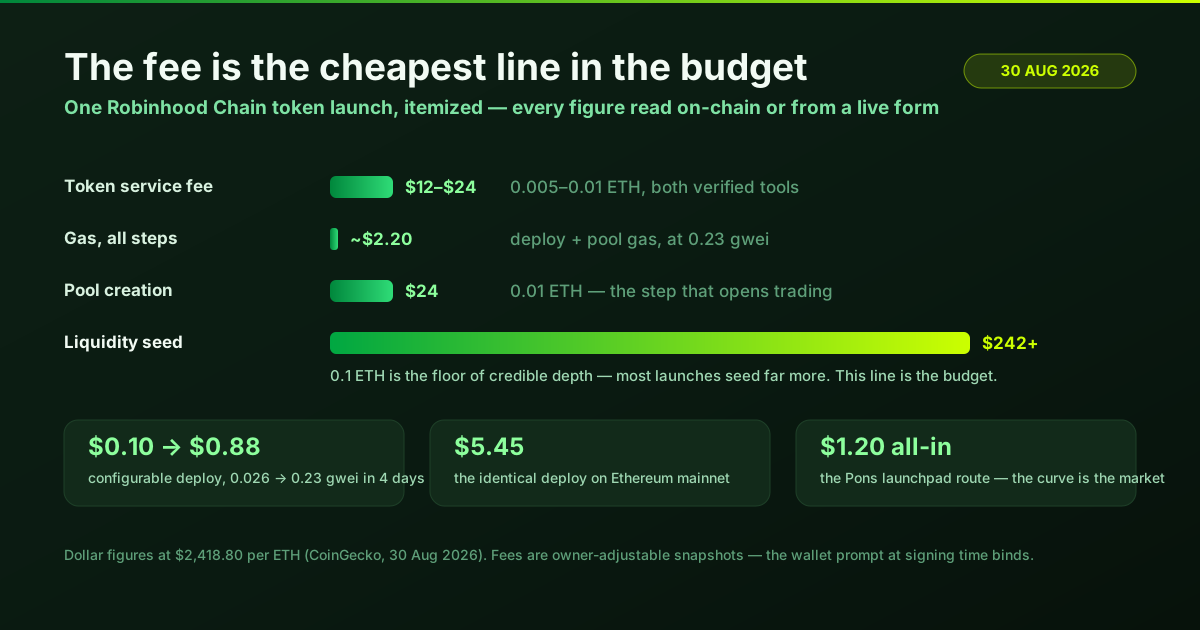
Ask how much it costs to create a token on Robinhood Chain and you will get three different honest answers, because there are three different budgets hiding in the question. The token: $13 to $25 all-in. The market — the thing that lets anyone buy the token: one more fee, plus liquidity that starts around a few hundred dollars for anything credible. The launch — the thing where people actually show up: mostly not money at all, but distribution work no fee schedule captures.
Most cost guides answer only the first question and let you discover the other two after you have already deployed. This one prices all three, with every number read off the chain or a live page on August 30, 2026, and dollar figures at that day's $2,418.80 ETH price from CoinGecko.
Quick Facts
| What | Reading | How we know |
|---|---|---|
| Standard token, service fee | 0.005 ETH (10 Coin Lab) / 0.01 ETH (Alchemii) | Live form + creationFee(), 30 Aug 2026 |
| Gas per deployment | 564,315–1,586,188 gas ≈ $0.04–$0.88 | Two real deployments (fixed-supply, configurable); two dated gas readings |
| Robinhood Chain gas price | 0.026 gwei (26 Aug) → 0.23 gwei (30 Aug) | eth_gasPrice, both dates |
| Ethereum mainnet, same configurable deploy | ~0.00225 ETH ≈ $5.45 | 1.42 gwei mainnet reading, 30 Aug 2026 |
| Pool creation | 0.01 ETH + ~0.0004 ETH gas | Live tool + measured pool transaction |
| Launchpad alternative (Pons) | 0.0005 ETH, tradeable from block one | Pons factory config, explained here |
| Free option | Testnet only (10 Coin Lab) | Live site, 30 Aug 2026 |
| ETH price used for $ figures | $2,418.80 | CoinGecko, 30 Aug 2026 |
Budget one: the token itself
| Route to a token | Service fee | Gas | What you get |
|---|---|---|---|
| 10 Coin Lab — standard token | 0.005 ETH (~$12) | ~$0.14–$1.20 | Fixed-supply ERC-20, custom decimals, supply to your wallet |
| Alchemii — plain token | 0.01 ETH (~$24) | ~$0.14–$1.20 | Fixed-supply ERC-20, no owner powers, atomic fee |
| + Burnable / Mintable / Pausable | +0.01 ETH each | included | Optional owner powers, permanent at deployment |
| + Transfer fee / Trading limits | free toggles | included | Tax capped at 25% permanently; anti-whale caps |
| + Deflation | +0.015 ETH (~$36) | included | Burns part of each collected fee as the token trades |
| Reflection template | 0.025 ETH (~$60) | ~$0.19–$1.70 | Holders earn a share of every taxed transfer, no claiming |
| Write the Solidity yourself | none | under ~$1 — lighter deploy | Full control, your own audit burden — a tool is not required |
| Pons launchpad (different product) | 0.0005 ETH (~$1.20) | cents | Curve-priced token, tradeable from block one, fixed rules |
Two structural things the table cannot show:
The fee is atomic on the Alchemii factory. One transaction pays the service fee and deploys the contract, and the whole thing reverts together — you cannot pay and receive nothing. That is a property in the verified source of 0x6b6D…c0Ac, not a support promise.
Every fee here is a snapshot of an owner-adjustable getter. We read these numbers on August 30, 2026. The create form reads them again from the contract immediately before you sign, and the wallet prompt is the binding figure. If a page and a prompt ever disagree, believe the prompt.
If you only need one standard fixed-supply token and nothing after it, 10 Coin Lab's 0.005 ETH deploy is the cheapest verified route we know of, and we say so plainly even though the alternative is our own tool — the full comparison is in our best Robinhood coin creator ranking.
Gas: measured twice, four days apart
Gas deserves its own section only because the intuition people import from Ethereum mainnet is wrong here in a useful way.
Our two real deployments burned 564,315 gas for a fixed-supply token and 1,586,188 gas for a configurable one with a 5% fee and limits — the execution weight of a factory deploying and initializing a fresh ERC-20 and collecting its fee. On August 26 the chain priced gas at 0.026 gwei, which made those receipts 0.0000148 ETH and 0.0000414 ETH: four and ten cents. When we re-read the chain for this article on August 30, gas stood at 0.23 gwei — nine times higher — and the same deployments price near 0.00013 ETH and 0.000365 ETH: about $0.31 and $0.88.
Both readings teach the same lesson from different directions. Gas on this chain fluctuates by an order of magnitude with load, and it does not matter for your budget, because even the expensive reading is a tenth of the cheapest service fee. Compare Ethereum mainnet the same day: 1.42 gwei, so the identical configurable deployment would burn about 0.00225 ETH — $5.45. Cheaper than mainnet by roughly 6x, and still the smallest line in any real launch plan.
Budget two: the market
A deployed token cannot be bought. Not "is hard to buy" — cannot. There is no price, no chart, and no venue until a Uniswap V3 liquidity pool exists for it, and creating that pool is where the real money enters the picture.
The pool step itself is priced like the token step: 0.01 ETH service fee on the pool creator, plus gas we measured around 0.0004 ETH. The position NFT — the ownership record of your liquidity — mints to your own wallet, which is the custody property to demand from any pool tool.
What the fee schedule cannot price is the deposit. You seed the pool with your token on one side and ETH on the other, and the ratio is your opening price. That ETH:
- is locked in a volatile pair — you can withdraw it (unless you burn the LP), but while it sits there it is exposed to every swing,
- is visible to everyone — a pool holding 0.05 ETH of depth tells every trader that one modest sell empties it, and
- scales the launch you can credibly claim. Thin liquidity is the single most common self-inflicted wound we see in new launches.
The tiers above are planning scenarios, not measurements — the fee lines inside them are measured, the seed amounts are judgment calls you should resize to your own risk tolerance. What does not resize is the ordering: in every tier, liquidity outweighs every fee combined.
The 0.0005 ETH alternative: skip the pool entirely
There is one route where the market comes built in. Pons, the bonding-curve launchpad on Robinhood Chain, creates a token for a 0.0005 ETH launch fee — about $1.20 — and the curve itself is the liquidity: your coin is tradeable from block one with no pool to fund.
The price of skipping the pool is control. Every Pons token gets the same fixed 1,000,000,000 supply, every trade pays the curve's 1% fee, and when 4.2 ETH of real reserves accumulate the token graduates to a locked pool — liquidity you never own. And graduation is rare: 10 Coin Lab's launchpad data puts it at roughly 1.3% of launches, and our own earlier first-days reading on Pons was lower still at 0.74%. Cheap entry, fixed rules, long odds — which is exactly the honest description of every bonding-curve launchpad on every chain. Our meme coin guide walks the decision between the two routes properly; the Pons tooling page is where to start if the curve fits.
Costs people forget to budget
Getting ETH onto the chain. Robinhood Chain uses ETH for gas, but it must be ETH on chain 4663 — mainnet ETH does not spend here. Bridging costs a little gas on the origin chain and takes minutes; the bridge page covers the flow and our measured route comparison prices it — 0.85% through the fast route against about three cents of gas through the canonical bridge. Budget the origin-chain gas and the round trip time, not just the amount.
Failed transactions. Nearly free here — a failed transaction costs its gas, and gas is cents. This is a real difference from congested chains where failures during a hot launch quietly eat a budget.
Optional powers you did not need. Burnable, mintable and pausable cost +0.01 ETH each on the Alchemii template, and mintable or pausable can also cost you buyers, because both are visible on chain and experienced traders price them as risk. The cheapest configuration — all toggles off — is usually also the most trusted one.
LP top-ups. If your launch goes well, the first thing you will want is more depth. Money you planned to add calmly beats money you scramble for mid-move.
Marketing and distribution. The fee schedule ends where the actual work begins, and the Robinhood Chain marketing playbook prices that side of the launch. CoinGecko's study of 18.67 million launchpad tokens found 68.67% stopped trading on launch day — tooling was never the constraint. No line item fixes distribution.
How Robinhood Chain costs compare to other chains
On Solana, our measured all-in figure for a standard token is about 0.22 SOL — a comparable order of magnitude to the $13–$25 here once you convert. On Ethereum mainnet, the same 1,586,188-gas configurable deployment costs about $5.45 of gas at the 1.42 gwei we read on August 30 — but service fees and liquidity dominate there too. On BNB Smart Chain, Alchemii's BSC factory charges a constant 0.05 BNB base fee (about $37 on September 8, 2026), and BSC vs Robinhood Chain reads both EVM creators' fee ladders, tax caps and pool routes the same hour. The honest conclusion cuts against chain-shopping on cost: no major chain's creation cost will make or break a launch budget in 2026. Pick the chain where your buyers and your story are; 10 Coin Lab's three-chain launch comparison measures the same trade-off from the other direction.
Where Robinhood Chain is genuinely distinct is speed and freshness: ~101 ms blocks (we measured 100.9 ms over 10,000 blocks on August 30), Uniswap live since day one, and a two-month-old ecosystem whose discovery culture is still forming — busy, but not yet settled. The full picture is in what is Robinhood Chain.
How to verify every number in this article
- Service fees: call
creationFee()andfeatureFee(0..5)on0x6b6D348F16A4C399b3599Cd7FB0689A849a5c0Acvia the public RPC (https://rpc.mainnet.chain.robinhood.com), or read the total on the create form before signing. For 10 Coin Lab, the form and wallet prompt show the fee directly. - Gas price:
eth_gasPriceagainst the same RPC. Expect it to differ from our readings — that is the point of dating them. - Deployment gas: open any token-creation transaction on Blockscout and read its gas-used field; ours read 564,315 (fixed-supply) and 1,586,188 (configurable).
- ETH price: any live source; we used CoinGecko's $2,418.80 on August 30, 2026. Redo the multiplication with today's price.
Limitations
- Every fee is owner-adjustable and every gas figure is a point-in-time reading. This article is a dated snapshot with a verification recipe, not a permanent price sheet. The wallet prompt at signing time is the only binding number.
- The budget tiers are scenarios, not measurements. Fee lines within them are measured; seed amounts are planning judgment you should resize.
- Dollar figures move with ETH. All conversions use $2,418.80 (August 30, 2026); at a different ETH price, redo the arithmetic — the ETH amounts are the stable claims.
- This prices creation and market-making, not outcomes. Distribution, listings and volume are real costs this article does not attempt to schedule.
- Nothing here is financial or legal advice. Issuing a token, promoting it and earning fee income can create obligations that vary by jurisdiction.
FAQ
How much does it cost to create a token on Robinhood Chain?
Alchemii's standard fixed-supply token creation fee is 0.015 ETH plus gas as of September 7, 2026. Burnable, mintable and pausable each add 0.01 ETH; deflation adds 0.015 ETH. Creating a liquidity pool costs a separate 0.01 ETH plus gas and the token and ETH deposits. The form reads the current fee from the contract before signing.
How much gas does a Robinhood Chain token deployment use?
Our two real mainnet deployments through the Alchemii factory burned 564,315 gas for a fixed-supply token and 1,586,188 gas for a configurable one with a 5% fee and limits. What that costs in ETH moves with the chain's gas price: at the 0.026 gwei we read on August 26 the receipts came to 0.0000148 ETH and 0.0000414 ETH (about $0.04 and $0.10), and at the 0.23 gwei we read on August 30 the same deployments price near 0.00013 ETH and 0.000365 ETH (about $0.31 and $0.88). Either way gas is a rounding error next to the service fee.
Is creating a token cheaper on Robinhood Chain than on Ethereum mainnet?
On gas, yes — by roughly six times at the prices we measured: about $0.88 versus about $5.45 for the same 1,586,188-gas deployment, using same-day readings of 0.23 gwei here and 1.42 gwei on mainnet. Both are small next to service fees and liquidity, so chain choice barely moves the total budget — it moves speed, ecosystem and where your buyers are.
What is the cheapest way to launch a tradeable coin on Robinhood Chain?
The Pons launchpad, at a 0.0005 ETH launch fee — about $1.20. You skip the pool entirely because the bonding curve is the market, and the coin trades from block one. The trade-offs are fixed rules: 1,000,000,000 supply for every token, a 1% fee on every curve trade, and liquidity that locks at graduation, which only about 1.3% of launches reach.
Can I create a Robinhood Chain token for free?
On mainnet, no — every deployment costs gas, so a "free" mainnet creator is recovering costs somewhere less visible. The genuinely free route is 10 Coin Lab's testnet mode, which runs the same create flow on the test network at no cost. Treat it as a rehearsal; testnet tokens cannot carry real value.
How much liquidity should I seed into the pool?
There is no correct universal number, but there is a correct principle: seed what you can afford to leave locked in a volatile pair, and know that thin liquidity is visible to everyone. A pool where one modest buy moves the price 30% reads as a rug setup to experienced traders. The tiers in this article start around 0.1 ETH of seed for a minimum credible pool.
Are there ongoing fees after creation?
None from the tooling — service fees are one-time, with no subscription. Two caveats: fee getters are owner-adjustable, so the signing-time prompt is the binding price, and if you enabled a transfer fee on your token, your holders pay it on every transfer — capped at 25% permanently on the Alchemii template.
References
Sources & references
- Alchemii ERC-20 factory — verified source and live fee getters — Blockscout (Robinhood Chain)creationFee() 0.01 ETH; featureFee: burnable/mintable/pausable 0.01, deflation 0.015, transfer-fee and limits 0. Re-read 30 Aug 2026. (accessed 2026-08-30)
- 10 Coin Lab — Robinhood Chain token creator — 10 Coin LabStandard token 0.005 ETH and free testnet mode, read from the live create form. (accessed 2026-08-30)
- Robinhood Chain vs Base vs Solana: launch costs compared — 10 Coin LabPer its abstract: 101ms vs 316ms vs 2s blocks and live gas for an identical deploy, measured head to head. (accessed 2026-08-30)
- Robinhood Chain developer documentation — Robinhood MarketsETH as gas token, chain ID 4663, permissionless deployment. (accessed 2026-08-30)
- Ethereum price, 30 August 2026 — CoinGecko$2,418.80 — the rate behind every dollar figure in this article. (accessed 2026-08-30)
- The average lifespan of Pump.fun memecoins is less than a day — CoinGecko ResearchThe 68.67% launch-day figure behind the distribution warning.
- Uniswap V3 contracts overview — UniswapPool mechanics: why the two deposit amounts are the opening price. (accessed 2026-08-30)
- OpenZeppelin ERC-20 documentation — OpenZeppelinThe base implementation the priced templates extend. (accessed 2026-08-30)
- Gas and fees — ethereum.orgBackground on gas units versus gas price — the split this article's arithmetic relies on. (accessed 2026-08-30)
- Robinhood Chain mainnet launch announcement — Robinhood Markets newsroomJuly 1, 2026 — the date behind every 'two-month-old chain' framing.
- Robinhood rolls out public blockchain — CoinDeskIndependent coverage of the mainnet rollout.
- Alchemii launch-data methodology — AlchemiiHow the first-party launch sample behind the author's operator history is defined.
The arithmetic of this chain is friendly to small experiments: for less than the price of lunch you can deploy a real token, and for the price of a modest dinner you can give it a real market. What the fees cannot buy is a reason for anyone to care — so spend the $25 quickly, and the saved attention on the launch. Start with the token creator, or the meme coin flow if that is the shape of the thing, and open the pool in the same sitting.
Create your token on Robinhood Chain
Set your ERC-20 name, symbol and supply, then review the options and fee in the creator. Confirm deployment in your wallet. Add a liquidity pool separately when you are ready to open trading.
Related Topics
More guides to token creation and liquidity on Robinhood Chain.
How to Create a Meme Coin on Robinhood Chain (2026 Guide)
Create a meme coin on Robinhood Chain without code: current ETH fees, a shareable meme idea, token setup, liquidity and a practical community launch plan.
How to Market a Robinhood Chain Token (2026 Playbook)
How to market a Robinhood Chain token when buyers hold no ETH on chain 4663 yet: the bridge-to-buy funnel, live launch costs, and what to measure.
BSC vs Robinhood Chain: Where to Launch a Token (2026)
BSC vs Robinhood Chain for a token launch, read on both chains the same hour: 0.05 BNB vs 0.015 ETH fees, 9% vs 25% tax caps, PancakeSwap V2 vs Uniswap V3.
How to Bridge ETH to Robinhood Chain — and What Actually Arrives
Six documented routes onto chain 4663, measured. A 40-quote snapshot of what arrives after fees, the canonical bridge priced at 92,955 gas, and the size below which bridging stops making sense.
How Reflection Tokens Work — and What Breaks Them in a Pool
Reflection tokens pay holders by changing one rate, not by looping over wallets. The on-chain mechanics, the permanent 25% ceiling, and a forked-mainnet test showing why an un-exempted DEX pool turns sells into reverts.
Best Robinhood Coin Creator in 2026: Only Two Pass Verification
We checked every Robinhood Chain coin creator we could find against the chain itself. Two are verifiable — here are their live fees, tools and trade-offs.