How to Market a Robinhood Chain Token (2026 Playbook)
How to market a Robinhood Chain token when buyers hold no ETH on chain 4663 yet: the bridge-to-buy funnel, live launch costs, and what to measure.

Ready to create on Robinhood Chain? Review your ERC-20 settings and fee before signing.
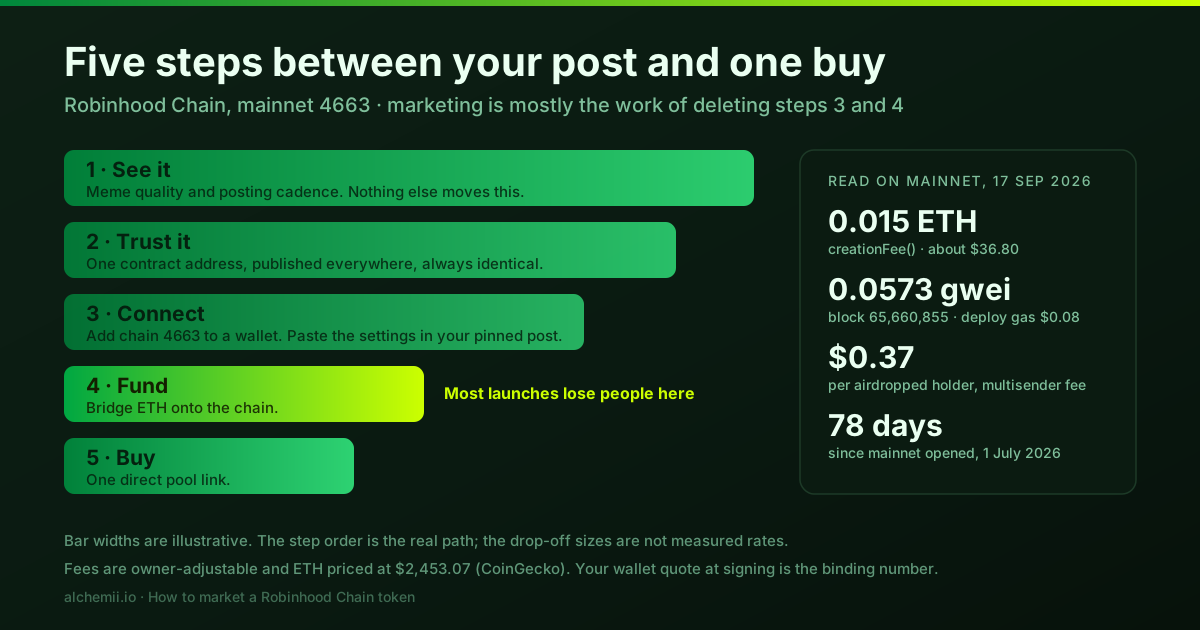
To market a Robinhood Chain token, shorten the distance between seeing your post and finishing a buy, because on a chain this young that distance is the whole problem. Publish the contract address, the chain 4663 network settings and a direct pool link in the same place. Seed holders with a cheap airdrop before you ask for attention. Pay for reach only after the pool can absorb it. The fees below were read from mainnet on September 17, 2026, and the survival figures are labelled with the sample they came from.
Quick Facts
| What | Reading | How we know |
|---|---|---|
| Chain age today | 78 days since mainnet | Robinhood's July 1, 2026 launch announcement |
| Chain ID to publish | 4663 (testnet 46630) | Robinhood connection documentation |
| Token creation fee | 0.015 ETH ≈ $36.80 | creationFee(), block 65,660,855, Sept 17 2026 |
| Deployment gas | ~$0.08 at 0.0573 gwei | 564,315 gas receipt priced at that block |
| Cost per airdropped holder | 0.00015 ETH ≈ $0.37 | feePerRecipient() on the multisender |
| Cheapest tradeable-at-launch route | 0.0005 ETH ≈ $1.23 | launchFee() on the Pons V2 factory |
Almost every answer you will find to how to market a Robinhood Chain token is recycled Solana advice. That advice assumes a reader who already holds SOL in a wallet that already knows the network: your post lands, they tap, they own the token ninety seconds later.
That funnel does not exist here yet.
Why marketing a Robinhood Chain token is a reach problem
Robinhood Chain went live on July 1, 2026 as a permissionless Ethereum Layer 2 built with Arbitrum technology, described in the company's developer overview. Activity has arrived fast: Bitquery compared August 4–10 with August 25–31, 2026 and reported weekly meme coin volume on the chain rising from roughly $1.4 billion to $3.5 billion, with comparable weekly active wallets going from 403,000 to 797,000. Those are its dataset's figures under its own filters, not a census of people, and its published methodology is worth reading before you quote it anywhere.
Here is the part that changes your marketing plan. Wallet counts in the hundreds of thousands are still small next to the audience any decent meme reaches, which means the median person who sees your launch post has never added chain 4663 to a wallet. They are not refusing to buy. They cannot yet.
So the funnel looks like this:
| Step | What your buyer has to do | What you can do about it |
|---|---|---|
| 1. See it | Encounter the post, get the joke | Meme quality and posting cadence, nothing else |
| 2. Trust it | Confirm the token is the one you named | Publish the contract address everywhere, always the same string |
| 3. Connect | Add Robinhood Chain mainnet to a wallet | Paste the settings from the connection docs into your pinned post |
| 4. Fund | Get ETH onto chain 4663 | Link the official bridge route and state the wait honestly |
| 5. Buy | Find the pool and complete a swap | One direct pool link, never "search the ticker" |
Steps 3 and 4 are where launches quietly die, and they die silently. Nobody replies to your post to say they gave up halfway through bridging, and no dashboard you own will ever show you the person who closed the tab at the network-settings screen. A launch that looks like a failed meme is often a funnel that asked for two unpaid chores before the fun part.
Every step you remove is worth more than a step of extra reach. That is the whole thesis of this playbook.
Choose the chain your audience is already standing on
Before the copywriting, the honest question: is chain 4663 where your buyers are? Every argument about how to market a Robinhood Chain token eventually collapses into this one, and it is settled before you sign anything.
Chain choice is a distribution decision, and it is permanent for the token you are about to deploy. Three cases cover most launches.
Your community lives in Phantom and talks about Solana all day. Launching on Robinhood Chain puts a bridge in front of every single one of them for no gain. Create it on Solana from the Solana token creator instead, where the buyer's next tap is a swap rather than a network setup.
Your story is ETH-native, or Robinhood-adjacent, or you want an ERC-20 with EVM tooling. Then the young chain is the point. Fees are tiny, the SERP for chain-specific queries is thin, and ecosystem lists are still forming and still cheap to get into. Deploy with the Robinhood Chain token creator and budget real effort for steps 3 and 4 above.
You genuinely do not know. Ask where the last twenty people who engaged with your posts keep their money. If you cannot answer that, the marketing plan is not ready, and neither is the token.
One caution worth repeating, because it shows up in draft announcements again and again: deploying on the chain does not put your coin in the Robinhood app. Robinhood's own information page for CASHCAT says outright that Robinhood is not the issuer and has no affiliation with the token. Imply otherwise and you are not doing marketing, you are doing something a regulator has a different word for.
What a launch week costs when you read the fees instead of guessing
Everything in this table came out of a live contract call on September 17, 2026, at block 65,660,855, with ETH at $2,453.07 from CoinGecko. The raw readings are downloadable so you can re-run them yourself.
| Line item | Fee | In dollars | What it buys you |
|---|---|---|---|
| Token creation | 0.015 ETH | $36.80 | The contract, deployed from your wallet |
| Each optional control | 0.01 ETH | $24.53 | Burnable, mintable or pausable |
| Deployment gas | 0.000032 ETH | $0.08 | Network cost of a fixed-supply deploy |
| Liquidity pool creation | 0.01 ETH | $24.53 | The step that makes buying possible |
| Airdrop, per recipient | 0.00015 ETH | $0.37 | One holder added to the token's ledger |
| Airdrop to 250 wallets | 0.0375 ETH | $91.99 | A seeded holder base before launch day |
| Pons launchpad entry | 0.0005 ETH | $1.23 | Curve trading from block one, fixed rules |
Three observations a budget spreadsheet usually misses.
The contract is a rounding error. At $36.80 plus eight cents of gas, creation costs less than a single mid-tier promoted post. Any plan where deployment is the expensive line has its priorities inverted.
Holders are purchasable at $0.37 each, and that is not the same as demand. The multisender's feePerRecipient() reads 0.00015 ETH, so 250 recipients is about $92 and 1,000 is about $368. Useful for rewarding a community you already have. Useless as a substitute for one, since airdropped wallets sell first and fastest.
Liquidity is the marketing budget nobody labels as marketing. A pool where a modest buy moves the price 30% reads as a rug setup to everyone experienced enough to check, and they check before they post about you. Seed depth is a credibility purchase. Our full cost breakdown for a Robinhood Chain token prices the whole stack including deposits.
The first 100 holders: a seven-day plan
This is the sequence we would run, and have run, for a launch with no existing audience. It is the practical version of how to market a Robinhood Chain token from a standing start: each item is independently actionable, and the dates matter more than the effort.
Day -30 to -8: build the thing that cannot be bought later.
- Open the project account now, not launch week. The 30-day age signal is the cheapest survival multiplier available: 2.7× versus a same-week account, 0.37× for an account created on launch day, both from the 50,000-launch sample documented in our launch-data methodology. Those are Solana observations, and I am extending them to a different chain on the argument that account age is a trust signal rather than a chain feature. Treat it as reasoning, not as measurement.
- Post the meme without the token. If the character gets no organic traction with nothing to sell, the launch will not fix that.
- Write the pinned post you will need on day zero, including the chain 4663 network settings and the bridge route, with the contract address left blank for now.
Day -7 to -1: remove steps from the buyer's path.
- Bridge your own ETH first and time it. Publish the real number, because transaction finality on the chain and bridge timing are the two questions your first buyers will ask.
- Prepare the airdrop list as a CSV. Our Robinhood Chain airdrop guide covers the format and the batch verification, and the multi-send tool does the sending.
- Decide the allocation out loud: how much to liquidity, how much to rewards, how much stays with the team. Publishing this before launch costs you nothing and answers the first hostile question for free.
Day 0: one announcement, complete.
- Deploy, then create and fund the pool in the same session. A token nobody can buy is not a launch, it is a press release.
- Publish one announcement containing the premise, the exact contract address, the chain, a direct pool link, and the allocation summary. Not five posts. One that a stranger can act on end to end.
- Send the first airdrop batch within the hour, small amounts, to wallets that already transact on the chain. You are buying ledger entries and first impressions, not loyalty.
Day 1 to 7: answer everything, publish proof.
- Be present for questions in your own channel for seven straight days. This is the actual job, and it is the one people skip.
- Order Enhanced Token Info once the pair is indexed so the chart carries your logo and links instead of a blank profile.
- Post one update mid-week showing a number: holders, buys, liquidity depth. Any real number beats another round of adjectives.
Get the token findable before you spend anything on attention
Paid reach into an unfindable token is a donation. Work through the surfaces in order of who controls them.
| Surface | What it needs from you | Who controls the outcome |
|---|---|---|
| Blockscout token page | A deployed contract, nothing else | Automatic once the transaction lands |
| DEX Screener pair page | A funded pool plus one trade | Automatic per its listing documentation |
| DEX Screener profile | A paid Enhanced Token Info order | DEX Screener reviews the submission |
| DEX Screener trending | Market activity it will not fully disclose | DEX Screener, by an undisclosed formula |
| Robinhood brokerage app | A listing decision, not a deployment | Robinhood, entirely |
The pair page is the one that matters, and it costs nothing beyond the pool you were funding anyway. DEX Screener's listing documentation describes basic listing as automatic once an indexed pair has a transaction, and our DEX Screener listing walkthrough covers what to check when a pair does not appear. Confirm your chain and DEX are indexed before you advertise a chart link, because a dead link in a launch post costs more trust than it saves time.
Trending is a different animal. The company's own trending documentation lists market activity, community engagement and credibility among its inputs while keeping the formula private. Anyone promising you placement is selling access they do not have.
Measure completed buys, not impressions
Marketing a Robinhood Chain token gets judged on numbers a stranger could verify from a block explorer. Pick those, then hold yourself to them.
| Metric | Where to read it | The trap |
|---|---|---|
| Holder count | Token page on Blockscout | Addresses are not people, and airdrops inflate this on purpose |
| Buys versus sells | The pair page, first 24 hours | Your own test swaps are in there; subtract them |
| Liquidity depth | The pool position | Depth you added yourself is not market confidence |
| Wallets still holding at day 7 | Explorer holder list, re-checked | Snapshot bias; check the same list, not a new one |
| Questions from new people | Your community channel | The only number here that cannot be bought |
Publishing your own figures this way is occasionally embarrassing, which is the point of doing it. If a thousand addresses hold your token and a dozen wallets ever bought it, that is not a success with a marketing problem. That is an airdrop with a chart.
Four things we have watched fail
Paid volume. It moves the transaction count and moves nothing else. Experienced traders read the wallet pattern in about a minute, and the tools that generate it cannot generate a buyer who wants the token.
Guaranteed trending packages. See the paragraph above about who controls that ranking.
Launching the token before the meme has been tested. CoinGecko's study of 18.67 million launchpad tokens found 68.67% stopped trading on launch day and only 4.55% survived past 90 days. Different chain, same lesson: the tooling was never the constraint.
Enabling a transfer tax because a competitor did. Uniswap documents that fee-on-transfer tokens do not work with its standard V3 router, so a tax you added for revenue can quietly break the swap you are advertising. If you want the token to trade on a V3 pool, leave it off. Actually, more precisely: leave it off unless you have tested your exact configuration against the exact router your pool uses, which is a week of work nobody budgets for.
Limitations
- Every fee here is a dated snapshot from owner-adjustable contracts. The quote your wallet shows at signing time is the one that binds.
- The survival multipliers come from a Solana observational sample. No equivalent dataset exists for Robinhood Chain yet, and I have flagged each place where the reasoning travels rather than the measurement.
- Nothing in this playbook creates demand. It removes friction between demand and a completed trade, which is a different and much smaller claim.
- This is not legal, tax or financial advice, and token promotion rules differ sharply by jurisdiction.
- Bonding-curve launches through Pons follow different mechanics than the direct pool route this playbook assumes; the 30-second Pons launch flow covers that route and its measured graduation odds.
FAQ
How do you market a token on Robinhood Chain with no budget?
Start the account before the token. In our 50,000-launch Solana sample, a project account that was 30 or more days old at launch was associated with 2.7 times the 24-hour survival rate of one created the same week, and an account opened on launch day sat at 0.37 times the baseline. That costs nothing but lead time. Then remove work from your buyer: publish the contract address, the network settings for chain 4663 and a direct pool link in the same post.
Why is marketing a Robinhood Chain token different from marketing a Solana memecoin?
Reachability. A Solana buyer already holds SOL in a wallet that knows the network, so a good post can end in a trade within a minute. Robinhood Chain mainnet opened on July 1, 2026, so most people who see your post hold no ETH on chain 4663 at all. They have to add the network and bridge funds before they can buy, and every one of those steps loses people who meant to participate.
How much should I budget to launch and promote a Robinhood Chain token?
The contract is the cheap part. On September 17, 2026 the creation fee read 0.015 ETH (about $36.80) and a fixed-supply deployment cost roughly $0.08 in gas. Pool creation is quoted at 0.01 ETH, and an airdrop costs 0.00015 ETH per recipient, so seeding 250 wallets is about $92. The liquidity deposit dwarfs all of it, and paid promotion should come after the pool is credible, not before.
Does launching on Robinhood Chain get my token into the Robinhood app?
No. Deploying a contract on the chain is not a brokerage listing and carries no endorsement. Robinhood's own information page for CASHCAT states plainly that Robinhood is not the issuer and has no other affiliation with the token. Treat the app and the chain as separate distribution channels, and never imply an association you do not have.
How do I get my Robinhood Chain token onto DEX Screener?
Fund a liquidity pool and complete at least one trade. DEX Screener's listing documentation describes basic listing as automatic once an indexed pair has activity. The logo, description and social links are a separate paid Enhanced Token Info order that DEX Screener reviews. Trending is a third thing entirely, decided by a formula the company keeps private, and nobody can sell you a guaranteed slot in it.
What should I measure after launching a token on Robinhood Chain?
Completed buys and holders that persist, not impressions. Read the holder count from the token page on Blockscout, read buy and sell counts from the pair page, and separate your own wallets, airdrop recipients and any paid activity before you judge anything. An address count is not a headcount, and a spike in transactions during a promotion is not proof of demand.
Start the launch, then run the plan
Knowing how to market a Robinhood Chain token is mostly knowing which work cannot be bought later: the account age, the tested meme, the pool depth, the seven days of answering questions. The contract itself takes one signed transaction and about $37.
When the idea is ready, create your token on Robinhood Chain and fund the pool the same session. If your audience turns out to live on Solana instead, the Solana token creator on the homepage is the shorter path to the same buyer. Either way, publish the address, link the pool, and count the people who actually bought.
References
- Robinhood Chain mainnet launch announcement — Robinhood Newsroom, July 1, 2026.
- Robinhood Chain developer overview — Robinhood documentation, accessed September 17, 2026.
- Connecting to Robinhood Chain — network settings for chain ID 4663, accessed September 17, 2026.
- Bridging to Robinhood Chain — Robinhood documentation, accessed September 17, 2026.
- Transaction finality — Robinhood documentation, accessed September 17, 2026.
- Robinhood Chain versus Solana meme coin activity — Bitquery, published September 3, 2026.
- CASHCAT information page — Robinhood's issuer and affiliation disclaimer, accessed September 17, 2026.
- Token listing — DEX Screener documentation, accessed September 17, 2026.
- Trending — DEX Screener documentation, accessed September 17, 2026.
- The average lifespan of Pump.fun memecoins is less than a day — CoinGecko Research, June 23, 2026.
- Ethereum price — CoinGecko, $2,453.07 at 20:36 UTC on September 17, 2026.
- Unsupported tokens on Uniswap V3 — Uniswap developer documentation, accessed September 17, 2026.
- Alchemii token factory and multisender — verified sources on Blockscout, fee getters read September 17, 2026.
Create your token on Robinhood Chain
Set your ERC-20 name, symbol and supply, then review the options and fee in the creator. Confirm deployment in your wallet. Add a liquidity pool separately when you are ready to open trading.
Related Topics
More guides to token creation and liquidity on Robinhood Chain.
How Much Does It Cost to Create a Token on Robinhood Chain?
Every cost of creating a Robinhood Chain token, measured on mainnet: service fees read from live contracts, gas at two dated readings, and the pool.
How to Create a Meme Coin on Robinhood Chain (2026 Guide)
Create a meme coin on Robinhood Chain without code: current ETH fees, a shareable meme idea, token setup, liquidity and a practical community launch plan.
How to Launch a Token on Pons in 30 Seconds (2026)
How to launch a token on Pons in one transaction: the real form fields, the 0.0005 ETH fee, the 99% opening tax, and graduation odds measured today.
How to Bridge ETH to Robinhood Chain — and What Actually Arrives
Six documented routes onto chain 4663, measured. A 40-quote snapshot of what arrives after fees, the canonical bridge priced at 92,955 gas, and the size below which bridging stops making sense.
How Reflection Tokens Work — and What Breaks Them in a Pool
Reflection tokens pay holders by changing one rate, not by looping over wallets. The on-chain mechanics, the permanent 25% ceiling, and a forked-mainnet test showing why an un-exempted DEX pool turns sells into reverts.
Best Robinhood Coin Creator in 2026: Only Two Pass Verification
We checked every Robinhood Chain coin creator we could find against the chain itself. Two are verifiable — here are their live fees, tools and trade-offs.