How to Launch a Token on Pons in 30 Seconds (2026)
How to launch a token on Pons in one transaction: the real form fields, the 0.0005 ETH fee, the 99% opening tax, and graduation odds measured today.

Ready to create on Robinhood Chain? Review your ERC-20 settings and fee before signing.
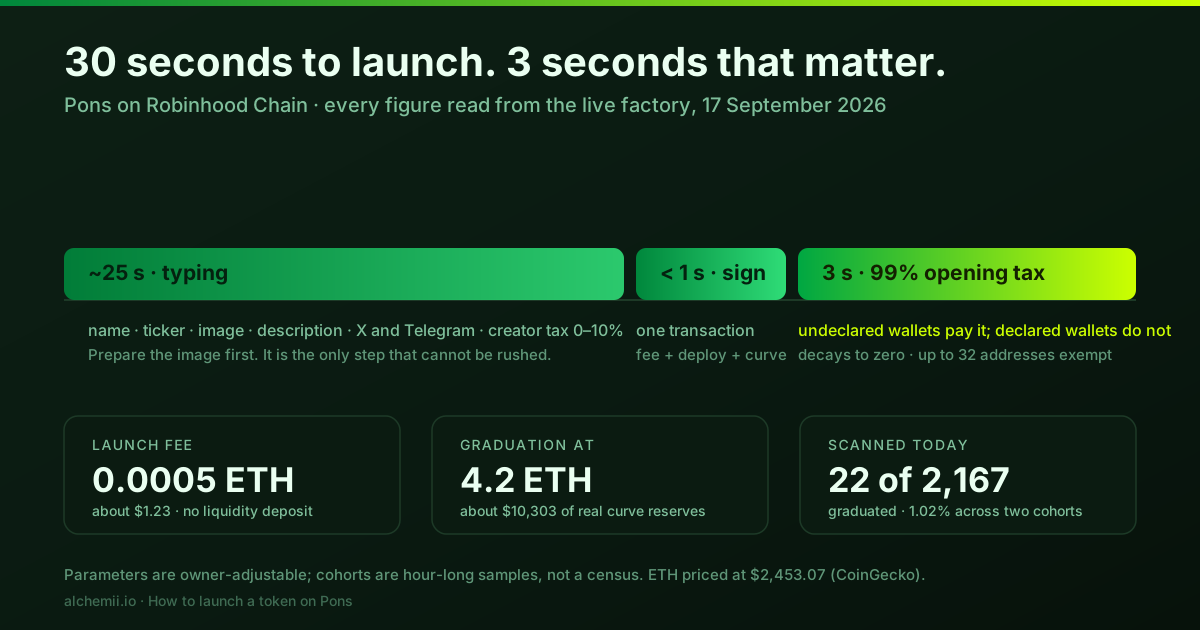
The short answer to how to launch a token on Pons: connect a wallet on Robinhood Chain, fill in the name, ticker, description and image on the create form, and sign one transaction that pays a 0.0005 ETH launch fee. The token deploys with a fixed supply of 1,000,000,000 units onto an ETH bonding curve and is tradeable in the same block. There is no liquidity to fund and no approval to wait for. Everything below was read from the factory that was actually emitting launches on September 17, 2026, at block 65,681,665.
Quick Facts
| What | Value | How we know |
|---|---|---|
| Launch fee | 0.0005 ETH ≈ $1.23 | launchFee() on the live factory |
| Supply, every launch | 1,000,000,000 units | getLaunchConfig(0).supply |
| Curve trade fee | 1% (100 bps) | getLaunchConfig(0).curveFeeBps |
| Graduation threshold | 4.2 ETH ≈ $10,303 | getLaunchConfig(0).graduationThreshold |
| Opening tax window | 9,900 bps decaying over 3 s | snipeTaxStartBps, snipeTaxSeconds |
| Launch pace today | 119 in 605 seconds, about 17,000/day | TokenLaunched log count |
Most guides to this stop at "click launch and share your link". That is genuinely most of the mechanical work, and it is also the part that decides nothing. What decides something is the three seconds after the transaction confirms, the tax number you picked without reading it, and the base rate nobody puts in the tutorial.
So: how to launch a token on Pons in the fast version first, then the parts that cost people money.
How to launch a token on Pons: the 30-second version
The Pons create page asks for a short list. Prepare these before you open it and the flow really is half a minute.
- Connect a wallet on Robinhood Chain. Chain ID 4663, ETH for gas, per Robinhood's network documentation. An empty wallet means bridging first, which is a 10-minute detour, not a 30-second one.
- Name and ticker. Both permanent. The contract is deployed with them baked in.
- Description and image. The image is the single asset that will represent your token on every chart and wallet, so make it before the timer starts.
- Socials. The form takes an X profile and a Telegram link. Leave them blank and the first question in your replies will be why.
- Creator tax, 0% to 10%. The default on the form reads "Traders pay 0.00% in total". This is the field people skip and then regret in both directions.
- Sign. One transaction. The fee, the deployment and the curve all settle together.
The paired asset is ETH, which the form shows fixed rather than as a choice. Liquidity is marked Locked on that same panel, which refers to what happens at graduation rather than to anything you are funding now.
| What you pay | Amount | In dollars | Paid to |
|---|---|---|---|
| Pons launch fee | 0.0005 ETH | $1.23 | The Pons protocol |
| Network gas | under 0.0001 ETH | under $0.25 | Robinhood Chain |
| Curve trade fee | 1% of every buy and sell | — | Split between protocol and creator |
| Your creator tax | 0% to 10%, your choice | — | You, from your traders |
| Bundler service fee | 0.004 ETH | $9.81 | Alchemii, only if you bundle the first buy |
| Your opening buy | whatever you choose | — | The curve, in exchange for tokens |
That table is the entire launch-side budget, and the missing row is the interesting one: there is no liquidity deposit. A conventional ERC-20 is untradeable until somebody funds a pool, which is why our Robinhood Chain cost breakdown spends most of its length on deposits. Here the curve replaces that step, and the trade is that the curve also sets the terms.
The three seconds that decide your entry
Everyone asking how to launch a token on Pons gets the form walkthrough. Almost nobody gets this parameter, which separates a launch that went fine from one where the creator quietly lost several hundred dollars.
The factory applies an opening tax of 9,900 basis points — 99% — decaying to zero across 3 seconds. Both values are public getters, and I re-read them today rather than trusting the August reading. A wallet that buys in the launch instant surrenders almost its entire spend to fees instead of receiving tokens.
There is a sanctioned exemption. The launch call accepts a list of addresses (the contract caps it at 32) that buy at the untaxed price during that window. This is the documented mechanism, not a loophole: it exists so that a team's own opening buy is not punished by an anti-bot rule aimed at somebody else.
Two consequences follow, and both are practical:
- Your first buy belongs inside the launch transaction. Send it afterwards as a second transaction and it competes with everyone watching for exactly that pattern, on a chain producing ten blocks a second.
- Wallets you did not declare pay the tax, including yours if you forgot. There is no retroactive exemption.
Pons ships an official launch-and-buy router for this. Alchemii's Pons Bundler drives that router directly: it deploys the token, registers up to 20 declared wallets as exempt, and executes the opening buys inside the same transaction, each wallet signing locally rather than handing us a key.
What happens after the 30 seconds, measured today
This is where the tutorials end and the data starts. On September 17, 2026 I scanned every launch inside two hour-long windows and then asked the factory what had become of each one.
| Cohort | Launched in | Tokens | Graduated | Rate |
|---|---|---|---|---|
| 24 hours old | 1 hour window, Sept 16 | 564 | 6 | 1.06% |
| 72 hours old | 1 hour window, Sept 14 | 1,603 | 16 | 1.00% |
| Combined | two hour-long windows | 2,167 | 22 | 1.02% |
Read the middle column twice. The 72-hour cohort had three times as long to reach 4.2 ETH as the 24-hour cohort, and it did not do better: 1.00% against 1.06%. Our Pons launchpad explainer measured 0.74% on a smaller sample in August and left open the possibility that tokens simply graduate later. On this evidence they do not. Graduation is an early event, decided in the first day, or it does not happen.
The launch pace tells you why. The Sept 14 window implies 37,821 launches a day and the Sept 16 window 13,457, with a live reading today of about 17,000. Whatever attention exists on that chain is being split across tens of thousands of new tokens daily, and a curve needs 4.2 ETH of real buying to graduate.
One more number from the same scan, because it surprised me. Creator tax is optional up to 10%, and 269 of 564 creators in the 24-hour cohort set it to zero. Among those who charged anything, the median was 1%. The mental model that every launcher maxes the tax is simply wrong, and a 10% tax on a token with no volume earns exactly nothing while giving every buyer a reason to pass.
Read the contract, not the documentation
A guide that tells you to trust the docs is doing you a disservice on a chain this young, and here is the concrete case.
Pons's published documentation names 0xA5aAb3F0c6EeadF30Ef1D3Eb997108E976351feB as the active factory and 0x0c37a24F5D23A486FA692d1500881d698B1F77a4 as its legacy one. I checked both against the chain. Across four 10-minute windows (right now, 24 hours ago, 7 days ago and 30 days ago) neither address emitted a single event, while 0x7eD598BcEf8bd9Edd8C97A195C6d13f40801EC7e emitted launches in every one of them. All three return the same 0.0005 ETH from launchFee(), so they are the same contract family; only one of them is doing the work.
I am not calling that dishonest. Docs go stale, and the launch flow on the site clearly points at the live contract. But if you copy an address out of a document into a script, you will be querying something that has not moved in a month, and the fix is thirty seconds of your own verification:
# Every figure in this article, re-read from the live factory
RPC=https://rpc.mainnet.chain.robinhood.com
F=0x7eD598BcEf8bd9Edd8C97A195C6d13f40801EC7e

cast call $F "launchFee()(uint256)" --rpc-url $RPC
cast call $F "snipeTaxStartBps()(uint256)" --rpc-url $RPC
cast call $F "snipeTaxSeconds()(uint256)" --rpc-url $RPC
cast call $F "getLaunchConfig(uint256)((uint256,uint256,uint256,uint256,uint24,int24,bool))" 0 --rpc-url $RPC
The last call returns supply, curve fee in basis points, the virtual quote reserve of 1.68 ETH, the 4.2 ETH graduation threshold, pool fee, tick spacing and an enabled flag. Our raw scan output records every reading, both cohorts and the idle-address check, so you can diff it against your own run.
Pons curve or your own pool: which launch are you actually doing?
Speed is the wrong axis for this decision. Both routes are fast now. The real question is who sets the terms.
| Decision | Pons bonding curve | Your own ERC-20 and pool |
|---|---|---|
| Time to tradeable | Same transaction | Two transactions plus funding |
| Upfront liquidity | None | Yours to seed and to lose |
| Opening price | Set by the curve formula | Set by your two deposit amounts |
| Supply and decimals | Fixed: 1,000,000,000 units | Whatever you choose |
| Ongoing trade fee | 1% on the curve, shared with you | The pool's fee tier, earned by the LP |
| Who owns the liquidity | Locked at graduation, nobody withdraws | You hold the position NFT |
| Base rate | About 1 in 100 reach graduation | No threshold to reach at all |
Take the curve when the token is a meme, you want trading live in the same second it exists, and you have no ETH to commit as liquidity. You are buying distribution mechanics and accepting fixed supply, a fixed fee and roughly a 1-in-100 shot at graduation.
Deploy your own ERC-20 when the token backs something and you want supply, decimals and powers under your control. The Robinhood Chain token creator does that in one transaction, then a Uniswap V3 pool opens trading at a price you set with your own deposits. It costs more upfront. It also means no countdown to anyone's threshold. And if your audience turns out to be Solana-native rather than EVM-native, the Solana token creator is the shorter path to those buyers.
Whichever you pick, the launch is not the campaign. The Robinhood Chain marketing playbook covers the part that decides whether anyone shows up.
Limitations
- Both cohorts are single hour-long windows, not a census. With 22 graduations in 2,167 launches the point estimate is stable enough to act on, but a different hour would give a slightly different number.
- Launch parameters live in an owner-adjustable contract. Everything here is a dated reading, and the quote in the form at signing time is what binds.
- We did not test the holder fee-sharing option visible on the create form, and it is not described in the published docs. Treat it as unverified until you read the contract yourself.
phase != 0is how we classify a graduated token. It is the post-curve state, and we did not separately verify the destination pool for each of the 22.- Nothing here is financial advice, and a launchpad that makes launching cheap does not make launching wise.
FAQ
How long does it actually take to launch a token on Pons?
The transaction is the fast part. Robinhood Chain produced blocks at about 9.9 per second during our September 17, 2026 measurement, so confirmation lands in well under a second. What takes time is the typing: name, ticker, description, image and two social links. With those prepared in advance, 30 seconds is a fair description of the whole flow. With the image still unmade, it is not.
What do I need before I can launch a token on Pons?
A wallet on Robinhood Chain mainnet (chain ID 4663), ETH on that network for the 0.0005 ETH launch fee and gas, and your token's name, ticker, description and image ready to paste. If you plan an opening buy, hold that ETH in the same wallet. You do not need code, an audit, a liquidity deposit, or anyone's approval — the factory is permissionless.
Should my first buy be part of the launch transaction?
Yes, if you are buying at all. The factory taxes the opening window at 9,900 basis points decaying to zero across 3 seconds, and only wallets declared inside the launch call are exempt. A buy sent as a separate transaction afterwards is exposed to that window and to anyone watching the mempool. Pons ships a launch-and-buy router precisely so the deploy and the buy cannot be separated.
Do Pons tokens graduate later if they do not graduate on day one?
Our measurement says mostly no. We scanned 564 tokens that were 24 hours old and found 6 graduated, a rate of 1.06%. A separate cohort of 1,603 tokens that had been live for 72 hours came in at 1.00%. Three times the runway produced no improvement, which points to graduation being an early event rather than a slow climb. Both cohorts are single-window samples, not the full population.
What happens to my token if it never reaches 4.2 ETH?
Nothing dramatic. It stays on its bonding curve and remains tradeable there indefinitely, because the curve is the market rather than a countdown. What it does not get is the graduation event: the locked Uniswap position, the deeper liquidity and the chart most traders expect. About 99 in 100 launches live in that state, so plan for it as the default outcome rather than the failure case.
Is the factory address in the Pons docs the one that processes launches?
Not on the day we checked. The documentation named 0xA5aAb3F0c6EeadF30Ef1D3Eb997108E976351feB as the active factory, but that address emitted no events in four sampled 10-minute windows spanning today back to 30 days ago. Every launch we observed came from 0x7eD598BcEf8bd9Edd8C97A195C6d13f40801EC7e. Verify the address your interface actually calls before you trust a copied one.
Before you sign: the 60-second checklist
- Name, ticker, description and image final, because none of them are editable afterwards.
- Creator tax chosen deliberately, with 0% as a real option that nearly half of creators pick.
- Every wallet that will buy in the first seconds declared in the launch call, or it pays the 99% opening tax.
- Your opening buy sized as money you can lose, in the same transaction as the deploy.
- Contract address, chart link and one honest announcement ready to post the moment it lands.
When that list is clean, launch on Pons with your first buy bundled in. If you would rather own the pool and set the opening price yourself, create a standalone ERC-20 instead and fund a pool the same session.
References
- Pons create page — form fields and fee display, checked September 17, 2026.
- Pons explore page — live launches and graduation framing, checked September 17, 2026.
- Pons documentation — launch fee, 4.2 ETH default threshold, fixed billion supply, creator/protocol fee split and factory addresses, accessed September 17, 2026.
- Pons V2 factory on Blockscout — verified source for every getter quoted here.
- Pons earned more fees in 24 hours than Hyperliquid, Polymarket and Fomo combined — BeInCrypto via Yahoo Finance, September 2, 2026, citing Bubblemaps and DefiLlama: $4.73M in 24-hour fees and $4.54B of cumulative volume.
- Pons announces V2 with a Uniswap upgrade — crypto.news, July 2026.
- Connecting to Robinhood Chain — chain ID 4663 network settings, accessed September 17, 2026.
- Robinhood Chain developer overview — permissionless EVM L2, accessed September 17, 2026.
- Robinhood Chain mainnet launch — Robinhood Newsroom, July 1, 2026.
- Ethereum price — CoinGecko, $2,453.07 at 20:36 UTC on September 17, 2026.
- Token listing — DEX Screener documentation on when a pair appears, accessed September 17, 2026.
Create your token on Robinhood Chain
Set your ERC-20 name, symbol and supply, then review the options and fee in the creator. Confirm deployment in your wallet. Add a liquidity pool separately when you are ready to open trading.
Related Topics
More guides to token creation and liquidity on Robinhood Chain.
Pons Launchpad Explained: Bonding Curve, Fees, Odds
The Pons launchpad explained from on-chain reads: how the bonding curve works, the 4.2 ETH graduation threshold, real fees, and why under 1% graduate.
How to Create a Meme Coin on Robinhood Chain (2026 Guide)
Create a meme coin on Robinhood Chain without code: current ETH fees, a shareable meme idea, token setup, liquidity and a practical community launch plan.
How to Market a Robinhood Chain Token (2026 Playbook)
How to market a Robinhood Chain token when buyers hold no ETH on chain 4663 yet: the bridge-to-buy funnel, live launch costs, and what to measure.
How to Airdrop Tokens on Robinhood Chain (Multisender Guide)
Airdrop your ERC-20 to multiple wallets on Robinhood Chain with a token multisender: prepare a CSV, calculate ETH fees, approve batches and verify delivery.
How to Bridge ETH to Robinhood Chain — and What Actually Arrives
Six documented routes onto chain 4663, measured. A 40-quote snapshot of what arrives after fees, the canonical bridge priced at 92,955 gas, and the size below which bridging stops making sense.
How Much Does It Cost to Create a Token on Robinhood Chain?
Every cost of creating a Robinhood Chain token, measured on mainnet: service fees read from live contracts, gas at two dated readings, and the pool.