How to Airdrop Tokens on Robinhood Chain (Multisender Guide)
Airdrop your ERC-20 to multiple wallets on Robinhood Chain with a token multisender: prepare a CSV, calculate ETH fees, approve batches and verify delivery.

Ready to create on Robinhood Chain? Review your ERC-20 settings and fee before signing.
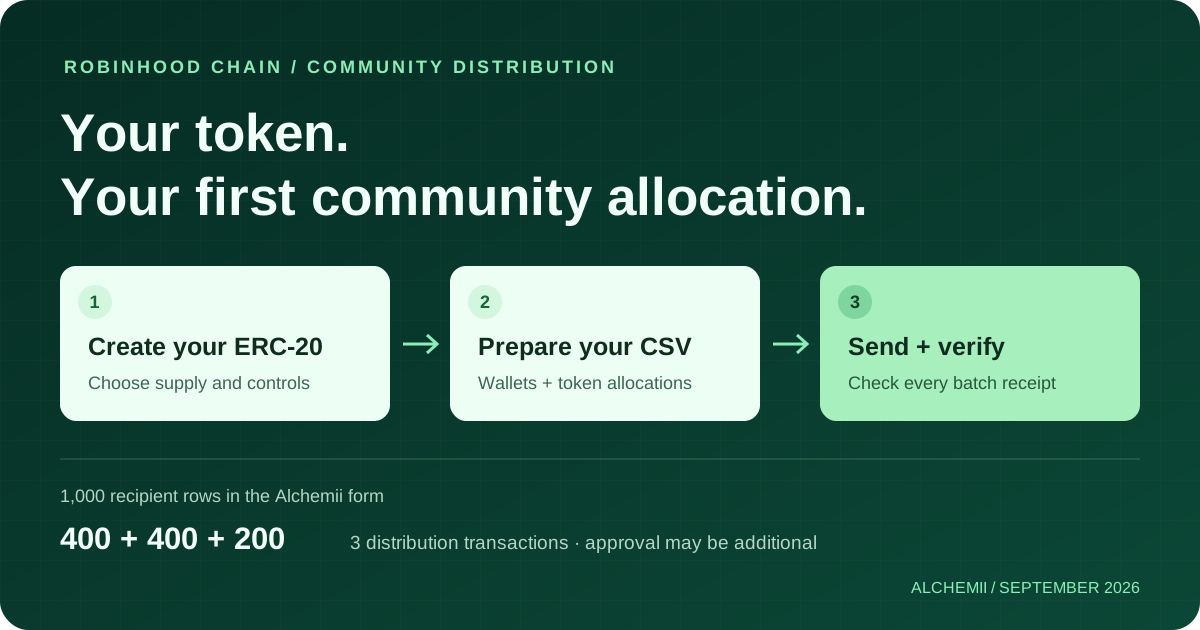
To airdrop your own token on Robinhood Chain, prepare a list of recipient wallets, hold the tokens and ETH on the same network, then use a multisender to distribute the allocations in batches. Recipients receive the ERC-20 directly. They do not need to visit a claim page or sign a transaction to receive it.
This guide covers distributing a community token you control with a token multisender. It is separate from claiming a reward from Robinhood or looking for an official network-token airdrop; if you searched “Robinhood Chain airdrop” hoping to receive one, the FAQ at the end explains why no such claim exists here. If you are preparing a new community launch, start with the Robinhood Chain Token Creator, then follow the distribution workflow below.
Checked September 6, 2026, at 11:40 p.m. EDT. We build Alchemii. The fee figures below come from a read-only mainnet contract query; the CSV format and batch limits were checked against the current application code.
What do you need before sending a community airdrop?
Prepare four things: your token's contract address, a sufficient token balance, a recipient list with allocations, and ETH for service fees and gas. Use Robinhood Chain mainnet, chain ID 4663. ETH on another network will not pay for these transactions. These network settings come from Robinhood's connection documentation; our ETH bridge guide covers funding the wallet.
Ask recipients for an EVM wallet address they control on Robinhood Chain. Collect public addresses only. A valid-looking address does not prove that its owner can access funds on this network, especially for exchange deposit addresses or smart contract wallets deployed on another chain.
You can distribute an ordinary transferable ERC-20 before opening a liquidity pool. Airdropping transfers part of the balance you already own; it does not mint extra supply or give the token a market price.
Set the allocation before you create or distribute the token
Decide who qualifies, the snapshot or signup deadline, and the amount each qualifying wallet receives. Publish that rule before collecting addresses so community members know what to expect. Remove duplicate submissions according to your rule; one address is not necessarily one person.
For example, a 1,000,000-token community allocation divided equally among 100 wallets gives each wallet 10,000 tokens. On a token with a total supply of 1 billion, that allocation is 0.1% of the supply. This is allocation arithmetic, not a prediction of the token's value.
Keep a working sheet with the recipient address, allocation, batch number and eventual transaction hash. Export only the address and amount fields needed for sending. A distribution list, a pool deposit and a team reserve should have separate totals so the same tokens are not committed twice.
Still planning the token? The creation tutorial covers deployment choices. The rest of this article starts with a token balance ready to distribute.
Which token multisender or ERC-20 airdrop tool should you use on Robinhood Chain?
There are three ways to send one token to many wallets on an EVM chain, and they differ in who pays gas, how many transactions you sign and how much engineering sits between you and the first recipient.
| Method | Transactions you sign | Who pays gas | Recipients must act? | Fits |
|---|---|---|---|---|
| Alchemii Robinhood Chain multisender | One approval plus one per batch of 400 rows (1,000-row cap per submission) | You: 0.00015 ETH per row plus gas at the September 6, 2026 reading | No, tokens arrive directly | Community allocations of ten to a few thousand wallets |
| Manual transfers from a wallet | One per recipient | You, one gas fee per transfer | No | Fewer than ten recipients |
| Claim contract (Merkle airdrop) | Deploy once, then none | Each recipient pays gas to claim | Yes, they must visit a page and sign | Very large lists where you want unclaimed tokens to stay in your control |
The middle row stops scaling almost immediately: a hundred manual transfers means a hundred wallet prompts and a hundred chances to paste the wrong address. A claim contract solves scale but needs a developer, a front end and a Merkle tree, and typically leaves a share of the allocation unclaimed. For a community launch on Robinhood Chain the multisender is the route this guide follows: one CSV, a handful of signatures, and a receipt per batch you can publish. Wallet setup for the network itself, including the chain ID 4663 and RPC values MetaMask asks for, is covered in what is Robinhood Chain.
How to format a Robinhood Chain airdrop CSV
Open the Robinhood Chain multisender. It supports pasted lists and CSV or TXT uploads, with one recipient per line and no header row. Choose the amount mode before importing the file.
| Amount mode | File contents | Where the amount comes from |
|---|---|---|
| Same | One wallet address per line | The single amount entered in the form |
| Different | One wallet address and amount per line, separated by a comma | Each row's amount |
For Different mode, the layout is:
RECIPIENT_WALLET_ADDRESS_1,10000
RECIPIENT_WALLET_ADDRESS_2,2500.5
Replace these placeholders with real 0x recipient addresses. They are deliberately not sendable addresses. Do not add address,amount as a header.
Before importing:
- Remove duplicate addresses. The current form does not deduplicate them; two rows for the same address mean two allocations and two recipient fees. Compare addresses without case differences when checking duplicates.
- Use ordinary decimal amounts. Write
10000, not10,000, and avoid currency symbols, spreadsheet scientific notation and quoted fields. Use no more decimal places than the token supports. - Use wallet addresses, not names or tickers. The list expects EVM addresses. Remove the zero address and confirm the intended network with recipients.
- Match the mode to the file. In Same mode, a second column does not set individual allocations; the form uses the common amount instead.
- Clear the old list before uploading a replacement. Uploading appends rows to the current list. Re-uploading a corrected file without clearing it can duplicate the entire distribution.
Review the displayed Wallets, Sending and Service fee totals against your working sheet. The Wallets count represents recipient rows, so it should match the unique-address count only after you have removed duplicates.
How much ETH does the airdrop cost?
At our reading, Alchemii's deployed multisender charged 0.00015 ETH per recipient row, plus network gas. This is a distribution fee; it does not include creating a token, funding a pool or the tokens you send.
| Recipient rows | Distribution transactions in the current form | Service fee at the checked rate |
|---|---|---|
| 10 | 1 | 0.0015 ETH |
| 100 | 1 | 0.015 ETH |
| 400 | 1 | 0.06 ETH |
| 1,000 | 3: 400 + 400 + 200 | 0.15 ETH |
Evidence: we read feePerRecipient() from the deployed multisender contract at block 56,519,984, timestamp September 7, 2026, 03:40:12 UTC (September 6 in New York). It returned 150000000000000 wei. The downloadable measurement records the RPC, address, block and values so the reading can be checked.
The contract's per-call limit is 500 recipients; the current form uses 400 per batch and caps a submission at 1,000 rows. An ERC-20 approval may require one additional transaction before distribution. The service fee is owner-adjustable, and gas depends on execution and current network conditions. Review the live fee and wallet gas estimates before signing; use the token creation cost guide for the separate deployment budget.
Approve and send the token allocations
- Connect the sending wallet on Robinhood Chain. It must hold the token allocation and enough ETH for fees and gas.
- Enter your token's contract address. Leave the native ETH option off for an ERC-20 airdrop. Check the symbol and decimals against your token before entering amounts.
- Choose Same or Different, import the list, and compare totals. Resolve every invalid row. Save the reviewed file so batch order can be reconstructed later.
- Run a small first distribution to wallets you control. Verify the amount actually received, especially if the token has transfer fees, pauses or limits. Account for this transfer separately from the community allocation.
- Submit the reviewed community list. If allowance is insufficient, the form requests an approval for the total token allocation. Then confirm the distribution transactions in your wallet.
- Check each transaction on Blockscout. Save the receipts alongside the relevant rows before marking the campaign complete.
Approval authorizes the multisender to spend the specified token amount; approval itself does not deliver the airdrop. The distribution transaction uses ERC-20 transferFrom to move tokens from your wallet to recipients. Ethereum's ERC-20 reference explains the allowance and transfer functions.
For 1,000 recipients, expect three distribution transactions, and an approval if needed. A single form submission is not a single blockchain transaction. Larger campaigns need additional submissions and a ledger of completed batches.
How to verify delivery and handle a failed batch
Use the transaction hash in your wallet history to open the receipt on Robinhood Chain Blockscout. Check that its status is successful, then inspect token transfers for the correct contract address, recipients and amounts. A familiar ticker alone is insufficient.
For your small first distribution, compare recipient balances before and after. A transfer-tax token may deliver less than the entered gross amount. A paused token or a recipient balance limit can prevent transfers. Check those controls before promising a net allocation.
If a batch reverts, its transfers and service fee roll back together; network gas may still be spent. Earlier successful batches remain delivered. The application contract performs this rollback per transaction, not across an entire multi-batch campaign.
Do not resend the whole original CSV after an interruption. Check every submitted transaction, wait for pending transactions to resolve, and build a new list containing only unpaid allocations. For example, if the first 400 rows succeeded and the next batch reverted, exclude those first 400 from the retry. Inspect any other submitted batches as well before deciding what remains.
Recipients may need to import the token address into their wallet to see it. Share the network, contract address, symbol and receipt link in your community announcement. For this direct distribution they do not need a claim website or a token approval to receive their allocation. Holding tokens does not automatically make them tradeable; opening a Robinhood Chain liquidity pool is a separate step.
Frequently asked questions
How do I airdrop my own token on Robinhood Chain?
Hold the ERC-20 tokens and ETH for fees on Robinhood Chain, prepare a recipient list, and open a multisender. Choose equal or individual amounts, review the total, approve token spending if needed, and confirm the batch transactions. Verify each receipt and recipient balance.
How much does a Robinhood Chain token airdrop cost?
Alchemii's multisender charged 0.00015 ETH per recipient row at the September 6, 2026 reading: 0.015 ETH for 100 rows or 0.15 ETH for 1,000. Network gas is additional. The service fee can change, so check the current quote before signing. Token creation is separate.
Can I send to 1,000 wallets in one transaction?
The Alchemii form accepts up to 1,000 recipient rows per submission and splits them into batches of 400, 400 and 200. That is three distribution transactions, plus an ERC-20 approval transaction if the existing allowance is insufficient.
Do recipients need ETH or a claim link to receive the airdrop?
For this direct ERC-20 distribution, the sender pays the transaction fees. Recipients do not need ETH or a claim link to receive tokens. They normally need ETH on Robinhood Chain to send or swap those tokens later.
Do I need a liquidity pool before distributing tokens?
A transferable ERC-20 can be sent directly to wallets before it has a liquidity pool. Distribution does not create a market or establish a price. A pool and its deposits are separate if you want DEX trading.
What happens if an airdrop batch fails?
A reverted Alchemii multisender transaction rolls back that batch's token transfers and service fee, but network gas may still be spent. Earlier successful batches remain delivered. Check every submitted transaction before retrying, and submit only recipients whose transfers did not succeed.
Is this the Robinhood Chain airdrop that users can claim?
No. This guide is for a project distributing its own ERC-20 to a list of wallets. Robinhood has not announced a network token, and any page promising a Robinhood Chain airdrop you can farm or claim is describing speculation or a third-party campaign, not something this article can help you receive. If a site asks you to connect a wallet and sign to claim one, treat it as a drainer until proven otherwise.
What is a token multisender?
A smart contract, with a form in front of it, that takes one list of recipients and amounts and performs all the ERC-20 transfers inside a single transaction per batch. You approve the contract to spend the total, it calls transferFrom for each row, and every recipient receives tokens without paying gas or claiming. Alchemii's Robinhood Chain multisender handles up to 500 recipients per contract call and 400 per batch in the form.
Your distribution starts with a token and a clear allocation. Create your Robinhood Chain token, keep the recipient plan alongside it, and use the steps above to deliver the first community allocation.
Create your token on Robinhood Chain
Set your ERC-20 name, symbol and supply, then review the options and fee in the creator. Confirm deployment in your wallet. Add a liquidity pool separately when you are ready to open trading.
Related Topics
More guides to token creation and liquidity on Robinhood Chain.
How to Create a Token on Robinhood Chain (Code or No-Code)
Both routes to a Robinhood Chain ERC-20, tested on mainnet: the no-code factory path and the Foundry deploy, with real costs and the pool step after.
How to Create a Meme Coin on Robinhood Chain (2026 Guide)
Create a meme coin on Robinhood Chain without code: current ETH fees, a shareable meme idea, token setup, liquidity and a practical community launch plan.
How to Launch a Token on Pons in 30 Seconds (2026)
How to launch a token on Pons in one transaction: the real form fields, the 0.0005 ETH fee, the 99% opening tax, and graduation odds measured today.
How to Bridge ETH to Robinhood Chain — and What Actually Arrives
Six documented routes onto chain 4663, measured. A 40-quote snapshot of what arrives after fees, the canonical bridge priced at 92,955 gas, and the size below which bridging stops making sense.
How Reflection Tokens Work — and What Breaks Them in a Pool
Reflection tokens pay holders by changing one rate, not by looping over wallets. The on-chain mechanics, the permanent 25% ceiling, and a forked-mainnet test showing why an un-exempted DEX pool turns sells into reverts.
Best Robinhood Coin Creator in 2026: Only Two Pass Verification
We checked every Robinhood Chain coin creator we could find against the chain itself. Two are verifiable — here are their live fees, tools and trade-offs.