Pons Launchpad Explained: Bonding Curve, Fees, Odds
The Pons launchpad explained from on-chain reads: how the bonding curve works, the 4.2 ETH graduation threshold, real fees, and why under 1% graduate.

Ready to launch on Pons? Bundle your first buy into the launch transaction, with your wallets declared snipe-tax exempt.
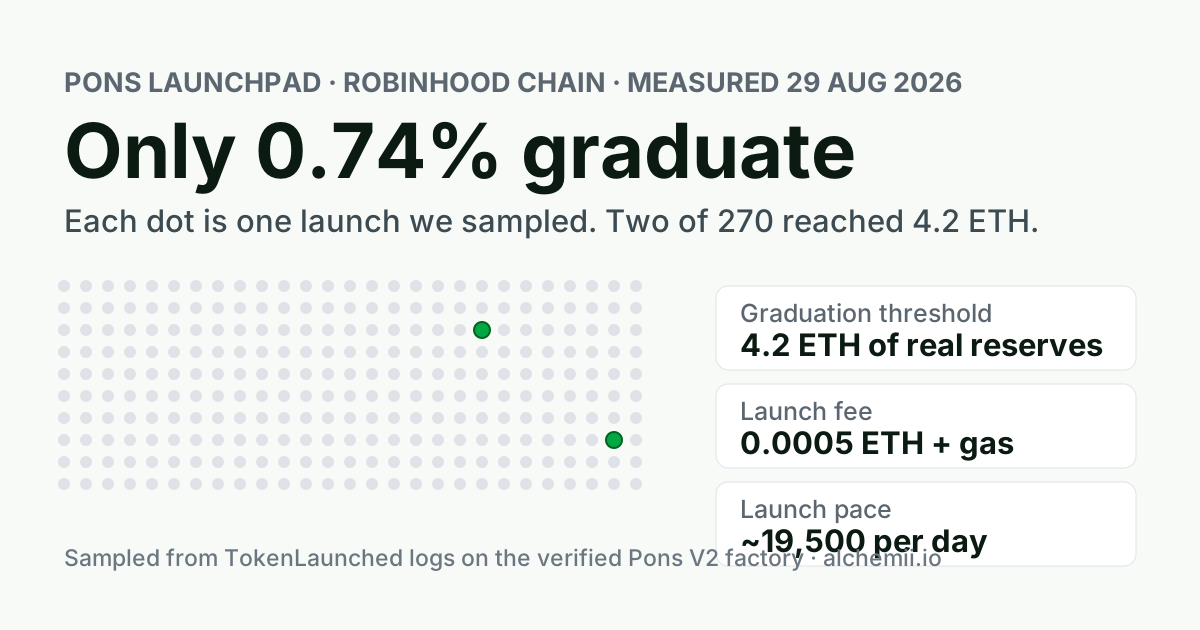
The Pons launchpad is the permissionless token launchpad on Robinhood Chain, and its V2 design works like this: every token starts on an ETH-denominated bonding curve rather than a funded liquidity pool, trades on that curve for price discovery, and graduates into a Uniswap v4 pool with permanently locked liquidity once it holds 4.2 ETH of real reserves. Launching costs 0.0005 ETH plus gas, needs no upfront liquidity, and takes one transaction from a wallet.
The number that matters most is the one nobody advertises. We sampled 270 launches across two cohorts on 29 August 2026 and found 2 that had graduated — 0.74%. At the same time the chain was absorbing roughly 19,500 launches a day. Both figures come from our own reads of the deployed contracts, and the method is written out below so you can reproduce them.
What is Pons, and how does the Pons launchpad work?
Pons is a launchpad contract suite deployed on Robinhood Chain — chain ID 4663, an Arbitrum Orbit L2 that uses ETH for gas. It is permissionless in the literal sense: the factory's canLaunch check returns true for any address, so no allowlist, application or approval stands between a wallet and a live token.
What the Pons launchpad actually does in one transaction is three things at once:
- Deploys the token. A fixed supply of 1,000,000,000 units, identical for every launch on the current config.
- Deploys a bonding curve that holds the token's entire tradeable supply and prices it against ETH.
- Opens trading immediately. There is no waiting period, no pool to fund, and no second step before the first buyer can arrive.
That last point is the whole pitch. A conventional ERC-20 is untradeable at birth — it exists, but nobody can buy it until someone funds a liquidity pool. A Pons launch inverts that: the curve is the market from the first block, and the creator contributes no liquidity at all.
Pons did not arrive into an empty field. As crypto.news reported in July 2026, the earlier market leader Noxa had generated $12 million in protocol fees across 60,000 token launches before shutting down — and Pons absorbed much of that activity. Our own log scans put the current pace at roughly 800 launches an hour, though as the measurement below shows, that number moves fast.
How the Pons bonding curve works, and what graduation means
A bonding curve is a formula that quotes a price from reserves rather than from an order book. Early buys are cheap; each purchase moves the price up the curve; each sale moves it back down. Nobody has to post liquidity on the other side, because the curve always quotes both directions.
| Stage | What happens | Who can trade | Where price comes from |
|---|---|---|---|
| Launch | Token + curve deployed in one transaction; 0.0005 ETH fee paid | Creator's declared wallets clear untaxed | Bonding curve formula |
| First ~3 seconds | Anti-snipe tax starts at 99% and decays to zero | Anyone, but undeclared buyers are taxed | Bonding curve formula |
| On the curve | Buys push price up, sells push it down; 1% trade fee accrues | Anyone, untaxed | Bonding curve formula |
| Graduation | At 4.2 ETH of real reserves the curve settles into a Uniswap v4 pool | Trading pauses for the settlement | Deterministic seed price |
| After graduation | Liquidity is locked in a full-range v4 position; curve is closed | Anyone, on the DEX | Uniswap v4 pool |
Pons graduation is the moment the token leaves that curve. When real reserves reach the 4.2 ETH threshold — a figure we read from getLaunchConfig(0).graduationThreshold on the live factory, and which matches Pons's own documentation — the accumulated ETH and a reserved token allocation are seeded into a Uniswap v4 pool at a deterministic price. The resulting liquidity position is locked permanently, so it cannot be pulled afterwards.
Two things follow from that design, and both are worth internalising before you launch:
- Graduation is not an endorsement. Pons's docs say it plainly: it "only confirms the threshold was reached. It is not a quality signal and does not guarantee future liquidity." A graduated token can still go to zero.
- The locked position is a genuine anti-rug property. Because the graduated liquidity cannot be withdrawn, the specific failure mode where a founder drains the pool is closed off. Other failure modes — everyone selling — are not.
What it costs: Pons launch fee, trading fee and creator payouts
The Pons launch fee is 0.0005 ETH. That is not an estimate; it is the return value of launchFee() on the factory, and it agrees with the documented figure. On a chain where gas runs in fractions of a cent, the total cost to put a token on the market is dominated by that half-thousandth of an ether.
| Cost | Amount | Who receives it | When |
|---|---|---|---|
| Pons launch fee | 0.0005 ETH | Pons protocol | At launch |
| Network gas | Fractions of a cent | Robinhood Chain | Per transaction |
| Curve trade fee | 1% of each trade | Split protocol / creator | Every buy and sell |
| Creator tax (optional) | 0–10%, you choose | Your creator wallet | Every buy and sell |
| Anti-snipe tax | 99% decaying to 0 over ~3s | Fee pool (not the sniper) | First seconds only |
| Alchemii bundler fee | 0.004 ETH (only if you bundle) | Alchemii | At launch, optional |
The ongoing economics matter more than the launch cost. The curve charges 1% on every trade, split between the protocol and the creator, which means a launch that trades actively pays its creator continuously in ETH — a V2 change from V1, where creator fees accrued in the launched token instead.
On top of that you may set an optional creator tax of up to 10%, enforced as a hard ceiling by maxCreatorTaxBps on the factory. Just because the ceiling is 10% does not mean the market accepts 10%: across the 120 launches we sampled, the typical creator set 1.76%. A visibly greedy tax is readable on chain before anyone buys, and buyers do read it.
We measured it: under 1% of Pons launches graduate
This is the part that changes decisions, so here is the method in full rather than a headline number.
We pulled every TokenLaunched event the factory emitted inside a fixed block window, sampled evenly across that window, then called getLaunchedToken(token).phase on each sampled token. Phase 0 means the token is still on its bonding curve; anything else means it graduated. We ran this on two separate cohorts, deliberately chosen at different ages so a single unusual day could not drive the result.
| Cohort | Age when measured | Sampled | Graduated | Rate |
|---|---|---|---|---|
| Cohort A | ~24–31 hours | 120 | 1 | 0.8% |
| Cohort B | ~2.3–2.9 days | 150 | 1 | 0.7% |
| Combined | — | 270 | 2 | 0.74% |
Two cohorts, 270 launches, 2 graduations — 0.74%. The two cohorts agree closely (0.8% and 0.7%) despite being sampled a day and a half apart, which is what you want from a measurement you intend to act on.
The honest caveats: these are first-days rates, and a token sitting on its curve today can still graduate next week, so the lifetime rate will be somewhat higher. The sample is a few hundred launches, not tens of thousands. But the order of magnitude is not in doubt — reaching 4.2 ETH of real reserves is the exception, not the expected outcome.
Why the launch pace makes this worse, not better
The competition for attention is intensifying quickly. Across four consecutive measurement windows on the same day, the launch rate roughly five-folded.
| Window (oldest → newest) | Duration | Launches | Per hour |
|---|---|---|---|
| Window 1 | 2.80 h | 748 | 267 |
| Window 2 | 2.80 h | 1,485 | 530 |
| Window 3 | 2.81 h | 3,145 | 1,118 |
| Window 4 (most recent) | 2.81 h | 3,730 | 1,328 |
| All four | 11.23 h | 9,108 | 811 (≈19,500/day) |
Nineteen and a half thousand launches a day against a sub-1% graduation rate is the real context for a launch plan. Distribution, not deployment, is the binding constraint — the deployment costs 0.0005 ETH and takes seconds, and that is precisely why it is not where the difficulty lives.
The anti-snipe window: why the first seconds decide your entry
Pons charges an anti-snipe tax on the opening moments of trading. We read its terms from the factory: snipeTaxStartBps is 9,900 — 99% — and snipeTaxSeconds is 3. A bot that buys in the launch instant therefore surrenders almost its entire spend to the fee pool rather than converting it into tokens, and the penalty decays smoothly to zero within about three seconds for ordinary buyers.
The design has a sanctioned exit, and it matters if you are launching as a team. The factory accepts a list of snipe-tax-exempt addresses at launch (capped at 32 in the contract). Wallets on that list buy at the untaxed price during the window while undeclared snipers pay the penalty. That is the mechanism behind coordinated opening buys: not a loophole, but a documented parameter of the launch call.
The practical consequence for a creator is that your own first buy should be atomic with the launch, not a second transaction sent afterwards. Pons ships an official launch-and-buy router for exactly this: it deploys the token, registers your exemptions, and executes your opening buy inside one transaction, so no third party can transact between the two steps. Alchemii's Pons Bundler drives that router directly, and can fire up to 20 declared wallets' opening buys alongside it.
Pons V2 vs V1: what changed, and why old guides mislead
If you have read an explainer claiming Pons has "no bonding curve", it was describing V1 — and it is now wrong about the live system. This is the single most common error in current coverage, and it matters because the two models behave differently in every way that affects a launch.
| Pons V1 | Pons V2 (live today) | |
|---|---|---|
| Launch model | Straight into a liquidity pool | ETH bonding curve first |
| DEX venue | Uniswap V3 | Uniswap v4 with hooks |
| Graduation | Threshold on pooled WETH | 4.2 ETH of real curve reserves |
| Creator payouts | Accrued in the launched token | Paid in ETH by default |
| Pair options | WETH | ETH plus approved pair tokens |
| Anti-snipe | First two blocks protected | 99% tax decaying over ~3 seconds |
V1 launched tokens straight into a Uniswap V3 pool with no curve phase. V2, which is what the deployed contracts do today, adds the ETH bonding curve in front, moves the destination venue to Uniswap v4 with hooks, and pays creators in ETH rather than in their own token. crypto.news reported the V2 plan in July 2026, including support for pair tokens beyond ETH such as USDG and tokenized equities; we verified the curve, the v4 destination and the ETH payouts against the deployed contracts.
The lesson for research: read the contract, not the guide. Every figure in this article is a public view call on a verified contract, and the factory source is published on Blockscout — including launchFee(), getLaunchConfig(0) and the snipe-tax parameters, all of which anyone can call for free.
Is the Pons launchpad safe to use?
"Safe" splits into two questions that get conflated constantly, and only one of them has a reassuring answer.
Is the contract behaviour predictable? Largely, yes, and verifiably so. The source is published and readable, the fee ceilings are enforced in code rather than by promise, the supply is fixed at deployment with no owner mint switch, and graduated liquidity is locked in a way that closes off the drain-the-pool exit. Those are structural properties you can check yourself before you send a transaction, which is more than most launch venues offer.
Is any given token on it a good bet? That is a different question, and the honest answer from our own data is that the base rate is brutal. A permissionless launchpad is permissionless for everyone, including people whose plan is to sell into you. The 0.74% graduation rate is not a knock on the Pons launchpad's engineering — the mechanism works exactly as specified — it is a measure of how many launches attract enough real demand to matter.
The useful mental model: the contracts remove one specific category of risk (custody and rug-by-withdrawal) and remove none of the others (no demand, an unfavourable creator tax, or simply being early to something nobody wants). Read the creator tax and the reserves before buying; both are on chain, and both are free to check.
Pons bonding curve or a fixed-supply ERC-20? How to choose
This is the decision most people actually face on Robinhood Chain, and it is not the same question as "which is better". They optimise for different things.
| Pons bonding curve | Fixed-supply ERC-20 | |
|---|---|---|
| Upfront liquidity | None — the curve is the market | You fund the pool yourself |
| Opening price | Set by the curve formula | Set by you when you seed the pool |
| Supply | Fixed at 1,000,000,000 | Any supply you choose |
| Token powers | Standard, no owner switches | Optional mint / pause / burn / tax |
| Trading starts | Instantly at launch | Only after you create a pool |
| Ongoing creator revenue | Yes — your share of the 1% trade fee | No (unless you set a transfer tax) |
| Ends up on a DEX | Only if it hits 4.2 ETH | Immediately, in the pool you made |
| Best for | Memecoins and price discovery | Utility, team and community tokens |
Choose the Pons bonding curve when the token is a memecoin, you want trading live in the same second it exists, you have no ETH to commit as liquidity, and you want the market to discover the price. You are buying distribution mechanics and giving up control of the opening terms — plus, on the evidence above, taking roughly a 1-in-135 shot at graduation. If that is your play, the Pons Bundler launches and dev-buys atomically, with sniper wallets declared exempt.
Choose a fixed-supply ERC-20 when the token backs something — a product, a community, a treasury — and you want the supply, decimals and behaviour to be yours. You set the opening price by seeding the pool, you can decide whether the contract has mint, pause or burn powers at all, and you are not on anyone's countdown to a threshold. That path costs more upfront because you fund the liquidity, and it gives you terms you control. Our Robinhood Chain token creator deploys that contract from your wallet in one transaction, with the fee read live from the factory before you sign.
A blunt summary of the trade: the curve is a bet on attention; your own pool is a bet on the thing you are building.
Sources and how to check them yourself
- Pons documentation — PonsPrimary source for the launch fee, 4.2 ETH graduation threshold, 1,000,000,000 supply and 1% trade fee. (accessed 2026-08-29)
- Robinhood Chain launchpad Pons announces V2 with Uniswap V4 upgrade — crypto.newsReports the V2 design — ETH bonding curve, Uniswap v4 hooks, ETH creator payouts, RWA pairs — and that Noxa had generated $12M in protocol fees across 60,000 launches before shutting down in July 2026. (accessed 2026-08-29)
- PonsV2LaunchFactory, verified source — Robinhood Chain BlockscoutThe contract every figure in this article was read from. launchFee(), getLaunchConfig(0), snipeTaxStartBps() and snipeTaxSeconds() are public view functions anyone can call. (accessed 2026-08-29)
- Robinhood Chain documentation — RobinhoodChain ID 4663, ETH as the gas token, and the public RPC used for every measurement here. (accessed 2026-08-29)
The short version
- The Pons launchpad puts a fixed-supply token on an ETH bonding curve for 0.0005 ETH, tradeable immediately, no liquidity required.
- Graduation happens at 4.2 ETH of real reserves and moves the token into a permanently locked Uniswap v4 pool. It is a threshold, not a seal of approval.
- Under 1% get there — 2 of 270 sampled launches, measured across two cohorts on 29 August 2026 — against a pace of roughly 19,500 launches a day that grew fivefold inside eleven hours. A larger re-scan on 17 September 2026 put it at 22 of 2,167, and found that a 72-hour-old cohort graduates at the same rate as a 24-hour-old one: see how to launch a token on Pons for that measurement and the step-by-step launch flow.
- Fees: 0.0005 ETH to launch, 1% per trade split with you, up to 10% optional creator tax (the typical creator sets 1.76%), and a 99% snipe tax that decays over about three seconds.
- V2 is not V1. Guides saying Pons has no bonding curve describe the retired model.
If you are launching a memecoin and want trading live instantly with your own opening buy inside the launch transaction, use the Pons Bundler. If you want a fixed-supply token whose terms you control and whose pool you own, use the Robinhood Chain token creator and open the pool in the same sitting. New to the chain itself? Start with what is Robinhood Chain, or follow the full walkthrough in how to create a meme coin on Robinhood Chain.
Launch your token on Pons
Fill in the name, ticker and image, bundle your own opening buy into the launch transaction, and declare your wallets snipe-tax exempt. One signature; trading is live in the same block.
Related Topics
More guides to token creation and liquidity on Robinhood Chain.
Jup Studio: Fees, Graduation & How to Launch (2026)
Jup Studio explained: Jupiter Studio's 1% fee split, anti-sniper window, 15K USDC graduation, measured launch cost, and when a direct Solana mint wins.
How to Launch a Token on Pons in 30 Seconds (2026)
How to launch a token on Pons in one transaction: the real form fields, the 0.0005 ETH fee, the 99% opening tax, and graduation odds measured today.
What Is Pump.fun? The Complete Platform Guide (2026)
Pump.fun Solana bonding-curve launchpad: free to create, 1.25% per trade, auto-LP at the 85-SOL (~$41K) graduation. How it works, who it's for.
Robinhood Meme Coins: Full List & Oct 2026 Data
Robinhood meme coins in October 2026: the 13 coins in the Robinhood app, the top Robinhood Chain memes like CASHCAT, and on-chain data on why the boom cooled.
Meme Coin Market Cap 2026: $36B by Coin & Chain
The meme coin market cap is $36.45B, 76% below its record, yet launchpad fees just hit $10.3M a day. See the data by coin and chain, then launch your own.
Pump.fun Callouts Explained: How to Use Them & Check Rewards
What Pump's Callout Rewards terms really say: the Activity Metric is confidential, rewards are discretionary, and only the on-chain transfer counts as payment.