Jup Studio: Fees, Graduation & How to Launch (2026)
Jup Studio explained: Jupiter Studio's 1% fee split, anti-sniper window, 15K USDC graduation, measured launch cost, and when a direct Solana mint wins.

Ready to create your Solana token? Enter your token details, choose your authority options, and confirm in your wallet.
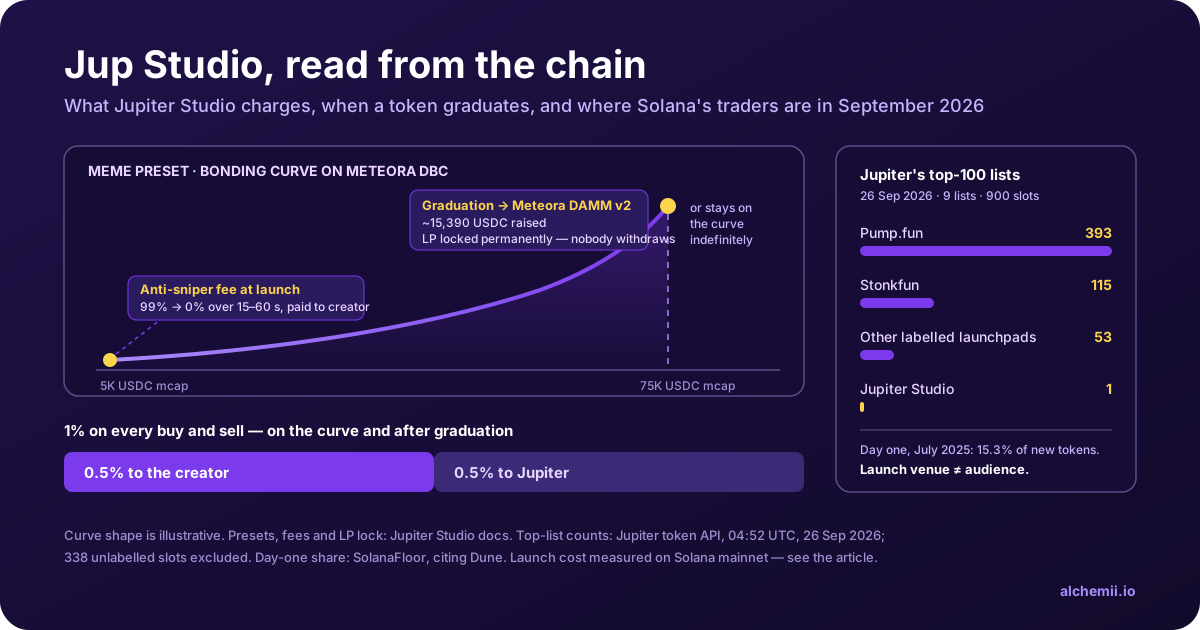
Jup Studio (Jupiter Studio) is Jupiter's no-code token launchpad on Solana: you upload an image, a name and a ticker, pick a preset, and your token goes live on a bonding curve that needs no starting liquidity. Under the hood it is Meteora's Dynamic Bonding Curve program. Every trade pays 1%, split evenly between you and Jupiter, for the life of the token. When the curve raises at least 15,000 USDC, the token graduates to a Meteora DAMM v2 pool with its liquidity locked forever. A launch costs about 0.03 SOL. What Studio no longer supplies, in September 2026, is much of an audience — and that is the real decision this guide is built around.
If you only came for the link: the launchpad is at studio.jup.ag and its manual at docs.jup.ag. Everything below was checked against those docs or read from Solana mainnet on 26 September 2026 — the fee split, both presets, the graduation arithmetic, a measured launch cost, and a snapshot of where Jupiter's own token lists say traders are. We build a competing product, a Solana token creator for minting SPL tokens directly, so every Studio figure here points at something you can verify yourself.
Quick Facts
Two of those six numbers pull in opposite directions, and the tension between them runs through the rest of this article. The fee terms are among the most creator-friendly of any Solana launchpad. The attention numbers are among the weakest. Which one matters more depends on who you expect to buy your token.
What is Jupiter Studio? A Meteora curve with Jupiter's front end
Jupiter launched the Jupiter Studio launchpad in July 2025; the earliest Studio-labelled mints we found in Jupiter's token API are dated 3 July. The first day was loud. SolanaFloor, citing Dune data, reported more than 6,000 Studio launches that day — 15.3% of the day's token deployments on Dune's count — and Jupiter COO Kash Dhanda reported $100 million of first-day volume. It arrived in the middle of the 2025 launchpad fight between Pump.fun, LetsBonk.fun and Raydium's LaunchLab, pitched on better creator economics.
Technically, Studio is a front end over someone else's engine. We pulled the creation transaction of three Studio tokens from July 2025, and each is a single transaction to Meteora's Dynamic Bonding Curve program, dbcij3LWUppWqq96dh6gJWwBifmcGfLSB5D4DuSMaqN (Solscan). The program writes a fresh curve config for the launch, opens a virtual pool, mints the token through the classic SPL Token program and hands the mint authority away — all in one signature. Meteora's own DBC documentation describes the same product from the other side: a permissionless launch primitive with up to 16 curve segments that migrates finished pools to DAMM v2. Jupiter's docs describe Studio's curve as constant product, the same x·y=k model as a Uniswap v2 pool.
What a Studio mint looks like once it lands, from the four we read directly on mainnet:
- Program: classic SPL Token (
Tokenkeg…), not Token-2022. - Decimals: 6.
- Mint authority and freeze authority: both null. Nobody can print more supply or freeze a holder, and that is settled at minute zero.
- Supply: Jupiter's FAQ fixes it at 1,000,000,000 tokens. The July 2025 launches we read were minted at 100,000,000 instead; a September 2026 Studio token was back at roughly 1 billion. The preset has changed since launch day, which is the best argument for reading the live form rather than any guide, this one included.
Studio tokens show up automatically on Alphascan inside Jup Pro, flagged as Studio launches, and on Jupiter's launchpad screener. A token with no recent trades can drop off those surfaces and reappear when trading resumes.
Meme mode vs Custom mode
Studio offers two launch paths. Meme mode is a fixed preset; Custom mode opens the knobs. Both are documented in Jupiter's launch guide.
| Setting | Meme mode | Custom mode |
|---|---|---|
| Quote token on the curve | USDC | SOL or USDC |
| Starting market cap | 5,000 USDC | You choose |
| Graduation market cap | 75,000 USDC | You choose, with at least 15,000 USDC raised |
| Raised before graduation | ~15,390 USDC | 15,000 USDC equivalent or more |
| Supply on the curve / to the pool | 795M (79.5%) / 205M (20.5%) | Depends on your settings |
| Anti-sniper fee | On | On or off |
| Creator vesting | None | 0–80% of supply, 6 or 12 months, daily unlocks, cliff of 0, 6 or 12 months |
| Trading fee | 1% | 1% by default |
| Editable after launch | No | No |
Meme mode is the right default for a meme. Custom mode earns its extra clicks in one situation: a team that wants a real allocation for itself and is willing to lock it on a public schedule. Vesting up to 80% is a lot of supply, and the schedule is immutable, so write it down before you open the form — buyers will read it on-chain whatever you say in the description.
Jupiter Studio fees: where the 1% goes on every trade
Studio charges one trading fee, and it is simple: 1% on every buy and every sell, on the bonding curve and on the Meteora pool after graduation, split 50/50 between the creator and Jupiter. There is no launch fee and no graduation fee on top. The creator claims their half from the token's Studio page using the deployer wallet — the green claim button on the right, per Jupiter's graduation and fees page.
| Fee | Rate | Paid by | Goes to | When |
|---|---|---|---|---|
| Trading fee | 1% | Every buyer and seller | 0.5% creator, 0.5% Jupiter | Every trade, curve and pool, for the token's life |
| Anti-sniper fee | 99% decaying to 0% | Buyers in the opening window | 100% creator | First 15–60 seconds, randomised per launch |
| Solana network fee | 5,000 lamports per signature, plus any priority fee | Whoever signs | Validators | Every transaction |
| Launch rent and fees | ~0.028–0.033 SOL | The creator | Account deposits and network fees | Once, at launch |
Set that against Pump.fun, which charges 1.25% on each side of a curve trade — 0.95% to the protocol and 0.30% to the creator, per its fee schedule (pump.fun). Studio is cheaper for the trader and pays the creator two-thirds more per trade. The difference that people miss is the word forever. After a Pump.fun token graduates, trading moves to PumpSwap, whose canonical-pool fee steps down as market cap grows (from 1.25% at the bottom to 0.30% for the largest pools). Studio's 1% follows the token into the DAMM v2 pool unchanged. On a token that keeps trading for months, that 1% is a permanent cost your holders carry every time they move.
The anti-sniper fee: 99% to 0% in 15–60 seconds
Sniper bots buy in the same block a token appears, then sell into the first human buyers. Studio's answer is an extra fee on buys in the opening window: it starts at 99% and decays to zero over a period Jupiter randomises per launch, somewhere between 15 and 60 seconds. A bot that buys in the first second pays almost everything it sends as fee — and that fee goes to the creator, not to Jupiter.
Two details matter in practice. The exact window is not displayed in the interface, though it is readable on-chain from the launch transaction and jup.ag shows a warning while the fee is live. And because the length is random, a bot cannot simply wait a fixed number of seconds. For everyone else the rule is plain: do not buy a Studio token in its first minute.
What a creator actually keeps
A fee split only means something next to the alternatives. The chart below puts three routes side by side: Studio, Pump.fun's curve, and minting a token yourself and opening your own Raydium pool. Toggle between what the trader pays, what the creator keeps per trade, and what that works out to on $100,000 of volume.
The owned-pool rows need the most care, because the highest number on the chart comes with the worst trust signal. If you seed a Raydium CPMM pool at the 1% tier and keep 100% of the LP tokens, you earn the LPs' share of the trade fee — 84% of it, per Raydium's fee documentation — or 0.84% of volume. But unburned, unlocked LP is exactly what buyers check for, since whoever holds it can pull the liquidity. Burn the LP to prove you cannot, and the fees accrue to tokens nobody can redeem: your take drops to zero. That is why how meme coin creators make money is mostly a story about the trade-off between fee income and trust.
Studio's design sits neatly between the two. The graduated LP is locked permanently by the protocol, so buyers get the protection of a burned LP, and the creator still receives 0.5% of every trade. That combination is the strongest thing Studio has going for it, and it is a genuine one.
How Jupiter Studio graduation works
Graduation is the moment a token leaves the bonding curve for a real pool. On Studio it triggers when the curve has collected enough quote tokens to reach the graduation market cap, with a hard floor of 15,000 USDC (or the SOL equivalent) raised. At that point, per Jupiter's docs:
- The quote tokens raised on the curve move into a new Meteora DAMM v2 pool.
- The token's migrating allocation — 205M tokens, 20.5% of supply, in Meme mode — pairs with that capital as the pool's opening liquidity.
- All LP tokens from the new pool are locked permanently. No one, creator included, can withdraw that liquidity. Anyone can add more.
A token that never reaches the threshold does not fail or disappear. It stays on the curve and keeps trading there indefinitely.
| Studio, Meme preset | Studio, Custom mode | Pump.fun | |
|---|---|---|---|
| Quote asset on the curve | USDC | SOL or USDC | SOL |
| Starting market cap | 5,000 USDC | You set it | ~28 SOL (~$3,400) |
| Graduates when | Market cap reaches 75,000 USDC | Your target, with at least 15,000 USDC raised | 85 SOL collected |
| Raised by graduation | ~15,390 USDC | 15,000 USDC equivalent or more | 85 SOL (~$10,250) |
| Market cap at graduation | 75,000 USDC | You set it | ~411 SOL (~$49,600) |
| Supply sold on the curve | 795M (79.5%) | Depends on your settings | 793.1M (79.3%) |
| Where it graduates | Meteora DAMM v2 | Meteora DAMM v2 | PumpSwap |
| LP after graduation | Permanently locked | Permanently locked | — |
| Creator vesting | None | 0–80% of supply, 6 or 12 months, optional cliff | None |
The comparison with Pump.fun surprises people in one direction. Studio's Meme preset asks buyers to put roughly 15,390 USDC into the curve before graduation — about one and a half times the ~$10,250 that completes a Pump.fun curve at today's SOL price of $120.65. Studio's bar is higher, and it is priced in USDC, so it does not move with SOL. Pump.fun's is fixed at 85 SOL, which is why dollar graduation figures for Pump.fun go stale every time SOL moves; our PumpSwap explainer covers what happens on that side after migration.
Neither venue publishes a headline graduation rate for recent cohorts. Jupiter's screener shows a daily "Bonded %" column per launchpad. For Pump.fun, an academic audit of 832,941 launches from May–June 2026 put lifetime graduation at roughly 1.4% and graduation within 24 hours at about 0.2% (arXiv 2607.02823). A higher bar does not make those odds better. It makes the successful launches bigger.
How to launch a token on Jup Studio, step by step
The flow is three screens and one signature. Here is how to launch a token on Jupiter Studio end to end, with the decisions that cannot be undone marked.
- Fund a wallet you intend to keep. About 0.05 SOL covers the launch rent and fees with headroom. The wallet that signs becomes the deployer wallet, and it is the only wallet that can claim your creator fees — for the life of the token. Do not launch from a burner you plan to discard.
- Open studio.jup.ag, connect, and choose Meme or Custom. Meme locks the preset in the table above. Custom exposes the quote token, both market caps, the anti-sniper toggle and vesting.
- Basics. Upload the image and set the name and ticker. The optional Magic Gen button generates all three if you want a placeholder; for a real launch, bring your own — the ticker is the thing people type.
- Custom settings, if you chose Custom. Pick SOL or USDC, set the starting and graduation market caps (minimum raise 15,000 USDC equivalent), decide on anti-sniping, and set vesting: 0–80% of supply over 6 or 12 months with an optional 6- or 12-month cliff. Every one of these is permanent.
- Enhance. Review the recap of supply split and estimated raise, add a header banner and description, and attach your socials. This page is what traders see first.
- Share. Confirm and sign. The token is live on the curve the moment the transaction lands — with the anti-sniper window already counting down.
- After launch. Your token appears on Alphascan and the Studio screener. Claim fees from the token's page with the deployer wallet whenever you like.
What a Studio launch costs in SOL
Studio charges no service fee, so the cost of a launch is whatever the transaction spends on rent and network fees. We measured it rather than estimating. The creation transactions of the three July 2025 Studio launches we pulled each debited the deployer wallet exactly 0.03270264 SOL: 20,000 lamports of network fees and the rent deposits for six new accounts, from 0.0015 SOL for the mint itself up to 0.0151 SOL for the largest.
Rent on Solana has since been cut. SIMD-0437 lowers the storage rate in five steps; the second took effect in September 2026, leaving rent about 27% below its long-standing level, as our spl-token CLI guide measured on 15 September. Across 25 launches we sampled on 25 September 2026 using the same two Meteora instructions — CreateConfig then InitializeVirtualPoolWithSplToken — the creator paid 0.0276 SOL each. More cuts are scheduled per Solana's rent upgrade page, so that figure will fall again.
For comparison, creating a coin on Pump.fun costs 0 SOL, and a direct SPL mint on Alchemii costs about 0.22 SOL all-in — the full cost breakdown itemises it. A Studio launch is cheap because the buyers, not the creator, fund the liquidity.
Jup Studio vs Pump.fun vs minting your own SPL token
Most creators searching for Jup Studio are really choosing between three routes to a tradeable Solana token. Here they are on the terms that decide the outcome.
| Jupiter Studio | Pump.fun | Direct SPL mint (Alchemii) | |
|---|---|---|---|
| Upfront cost | ~0.03 SOL | 0 SOL | 0.22 SOL (0.32 SOL with mint authority revoked) |
| Liquidity you must bring | None — buyers fill the curve | None | ~0.4 SOL of pool rent plus your seed |
| Fee on every trade | 1%, forever | 1.25% on the curve; PumpSwap tiers after | Your pool's tier (0.25%–1%); 0% to Alchemii |
| Creator's share per trade | 0.5% | 0.30% on the curve | LP fees, only if you keep the LP |
| Supply and decimals | Fixed: 1B, 6 decimals | Fixed: 1B, 6 decimals | Your choice |
| Mint and freeze authority | Null | Null | Your choice; freeze authority never set |
| Where the supply starts | 79.5% on the curve | ~79% on the curve | 100% in your wallet |
| Graduation bar | 15,000 USDC raised, minimum | 85 SOL | None — you open the pool |
| Liquidity after launch | Locked forever at graduation | Migrates to PumpSwap | You decide: keep, lock or burn the LP |
| Settings after launch | Nothing editable | Nothing editable | Metadata editable while update authority is live |
| Share of Jupiter's top lists, 26 Sep 2026 | 1 of 900 | 393 of 900 | — you bring the buyers |
Three honest readings of that table:
- If you have no SOL and no audience, a curve is the cheaper start. Both launchpads let a token exist and trade for pocket change, and the buyers fund the pool. A direct mint needs roughly 0.6 SOL plus seed liquidity before anyone can trade it.
- If you want the best creator terms on a curve, Studio beats Pump.fun on paper. Lower fee for traders, higher share for you, LP locked automatically, optional vesting for a team.
- If you are bringing your own buyers, the curve's advantages shrink and its costs stay. Your holders pay 1% per trade forever, you cannot choose supply or decimals, and 79.5% of the supply starts on a curve rather than in your hands.
Jupiter Studio in September 2026: where the traders actually are
The market Studio launched into has changed more than Studio has. Three things happened on Solana this month, and only one of them is good news for a Studio launch.
Token creation hit a record. SolanaFloor reported more than 263,000 new tokens created on Solana on 9 September 2026, the highest single day on record (Coinfomania). That count covers every new mint, and KuCoin's report notes it includes tokenized equities and real-world assets alongside meme coins. Our own census counted about 35,700 meme coin launches a day on Pump.fun alone earlier in the month. More launches means more competition for the same buyers.
The launchpad fight moved on. CoinGecko's launchpad analysis of 8 September tracked 30-day revenue from 9 August to 7 September: Pump.fun $35.5 million (64.2%), Pons $15.6 million (28.2%) and Stonkfun $4.2 million (7.6%). Pons overtook Pump.fun on daily revenue on 2 September and Stonkfun did on 6 September. Pons runs on Robinhood Chain, not Solana — our Pons explainer covers it — and Jupiter Studio does not appear in the comparison at all.
Launches got cheaper and bigger. Solana raised its maximum transaction size from 1,232 to 4,096 bytes at epoch 1035 on 15 September (Solana), and the rent cut above trimmed every launch's account deposits. Neither changes who is watching.
To see where attention sits right now, we pulled Jupiter's own token lists through its public tokens API at 04:52 UTC on 26 September: top trending, most traded and top organic score, each over 1-hour, 6-hour and 24-hour windows, 100 tokens apiece. That is 900 slots on the platform that runs Studio.
One Studio token made any of the nine lists: MINI, created on 3 September, at about a $2.9 million market cap. Pump.fun tokens filled 393 slots, and Stonkfun — the stock-and-crypto-paired launchpad CoinGecko tracks above, which runs on Solana — filled 115. On day one in July 2025, Studio launches were 15.3% of the day's token deployments on Dune's count. In late September 2026 they are 0.1% of the tokens Jupiter's own lists surface.
This is a measure of attention, not of how many tokens Studio creates, and a single morning is a thin sample. But the direction is not ambiguous, and it changes what a Studio launch buys you. You are no longer buying distribution. You are buying a mechanism — the curve, the locked LP, the 0.5% fee share — and you still need to bring every buyer yourself. That is the same problem a direct mint has, which puts the two routes on much more even terms than their launch costs suggest.
When to skip the curve and mint the token yourself
Neither route is right for everyone, so here are the two lists we would give a friend.
Jupiter Studio is the better call when:
- You have almost no SOL. A Studio launch costs about 0.03 SOL; a direct mint with a pool needs roughly 0.6 SOL plus liquidity.
- You want price discovery from zero without putting up capital, and a locked LP you do not have to remember to burn.
- It is a meme, and 1 billion tokens at 6 decimals is exactly what you would have picked anyway.
- You are a team that wants a vested allocation on a public, immutable schedule.
A direct SPL mint is the better call when:
- Your token needs its own shape. A game currency at 9 decimals, loyalty points at 0, a community token at 10 million supply — none of that fits a fixed 1B / 6 preset.
- You want the whole supply in your wallet first — for an airdrop, a community distribution, a treasury, or liquidity you size yourself. On a curve, 79.5% of it belongs to the curve.
- You would rather your holders not pay a platform 1% per trade forever. A Raydium pool at the 0.25% tier costs traders a quarter of that, and none of it goes to a launchpad.
- You want to fix mistakes before you lock them in. With update authority live, the name, image and description can still change; revoke it when you are sure. On Studio, nothing can change after the signature.
- You are bringing your own buyers anyway, which in September 2026 is true of almost every launch outside Pump.fun.
The direct route is three steps. Create the token on Alchemii's Solana token creator: name, ticker, image, supply and decimals, with mint authority revocable inside the same signed transaction and freeze authority never set, for a 0.2 SOL service fee — about 0.22 SOL all-in, with 0% taken from your trading volume afterwards. Then open a Raydium pool, which costs roughly 0.4 SOL of rent plus whatever liquidity you seed. If you want the trust signal Studio gives by default, burn the LP — accepting that burned LP earns you nothing — and check the result the way a buyer would with the Solana rug checker.
None of this creates demand. A token nobody buys fails on a curve and in a pool alike, and most do. If the comparison is still open for you, our scored rundown of Solana launchpads puts eight platforms on the same axes. If you have decided you want the token in your own wallet, start the mint here.
Limitations
Studio's fees, presets, graduation rules and LP lock come from Jupiter's user documentation as read on 26 September 2026. Jupiter has changed Studio before — early launches were minted at 100 million tokens, current ones at 1 billion — and can change it again, so the live form outranks this page.
The 0.0327 SOL launch cost is measured from three Studio launches in July 2025, before the rent cut. The 0.0276 SOL figure comes from 25 launches on 25 September 2026 that used the same two Meteora DBC instructions; we did not confirm that each one came through Studio's front end rather than another DBC launchpad, and account sizes can differ slightly between configs. Further rent cuts are scheduled.
The top-list snapshot is one pull at one moment. It measures which launchpads' tokens appear in Jupiter's trending, traded and organic-score lists, not how many tokens each venue creates or graduates. 338 of the 900 slots carried no launchpad label, and Jupiter's labelling may miss some launches.
The creator-earnings comparison ignores price moves, impermanent loss on seeded liquidity and priority fees. Raydium's fee rates are admin-configurable and should be read fresh. Pump.fun dollar figures use SOL at $120.65 on 26 September 2026 and move with the price. Alchemii sells a direct-mint product that competes with launchpads like Studio; we have tried to show where Studio is the better tool. Nothing here is financial advice, and launching a token guarantees no buyers, volume or income.
FAQ
What is Jupiter Studio?
Jupiter Studio, usually shortened to Jup Studio, is Jupiter's no-code token launchpad on Solana, live since July 2025 at studio.jup.ag. You add an image, name and ticker, pick the Meme or Custom preset, and the token goes live on a bonding curve that needs no starting liquidity. Launches run on Meteora's Dynamic Bonding Curve program. Every trade pays 1%, split evenly between the creator and Jupiter, and once the curve raises at least 15,000 USDC the token graduates to a Meteora DAMM v2 pool whose liquidity is locked permanently.
How much does it cost to launch a token on Jup Studio?
Very little in SOL. Three Studio launches we read on Solana mainnet each cost the deployer wallet exactly 0.03270264 SOL — rent for the mint, the curve config, the pool and its vaults, plus network fees. After Solana's September 2026 rent cut, the same pair of Meteora instructions cost 0.0276 SOL in launches we sampled. There is no service fee and no liquidity to seed; buyers fund the curve. The real cost comes later, as the 1% fee every trader pays for the life of the token.
How much do creators earn on Jupiter Studio?
Half of the 1% trading fee on every buy and sell, for the token's whole life — 0.5% of volume, or $500 per $100,000 traded. That applies on the bonding curve and on the Meteora pool after graduation. Creators also receive 100% of the anti-sniper fee charged in the first 15 to 60 seconds after launch. Fees are claimed from the token's Studio page with the deployer wallet. Most tokens never trade enough for this to matter; there is no guarantee a token graduates or earns anything.
When does a Jupiter Studio token graduate?
When its bonding curve has raised enough to hit the graduation market cap, with a floor of 15,000 USDC (or the SOL equivalent) raised. In Meme mode that happens at a 75,000 USDC market cap after roughly 15,390 USDC has come in. At graduation the raised funds and about a fifth of supply (205M tokens in Meme mode) move into a Meteora DAMM v2 pool, and every LP token from that pool is locked permanently. A token that never reaches the threshold keeps trading on the curve indefinitely.
What is the Jupiter Studio anti-sniper fee?
An extra fee on buys in the first moments after launch. It starts at 99% and decays to 0% over a randomised window of 15 to 60 seconds, set per launch, on top of the normal 1% trading fee. All of it goes to the creator. The exact window is not shown in the interface but can be read on-chain from the launch transaction, and jup.ag displays a warning while it is active. It is on by default in Meme mode and optional in Custom mode.
Is Jup Studio better than Pump.fun?
For fees, Studio is kinder on both sides: traders pay 1% per side instead of Pump.fun's 1.25%, and creators keep 0.5% instead of 0.30%. Studio also locks the graduated LP for you and allows vesting in Custom mode. Pump.fun wins on audience by a wide margin: on 26 September 2026 its tokens filled 393 of 900 slots in Jupiter's own top-100 lists, against one for Studio. It also graduates on a smaller raise, 85 SOL versus Studio's 15,000 USDC floor.
Can I change my token's settings after launching on Jup Studio?
No. Market caps, quote token, vesting schedule and the anti-sniper setting are fixed at launch and cannot be modified. Supply is always 1 billion on current launches, and every Studio mint we read on-chain had mint and freeze authority set to null. Decide the vesting schedule before you sign. If you need to adjust supply, decimals or metadata after launch, a bonding-curve launchpad is the wrong tool; a directly minted SPL token with update authority kept live is the one that allows it.
Can I launch a Solana token without a bonding curve?
Yes. Mint a standard SPL token directly and open your own liquidity pool. On Alchemii's Solana token creator you set the name, ticker, image, supply and decimals, can revoke mint authority in the same transaction, and receive the full supply in your wallet for a 0.2 SOL service fee, about 0.22 SOL all-in. Opening a Raydium pool adds roughly 0.4 SOL of rent plus the liquidity you seed. There is no launchpad fee on later trades — only the pool's fee tier.
References
- Jupiter Studio: the launchpad itself
- Jupiter docs: Studio overview
- Jupiter docs: launching a token — Meme and Custom presets, anti-sniper fee
- Jupiter docs: graduation and fees — 1% split, DAMM v2 migration, permanent LP lock
- Jupiter docs: Studio FAQ — fixed supply, 15,000 USDC minimum, immutable parameters
- Jupiter developer docs: Studio
- Jupiter developer docs: tokens API used for the top-list snapshot
- Jupiter: Studio launchpad screener
- Meteora docs: what is the Dynamic Bonding Curve (DBC)
- Solscan: Meteora DBC program account
- Pump.fun docs: fee schedule
- Raydium docs: CPMM fee tiers and the LP share of the trade fee
- Solana: larger transaction sizes (Transaction v1, 4,096 bytes)
- Solana: reduced rent (SIMD-0437)
- CoinGecko: memecoin launchpad wars — Pump.fun, Stonkfun, Pons (8 September 2026)
- SolanaFloor: Jupiter Studio's first day — 6,000+ launches, $100M volume
- Coinfomania: Solana records over 263,000 token launches in one day (10 September 2026)
- KuCoin: 263,000 launches in one day, expanding beyond meme coins
- Backpack Learn: what is Jupiter Studio
- arXiv 2607.02823: auditing graduation labels on Pump.fun, 832,941 launches
Create your Solana token
Choose your token name, symbol, supply and image. Review the authority options and creation fee, then confirm the transaction in your wallet. Liquidity is a separate step.
Related Topics
More guides to Solana token creation, authorities, liquidity, and meme coin launches.
What Is Pump.fun? The Complete Platform Guide (2026)
Pump.fun Solana bonding-curve launchpad: free to create, 1.25% per trade, auto-LP at the 85-SOL (~$41K) graduation. How it works, who it's for.
Pons Launchpad Explained: Bonding Curve, Fees, Odds
The Pons launchpad explained from on-chain reads: how the bonding curve works, the 4.2 ETH graduation threshold, real fees, and why under 1% graduate.
Best Solana Launchpad 2026: 8 Platforms Compared
8 Solana launchpads scored on cost, authority control, LP integration and trust signals. alchemii finishes first at 30/35. Full per-axis table.
Pump.fun Callouts Explained: How to Use Them & Check Rewards
What Pump's Callout Rewards terms really say: the Activity Metric is confidential, rewards are discretionary, and only the on-chain transfer counts as payment.
How Many Meme Coins Are Created Every Day? 35,700+ (2026)
We counted 1,048 Solana launches in 42 minutes — a new meme coin every 2.4 seconds, about 35,705 a day. Who makes them, what they earn, and what we got wrong.
Pump.fun Market Cap vs Replies: Read the Board (2026)
Two numbers sit on every pump.fun trending card. On one board: 14,017 replies at $128.1M, and $245.8M of market cap with zero replies. How to read the gap.