Best Solana Launchpad 2026: 8 Platforms Compared
8 Solana launchpads scored on cost, authority control, LP integration and trust signals. alchemii finishes first at 30/35. Full per-axis table.

Ready to create your Solana token? Enter your token details, choose your authority options, and confirm in your wallet.
The best Solana launchpad in 2026 is alchemii, which finishes top of this scorecard at 30 of 35 on the operator axes — four points clear of the next platform. It takes the maximum score on authority control, LP integration, trust signals at deploy, post-launch tooling, and a flat fee charged once that never touches your trading volume. It loses exactly one axis, multi-chain, because it is Solana-only by design. Two platforms beat it on a specific constraint rather than on the whole: Pump.fun (21/35) if you have zero upfront capital and want the bonding curve's trending feed, CoinFactory (26/35) if you need Solana plus seven EVM chains from one dashboard. Across the 47-launch dataset, the launchpad itself correlates weakly with 24-hour survival; what predicts it is hitting four on-chain commitments — full supply to LP, mint authority null, freeze authority null, LP burned — at a roughly 4.2× survival multiplier.
The Solana launchpad question is usually framed as "which one will let my memecoin succeed." That framing is wrong. Across our 47-launch dataset, the launchpad you pick correlates weakly with whether the token survives 24 hours. What correlates strongly is whether the launch hit four specific on-chain commitments. So the scorecard below ranks the eight platforms on one thing: how much friction each one puts between you and those four commitments.
This comparison covers the 8 Solana launchpads that handle 95%+ of real launches in 2026 — effectively every coin launcher a first-time deployer is likely to be shown, whatever the marketing on the front page calls it. We score on the operational axes that matter — cost, authority control, LP integration, trust signals, and post-launch tooling — and disclose our bias up front: I work on alchemii. The scorecard includes us. Read the methodology section if you want to verify how I scored the categories alchemii competes in.
Quick Facts
| Specification | Value |
|---|---|
| Top of the operator scorecard | alchemii, 30 / 35 |
| Runners-up | CoinFactory 26, Smithii 26, Raydium LaunchLab 25 |
| Total Solana launchpads compared | 8 |
| Bonding-curve launchpads | 3 (Pump.fun, Moonshot, four.meme) |
| Direct-mint launchpads | 4 (alchemii, Smithii, CoinFactory, Raydium LaunchLab) |
| Hybrid (curve + direct) | 1 (Believe) |
| Cheapest upfront | Pump.fun (0 SOL to create; ~0.02 SOL for the first buy) |
| Flat-fee direct mints, cheapest first | CoinFactory 0.2 SOL ≈ alchemii ~0.22 SOL all-in, then Smithii 0.3 SOL |
| Break-even vs Pump.fun's 2.5% round trip | ~9 SOL of cumulative volume |
| Most virality-optimized | Pump.fun |
| Most post-launch tooling | alchemii |
| Multi-chain support | CoinFactory (Solana + 7 EVM chains) |
| Underlying SPL program for all 8 | TokenkegQfeZyiNwAJbNbGKPFXCWuBvf9Ss623VQ5DA |
| Incinerator address used for LP burn | 1nc1nerator11111111111111111111111111111111 |
The 8 launchpads, what they actually are
Alchemii
Direct-mint platform with bundled LP creation + LP burn. A standard token creation runs ~0.22 SOL all-in, charged once. Optional extras add a flat amount, itemized on the create form before you connect a wallet: a typical memecoin that also revokes mint authority lands near 0.32 SOL, and turning on every extra tops out around 0.52 SOL. No per-trade tax. No subscription. The defining design choice: the authority revokes ride in the same signed transaction as the mint, and the LP burn is one click in the same flow the moment the pool is open, so the 4 trust-signal commitments are live at minute zero.
Bias disclosure: I work on alchemii. The cost numbers above are from the public pricing page and match what your wallet will display at signing time. Verify on Solscan after any test launch. Worth stating plainly: alchemii is not the lowest headline fee on Solana, and low headline fee isn't the pitch. The pitch is a flat fee charged once — under Smithii's 0.3 SOL and Orion Tools' 0.4 SOL effective floor, and under Pump.fun for any token that clears ~9 SOL of cumulative volume — with the trust commitments bundled into the same signature rather than sold as separate paid steps.
Strongest fit when: you want full control over authority decisions, you'll seed your own liquidity, and you plan to operate the token post-launch (utility tokens, project tokens, anything with a roadmap). Wrong fit when: you have no upfront capital and want pure bonding-curve virality — Pump.fun is the right tool for that.
A concrete run from February 2026: 5 SOL seed pool, LP burned at minute zero, $12k of cumulative volume across the first 72 hours. That same $12k through a 1.25% buy / 1.25% sell curve would have carried $300 in trade fees; on the flat-fee path that line was zero, because the creation cost is paid once at deploy and volume never touches it. The other side of that trade is real and worth stating: every bit of the comms work was mine, because there is no trending feed pulling eyeballs. Be clear about what the curve platforms actually spare you there, though. The comms work is the job on every platform in this comparison — Pump.fun just puts a trending feed in front of it, and that feed has a placement window of roughly 90 seconds and ignores the overwhelming majority of launches that enter it. Trading away authority control and a permanent 2% tax to enter that lottery is a choice, not a shortcut.
The one thing we did borrow back from the curve platforms is discovery of formats, not of buyers: Trending Coins renders Pump.fun's live trending and newest boards inside the app, and every card has a Copy Coin button that opens the creator prefilled with that coin's name, image, and standard memecoin config.
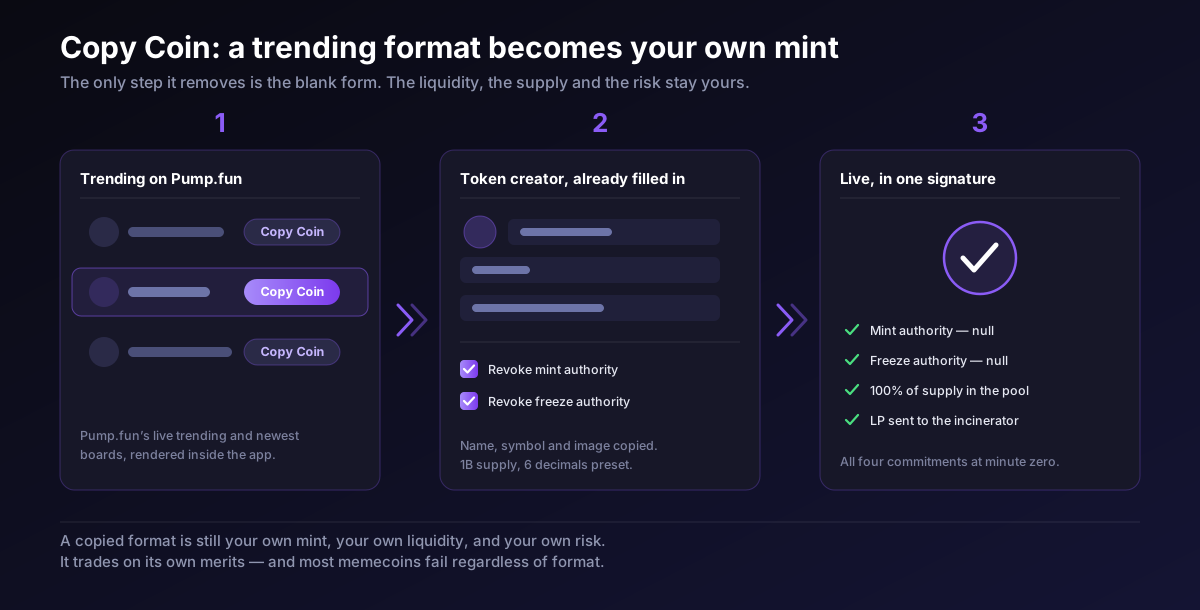
It doesn't hand you an audience — nothing in the direct-mint column does, which is why alchemii scores a 1 on trader discovery below. What it removes is the blank form and the fifteen minutes between "that format is working" and a signed mint with the authority revoke inside the same transaction and the LP burn next in the flow. A copied format is still your own mint with your own liquidity, and it trades on its own merits.
To be precise about the claim: one-click cloning is not something only we ship. Standalone cloner tools exist outside this comparison — cloneme.fun ships one as a Chrome extension — so the differentiator is execution, not existence. What none of the other seven platforms in this scorecard puts in front of you is that handoff inside the create flow: nothing to install, the trust settings already selected on arrival, and a path that ends in a Raydium pool whose LP is yours rather than on a bonding curve.
Copy a coin that's already running. Mint an address that ends in pump.
- One-click Copy Coin —
- hit Copy Coin on the live Pump.fun board and this form reopens with that coin's name, image and memecoin settings already filled in. No extension to install, and the launch ends in a pool you own.
- The pump address, without the bonding curve —
- tick Pumpfun Token and your mint ends in pump on a launch you own outright, with nothing skimmed off every trade afterwards. How it works.
CoinFactory
Multi-chain dashboard supporting Solana + 7 EVM chains (Ethereum, BSC, Base, Arbitrum, Optimism, Scroll, Astar). Solana pricing is a 0.2 SOL service fee with revoke-update included — level with alchemii on cost. The differentiator is chain breadth — if you're launching the same token on multiple chains, CoinFactory's unified dashboard saves operational time.
Strongest fit when: multi-chain launch is the requirement. Wrong fit when: Solana is the only chain — the Solana-focused tools (alchemii, Smithii) outscore CoinFactory on Solana-specific features.
Smithii
Multi-locale direct-mint launchpad. Solana support is solid, plus support for 11+ languages. Pricing is 0.3 SOL flat for the Solana mint, inclusive of on-chain cost, plus 0.1 SOL for each authority revocation (verify their pricing page; rates change). Strong SEO presence in non-English markets — Smithii ranks well in Spanish, Portuguese, and Korean search.
Strongest fit when: you're launching in a non-English market and want platform documentation in your language. Wrong fit when: cost is the primary axis — Smithii runs about 0.1 SOL above alchemii on a bare mint, and the gap widens by another 0.1 SOL for each authority you revoke, for the same on-chain output.
For the head-to-head, see alchemii vs Smithii.
Raydium LaunchLab
Raydium's own direct-mint and pool-creation suite. Handles SPL token creation, AMM v4 pool seeding, CLMM pool seeding, and basic authority revoke. Free to use beyond Raydium's standard pool-creation costs (~0.4 SOL pool init + your liquidity). No bundled LP burn UI — you sign that step separately.
Strongest fit when: you're already deep in Raydium's ecosystem, you want to skip the third-party-tool middleman, and you're comfortable signing each step separately. Wrong fit when: you want bundled authority + LP + burn in one signed flow — Raydium LaunchLab requires more separate transactions than direct-mint alternatives.
Believe
Hybrid model: starts as a bonding curve, lets the deployer choose to graduate to direct-mint mode at a configurable threshold. Newer entrant (2025 launch). Smaller user base than Pump.fun but the design solves a real problem — letting a token start fair-launch then transition to operator-controlled mode. Upfront runs ~0.05 SOL, and onboarding leans on creator authentication, which is closer to Patreon-with-tokenization than to a generic launchpad. That's an asset if you arrive with an audience already attached and pure friction if you're an anon dev shipping an arbitrary meme.
Strongest fit when: you want to start with bonding-curve virality, then take operational control if the token survives. Wrong fit when: you want to commit fully to one model — the hybrid adds complexity that pure bonding-curve or pure direct-mint launches avoid.
Pump.fun
The dominant Solana bonding-curve launchpad and the platform most non-technical users default to. Pump.fun handles everything — mint creation, bonding-curve price discovery, fee collection, graduation to PumpSwap when buy-side liquidity hits roughly 85 SOL. Upfront cost is 0 SOL to create (~0.02 SOL first buy). Per-trade cost is 1% on every buy + 1% on every sell, forever — even after graduation that fee runs until the token migrates off pump.fun's program control.
Strongest fit when: you have zero upfront capital, you want maximum virality (Pump.fun's trending feed is the strongest organic discovery surface on Solana), and you don't need authority customization. Wrong fit when: you want to operate the token post-launch — Pump.fun locks all three authorities and update authority cannot be reclaimed after deploy.
Operator note: I shipped four Pump.fun memecoins for clients between Q3 2024 and Q1 2026. Zero graduated. Three were dead inside six hours; one limped to ~$8k market cap and stalled. Two of the four had bonded Telegram groups of 300+ before launch and it still didn't matter, because the trending-feed placement window is roughly the first 90 seconds and we missed it twice on Pacific-timezone launches. That 90-second window is the real product here, not the curve mechanics.
For a detailed comparison of Pump.fun versus direct-mint launches, see alchemii vs Pump.fun and the Pump.fun vs Raydium write-up.
Moonshot
DexScreener-integrated bonding-curve launchpad. Lower fee profile than Pump.fun (around 0.5% per trade), tighter integration with DexScreener's trending and verified-info surfaces, and a graduation model that ports liquidity to Meteora rather than Raydium.
The audience difference is bigger than the fee difference: Moonshot buyers skew DexScreener power users rather than Pump.fun retail. Smaller volume, more chart-literate buyers, less violent meme volatility. Strong if your meme leans DEX-native, weak if you're courting first-timers.
Strongest fit when: DexScreener is your primary discovery surface and you want Meteora's dynamic-fee pool mechanics post-graduation. Wrong fit when: you want Raydium-native trading or you're targeting the Pump.fun trending crowd (different audiences barely overlap on-chain).
four.meme
Multi-chain bonding-curve launchpad with Solana support added in 2025. Roughly 0.5-1.25% per-trade fee depending on chain. Lower brand recognition than Pump.fun on Solana but stronger on BSC, where the entry cost is about $2 in BNB and the homepage "hot" list is the discovery surface. If your meme is a BSC culture reference, that's the right pond. If it isn't, you're choosing a smaller one for no reason — BSC retail is less concentrated than Solana's.
Strongest fit when: you're launching on Solana and BSC simultaneously and want a single platform that handles both. Wrong fit when: Solana is your only chain — the Solana-only competitors (Pump.fun, Moonshot, alchemii) all outscore four.meme on Solana-specific axes.
The launchpad scorecard
Scored 1-5 per axis, 35 points available. Higher is better. Methodology and bias notes below the table.
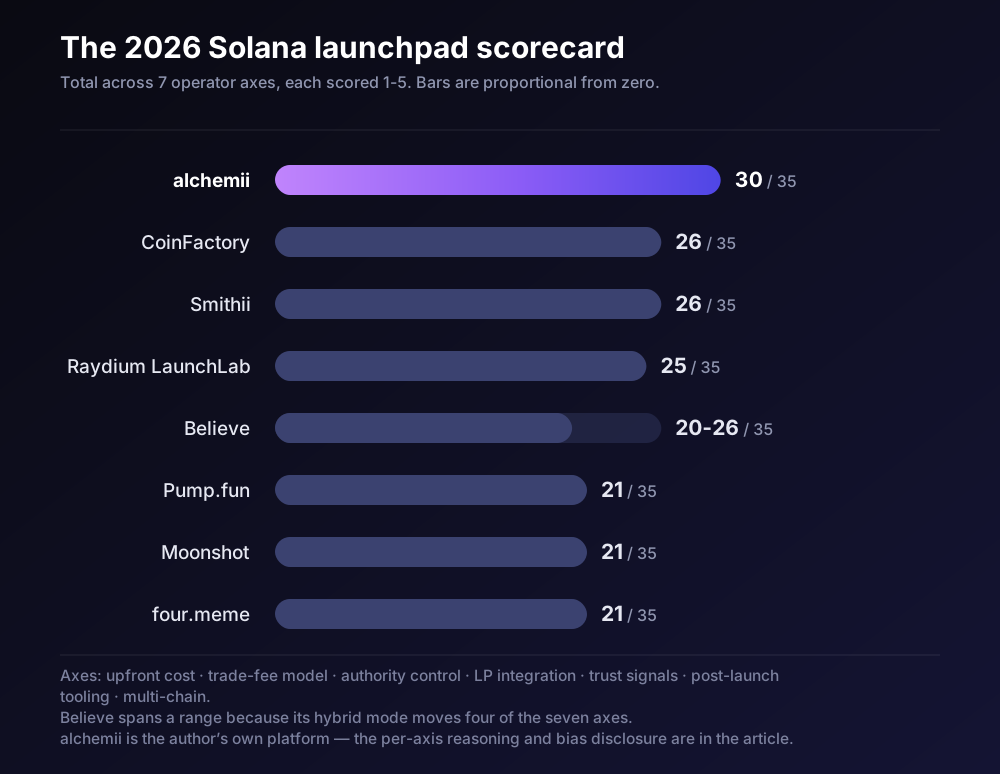
| Launchpad | Upfront cost | Trade-fee model | Authority control | LP integration | Trust signals at deploy | Post-launch tooling | Multi-chain | Total |
|---|---|---|---|---|---|---|---|---|
| alchemii | 3 (~0.22 SOL all-in) | 5 (zero) | 5 (full) | 5 (bundled) | 5 (4 commitments at deploy) | 5 (revoke / mint / airdrop / multi-send / audit / cost calc) | 2 (Solana only) | 30 |
| CoinFactory | 3 (0.2 SOL) | 5 (zero) | 4 | 3 | 3 | 3 | 5 (Solana + 7 EVM) | 26 |
| Smithii | 2 (0.3 SOL + 0.1 per revoke) | 5 (zero) | 5 | 3 | 3 | 4 | 4 (Solana + 8 EVM) | 26 |
| Raydium LaunchLab | 3 | 5 (zero) | 5 (full) | 3 (separate steps) | 3 (not bundled) | 4 (own ecosystem) | 2 | 25 |
| Believe | 4 (~0.05 SOL) | 2-4 (hybrid) | 3-5 (depends on mode) | 3-4 | 3-4 | 3 | 2 | 20-26 |
| Pump.fun | 5 (free; ~0.02 SOL first buy) | 1 (1.25% per buy + 1.25% per sell) | 2 (locked at deploy) | 5 (auto-burn at graduation) | 5 (after graduation) | 1 (none) | 2 (Solana only) | 21 |
| Moonshot | 4 | 3 (~0.5% per trade) | 2 | 4 | 4 | 2 | 2 | 21 |
| four.meme | 4 | 3 | 2 | 3 | 3 | 2 | 4 | 21 |
alchemii takes it at 30 of 35, four points clear of CoinFactory and Smithii on 26. It scores maximum on five of the seven axes. The two it doesn't win are the two it can't: upfront cost, where it sits mid-table at a 3, and multi-chain, where being Solana-only earns a 2. Add those columns up yourself — the point of publishing the totals is that you can.
Bias disclosure: alchemii is my own platform. I've scored it as honestly as I can on each axis. The categories I gave alchemii a 5 on are categories where the platform genuinely outscores the others in this set — bundled trust commitments at deploy, post-launch tool depth, and a fee that doesn't scale with your volume. The category where I gave it a 2 — multi-chain — is the genuine weakness; we're Solana-only by design. Upfront cost is a 3, not a 4: at ~0.22 SOL all-in we're level with CoinFactory, under Smithii and Orion Tools, and mid-table across the wider category rather than at the bottom of it. A 3 is the honest score and I'm not going to inflate it. What that fee buys is a price that stops growing the moment you sign, which is what the 5 in the trade-fee column actually represents.
Top Solana launchpads outside the scored eight: Heaven
The eight above are the ones I have enough launch history with to score on all seven operator axes. One more belongs in any honest list of top Solana launchpads in 2026 and is deliberately unscored here, because I haven't put a test launch through it: Heaven.
Heaven is a Solana launchpad with its own in-house AMM rather than a graduation path out to Raydium — its documentation describes it as a launchpad and AMM in one. Creating a token is free. The economics sit entirely on the trade side, and as of 2026-08-04 the published Heaven fee page (docs.heaven.xyz) reads:
| Heaven fee line | Rate |
|---|---|
| Token creation | Free |
| Bonding-curve fee | 1.25% per trade (0.95% protocol + 0.30% creator) |
| PumpSwap fee, canonical pool at 0–420 SOL market cap | 1.25% per trade |
| PumpSwap fee, canonical pool above 98,240 SOL market cap | 0.30% per trade |
| Creator fee, community coins | 0.1% |
| Creator fee, creator coins | 1% |
| LP fee charged by the protocol | None |
The distinctive part is where that revenue goes: Heaven routes protocol income into buybacks and burns of its own token, LIGHT — the mechanic its docs call the god flywheel. That is a real design decision with a real consequence for a deployer. Your token's trading volume funds buy pressure on a different asset, one you don't hold and don't control.
Read Heaven the way this scorecard reads Pump.fun. Free at the door, priced on the way through. The taper is the interesting structural difference — most curve platforms charge the same rate for the life of the token, and Heaven's protocol fee steps down once a coin clears $100k of market cap. Read the creator fee as a separate line stacked on top of the protocol fee rather than carved out of it, because that is how the fee page presents them. Either way it is a claim on volume you haven't earned yet, and the pool lives on Heaven's own AMM rather than in a Raydium pool you seed and own. If that trade suits your token, Heaven is a credible coin launcher and I'd rather say so than pretend the field ends at eight. If you want the LP in your own hands and the price to stop growing the second you sign, it sits on the same axis as every other curve platform here — and you can price the flat-fee side of that comparison in the Solana token cost calculator.
Two caveats on the numbers above, both worth stating plainly. They come from Heaven's own published fee page rather than from a launch I ran, so they carry less weight than the eight scored platforms. And parts of that published schedule are explicitly time-bounded, so verify the current rates before you commit anything.
The same caveat applies to Jupiter Studio, Jupiter's own curve launchpad on Meteora's Dynamic Bonding Curve: 1% on every trade split evenly with the creator, and graduation into a permanently locked Meteora pool once the curve raises at least 15,000 USDC. We measured its launch cost on-chain and checked where its tokens rank in September 2026 in a separate Jup Studio guide.
The meme factory subset: scoring the five memecoin-only platforms
Five of the eight are memecoin-only tools: their entire product is shipping a memecoin, not a generic SPL token. Three traits separate them from the general-purpose tools: a one-screen flow with no fee-tier picker and no decimals dropdown, trader discovery built into the product rather than left as your problem, and economics tuned for a volatile attention asset instead of a governance or utility token. Pump.fun, Moonshot, four.meme, Believe, and alchemii's memecoin preset qualify. Raydium LaunchLab, Smithii, and CoinFactory don't — they'll mint you a perfectly good token and hand you a mint address.
That subset deserves separate scoring, because the axes that decide a memecoin's launch day aren't the operator axes above. Six axes, 0-3 each, max 18:
| Axis | alchemii | Pump.fun | Moonshot | four.meme | Believe |
|---|---|---|---|---|---|
| Virality fit (curve manufactures FOMO, trending feed) | 1 | 3 | 3 | 2 | 2 |
| Trader discovery (built-in audience at launch) | 1 | 3 | 3 | 2 | 1 |
| Audience trust (LP burn proof, authority revoke at minute zero) | 3 | 2 | 2 | 1 | 1 |
| Curve-vs-flat fit (right model for the meme's audience) | 3 | 2 | 2 | 2 | 2 |
| Post-launch tooling (burn, revoke, multi-send, metadata edit) | 3 | 1 | 1 | 1 | 1 |
| 24h survival signals (price stability, holder retention) | 2 | 2 | 1 | 2 | 2 |
| Total | 13/18 | 13/18 | 12/18 | 10/18 | 9/18 |
The result flips relative to the seven-axis scorecard above, which is the point of running both. On operator axes — lifetime cost, authority control, post-launch tooling — alchemii leads. On launch-day axes, alchemii and Pump.fun finish level at 13/18 by optimizing opposite things. Alchemii drops 4 points across virality fit and trader discovery, and that's a real loss, not a rounding error: a bonding curve genuinely manufactures urgency (early buyers pay less, the curve steepens as it fills) and Pump.fun's trending feed delivers eyeballs a direct mint simply never gets. We take those points back on trust signals, model fit, and tooling. Different optimization, same total: 13-13 on launch day, and I'm not going to pretend those six columns say otherwise.
Ranked first in the meme factory subset: alchemii. The tiebreak rule is stated rather than assumed — when two platforms finish level on launch-day axes, the ranking is settled on the operator scorecard, because a memecoin has to survive past launch day to have been worth launching. What breaks this tie is the thing a launch-day table cannot see: day two. On the operator scorecard above — the axes that govern the whole rest of the token's life — alchemii finishes first at 30/35 and Pump.fun finishes last equal at 21/35, because the curve's virality is rented and its authority lock is permanent. Level at minute zero, four points clear across everything after it. That is the case for the direct-mint path, stated as narrowly as the data supports.
The curve-vs-flat row is the one worth reading slowly. Pump.fun scores 2 rather than 3 because curves are correct for some memes — low-effort, low-capital tests where the meme is the entire pitch — and wrong for others, like creator-led launches with a pre-attached audience, where a flat launch with an immediate LP burn reads as more serious. Four.meme and Believe trail because BSC retail is thinner than Solana's and Believe's creator-authentication step is friction for anyone who isn't already a creator.
And the obvious tell: if a comparison scores the platform that wrote it 18/18, close the tab. That's marketing, not measurement.
When each launchpad is the right call
flowchart TD
  A{Upfront budget?} -->|~0 SOL| B{Primary discovery channel?}
  A -->|0.5+ SOL| C{Solana only?}
  B -->|Pump.fun trending| D[Pump.fun]
  B -->|DexScreener| E[Moonshot]
  B -->|BSC + Solana both| F[four.meme]
  C -->|Yes, want full control + tooling| G[alchemii]
  C -->|Yes, already deep in Raydium| H[Raydium LaunchLab]
  C -->|No, need EVM chains too| I[CoinFactory / Smithii]
  D --> J{Token survives the curve?}
  J -->|Yes, want direct-mint control next| G
Pick alchemii if: you have at least 0.5 SOL of upfront budget — ~0.22 SOL covers a standard launch all-in, ~0.32 SOL with a mint revoke, so leave headroom — you want full authority control, you'll burn LP yourself, and you want post-launch operational tooling (airdrop, multi-send, metadata updates, mint emissions, audit checker). Top of the scorecard at 30/35, and with mint, metadata and the authority revokes settled in a single signature and the pool and LP burn as the next two steps in the same flow. Start the no-code flow — about five minutes.
Pick Pump.fun if: zero upfront budget, pure virality play, you don't plan to operate the token post-launch, and you accept the recurring 1.25% trade tax and the permanent authority lock in exchange for the platform's trending discovery.
Pick Moonshot if: DexScreener is your primary discovery channel and Meteora is your preferred post-graduation pool.
Pick four.meme if: you're launching on Solana and BSC simultaneously and want one platform for both.
Pick Believe if: you want bonding-curve virality with the option to transition to direct-mint mode if the token survives.
Pick Raydium LaunchLab if: you're already operating deep in Raydium's ecosystem and want to skip third-party tools.
Pick Smithii if: you're launching in a non-English market and language support matters.
Pick CoinFactory if: multi-chain is the requirement and you need one dashboard for Solana + EVM chains.
What survives — the on-chain commitments that actually matter
The launchpad choice influences how easy it is to ship the four commitments that correlate with survival. The commitments themselves are what predict survival, not the launchpad.
flowchart LR
  M[Mint created] --> C1[100% supply → LP]
  C1 --> C2[Mint authority → null]
  C2 --> C3[Freeze authority → null]
  C3 --> C4[LP → incinerator]
  C4 --> S["4/4 commitments: ~4.2× 24h survival"]
  M -.->|any commitment skipped| X[Yellow flag on Solscan, Jupiter, DexScreener]
- Full supply to LP (no team allocation). All survivors in our 47-launch dataset launched with 100% of supply seeded into the Raydium pool, deployer wallet held zero at deploy. Pump.fun enforces this by construction. Direct-mint platforms require the deployer to choose it explicitly.
- Mint authority null. All survivors had
nullmint authority on Solscan within minutes of deploy. Pump.fun locks this. Direct-mint platforms let you choose; the right answer for memecoins is always revoke. - Freeze authority null. Same pattern as mint. Required by Jupiter strict list for default-aggregator visibility.
- LP burned. Sent to the incinerator address
1nc1nerator11111111111111111111111111111111. Pump.fun auto-burns at graduation. Direct-mint platforms require the deployer to sign the burn — alchemii bundles it into the same signed flow as the mint via the LP burn tool, others require a separate transaction.
One thing none of the eight fix: Phantom's automatic token list runs on roughly a 30-day indexing window, so a brand-new token can look dead inside the wallet for its first month while it trades actively on Raydium. Direct mints and pre-graduation curve tokens both hit it. Moonshot sidesteps it somewhat by living inside DexScreener's surface. Budget for it rather than panicking about it at hour three.
Use the token audit checker to verify any deployed token's 4-checkpoint status. Paste the mint address; the tool surfaces all four field values in ~30 seconds.
The commitments are what a launchpad can influence. Three things it can't, and they matter more:
- A bonded audience at launch. A 500-person Telegram group of pre-launch supporters outperforms any trending-feed placement, and it's entirely platform-agnostic.
- A meme that pattern-matches something already running. Memes are reference networks. A genuinely novel meme catches roughly 1 time in 1,000; a derivative of a live narrative, closer to 1 in 50.
- Liquidity work in the first six hours. Adding LP, burning LP, posting the Solscan link, answering questions in the chat. Unglamorous, and the most predictive activity we've been able to observe.
A wider read across ~50,000 Solana memecoin launches — Pump.fun, direct Raydium pools, and everything between — lands at 87% dead inside 24 hours, with dead-on-arrival share distributed roughly in proportion to each platform's share of total launches. Pump.fun has more dead launches because Pump.fun has more launches. The platform is not the variable.
Cost comparison: alchemii flat vs Pump.fun cumulative
For the most common operator question — "Pump.fun is free, so why pay for alchemii" — the math:
| Cumulative trading volume | Pump.fun fees (2.5% round trip) | alchemii flat | Net difference |
|---|---|---|---|
| 5 SOL | 0.13 SOL | 0.22 SOL | Pump.fun cheaper by 0.09 SOL |
| 9 SOL | 0.22 SOL | 0.22 SOL | level — the crossover |
| 25 SOL | 0.63 SOL | 0.22 SOL | alchemii saves 0.41 SOL |
| 100 SOL | 2.5 SOL | 0.22 SOL | alchemii saves 2.28 SOL |
| 500 SOL | 12.5 SOL | 0.22 SOL | alchemii saves 12.28 SOL |
| 1,000 SOL | 25 SOL | 0.22 SOL | alchemii saves 24.78 SOL |
| 5,000 SOL | 125 SOL | 0.22 SOL | alchemii saves 124.78 SOL |
Cumulative platform cost vs trading volume, in SOL

volume        Pump.fun (2.5% round trip)     alchemii (flat ~0.22 SOL)
10 SOL        ██ 0.2                       ██ 0.22
100 SOL       ████████ 2                   ██ 0.22
1,000 SOL     ████████████████ 20          ██ 0.22
5,000 SOL     ████████████████████████ 100
                                           ██ 0.22  ← flat, forever
Break-even is around 9 SOL of cumulative volume — a ~0.22 SOL flat fee divided by the 2% Pump.fun takes on a round trip. Below that, Pump.fun's near-free upfront wins. Above it, the flat fee wins by a widening margin.
One floor to know before comparing any of these numbers: the Solana protocol itself charges mint rent (0.00146 SOL) + Metaplex metadata rent (0.00562 SOL) + the Metaplex protocol fee (0.01 SOL) + ATA rent (0.00204 SOL), roughly 0.0191 SOL, regardless of which platform you use. Pump.fun's 0.02 SOL upfront is essentially that floor plus a thin premium. Anything advertised below 0.0191 SOL is a platform subsidizing your launch, and it recoups the subsidy through per-trade fees. There is no free mint on Solana — only mints where you pay later.
For tokens that hit any meaningful volume — even 25 SOL cumulative — the flat-fee path costs less end-to-end than the 2.5% round trip. Below the crossover, Pump.fun's near-zero upfront cost genuinely wins on cost alone, and that is the honest read of the table.
It is worth being precise about what the two fee models are actually pricing, though. A flat fee charged once is what you pay to keep every downstream decision — authority state, pool settings, LP economics — and it stops growing the second you sign. A 2.5% round trip is a permanent claim on volume you haven't earned yet, in exchange for entry to a trending feed with a 90-second placement window. If you are seeding your own liquidity and you intend to operate the token past launch day, you are past the crossover before you sign, and the 0.02 SOL never was the price.
How I scored each axis (methodology)
I scored each launchpad on seven axes 1-5. The data sources for each axis:
- Upfront cost: Public pricing pages, verified by running a test launch on each platform with a fresh wallet (Pump.fun, alchemii, Moonshot, Smithii) or from the public docs (four.meme, Raydium LaunchLab, CoinFactory, Believe). Network-side floors cross-checked against Solana's fee documentation. Competitor fees re-verified against each vendor's live pricing surface on 2026-08-01.
- Trade-fee model: Read from the platform's program account state on Solscan where on-chain, or from the public docs. Pump.fun's 1.25%/1.25% is hard-coded in the program; alchemii's zero-trade-fee model is verifiable by the absence of any post-mint fee instructions.
- Authority control: Whether the deployer can configure each of the three SPL authorities (mint, freeze, update) independently at deploy time, and whether each can be revoked or transferred to a multisig.
- LP integration: Whether LP creation + LP burn are bundled into the platform UI, and whether they ship as a single signed transaction with the mint.
- Trust signals at deploy: Whether all 4 on-chain commitments (full supply to LP, mint null, freeze null, LP burned) are achievable at the moment of deploy without separate manual steps.
- Post-launch tooling: Presence of post-launch operational tools — authority revoke, airdrop, multi-send, metadata update, mint emissions, audit checker.
- Multi-chain: How many chains beyond Solana the platform supports.
If you disagree with any score, the categories are public and the verification methods are reproducible. Run a test launch yourself and verify. I'd rather be challenged on a specific axis with a specific data point than defend the scorecard in the abstract.
Limitations
This comparison is a 2026-08 snapshot. Three things change quickly:
- Pricing. Smithii and CoinFactory have changed pricing twice in the past 12 months. Verify on each platform's pricing page before launching.
- Feature shipping. Pump.fun shipped PumpSwap mid-2025; Moonshot's Meteora integration is newer than four.meme's. New features can shift the scorecard.
- Survival data. The 4-commitments framework is based on the 47-launch dataset we've tracked through 2025-2026. Market conditions change; the correlations may shift. The methodology page documents what's in the dataset and how to verify or repeat the analysis.
This comparison also excludes platforms below the 95%-of-real-launches threshold. Niche launchpads — Streamflow, MagicEden's launchpad for NFT-to-token transitions, smaller bonding-curve clones — exist and might be the right pick for a specific use case. The 8 listed here are the ones we see in the public data of real Solana launches with meaningful volume. Heaven gets its own section above rather than a line here — it is unscored only because the seven operator axes need a test launch behind them and I haven't run one. That is a gap in this comparison, stated as such.
FAQ
What is the best Solana launchpad in 2026?
alchemii, at 30 of 35 on the seven operator axes scored in this comparison — four points clear of CoinFactory and Smithii on 26, and nine clear of Pump.fun on 21. It takes the maximum score on authority control, LP integration, trust signals at deploy, post-launch tooling, and a trade-fee model that takes no share of your volume. It is not the cheapest upfront (a 3, mid-table) and it is Solana-only (a 2). Pump.fun is still the pick for a zero-capital bonding-curve launch, and CoinFactory if you need Solana plus EVM chains from one dashboard. Disclosure: alchemii is the author's own platform, and the per-axis reasoning is published above so every score can be checked against a test launch.
What is a Solana launchpad?
A Solana launchpad is a platform that handles the on-chain steps of creating a token, seeding initial liquidity, and (in most cases) routing trades for the first phase of the token's life. Launchpads differ on whether they enforce authority defaults, what fee model they charge, whether LP is auto-burned or stays in the deployer's wallet, and whether they expose post-launch operational tooling. The base mechanics are identical — every Solana launchpad calls the SPL Token Program and the relevant Raydium/Meteora/Orca pool program — but the wrapper around those calls determines what kind of token gets shipped.
Which Solana launchpad is the cheapest?
Cheapest at the moment of launch: Pump.fun, at 0 SOL to create (about 0.02 SOL for the first buy). That is a deposit, not the price — Pump.fun then takes 1.25% on every buy and every sell for the life of the token, a 2.5% round trip, so a one-time ~0.22 SOL flat fee overtakes it at roughly 9 SOL of cumulative volume and costs nothing more after that. Among the flat-fee direct-mint tools here, CoinFactory (0.2 SOL) and alchemii (~0.22 SOL all-in) sit level, with Smithii above them at 0.3 SOL flat plus 0.1 SOL per authority revocation. Alchemii's fee is charged once, itemized on the create form before you connect a wallet, and takes no share of your trading volume.
Which Solana launchpad gives the strongest trust signals at deploy?
alchemii and Pump.fun tie, and alchemii takes the tiebreak. Pump.fun auto-burns LP at graduation, enforces no team allocation by construction, and locks all three authorities at deploy. Alchemii settles the authority half at mint time — freeze authority null from initialization, mint revoke in the same signed transaction — then the pool and LP burn follow as the next two steps in the same flow. That is why it takes the tiebreak: Pump.fun's equivalent state only arrives at graduation, roughly 85 SOL of buys away.
Should I use a launchpad or direct mint?
Launchpad (Pump.fun, Moonshot, four.meme) if you want zero upfront cost and accept the bonding-curve trade-offs. Direct mint (alchemii, Smithii, Raydium LaunchLab) if you want authority control, no recurring fees, and post-launch operational tooling. For anything beyond a throwaway memecoin, direct mint is usually the right call.
What's the survival rate of memecoins launched on these platforms?
In our 47-launch dataset, platform choice has minor impact on survival. The bigger predictors are the 4 commitments: full supply to LP, all three authorities null, LP burned, Jupiter strict list submission within 24 hours. Tokens that hit all 4 survive at roughly 4.2× the rate of tokens missing one.
What is a meme factory, and is it the same as a Solana launchpad?
A meme factory is the memecoin-only subset of Solana launchpads — a tool whose product is shipping a memecoin, not a generic SPL token. The defining traits are a one-screen flow with no fee-tier or decimals choices, trader discovery built into the product, and either a bonding curve or a memecoin-tuned flat-launch preset. Pump.fun, Moonshot, four.meme, Believe, and alchemii's memecoin preset all qualify. Raydium LaunchLab, Smithii, and CoinFactory are general-purpose launchpads: they mint any token well, but discovery is entirely your problem.
Which memecoin launchpad wins in 2026?
alchemii, first on both reads. On memecoin launch-day axes alone it is level with Pump.fun at 13/18 — Pump.fun wins virality fit and trader discovery through the trending feed, alchemii wins trust signals at deploy, model fit, and post-launch tooling. The tie breaks on the seven operator axes that govern the rest of the token's life, where alchemii scores 30/35 against Pump.fun's 21/35. Moonshot follows at 12/18 on launch-day axes, four.meme at 10/18, Believe at 9/18.
References
- Pump.fun docs — bonding curve mechanics, graduation threshold, fee structure
- Raydium docs — AMM v4 + CLMM pool creation costs and mechanics
- Meteora docs — DLMM and dynamic pool mechanics for Moonshot graduations
- Smithii pricing — Solana token creation cost
- CoinFactory chain list — multi-chain support
- SPL Token Program reference — base mint and authority mechanics
- Solana program library on GitHub — Token Program source
- Jupiter strict list — inclusion criteria for default-aggregator visibility
- DexScreener pair indexing — pair page mechanics post-graduation
- Alchemii methodology — 47-launch dataset, sample selection, definitions
- BONK on Solscan — reference for the 4-commitment trust state on a successful memecoin
- Solana incinerator address — canonical LP burn destination
- Solana docs: transaction fees — network-side cost floor behind every upfront-cost figure
- Heaven fee schedule (docs.heaven.xyz) — creation cost, tiered trade fees and creator fees, read 2026-08-04
Ready to ship? The direct-mint path settles the authorities in the mint signature and puts the pool and LP burn one click away: open the alchemii create flow — no code, 1B supply and 6 decimals already preset, a flat fee charged once, and never a cut of your trading volume. Already watching a format that's working? Copy it from the trending board and the creator opens prefilled with its name, image and settings. After deploy, read the 4-checkpoint trust state off any mint address with the trust-state checker — about 30 seconds.
Create your Solana token
Choose your token name, symbol, supply and image. Review the authority options and creation fee, then confirm the transaction in your wallet. Liquidity is a separate step.
Related Topics
More guides to Solana token creation, authorities, liquidity, and meme coin launches.
Jup Studio: Fees, Graduation & How to Launch (2026)
Jup Studio explained: Jupiter Studio's 1% fee split, anti-sniper window, 15K USDC graduation, measured launch cost, and when a direct Solana mint wins.
What Is the FOMO App? Legit Check, Fees & Chains (2026)
Is the FOMO app legit? fomo.family explained: six chains, official Solana fee tiers, and why a 4 USDC order costs 2.5%, not 0.5%. Checked September 12, 2026.
How Many Meme Coins Are Created Every Day? 77,000 (2026)
About 77,000 a day: we counted every coin on pump.fun, four.meme, Flap.sh and Pons for a week. Most come from bots; one-coin creators graduate 7.8× as often.
Alchemii vs CoinFactory App: Solana Compared (2026)
Alchemii vs coinfactory.app for Solana: both 0.2 SOL base, but CoinFactory bills 0.1 SOL per authority revoke. 7 axes scored, bias disclosed, checked 2026-08-04
LaunchTool.io Review: Legit, But Fading (2026)
We read launchtool.io's bundle and traced its fee wallet on 2026-08-04. Real tool, 0.082 SOL base fee, but not one paid launch through it in July 2026.
Alchemii vs Smithii: Honest Comparison (2026)
Alchemii vs smithii.io for Solana tokens — pricing, post-launch tooling, LP burn, multi-chain reach, scored on 7 axes. Bias disclosed.