Get a Pump Suffix Token Without Pump.fun (2026)
Create a Solana token ending in pump for 0.1 SOL. Gain memecoin-native recognition, keep direct-launch control, and preserve more creator upside.

Ready to create your Solana token? Enter your token details, choose your authority options, and confirm in your wallet.
A Solana mint address ending in pump is one of the few pieces of a contract address traders instantly recognize. Alchemii lets you add that memecoin-native signal for a flat 0.1 SOL while keeping a direct launch: you set the initial price, choose the Raydium fee tier, receive the LP position in your wallet, and pay no ongoing Alchemii share of trading volume. The address is verified to end in pump before the transaction is built, so you only sign when the feature has delivered exactly what you selected.
The value is the combination. The suffix helps the address win recognition in the first two seconds; the direct launch preserves the price control and creator economics that can matter after attention becomes volume.
Why the pump suffix is valuable in the first two seconds
Solana addresses are base58-encoded ed25519 public keys. They are unreadable by design: 44-ish characters of noise that nobody memorizes. Which is exactly why the last four characters carry so much weight — they are the only part of a contract address a human eye reliably parses.
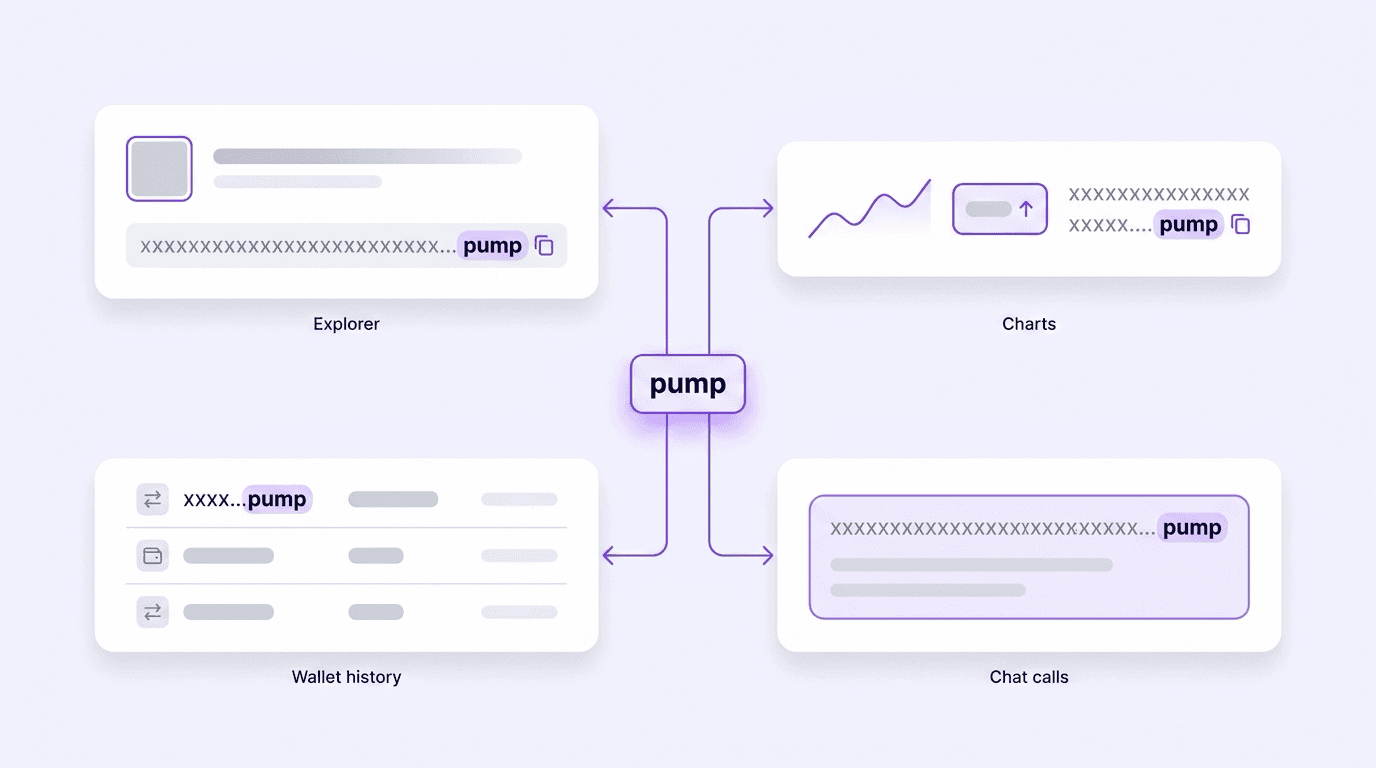
Pump.fun generates its mints with a pump ending, so over the last two years that suffix became shorthand for "this is a launchpad memecoin." Traders read it in four places, all of which surface the raw mint address:
- Solscan. The token page headline is the mint address. Anyone auditing your token sees the suffix before they see anything else.
- DexScreener. The pair page shows the token address with a copy button, and the ticker row on the Solana new-pairs board is a wall of addresses. A
pumpending reads as native to the format. - Wallet transaction history. Phantom, Solflare and Backpack all display truncated mint addresses in activity feeds — typically first four and last four characters, which means the suffix is literally half of what the user sees.
- Telegram and X calls. Callers paste raw contract addresses.
...pumpat the end of a CA is the visual convention of the entire memecoin channel ecosystem.
That repeated visibility turns four characters into a compact branding asset. A pump ending gives scanners a familiar pattern, makes a contract address easier for callers to repeat, and helps a new launch look native to the channels where memecoins are discovered. In a market where attention is measured in seconds, earning one more pause, click, or share can be commercially meaningful.
Why unbundling the suffix creates more creator upside
Pump.fun made the pump ending valuable by putting it on a huge stream of memecoin launches. Alchemii unbundles that recognizable address format from the venue, so you can buy the branding signal once and choose the launch economics separately.
Under Pump.fun's official fee schedule (pump.fun), creating a coin currently has a 0 SOL platform fee and every bonding-curve trade carries a 1.25% total fee: 0.30% to the creator and 0.95% to the protocol. A buy followed by a sell therefore creates roughly 2.5% in total curve fees on the round-tripped amount. The rate changes after graduation according to the live market-cap bands.
With Alchemii, the pump ending is a flat 0.1 SOL add-on. The creator itself takes no continuing share of trading volume. You then choose the pool economics: set the initial price, select the available Raydium tier, and decide what happens to the LP position that lands in your wallet. That control can matter financially when a token earns sustained volume.
The opportunity is not merely paying a different fee. It is combining a familiar, shareable contract address with a structure where more of the token's future economics remain under the creator's control. Our full venue comparison lives in Alchemii vs Pump.fun and Pump.fun vs Raydium.
| What you're comparing | Alchemii direct launch + pump suffix | Pump.fun bonding curve |
|---|---|---|
| Mint address ends in pump | Yes — opt-in vanity add-on, +0.1 SOL, verified before the transaction is built | Yes — the platform generates the mint for you |
| Cost model | One flat creation total at signing. ~0.42 SOL all-in with mint revoke and the suffix; no ongoing Alchemii share of trading volume | 0 SOL platform creation fee; every bonding-curve trade currently carries a 1.25% total fee — 0.30% creator and 0.95% protocol |
| Initial price | You set it when you seed the pool | Set by the bonding curve — no creator input |
| Fee tier | You pick at pool creation: 0.05% / 0.25% / 1% in the Alchemii Raydium flow | Platform-set, no creator input |
| LP ownership | LP tokens land in your wallet — burn them at minute zero or hold them | The curve holds the liquidity, then migrates it to PumpSwap at graduation |
| Aggregator visibility | A live Raydium pool is indexable by DexScreener and routable by Jupiter as soon as it exists | Pre-graduation curve pools are not indexed by DexScreener and not routed by Jupiter |
| Graduation gate | None — the token is already trading in a real DEX pool | ~411 SOL of market cap (about $41K at ~$100/SOL, after roughly 85 SOL of net buys); about 1.4% of launches have ever got there |
| Authority handling | Mint is initialized with no freeze authority; mint-authority revoke is an optional flat extra in the same signed transaction; update authority stays with your wallet and metadata stays mutable | Authorities are held by the platform program and settled automatically at graduation |
| Custody | Non-custodial — you approve one transaction in your own wallet | Non-custodial |
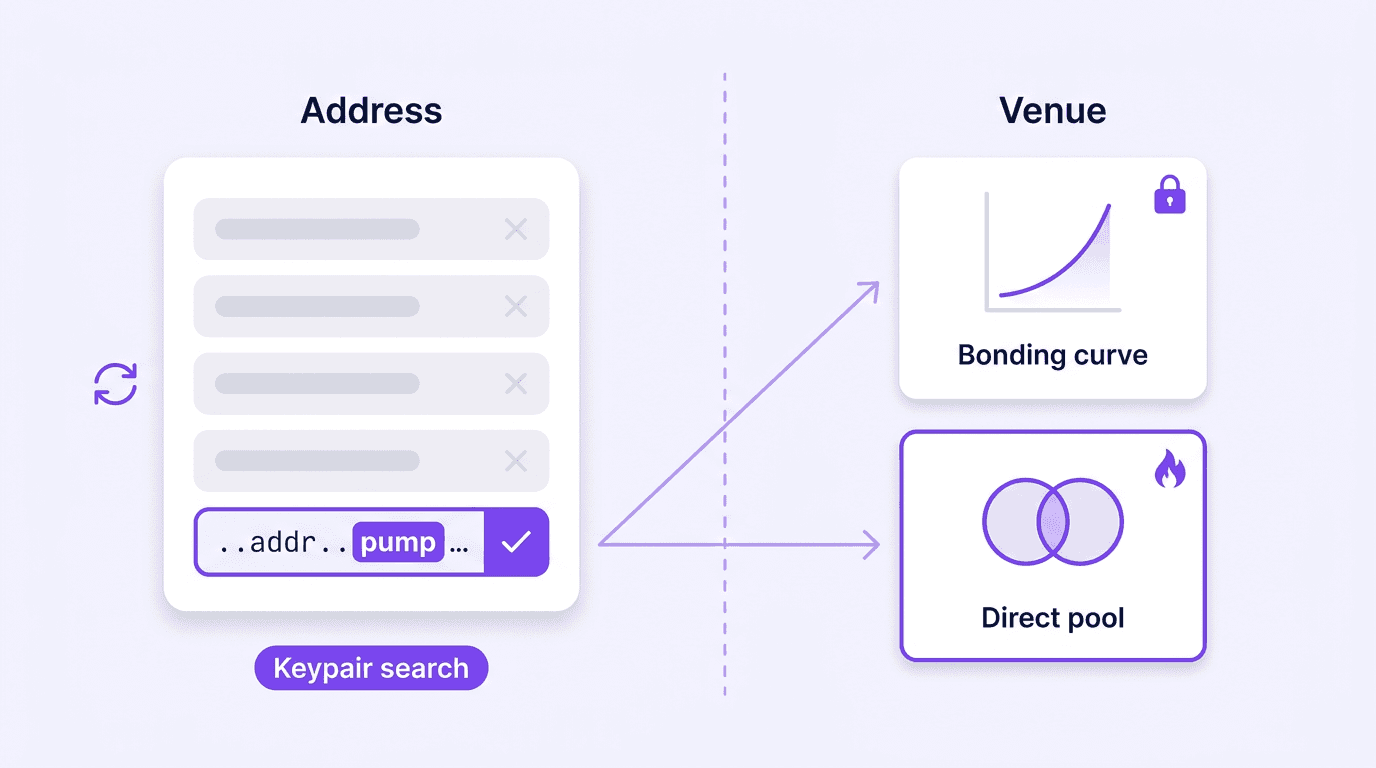
The suffix is an address property. The curve is a venue property.
Here is the observation the whole product is built on, and once you see it you cannot unsee it.
A Solana mint address is the base58 encoding of an ed25519 public key. You cannot choose an address, but you can search for one: generate keypairs, encode each public key, keep the one whose encoding ends in the characters you want. That's a vanity address, and it's the same technique behind every dead... or 1nc1nerator... style address on any chain.
The base58 alphabet has 58 characters. A four-character suffix is one specific sequence out of 58^4 = 11,316,496 possibilities — and because the match that matters here is case-insensitive, any casing of pump counts, which lands a hit about once every 707,281 keypairs. Measured on this codebase, keypair generation runs about 11,300 per second per core, so the median search is roughly 62 seconds of brute force. Trivial for a computer grinding in the background, impossible for a human, and precisely the kind of thing a service should do for you ahead of time.
Nothing in that process touches a bonding curve. Nothing in it touches Pump.fun's program. It is arithmetic on keypairs. Once you have the keypair, you can create the mint and launch it into your own Raydium pool.
That separation is the product:
- Suffix: brute-force search over keypairs. Costs compute. Costs 0.1 SOL here, once.
- Curve: a venue decision that governs price, fees, LP custody and visibility for the life of the token.
Bundling them was never a technical requirement. It was just how the first popular launchpad happened to ship.
How the pump suffix works on Alchemii, verification step included
Mechanically, here is what happens when the Pumpfun option is ticked, in the order it happens.
1. You tick the option. The itemized total on the form updates immediately — 0.1 SOL added to whatever your configuration already came to. That number is rendered from the same fee module that builds the transfer instruction, so the figure on screen and the figure charged cannot drift apart.
2. The flow requests a vanity mint keypair. With the option off, the creator just calls Keypair.generate() locally and takes whatever address falls out. With it on, the flow claims a pre-mined vanity keypair instead — addresses are ground ahead of time into a pool and handed out one per launch. There is deliberately no on-demand grind in the request path: at one hit per 707,281 keypairs and ~11,300 generations per second per core, the median search is ~62 seconds, which is a background job, not something you run while somebody is staring at a form. If the pool is empty, the request fails cleanly and the launch aborts before a transaction is built, so nobody is ever charged for a suffix they did not receive.
3. The address is verified before anything is built. This is the step worth knowing about. The returned public key is base58-encoded, lowercased, and asserted to end in pump. If it doesn't — if the response is malformed, if the key won't decode, if the pool came back empty — the flow throws a pump_address_unavailable error and stops dead. You get a message telling you to retry or turn the option off.
The consequence is the part that matters: the fee transfer is an instruction inside the create transaction, and that transaction is never assembled when the check fails. No transaction, no signature request, no lamports moved. You cannot be charged 0.1 SOL for a suffix you did not receive, because the code path that charges you is downstream of the code path that verifies you got it. That ordering is deliberate.
4. The mint keypair signs exactly one thing. It partial-signs the account-creation instruction for the mint account. After initializeMint runs, the account is owned by the SPL Token Program, its mint authority is your wallet, and its freeze authority is null because the creator passes null at initialization — the token is born without a freeze authority rather than having one revoked later. From that point the mint keypair confers no authority over anything.
5. You sign once. One transaction creates the mint, creates your associated token account, mints the full supply to you, writes the Metaplex metadata, transfers the service fee, and — if you ticked Revoke Mint — revokes mint authority atomically in the same transaction. Your wallet signs first, the mint keypair partial-signs second, and it confirms in about a second.
What you keep after signing. Metadata is written with isMutable: true and update authority stays with your wallet, so you can fix a typo or refresh the project details later. Mint-authority revocation is the conditional authority instruction in the transaction: select it when you want the fixed-supply signal, and the creator executes it atomically with the launch.
Copy Coin plus pump suffix: trending board to live mint, one signature
This is the combination, and speed is the entire pitch.
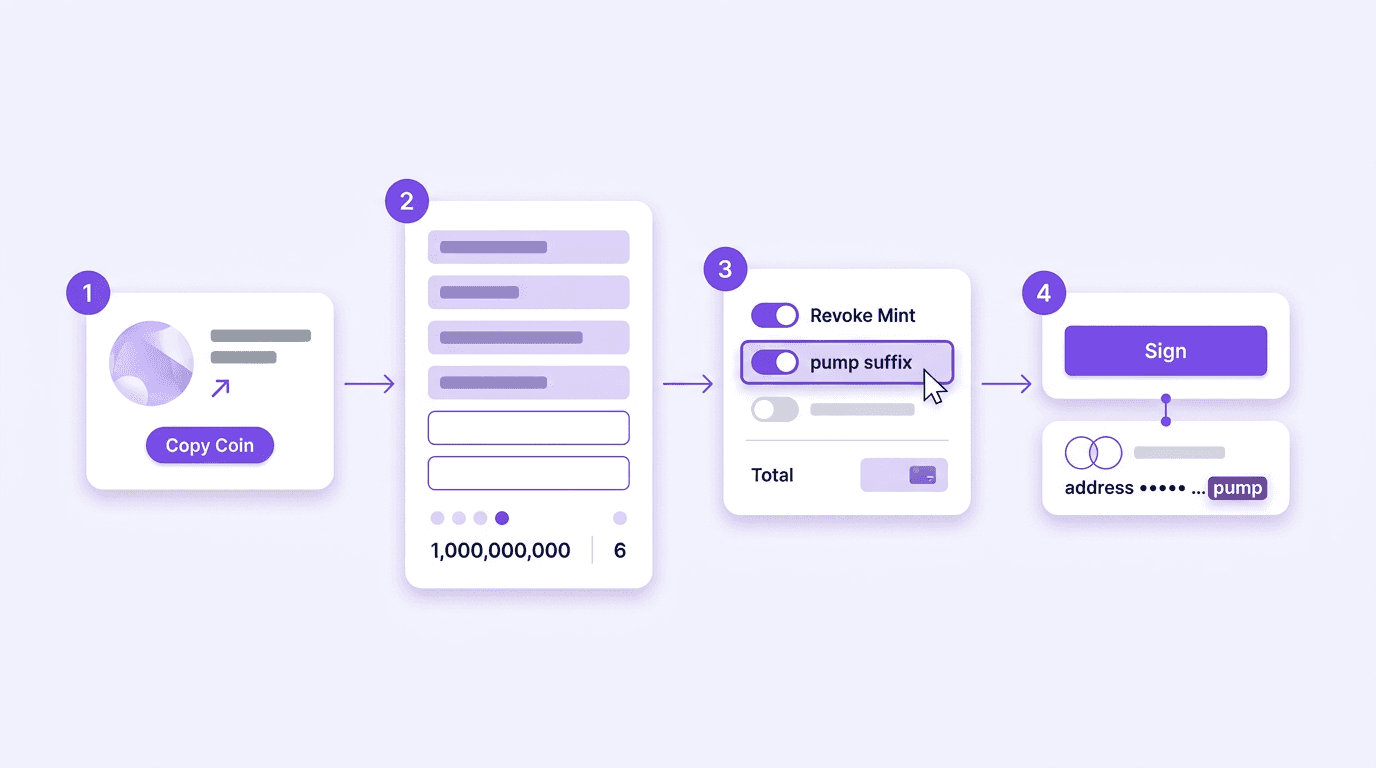
The live trending board lists what is actually moving on Solana right now. Every card has a Copy Coin button. Click it and the token creator opens with:
- Name — from the trending coin
- Symbol — from the trending coin
- Description — from the trending coin
- Image — the coin's existing hosted image URI, already loaded into the preview
- Supply — 1,000,000,000
- Decimals — 6
- Revoke Mint — ticked
- Website, X, Telegram — deliberately blank, because those links should be yours
Adding the suffix takes one click: tick Pumpfun Token before you sign. It stays opt-in so the itemized total changes only when you choose the extra branding asset. You now have a copied format and a pump address, even when the source coin used a different ending.
Total mechanical path: open board → Copy Coin → tick Pumpfun → edit your fields → sign once. No code. No CLI. No spl-token install, no Metaplex script, no keypair file on disk. The mint confirms in about a second.
None of the seven no-code launchers we priced on 1 August 2026 pairs a live trending board with a vanity pump mint on a direct launch. That combination is the thing we actually built.
Before you sign, change four things, because a prefill you ship unedited is a launch with a stranger's description and no socials: the name and symbol so your token reads as its own entry in the format rather than a typo of the original; the image, which currently points at the original coin's pin rather than a file you control; the description, which arrives verbatim and still describes someone else's premise; and your links. The full walkthrough is in how to copy a trending Pump.fun coin, and the legal and ethical boundary is covered in is cloning a memecoin legal.
The economics: a flat feature fee that stops growing
Now the arithmetic, shown rather than asserted.
Take the configuration this article describes: a standard launch, mint authority revoked (the typical memecoin choice), plus the pump suffix. That is ~0.42 SOL all-in — around 0.22 SOL for the standard launch, 0.1 SOL more to revoke mint authority, 0.1 SOL more for the suffix. One payment, at signing, never repeated.
Pump.fun currently lists a 0 SOL platform creation fee and a 1.25% total fee on each bonding-curve trade. Define one SOL "round-tripped" as one SOL bought and later sold: the two trades create roughly 0.025 SOL in total curve fees. Of that, about 0.006 SOL is creator fee and 0.019 SOL is protocol fee under the current bonding-curve split.
The fee-load crossover is a single division:
- Flat direct-creation total: 0.42 SOL
- Current curve fee load: 0.025 SOL per SOL round-tripped
- Crossover volume: 0.42 ÷ 0.025 = 16.8 SOL
After roughly 16.8 SOL of round-tripped volume, the cumulative Pump.fun curve fees are larger than the full ~0.42 SOL direct-creation total used in this example. The comparison is fee load, not identical cash flow — traders pay swap fees, and Pump.fun routes part of them back to the creator — but it shows why a fixed launch cost becomes more attractive as volume grows.
Run the same arithmetic at scale: 250 SOL round-tripped creates about 6.25 SOL in current bonding-curve fees; 1,000 SOL creates about 25 SOL. At 1,000 SOL, roughly 6 SOL is routed as creator fees and roughly 19 SOL as protocol fees under the current split. The Alchemii creation total stays ~0.42 SOL either way, while your chosen DEX applies its own separate pool fees.
For a leaner configuration — standard launch plus the suffix, mint authority left active — the total is ~0.32 SOL and the same fee-load crossover lands at 12.8 SOL of round-tripped curve volume. The form shows the exact flat total for the options you select before you connect a wallet.
Can this feature help a creator make more money? It can improve the setup in three ways: the recognizable ending can help the contract address earn attention, the flat add-on stops growing when volume grows, and a direct pool can leave an LP fee position under the creator's control. Those advantages create more room for creator income when the token finds real demand. They are leverage, not a guaranteed return.
How a direct pool can turn volume into creator income
Holding your own LP is the structural benefit the fee comparison above does not capture.
When you seed your own Raydium pool, the LP tokens land in your wallet. Raydium's CPMM splits trade fees 84% to LP holders, 12% to the protocol treasury and 4% to a fund account. A creator holding 100% of the LP on the 1% tier therefore accrues 0.84% of one-way trading volume as LP fee share — about 1.68 SOL across 100 SOL bought and 100 SOL later sold, before price movement and other costs.
That gives the creator a real economic choice. Keep the LP and retain the fee stream, or burn the LP to turn it into a public trust signal. In our launch dataset, tokens whose LP was burned at minute zero had a 5.7x higher 24-hour survival correlation. The right decision depends on whether your model prioritizes recurring LP income or irreversible liquidity proof; the key benefit is that a direct launch lets you make the decision.
The same dataset shows tokens with revoked mint authority surviving their first 24 hours at 4.2x the rate of tokens that kept it — again a correlation, methodology documented here. That's why Copy Coin pre-ticks Revoke Mint and leaves everything else opt-in.
If your interest is creator income, read how meme coin creators make money. It covers creator fees, LP fee share, disclosed allocations, and retained-token appreciation with current rate math. The pump suffix strengthens the branding and launch structure around those mechanisms; real volume is what activates them.
Three ways the pump suffix can work harder for your launch
1. It packages recognition into the contract address. Logos and names can be copied, cropped, or lost when a token is shared. The last four characters survive every truncated wallet view and pasted CA. A pump ending keeps a recognizable memecoin cue attached to the token wherever the mint travels.
2. It makes a direct launch easier to explain. The pitch is simple: familiar pump address, creator-set price, selected pool tier, LP position in the creator's wallet, and a flat add-on paid once. A feature people understand in one sentence is easier for callers, partners, and community members to repeat.
3. It preserves more ways for success to pay the creator. Alchemii takes no ongoing share of trading volume. If you keep a direct-pool LP position, swap fees can accrue to it; if you prioritize trust and burn the LP, the fixed suffix cost is already finished. Either way, the address keeps doing its branding job while you choose the economic model.
The best time to add the suffix is at creation because the mint address cannot be changed later. Open the Solana Token Creator →, enter the meme, tick Pumpfun Token, review the itemized SOL total, and sign once.
Quick Facts (verifiable specifications)
| Specification | Value | Source |
|---|---|---|
| Pump suffix add-on fee | 0.1 SOL flat, one-time, opt-in | Alchemii fee schedule |
| Standard launch, all-in | ~0.22 SOL | Article body |
| Standard launch + mint revoke | ~0.32 SOL | Article body |
| Standard + mint revoke + pump suffix | ~0.42 SOL | Article body |
| Every optional extra enabled | up to ~0.52 SOL | Article body |
| On-chain protocol floor | ~0.0191 SOL | Article body |
| Base58 alphabet size | 58 characters | Solana address format |
| Exact 4-character base58 combinations | 58^4 = 11,316,496 | Article body |
Expected case-insensitive pump search | ~707,281 keypairs | Article body |
| Pump.fun platform creation fee | 0 SOL | Pump.fun fee schedule |
| Pump.fun bonding-curve fee | 1.25% per trade; ≈2.5% per buy-and-sell round trip | Pump.fun fee schedule |
| Current curve-fee split | 0.30% creator + 0.95% protocol per trade | Pump.fun fee schedule |
| Curve-fee crossover (0.42 SOL config) | ~16.8 SOL round-tripped | Article body |
| Curve-fee crossover (0.32 SOL config) | ~12.8 SOL round-tripped | Article body |
| Copy Coin default supply | 1,000,000,000 | Alchemii token creator |
| Copy Coin default decimals | 6 | Alchemii token creator |
| Copy Coin pre-ticked option | Revoke Mint only | Alchemii token creator |
| Raydium CPMM LP share of trade fees | 84% | Raydium docs |
| Mint-authority-revoked 24h survival | 4.2x (correlation) | Launch data methodology |
| LP-burned-at-minute-zero 24h survival | 5.7x (correlation) | Launch data methodology |
Launch notes to keep in view
- The suffix is fulfilled before payment can happen. Alchemii serves addresses from a pre-mined pool and verifies the result before building the transaction. If a verified address is temporarily unavailable, the launch stops and no suffix fee is charged.
- The match is case-insensitive. The verifier lowercases the address before checking the ending. Read the final address on the confirmation screen if exact casing matters to your brand.
- Add liquidity after creation. This page prices the token-creation step. A tradable launch also needs seed liquidity and a Raydium pool; plan that capital with the Solana token cost guide.
- Make the concept your own. Copy Coin is a speed tool, not permission to impersonate another project. Change the name, art, description, and links, and review the boundaries in is cloning a memecoin legal.
- Fee schedules can change. The Pump.fun comparisons use its official fee schedule checked on 1 August 2026; review the live schedule before launching.
Sources & references
- Alchemii token creator — live fee schedule — AlchemiiThe Pumpfun option and the itemized total are displayed on the form before a wallet is connected: 0.1 SOL for the vanity suffix, flat and one-time.
- Pump.fun official fee schedule (pump.fun/docs/fees) — Pump.funCurrent schedule checked 1 August 2026: 0 SOL platform fee to create a coin and a 1.25% total fee on each bonding-curve trade, split 0.30% to the creator and 0.95% to the protocol.
- Alchemii launch dataset methodology — AlchemiiHow the 50,000-launch sample is built and what the survival correlations do and do not mean.
- Raydium CPMM fees and fee tiers — RaydiumTrade fees split 84% to LP holders, 12% protocol, 4% fund; creator-selectable tiers at pool creation.
- Raydium CPMM pool creation guide — RaydiumPool creation, fee-tier selection, and the one-time rent for pool program accounts. Alchemii's current form exposes 0.05%, 0.25%, and 1% tiers.
- Metaplex Token Metadata — Metaplex FoundationMetadata account rent (~0.00562 SOL) and the flat 0.01 SOL protocol fee charged on create.
- SPL Token Program — InitializeMint and SetAuthority — GitHub / Solana LabsReference implementation: initialize_mint takes an optional freeze authority, and set_authority is the only path to revoking mint authority.
- Solana transaction fees — Solana docs5,000 lamports per signature plus optional prioritization fees — the network side of the on-chain floor.
- Solana rent-exempt minimums — Solana docsRent-exempt deposits for the mint account (~0.00146 SOL) and associated token account (~0.00204 SOL).
- Solana keypairs and the ed25519 address format — Solana docsAddresses are base58-encoded ed25519 public keys — the reason a vanity suffix has to be brute-forced rather than chosen.
- Solscan — token pages and holder distribution — SolscanWhere the mint address, mint authority, freeze authority and holder concentration are all publicly readable.
- DexScreener — Solana new pairs — DexScreenerWhere the mint address and liquidity status are surfaced to traders; direct Raydium pools appear here without a graduation gate.
- Jupiter — Solana swap aggregator — JupiterRoutes swaps against live DEX pools; pre-graduation bonding-curve pools are not routed.
- Solana incinerator address — SolscanStandard LP burn destination — the transfer that produces a verifiable burn proof.
FAQ
Can I get a token address ending in pump without launching on Pump.fun?
Yes. The suffix is a property of the mint address, not of the venue. Alchemii's Solana token creator has a Pumpfun option that mints your token to a vanity address ending in pump and launches it directly, so you seed your own Raydium pool, set your own price and fee tier, hold your own LP, and pay no percentage of trading volume. The option costs a flat 0.1 SOL on top of the launch fee, charged once.
How much does a pump suffix address cost on Alchemii?
A flat 0.1 SOL, added to whichever launch total applies. A standard launch is around 0.22 SOL all-in, so a standard launch with the suffix is around 0.32 SOL. The typical memecoin configuration — mint authority revoked plus the suffix — comes to around 0.42 SOL, and a fully loaded launch tops out near 0.52 SOL. The exact total is itemized on the form before you connect a wallet.
What happens if the vanity address search fails?
You are not charged. The create flow requests the mint keypair, lowercases the public key, and asserts that it ends in pump before it builds the transaction. If that assertion fails, the flow throws a pump_address_unavailable error and stops. No transaction is assembled, nothing is signed, and the fee transfer instruction never exists, because the fee transfer lives inside the transaction that was never built.
Why is a pump suffix valuable for a meme coin?
The last four characters are often the most visible part of a Solana address in wallets, scanners, Telegram calls, and X posts. An address ending in pump looks native to the memecoin format, is easier to recognize at a glance, and gives callers and traders a more memorable contract address to share. That extra recognition can help a launch earn the first click and second look.
How can a pump-suffix launch improve creator economics?
The suffix costs a flat 0.1 SOL once, and Alchemii takes no ongoing share of trading volume. A direct Raydium launch also leaves the LP position in your wallet; at a 1% trade-fee tier, 84% of that fee bucket accrues to LP holders. If the token earns real volume and you keep the LP, that can become creator fee income. Revenue is possible, not guaranteed.
Can I copy a trending coin and give my version a pump address?
Yes, and it is the fastest path in the product. Hit Copy Coin on any card on the live trending board and the token creator opens with that coin's name, symbol, image and description prefilled, supply at 1,000,000,000, decimals at 6, and Revoke Mint already ticked. The Pumpfun option is deliberately left off so the template never spends more of your SOL than you asked for — tick it yourself, edit the fields that should be yours, and sign once.
Can a pump suffix help my token attract attention or make money?
It can help with recognition: traders repeatedly see the final four characters in wallets, scanners, and shared contract addresses, so a pump ending can make a new token feel immediately legible in memecoin channels. More attention can create more opportunities for volume, and volume is what activates creator fees or LP income. The suffix improves the presentation and economics of the launch; it does not guarantee demand or profit.
Your mint gets one permanent address. Make its most visible four characters work for the launch from day one.
Go to the Alchemii homepage and create your pump-suffix meme coin → Tick Pumpfun Token, get the recognizable ending for a flat 0.1 SOL, and keep the launch price, LP position, and potential fee upside under your control. To start from a format already moving, hit Copy Coin on the live trending board, personalize the concept, and launch in one wallet signature.
Create your Solana token
Choose your token name, symbol, supply and image. Review the authority options and creation fee, then confirm the transaction in your wallet. Liquidity is a separate step.
Related Topics
More guides to Solana token creation, authorities, liquidity, and meme coin launches.
How to Copy a Trending Pump.fun Coin in 2026 (60 Seconds)
Copy a trending Pump.fun coin in under a minute: one click prefills the token creator with name, ticker, image and settings — plus an optional pump-suffix mint.
Is the Crypto Bull Market Back? Meme Coin Launch Guide (2026)
Bitcoin just logged its biggest week in two years as meme volume returned. Read the data, then launch a Solana meme coin without waiting for migration.
How to Find Trending Pump.fun Coins Fast (2026)
How to find trending pump.fun coins in 2026: the four signals that matter, where to look, and why a trending board is a receipt rather than a forecast.
Pump.fun Market Cap vs Replies: Read the Board (2026)
Two numbers sit on every pump.fun trending card. On one board: 14,017 replies at $128.1M, and $245.8M of market cap with zero replies. How to read the gap.
Solana Memecoin Narrative Clusters: How Theme Waves Form (2026)
Seven of nine cards on one live pump.fun board were one narrative. How memecoin theme waves form, what a cluster's cap curve means, and when it's spent.
What Happens When You Clone a Solana Token? (2026)
Cloning a Solana token copies name, symbol and image — nothing else. New mint address, no liquidity, no holders, no price. Exactly what transfers.