How to Find Trending Pump.fun Coins Fast (2026)
How to find trending pump.fun coins in 2026: the four signals that matter, where to look, and why a trending board is a receipt rather than a forecast.

Ready to create your Solana token? Enter your token details, choose your authority options, and confirm in your wallet.
To find trending pump.fun coins, use a board that reads pump.fun's own feed directly — pump.fun's board or Alchemii's Trending Coins page — and read four signals in this order: how many seconds since the last trade, how fast replies are arriving, where the coin sits on the bonding curve, and whether the meme exists anywhere off the platform. Aggregator category pages cannot help you here: a pre-graduation pump.fun coin has no liquidity pool, so DexScreener, Birdeye, GeckoTerminal and CoinGecko have nothing to index until the coin graduates, and roughly 98.6-99% never do. The uncomfortable part every other guide skips is that a trending board sorts by market cap, and market cap is a record of buying that has already happened. By the time a coin ranks, the move is partly priced. The only edge that survives that fact is reaction speed on the format rather than discovery of the coin.
Quick Facts
| Spec | Value |
|---|---|
| Fields a pump.fun card exposes | name, ticker, image, description, market cap (USD), reply count, last-trade timestamp, socials |
| Sort order on a trending board | market cap, descending |
| Graduation threshold (2026) | ~411 SOL of market cap (about $41K at ~$100/SOL), about 85 SOL of cumulative buy volume |
| Share of pump.fun tokens that graduate | ~1.4% lifetime; 0.198% within 24h (May-Jun 2026) |
| Pre-graduation aggregator visibility | none — no pair exists to index |
| Alchemii board, server-rendered coins | top 24 by market cap |
| Alchemii board refresh | 5-minute server cache, 8-second browser poll while the tab is visible |
| Alchemii board categories | Trending and New |
| Solana block time | ~400 ms |
| Sign to mainnet finality | 1-2 seconds |
| Alchemii launch cost | ~0.22 SOL standard, ~0.32 SOL with mint authority revoked, up to ~0.52 SOL fully loaded |
| Vanity mint address ending "pump" | 0.1 SOL optional extra, unticked by default, verified before the transaction is built |
| On-chain protocol floor for any Solana token | ~0.0191 SOL |
| 24-hour memecoin outcome (50,000-launch sample) | 87% lose 90%+ of peak market cap |
Search "trending pump.fun coins" and you get two kinds of page. The first is a data table — a category page on an aggregator, sorted by 24-hour volume, that will never contain a single pre-graduation pump.fun coin for reasons we will get to. The second is a listicle telling you to "check the board, follow crypto Twitter, join Telegram groups." Neither one tells you what the numbers on a card actually measure, how far behind reality each one lags, or what you are supposed to do once you have found something.
This is the version written by someone who builds the board. Alchemii runs a live pump.fun feed at Trending Coins, and building it meant deciding which fields were worth rendering, which were noise, and which were actively misleading. That is the article.
Why aggregators cannot show you pump.fun coins
Start here, because it is the single most common wasted hour in this whole workflow.
A pump.fun coin pre-graduation does not have a liquidity pool. Trading runs through a bonding curve, a program account that holds SOL and tokens in escrow and prices every buy and sell by formula. There is no pair. DexScreener, Birdeye, GeckoTerminal and Jupiter are all pair indexers — they watch AMM pools and report what happens inside them. A curve is not a pool, so there is nothing to watch.
That changes only at graduation, when cumulative buy volume takes the coin to ~411 SOL of market cap (about $41K at ~$100/SOL) and pump.fun migrates liquidity into a PumpSwap pool. At that moment the coin acquires a pair, and the aggregators light up within minutes. Before that moment they are structurally blind. Since roughly 1-1.4% of pump.fun tokens graduate, the aggregator view of "trending pump.fun coins" is a view of the surviving fraction of a percent, delivered after the fact.
The practical consequence: any workflow that starts on an aggregator is looking at graduated coins, which are the late stage of the lifecycle. If you want the live board you have to read pump.fun's own feed, either on pump.fun's board or on a page that proxies it. The full mechanics of the curve, the graduation event and the fee model are in our pump.fun platform guide.
The four signals, compared
Every trending board is a rendering of the same handful of fields. What separates a useful read from a useless one is knowing what each field measures and how badly it lags.
| Signal | What it actually measures | Lag behind reality | How it is gamed | Best used as |
|---|---|---|---|---|
| Last-trade recency | Whether anyone is trading it right now | Near zero — it is a timestamp | Dust trades from a bot to keep the clock fresh | A disqualifier |
| Reply velocity | Human attention arriving per minute | 5-20 minutes behind price | Reply farms, cheap and common | Separating a bot chart from a human one |
| Market cap / curve position | Cumulative SOL already spent buying | Fully backward-looking | Bundled self-buys at creation | Lifecycle staging |
| Off-platform chatter | Whether the meme escaped the platform | Hours ahead, or hours behind | Paid promotion | Format detection |
Each one is worth unpacking, because the ordering is the whole method.
1. Last-trade recency — read this first, and read it as a veto
The most valuable number on a card is the one people ignore: seconds since the last trade. Market cap is a stock; last-trade time is a flow. A coin sitting at a healthy market cap whose last trade was forty minutes ago is not trending. It trended. The buyers who put that number on the board have already stopped.
Use it as a veto rather than a ranking. If the last trade is older than a couple of minutes on a board that refreshes every few seconds, skip the card regardless of how good the rest of it looks. This one rule eliminates most of what a market-cap-sorted board puts in front of you, which is exactly why it belongs first.
The gaming vector is real but shallow: a bot doing tiny trades to keep the timestamp fresh. That is detectable — recency that never goes stale while market cap never moves is a wash pattern, not activity.
2. Reply velocity — the rate, not the total
Reply count is the closest thing a pump.fun card has to a human-attention meter. It is also the field most people misread, because they look at the total instead of the derivative.
A coin with 400 replies accumulated over six hours is a coin whose conversation is over. A coin with 60 replies that were all posted in the last four minutes is a coin where something is happening. The card gives you a total; the velocity has to come from watching the same card across two refreshes. On a board that repolls every eight seconds, that costs you fifteen seconds of attention and tells you more than any other single observation.
Reply farming is cheap and widespread, so treat volume of replies as a weak positive and pattern of replies as the actual signal. Ten identical one-word replies in ten seconds are a purchase. A thread where people are riffing on the joke is not something you can buy at scale.
3. Market cap and curve position — staging, not selection
Market cap on a pump.fun card is derived from where the coin sits on its bonding curve, which is a direct function of cumulative buy-side SOL. It is the definition of a lagging indicator: every dollar of it is buying that already happened.
What it is genuinely good for is telling you which stage of the lifecycle you are looking at:
- Early curve. Almost no buys yet. Everything is still possible and nothing is confirmed. This is where the New tab lives.
- Mid curve. Real buying has occurred, the format has some evidence behind it, and the coin is visible to everyone else looking at the same board.
- Late curve, approaching graduation. The most competitive zone on the board and the one where a trending list is most obviously a rear-view mirror.
- Graduated. Now it has a pool, aggregators can see it, and it belongs to a different game entirely.
The gaming vector here is bundling — funding several wallets and buying your own curve in the same block to manufacture a market cap that implies demand that does not exist. The tell is distribution: a market cap built by a handful of wallets that all received SOL from the same source within a few minutes of the mint. That check happens on Solscan, not on the board, and it takes about thirty seconds on the Holders tab.
4. Off-platform chatter — the only forward-looking input
Everything above is on-chain and therefore historical. The only signal that can be ahead of the board is the meme itself, which usually exists somewhere before anybody tokenises it: a video, a news cycle, a screenshot going around.
This is the least mechanical signal and the hardest to systematise, which is why every guide waves at it and moves on. The useful, specific version: when a meme lands off-chain, several people mint versions of it within minutes of each other. That produces a recognisable pattern on a New feed — three or four coins with near-identical naming inside a short window. That cluster is the format announcing itself, and it shows up on the New tab well before any one member of it climbs high enough to appear on Trending.
That is the closest thing to an early read available, and it comes from the tab most people never open.
The lag ladder: where a trending board sits in the sequence
Put the events in order and the problem with "find trending coins" as a strategy becomes obvious.
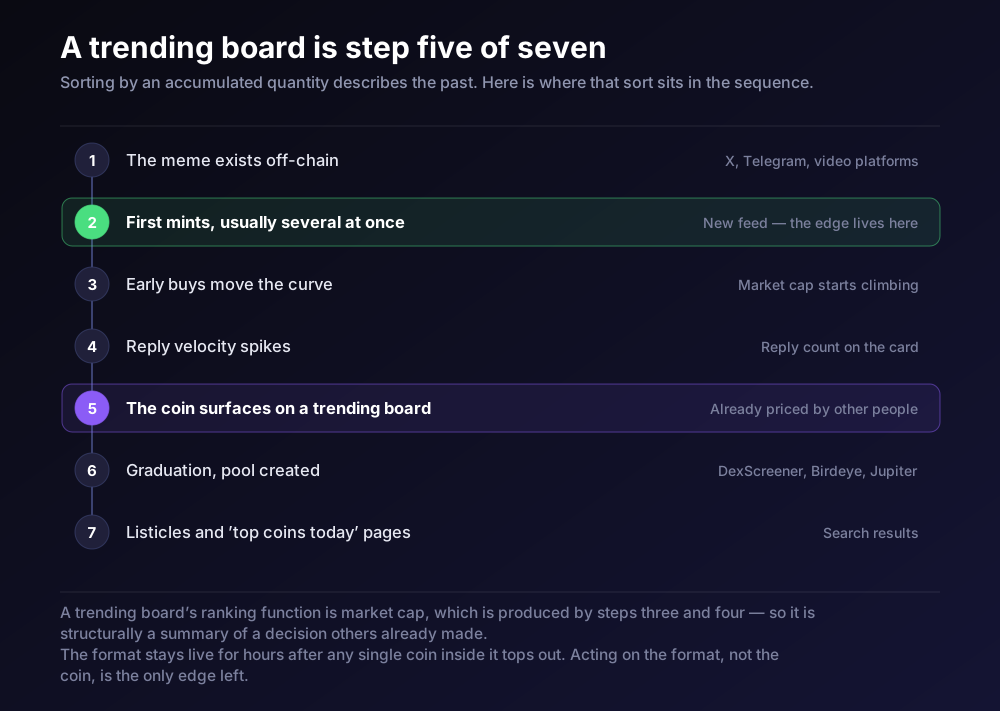
| Order | Event | Where you can see it |
|---|---|---|
| 1 | The meme exists off-chain | X, Telegram, video platforms |
| 2 | First mints, usually several at once | New feed on pump.fun or Alchemii |
| 3 | Early buys move the curve | Market cap starts climbing |
| 4 | Reply velocity spikes | Reply count on the card |
| 5 | The coin surfaces on a trending board | Trending tab |
| 6 | Graduation, pool created | DexScreener, Birdeye, Jupiter |
| 7 | Listicles, newsletters, "top coins today" pages | Search results |
A trending board is step five of seven. Its ranking function is market cap, which is generated by steps three and four. The board is, structurally, a summary of a decision other people already made. That lag has a price attached to it: by the time a coin reaches step five, most of its cheap supply is gone, which is the arithmetic behind memecoin FOMO.
This is the honest admission the competing guides in this search result dodge: no trending list can be predictive, because sorting by an accumulated quantity is definitionally a description of the past. Anyone promising you "the next runner before it runs" from a page whose sort key is market cap is describing something the page cannot do.
So what edge is actually left?
Reaction speed — and specifically, reaction speed on the format rather than the coin.
Those are two different clocks. The individual coin at the top of the board has been priced by the people who bought it; you are late to that. The format — the naming convention, the art style, the genre of joke the market is currently rewarding — has a much longer half-life. Formats stay live for hours after any single coin inside one has topped out, which is why you see clusters rather than singletons.
Callouts are worth reading the same way. Pump's Callouts feed and leaderboard surface tokens that other users have chosen to highlight, which makes them a format signal more than a coin signal — a cluster of Callouts around one naming convention tells you more than any single post does. Note that a Callout's author is paid on an undisclosed activity metric, so the incentive is engagement rather than accuracy; Pump.fun Callouts explained covers what the rewards terms actually say.
Acting on a format means having your own token live while the format is still current. Historically that meant a clerical slog at the worst possible moment: find the coin, right-click the logo, save it, open a creator in another tab, type the name, type the ticker, paste a description, upload the image, set supply, set decimals, check the toggles. Two or three minutes of typing, during the only window where minutes matter.
Copy Coin: from spotting to signed in one click
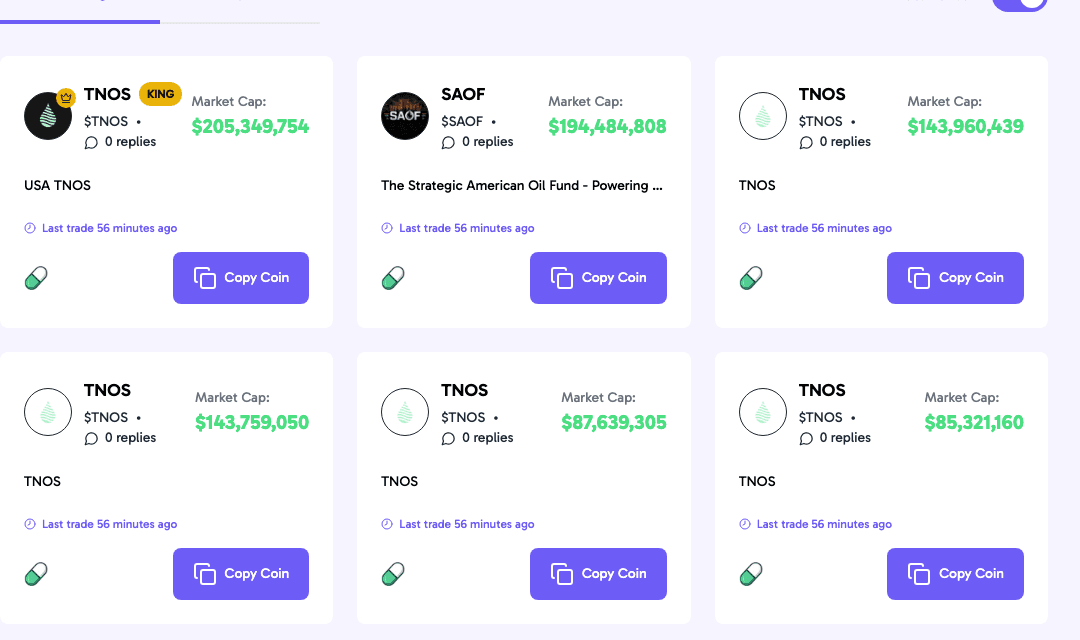
The board as it actually renders. Clicking Copy Coin costs nothing and signs nothing — it only fills the form.
This is the part of the workflow Alchemii actually changed, and it is the reason Trending Coins exists as a page rather than as a widget.
Every card on the board carries a Copy Coin button. Click it and Alchemii's Solana token creator opens with the fields already populated:
- Name, ticker and description carried straight from the card.
- The image, passed through as the existing IPFS URI — no download, no re-crop, no re-upload, no waiting on a pin. The artwork is in the preview pane before the page finishes loading.
- Supply and decimals at the Solana memecoin standard, 1,000,000,000 and 6.
- Mint-authority revocation pre-ticked — the one paid extra the template opts into, because it is the trust signal buyers check first, and switchable before you sign.
- A vanity mint address ending in "pump" available as an unticked 0.1 SOL checkbox, so your token can wear the same address shape as the coins on the board without going anywhere near their bonding curve.
- Social links deliberately left blank. Those should be yours, not the original coin's.
Clicking Copy Coin signs nothing and spends nothing. It is a prefill and a redirect — nothing touches the chain until you review the form, connect a wallet and approve a single transaction. Every field stays editable, so it is a starting point that happens to be most of the way filled in.
What that buys you is the gap between step 2 and step 5 on the ladder above. Solana confirms in one to two seconds at roughly 400 ms per block, so once you have decided, the chain is not the bottleneck — the form was. Removing the form is the entire product argument.
The one field on the board you can also wear
There is a fifth signal on every card that no guide bothers to name, because until recently there was nothing to do about it: the mint address. Scroll the board and almost every address ends in the same four characters, pump. That is a vanity suffix — candidate keypairs ground out until one lands on the right tail — and it is how a pump.fun launch announces itself. On a board of otherwise interchangeable cards it is one of the few fields that means something before you click anything.
Reading it is useful: an address that does not end in pump on a board of coins that do usually means the token was minted somewhere else and is being surfaced by a different route. Wearing it used to require launching on the curve.
Alchemii's create form makes it an unticked checkbox. Pumpfun Token, a flat 0.1 SOL, and your mint address ends in pump — taking a copy launch to around 0.32 SOL, or around 0.42 SOL with the mint-authority revoke as well. The address is verified to actually end in pump before the transaction is assembled, so a failed grind aborts the launch rather than billing you for a tail you did not get. Nothing else about the launch changes: your price, your fee tier, an LP you hold and can burn at minute zero, and a Raydium pool DexScreener indexes and Jupiter routes as soon as it exists instead of after a graduation roughly 1% of curve launches reach.
Against launching on the curve for the same address, the arithmetic is short. Pump.fun costs 0 SOL to create (about 0.02 SOL for the first buy) and takes 1.25% on every buy and every sell — 2.5% on a round trip — for as long as the token trades. Against a 0.32 SOL pump-suffix launch that is 0.30 SOL of difference, and 0.30 ÷ 0.02 = 15 SOL of buying and selling before the curve has taken more than the flat fee; with the revoke, (0.42 − 0.02) ÷ 0.02 = 20 SOL. The full breakdown lives in how to get a pump-suffix token without Pump.fun.
The boundary, since this page is about reading signals honestly: the suffix says which format you are playing in. It is not a claim that Pump.fun launched your token, it did not, and anyone can confirm that on Solscan in one click.
A standard launch is around 0.22 SOL all-in, around 0.32 SOL with mint authority revoked, and up to roughly 0.52 SOL fully loaded. Every optional extra is itemised on the create form with your exact total shown before you connect a wallet. For reference, the unavoidable on-chain protocol floor for any Solana token — mint rent, Metaplex metadata rent, the Metaplex protocol fee, an associated token account and a signature — is about 0.0191 SOL, and nothing can be cheaper than that.
We are not going to claim Alchemii is the cheapest tool in this category, because it is not and you can check. It undercuts Smithii and Orion Tools, sits level with CoinFactory, and beats pump.fun's own model past roughly 9 SOL of cumulative volume — pump.fun takes 1.25% on every buy and every sell for as long as the token trades, while a flat fee is charged once. Several cheaper tools exist. Standalone cloners exist too — cloneme.fun ships one as a Chrome extension — so one-click copying is not the rare part. What differs here is that the copy happens inside the create flow with nothing to install, and finishes in a Raydium pool whose LP tokens are yours rather than on a bonding curve.
Reading a card in ten seconds
The repeatable loop, in the order that discards fastest:
- Last trade under two minutes old? If not, next card. This is most of your filtering.
- Reply count moved between two refreshes? Watch it across one poll cycle. Static replies plus rising market cap is a bot chart.
- Does the meme make sense in three words? If you have to explain it, the market will not.
- Is this a cluster or a singleton? Two or three similar names on the New tab means the format is live, not just the coin.
- Holders on Solscan. One click from the card. A market cap held by a handful of wallets funded from one source is manufactured.
- Decide: pass, watch, or copy the format. Then act, because the window is measured in minutes.
Traps that eat beginners
Stale market cap. The highest number on the board is frequently the oldest. Sorting by market cap surfaces yesterday's winner right next to something happening now, with no visual distinction other than the timestamp you skipped.
Bundled launches. A curve moved by wallets that all got their SOL from the same place is not demand. Solscan's Holders tab is the check and it is free.
Reply farming. Total reply counts are purchasable. Reply pattern is not, at least not cheaply.
Recycled tickers. The same ticker gets reused constantly — there is no namespace registry on Solana, so nothing prevents it. Always work from the mint address, never the symbol. This is also the mechanism behind most impersonation scams, covered in our is pump.fun safe breakdown.
Treating the board as a shopping list. Every signal above is a filter for attention, not a valuation. Attention is what memecoins run on and it is also completely capable of evaporating between two refreshes.
The reality check
We are contractually obliged to ourselves on this one, because the dataset is the most credible thing we own.
Alchemii's observational sample of roughly 50,000 Solana launches shows 87% of memecoins lose 90% or more of their peak market cap within 24 hours. Starting from a trending format does not move that number. Two configuration choices correlate with better 24-hour survival in that sample — revoked mint authority at 4.2x and LP burned at minute zero at 5.7x — but these are correlations in observational data, not causal guarantees, and the full method is documented at our launch-data methodology with the underlying figures published in the open 50,000-launch dataset. Read why 87% of Solana memecoins die within 24 hours before you decide what any of this is worth.
If your motive here is specifically financial, read how meme coin creators actually make money first. It is the honest version, written off the same dataset, and it will save you more than any launch tool will.
And be clear about what a copy is. Your mint is a brand new address with zero holders and zero liquidity. Starting from a proven format means borrowing the visual style, the naming convention and the genre — it does not bring the original's chart, holders or community with it. Anyone can verify in one Solscan click that your token is not the coin on the board, so make it visibly your own: change the name, edit the art, rewrite the description, add your own socials. The copies that go anywhere add a twist. A copy trades on its own merits from block one.
What to do after the mint
The token existing is not the launch. Once the signature confirms, the sequence is: create a Raydium pool, seed it with liquidity you can genuinely afford to lock, burn the LP tokens, then publish the on-chain receipts. Those are separate, deliberate decisions and they are where the survival correlations above actually live. The full sequence is in our Solana memecoin launch checklist.
One detail worth knowing before you sign: Alchemii's create flow never sets a freeze authority in the first place, so there is nothing to revoke there. The only authority the transaction revokes is mint authority. Metadata ships mutable, so check the isMutable byte on Solscan after you launch rather than trusting any tool's description of what it did — including ours.
Limitations of this guide
- No price prediction. Nothing here tells you what any coin will do. The signals are attention filters and nothing more.
- No trading strategy. This guide is written for someone who wants to launch a token, not someone deciding what to buy. If you are buying, the risk surface is a different article.
- No bot or sniper tooling. Automated mempool-adjacent workflows exist and are out of scope.
- No post-graduation analysis. Once a coin has a pool it is a normal AMM asset. See pump.fun vs Raydium for that boundary.
- Third-party feed. The live board proxies a public pump.fun data feed. If the upstream is down the list degrades to empty and refills on the next poll.
- Not legal advice. Copying a format is not the same as impersonating a project. Where that line sits depends on your conduct and your jurisdiction.
FAQ
How do I find trending pump.fun coins?
Use a board that reads pump.fun's own feed rather than an aggregator. Pump.fun's board at pump.fun/board and Alchemii's Trending Coins page both show live coins with market cap, reply count, and the time of the last trade. Aggregators like CoinGecko and GeckoTerminal cannot show you pre-graduation pump.fun coins at all, because a coin on the bonding curve has no liquidity pair for them to index — and only about 1-1.4% of pump.fun tokens ever graduate.
What is the fastest way to see brand-new pump.fun launches?
Watch a New feed rather than a Trending feed. Trending is sorted by market cap, which is cumulative buy volume that has already been spent, so it is inherently backward-looking. A New feed shows mints that are minutes or seconds old, before the curve has moved. Alchemii's Trending Coins board has both tabs, refreshes the server-rendered board every five minutes, and polls every eight seconds in your browser while the tab is visible.
Which signal matters most on a pump.fun trending board?
Last-trade recency, used as a disqualifier rather than a picker. Market cap tells you what has already happened; the last-trade timestamp tells you whether anything is happening now. A coin with a large market cap whose last trade was forty minutes ago is not trending in any useful sense — the buyers who set that number have already left. Check recency first, then reply velocity, then market cap, in that order.
Why don't pump.fun coins show up on DexScreener or CoinGecko?
Because a pre-graduation pump.fun coin has no liquidity pool. Trading runs through the bonding curve, which holds SOL and tokens in escrow rather than as an indexable pair. DexScreener, Birdeye, GeckoTerminal and Jupiter index pairs, so there is nothing for them to pick up until the coin graduates at ~411 SOL of market cap (about $41K at ~$100/SOL) and pump.fun migrates liquidity to a PumpSwap pool. Roughly 98.6-99% of launches never get there.
Is it too late to act once a coin appears on a trending list?
To buy that specific coin, largely yes — a trending list ranks by market cap, and market cap is the record of buying that already occurred. The list is a receipt, not a forecast. What is not late is the format: the naming convention, the art style, the category of joke the market is currently rewarding. Formats stay live for hours after any single coin inside them has been priced, which is why reaction speed beats discovery.
Can I copy a trending pump.fun coin and launch my own?
Yes. Every card on Alchemii's Trending Coins board has a Copy Coin button that opens the Solana token creator with that coin's name, ticker, description and IPFS image already in the fields, plus the memecoin standard of 1,000,000,000 supply and 6 decimals. Clicking it signs nothing and spends nothing. Your mint is a new address with no holders and no liquidity, so start from the format and make the token visibly your own — a copy trades on its own merits.
Does copying a trending coin improve my odds?
No, and we will not pretend otherwise. Alchemii's observational sample of roughly 50,000 Solana launches shows 87% of memecoins lose 90% or more of their peak market cap within 24 hours, and starting from a trending format does not move that number. These are correlations in observational data, not guarantees. What a prefilled creator gives you is speed and control — a live mint of your own in seconds, with the authority and liquidity decisions in your hands.
Why do almost all pump.fun mint addresses end in pump?
Because they are vanity addresses. A Solana mint address is the base58 public key of a generated keypair, and grinding candidate keypairs until one ends in a chosen string is cheap for a four-character tail. Pump.fun does that grind for every token it launches, which is why the suffix reads as its signature on Solscan and DexScreener. It carries no protocol meaning — nothing about the token behaves differently — and it is not exclusive to the platform: Alchemii offers the same suffix as a 0.1 SOL checkbox on a direct launch, verified to actually end in pump before the transaction is built, with no bonding curve, no 1.25% per trade and no wait for graduation.
References
- Pump.fun board — the platform's own live feed of trending and new coins
- Pump.fun Dune dashboard — public launch, graduation-rate and curve-fill statistics
- DefiLlama: pump.fun protocol fees and volume — platform volume aggregates
- DexScreener Solana pairs — pair indexing; why pre-graduation coins are absent
- GeckoTerminal Solana pools — pool-level indexing behaviour
- Birdeye — holder and volume cross-checks post-graduation
- Solscan — Holders tab for distribution and bundling checks
- Jupiter token list API — when a graduated token becomes routable
- SPL Token Program — mint accounts, supply and authority model
- Metaplex Token Metadata — the metadata account behind every card's name and image
- Solana clusters and block time — ~400 ms block time reference
- Solana confirmation levels — sign-to-finality timing
Found a format that is still live? Do not retype it. Open Trending Coins →, hit Copy Coin on the card, and the creator opens with the name, image and memecoin settings already filled — review, adjust, tick the pump address if you want it, sign once. One transaction, one to two seconds, live on mainnet.
Starting from scratch instead? Launch a meme coin with the defaults already set →, or open the full Solana token creator → if you want every field yourself.
Create your Solana token
Choose your token name, symbol, supply and image. Review the authority options and creation fee, then confirm the transaction in your wallet. Liquidity is a separate step.
Related Topics
More guides to Solana token creation, authorities, liquidity, and meme coin launches.
How to Copy a Trending Pump.fun Coin in 2026 (60 Seconds)
Copy a trending Pump.fun coin in under a minute: one click prefills the token creator with name, ticker, image and settings — plus an optional pump-suffix mint.
Pump.fun Market Cap vs Replies: Read the Board (2026)
Two numbers sit on every pump.fun trending card. On one board: 14,017 replies at $128.1M, and $245.8M of market cap with zero replies. How to read the gap.
Get a Pump Suffix Token Without Pump.fun (2026)
Create a Solana token ending in pump for 0.1 SOL. Gain memecoin-native recognition, keep direct-launch control, and preserve more creator upside.
Solana Memecoin Narrative Clusters: How Theme Waves Form (2026)
Seven of nine cards on one live pump.fun board were one narrative. How memecoin theme waves form, what a cluster's cap curve means, and when it's spent.
Pump.fun Callouts Explained: How to Use Them & Check Rewards
What Pump's Callout Rewards terms really say: the Activity Metric is confidential, rewards are discretionary, and only the on-chain transfer counts as payment.
How Many Meme Coins Are Created Every Day? 35,700+ (2026)
We counted 1,048 Solana launches in 42 minutes — a new meme coin every 2.4 seconds, about 35,705 a day. Who makes them, what they earn, and what we got wrong.