How to Earn Trading Fees From Your Own Meme Coin
Create a Solana meme coin, fund a pool, and earn a share of trading fees. See the income math, launch costs, and one-click trending coin setup.

Create a meme coin that can earn you trading fees Start with your own token, then fund a pool and keep the LP position that earns your share.
To earn trading fees from your own meme coin, create the token, supply liquidity to a trading pool, and keep the LP position that entitles you to its fee share. This gives a creator a potential revenue source beyond selling a token allocation. It also puts your capital at risk: fees can accrue while the total position loses value.
If you already have a meme, a community, or an idea people want to share, the practical next step is a token you can build around. Open Alchemii's homepage and create your token → Set your name, ticker, image, and supply, review the fee, and approve creation in your wallet. You can inspect the form before connecting.
This guide focuses on the direct-launch path: your SPL token and a pool you fund. For a comparison of other income mechanisms, see how meme coin creators make money. We build Alchemii, and the product steps below describe its current creation and liquidity forms.
Can you earn from a meme coin without selling your allocation?
Yes: a liquidity provider can earn swap fees while holding a separate creator allocation. The key is what you own. Holding the token alone does not give you a claim on a pool's fees; holding the appropriate liquidity position does.
Think of a hypothetical creator launching a community meme. They allocate some tokens to a treasury and put others into a token/SOL pool, alongside SOL. Buyers and sellers use that pool. The creator's LP position receives its share of the pool's fee accrual as those swaps happen. The treasury allocation is a separate holding.
That is an opportunity to build around repeated activity, rather than needing one perfectly timed sale. It still requires people who want to trade your coin. A compelling name and image help explain a project; an active community, useful links, and clear ownership help people decide whether to engage with it.
There are also two different meanings of “creator fees” to keep separate:
| Income path | What establishes your claim? | Does creating on Alchemii alone activate it? |
|---|---|---|
| Launchpad creator rewards | That launchpad's launch and reward rules | No |
| LP fee share in your own pool | Funding the pool and holding its redeemable LP position | No; create and fund the pool after minting |
| Selling a disclosed allocation | Holding tokens that buyers are willing to buy | No; an unsold balance is not realized revenue |
Pump.fun has its own creator-fee schedule (pump.fun). A direct mint made with Alchemii does not inherit that reward stream, even if you used Copy Coin or selected a mint address ending in pump.
How much can your own meme coin earn in trading fees?
For a Raydium CPMM example, use this formula:
Gross LP fee value = volume through your pool × swap fee × LP fee portion × your LP ownership share.
Raydium documents an 84% LP portion for CPMM swap fees. A pool charging 0.25% therefore directs 0.21% of traded value to LPs collectively. Your own share depends on how much of the redeemable LP position you hold. Source: Raydium protocol fees.
The following is illustrative arithmetic, assuming a constant 0.25% trade fee, an 84% LP portion, and 50% LP ownership throughout the measurement period. Dollar values are equivalent values for comparison, not a promise that fees arrive in dollars.
| Volume through your pool | Gross fees attributed to your 50% LP share |
|---|---|
| $0 | $0 |
| $1,000 | $1.05 |
| $10,000 | $10.50 |
| $100,000 | $105 |
These are scenarios, not expected results. Count only trades routed through your pool: activity in another pool for the same token does not pay your position. If your ownership changes during the period, calculate each interval separately.
The distinction between revenue and profit matters here. A position can accumulate $10.50 in fees while losing considerably more than that as its assets change in value. Launch expenses, promotion, transaction fees, and the cost of entering or exiting also affect the result. Track the value you can actually withdraw alongside fees, rather than treating gross fee accrual as cash profit.
For CPMM, LP fees accumulate in the pool and are realized through withdrawal; they are not a separate SOL payment to your wallet after each trade. Source: Raydium fee comparison.
Start with a trending coin instead of a blank form
The hardest part of getting started is often deciding what to put in the form. Alchemii's Copy Coin feature shortens that step.
- Open Trending Coins and inspect a format that interests you.
- Click Copy Coin. You land on the homepage token creator, with metadata and memecoin settings filled in.
- Give the token your own name, ticker, description, artwork, and social links.
- Review supply, authorities, optional extras, and the estimated total.
- Connect your wallet and approve creation when the setup is ready.
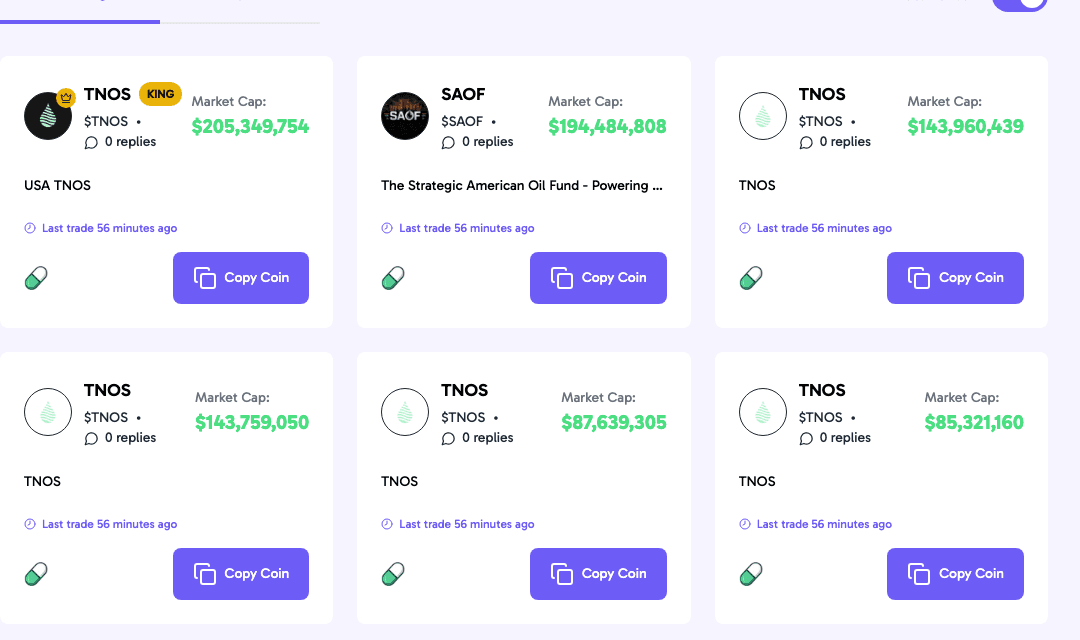
The handoff brings across the name, symbol, description, and image URI, with 1 billion supply and 6 decimals as defaults. Mint-authority revocation is selected and costs an additional 0.1 SOL; other paid extras remain optional. Social links start blank so you can add your own.
This is a shortcut to an editable draft. Use a trend as inspiration and make the result identifiable as your project; use artwork you have permission to publish. The new mint has its own address and needs its own buyers and pool. It inherits none of the original coin's trading activity or earnings.
Already know what to launch? Create your token on the homepage → If you want help choosing a starting format, browse trending coins and use Copy Coin to bring a template into that same form.
What does the first launch cost?
Alchemii's current base creation service fee is 0.2 SOL, with roughly 0.02 SOL estimated for network and account costs. That makes the starting estimate approximately 0.22 SOL. Copy Coin selects mint-authority revocation, adding 0.1 SOL, for approximately 0.32 SOL before any further extras.
These figures describe token creation. Keep three budget lines separate:
| Budget line | What it covers | Where to review it |
|---|---|---|
| Token creation | Mint, metadata, and selected creation options | Homepage creator |
| Pool setup | Pool service/protocol charges and account costs | Liquidity creation form |
| Liquidity capital | Tokens and SOL committed to the pool | Your deposit amounts in the liquidity form |
The live form shows the selected options and estimate before signing. Liquidity capital remains exposed to trading and price changes; it is not a refundable setup charge. Decide how much capital the project can put at risk before opening the pool.
Alchemii takes no ongoing percentage of your token's trading volume. That leaves pool economics with the venue and its liquidity providers. It does not remove the DEX's fees or mean the entire swap fee belongs to you.
From Create Token to a pool that can earn fees
1. Create the asset you want to build around
Open the Solana token creator. Choose the details people will see, decide the supply, and check the authority options. If you arrived through Copy Coin, review each prefilled field before approving. After creation, save the mint address: it is the identifier you will use when setting up the pool and announcing your token.
2. Choose the pool deliberately
Open Create Liquidity. The interface offers PumpSwap and CPMM Raydium LP; its default is PumpSwap. To follow the Raydium example above, explicitly choose CPMM Raydium LP and review its fee tier. Enter the token mint and deposit amounts, then inspect the quote before signing.
The deposit ratio establishes the starting price. Write down what you are depositing and why that price makes sense for the supply you plan to circulate. A large displayed market cap created by a thin pool does not mean that much money is available to withdraw.
3. Decide what happens to the LP position
If LP income is the plan, you need to preserve the claim that makes it possible. An ordinary irreversible LP-token burn gives up the redeemable position. It is different from a pool withdrawal that burns LP tokens in exchange for underlying assets. Do not promise to permanently burn all your LP and also count its future fees as withdrawable income.
Tell your community how liquidity is managed and what allocation you retain. This makes the revenue model something people can evaluate before they trade.
4. Bring people to a clear launch page
Publish the mint address, the correct pool link, your project description, and allocation information together. Show people what makes the meme yours and why they might return to the community. Track actual pool activity and fee accrual after launch.
The creator's work is to make something people want to participate in. Copy Coin saves setup work so you can spend more of your time on that part.
FAQ
Can you make money from a meme coin without selling your creator allocation?
Yes. Providing liquidity can earn you a share of swap fees without selling a separate creator allocation. You must fund a trading pool and retain a redeemable LP position. Fees depend on actual volume, and losses on the liquidity position can exceed the fees. Creating a token alone does not generate income.
How much can a meme coin creator earn from trading fees?
For an illustrative Raydium CPMM pool charging 0.25%, the 84% LP portion equals 0.21% of volume. A 50% LP position would accrue about $10.50 on $10,000 of volume through that pool. This is gross fee value before costs and changes in the position's value, not a profit forecast.
Does Alchemii's Copy Coin button include Pump.fun creator rewards?
No. Copy Coin opens the homepage token creator with editable metadata and memecoin defaults. It creates no token until you approve the transaction and copies no buyers, pool, volume, or creator rewards. Your new token needs its own liquidity and demand.
How much does it cost to create the token on Alchemii?
The base service fee is 0.2 SOL plus an estimated 0.02 SOL for network and account costs. Copy Coin preselects mint-authority revocation, adding 0.1 SOL for an estimated 0.32 SOL total. Pool setup and liquidity deposits are separate. Review the current form before signing.
Can I burn my LP tokens and keep collecting the same LP fees?
An ordinary irreversible burn gives up your redeemable LP claim, including the fees attached to it. It is different from redeeming LP tokens through a pool withdrawal. Do not count burned liquidity as a position you can later withdraw for income.
Does a higher fee tier mean more money?
Only if enough activity remains. A higher rate increases the fee on an otherwise identical trade, but can make your pool less attractive to traders. Compare the rate with actual routed volume and liquidity conditions rather than assuming volume stays constant.
Create the token behind your next idea
You have two ways to begin: bring your own concept, or use a trending format to fill the first draft. Both lead to the homepage creator, where you can review the token before spending SOL.
Create my Solana token → Then fund the pool, keep the LP claim your income plan depends on, and build the community that gives people a reason to trade.
Turn your next meme into a token you own
Open the homepage creator with your own idea, or use Copy Coin on Trending Coins to prefill it. Review the details and fee before signing. A separately funded pool and a redeemable LP position can earn a share of trading fees when your coin attracts activity.
Related Topics
More guides to Solana token creation, authorities, liquidity, and meme coin launches.
How Do Meme Coin Creators Make Money? 4 Real Ways (2026)
How meme coin creators can make money through creator fees, Raydium LP fee share, disclosed allocation, and appreciation — with current 2026 fee math.
How to Make Money on Pump.fun: Creator Rewards
How to make money on pump.fun by creating a coin: creator rewards pay 0.30% to 0.95% of every trade. See Sept 2026 payouts, Holder Rewards, and how to withdraw.
How to Copy a Trending Pump.fun Coin in 2026 (60 Seconds)
Copy a trending Pump.fun coin in under a minute: one click prefills the token creator with name, ticker, image and settings — plus an optional pump-suffix mint.
How to Find Trending Pump.fun Coins Fast (2026)
How to find trending pump.fun coins in 2026: the four signals that matter, where to look, and why a trending board is a receipt rather than a forecast.
Is Cloning a Memecoin Legal? Solana Rules for 2026
Where the line sits between building on a proven memecoin format and impersonating a live token — trademark, fraud, and a checklist to ship on the right side.
Pump.fun Market Cap vs Replies: Read the Board (2026)
Two numbers sit on every pump.fun trending card. On one board: 14,017 replies at $128.1M, and $245.8M of market cap with zero replies. How to read the gap.