Is Cloning a Memecoin Legal? Solana Rules for 2026
Where the line sits between building on a proven memecoin format and impersonating a live token — trademark, fraud, and a checklist to ship on the right side.

Ready to create your Solana token? Enter your token details, choose your authority options, and confirm in your wallet.
Cloning a memecoin's format — the naming convention, the art style, the category of joke the market is currently rewarding — is not by itself illegal in most jurisdictions, because Solana has no name registry and nothing in the SPL Token Program treats a ticker as property. Legal exposure attaches to three things that sit entirely outside the chain: trademark, where the meme you are copying is somebody's registered brand or a real person's likeness; fraud and impersonation, where you tell buyers your token is the original, an official V2, or a migration; and platform terms of service, which are contract rather than law and get enforced within hours rather than years. A derivative that publishes its own mint address, runs its own socials, and never claims to be anyone else is a fundamentally different act from an impersonation token, and the on-chain record makes the difference legible to anyone who looks. This article is not legal advice.
Every Solana token creator in this category — ours included — has a button that copies a coin. Not one of them will tell you where the line is. They route around the question with a disclaimer link and let you find out on your own.
That is a bad trade for you and, frankly, a bad trade for us. So here is the line, drawn properly, from someone who ships the button.
The short version, in one paragraph
There are two different acts people call "cloning" and they have almost nothing to do with each other.
The first is building on a proven format. The market is telling you, live, that dog-with-a-hat art and three-letter tickers are what it wants this week. You take the format, put your own spin on it, and ship a token that is transparently yours. This is what every genre in creative history has ever done, and on Solana it is also mechanically unavoidable: there is exactly one fungible-token standard, so every token is a copy of every other token at the level that actually matters.
The second is impersonating a live token to divert its buyers. You mint a token that is indistinguishable from a coin currently trading, then you go where its buyers are and let them believe — or actively tell them — that yours is it. This is fraud. It is fraud on Solana, it was fraud on Ethereum, and it would have been fraud in 1890 with a fake trade sign.
The rest of this article is about where exactly the boundary between those two runs, because in practice it is narrower than people assume in one direction and much wider than they fear in the other.
Why the chain itself has no opinion
Start with the mechanics, because most of the confusion here comes from imagining that Solana has some registry it does not have.
Every fungible token on Solana is created by the same program: the SPL Token Program at TokenkegQfeZyiNwAJbNbGKPFXCWuBvf9Ss623VQ5DA. A token is not a deployed contract the way an ERC-20 is. It is a mint account inside that one shared program, and the mint account stores four things that matter — supply, decimals, mint authority, freeze authority. That is essentially it. Nothing human-readable lives there at all.
The name, the symbol and the image URI live somewhere else entirely: a Metaplex Token Metadata account, a program-derived address under metaqbxxUerdq28cj1RbAWkYQm3ybzjb6a8bt518x1s, seeded from the mint. It is a separate account created by a separate instruction in the same transaction.
Two consequences follow, and they are the entire technical spine of this question:
- A billion-dollar token and a token minted five minutes ago are structurally identical. Same program, same account layout, same instruction set. If you loaded both mint accounts side by side you could not tell which was which. The only difference is the strings in the metadata account and the liquidity somebody else put behind it.
- Nothing enforces uniqueness. There is no first-come-first-served claim on "BONK". There is no reservation system, no
CREATE2collision, no registry contract. You could mint ten thousand tokens named BONK this afternoon and the program would accept every one of them, because from the program's point of view you are just writing a UTF-8 string into an account you paid rent for.
So when somebody asks "is it legal to clone a memecoin", the on-chain answer is that there is nothing to clone. Copying metadata does not take anything from anyone. It creates a brand-new mint address with a fresh supply, zero holders, zero liquidity and an empty chart. Whatever the law has to say about your launch, it will be saying it about your conduct off-chain, not about the transaction.
Duplicate tickers are normal, and the tooling assumes it
This part surprises people who came from web2, where a namespace collision is a bug.
Every serious Solana surface resolves tokens by address, not by ticker. A DexScreener chart URL is keyed to a pair address, not a symbol — the ticker in the header is a display label pulled from metadata. Solscan resolves a token page by mint address. Jupiter routes by mint. Your wallet keys balances to mints. The symbol is the least authoritative field in the entire stack, which is precisely why it is the only field nobody bothered to make unique.
This is also why "check the CA" — check the contract address — is the single most repeated piece of advice in Solana trading, repeated to the point of cliché. The advice exists because duplicate tickers are the expected state of the world. There are dozens of tokens named after every meme that has ever run. The market handles it by addressing, and traders who do not check the address lose money in ways that have nothing to do with you.
Two honest implications, one in each direction:
- For you as a launcher: a duplicate ticker is not, on its own, evidence of bad intent, and treating it as such would make the entire category illegal. It is not.
- Also for you as a launcher: because addressing is the norm, you cannot lean on ambiguity. Anyone can verify in one Solscan click that your mint is not the original. If your plan depends on people not checking, your plan depends on the one behaviour the entire ecosystem trains against.
Where the legal exposure actually is
Three buckets, in descending order of how likely they are to matter to you.
1. Trademark — the meme, not the token
This is the exposure most people miss, because they are looking at the chain when they should be looking at the picture.
Most memecoin art is unowned in any practical sense: a photograph of somebody's dog, a distorted screenshot, a shape. Nobody is coming for a cartoon frog derivative. But some memes are somebody's registered brand — a corporate logo, a protected wordmark, a film character, a sports league, or a living person's name and likeness. Those have owners, and those owners have lawyers whose entire job is monitoring for use in commerce.
In the US the operative test under the Lanham Act is likelihood of confusion: would an ordinary buyer think your thing is affiliated with, sponsored by, or endorsed by the mark holder? A token that puts a registered logo in its metadata and trades publicly is being used in commerce, and the chain's indifference to trademark is not a defence. Other jurisdictions frame it differently, but essentially all of them have some version of this.
The under-discussed part, and the reason it belongs in an article about cloning specifically: if the coin you are copying is itself riding somebody's brand, cloning it imports that exposure onto you. The original launcher took a risk. When you copy their metadata you are not inheriting their upside — you established that already, you inherit none of their liquidity or holders — but you absolutely are inheriting their legal posture. That is an asymmetry worth pricing before you sign.
Practical rule: copy the format, not the brand. The format is "absurd animal, three-letter ticker, flat pastel art". The brand is a logo somebody's legal department has a docket number for.
2. Fraud and impersonation — the FBI's actual concern
The FBI has issued public advisories about cryptocurrency impersonation, and they are worth reading properly because they are more specific than the summaries suggest. Two patterns dominate:
- Impersonation tokens. A token is deployed with a name, ticker and logo identical to a real project, then promoted into that project's audience — its Telegram, its replies, its Discord — so buyers who do not check the mint address buy the wrong asset.
- Address poisoning. The attacker seeds a victim's transaction history with dust from an address whose first and last characters match one the victim has legitimately used, betting that the victim copy-pastes from history without checking the middle. Funds route to the attacker.
Notice what both have in common, and what neither is. Neither is about duplication. Both are about a deception layer built on top of the duplication — a claim made to a specific person that a specific asset is a specific other asset. The impersonation token is not illegal because it exists; it is illegal because of what was said to whom.
This is the actual line, and it is a behavioural line rather than a technical one. Two identical mints can sit side by side on-chain where one is a defensible derivative and the other is a criminal act, and the only difference is what their creators said in Telegram.
Buyer-side risk on launchpads is a related but separate topic — we cover that in Is Pump.fun Safe?, which is written for the person buying rather than the person launching.
3. Securities, consumer protection, and platform terms
Two things get lumped together here and should not be.
Securities and consumer-protection law is jurisdiction-dependent and fact-dependent, and no blog post can resolve it for your situation. What is worth knowing is that the facts that push a token toward that analysis are almost entirely facts you control and mostly have nothing to do with cloning: promising returns, describing a treasury, publishing a roadmap with revenue, marketing the token as an investment. A memecoin that claims nothing is a much simpler object than one that claims something. If your motive here is income rather than speed, read our honest breakdown of how meme coin creators actually make money before you build a narrative you will have to defend.
Platform terms of service are not law at all — they are contract — and they are the thing that will realistically bite you, because enforcement takes hours instead of years. X will suspend an account for impersonation on a report. Telegram will nuke a group. DexScreener has its own process for token info updates. Jupiter's routing list has vetting criteria of its own. None of these require a court, a filing, or a jurisdiction. They require one annoyed person with a report button.
Derivative vs impersonation: the actual boundary
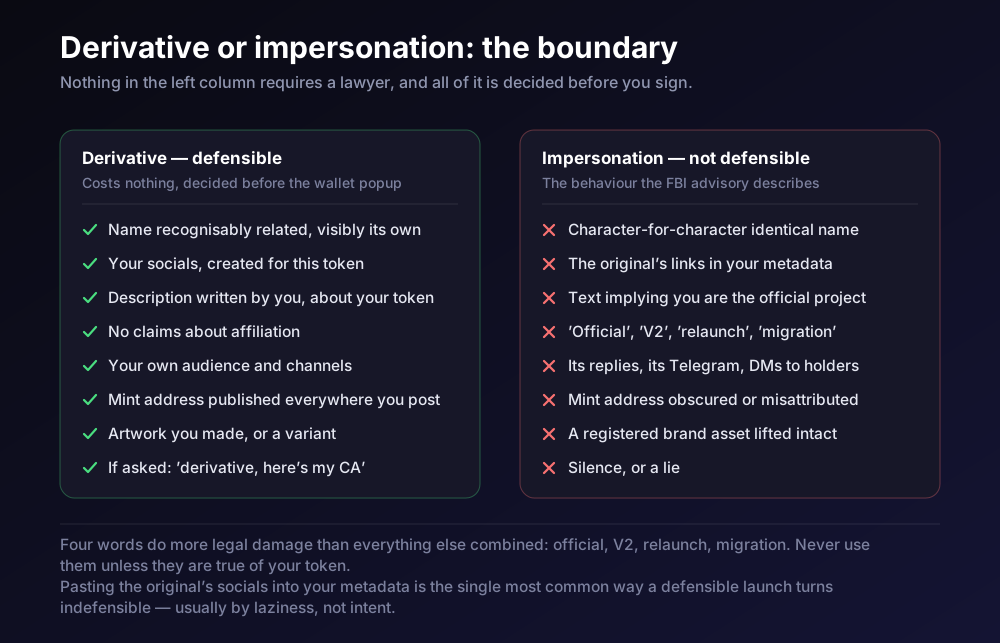
| Signal | Derivative (defensible) | Impersonation (not) |
|---|---|---|
| Name / ticker | Recognisably related, visibly its own | Character-for-character identical to a live token |
| Socials | Yours, created for this token | The original's links pasted into your metadata |
| Description | Written by you, about your token | Copied text implying you are the official project |
| Claims | None about affiliation | "Official", "V2", "relaunch", "migration", "the real one" |
| Distribution | Your own audience and channels | The original's replies, its Telegram, DMs to its holders |
| Mint address | Published everywhere you post | Obscured, or posted where it reads as the original's |
| Artwork | A variant, or something you made | A registered brand asset lifted intact |
| If asked directly | "It's a derivative, here's my CA" | Silence, or a lie |
Nothing in the left column requires a lawyer. Everything in it is free, and all of it is decided in the ninety seconds before you sign.
The 9-point ship-it-as-a-derivative checklist
Run this before the wallet popup, not after the token has attention.
- Change at least one thing that is yours. The name, the ticker, or the art. One is the floor; two is better. A copy that differs in nothing is the only version of this that is hard to defend.
- Write your own description. Two sentences in your own voice. Do not carry over text that describes somebody else's project.
- Use your own socials, or none. Never paste the original's X or Telegram into your metadata. This is the single most common way a defensible launch turns into an indefensible one, and it usually happens by laziness rather than intent.
- Never use the words official, V2, relaunch, or migration unless they are true of your token. These four words do more legal damage than everything else on this list combined.
- Publish your mint address everywhere you publish anything. Bio, pinned post, first message. Make the two-second Solscan check easy rather than adversarial.
- Do not go where the original's buyers are. No replies under its threads with your CA, no DMs to its holders, no seeding your address into its group. This is the exact behaviour the FBI advisory describes.
- Skip registered brands entirely — and check whether the coin you are copying is riding one. You inherit that risk without inheriting anything else.
- Keep the receipts. Your mint transaction signature, your metadata, your first public post, timestamped. If a dispute ever happens, a clean chronology showing you launched openly as a derivative is worth more than any argument you can make later.
- Answer honestly if asked. "It's a derivative, here's my contract address" costs you nothing with an audience that was never going to be confused, and it is the sentence that makes every other item on this list credible.
The part where your tooling actually helps
There is one genuinely useful thing a rename can do for you, and it is specific to how Alchemii builds the transaction.
Ground truth from our transaction builder: update authority stays with your wallet, and the Metaplex metadata ships with isMutable set to true. The only authority the transaction revokes is mint authority, and only if you tick that option — freeze authority is set to null at initialisation, so there is nothing to revoke there. Update authority is not touched. Don't take that on faith: pull the mint on Solscan after you launch and read the isMutable byte and the update authority field yourself.
The practical consequence: if a mark holder sends a complaint, or you decide on reflection that the name sits closer to the line than you want, renaming, re-tickering or swapping the image is a single metadata update rather than a redeploy. You do not have to abandon the mint, migrate holders, or re-seed liquidity. That is a real operational advantage in exactly the scenario this article is about.
The honest tradeoff, because it cuts both ways: a retained update authority is visible on-chain, and some traders read mutable metadata as a risk signal — a dev who can rename the token later can also rebrand it into something else. That is a legitimate concern and we are not going to pretend otherwise. It is the same property that lets you fix a problem in one transaction. Our can you edit a Solana token after launch guide covers what is and is not changeable in detail.
Why speed is the real argument, not the legal one
Here is the thing the vendor pages get backwards. The reason to copy a trending format is not that it is a loophole. It is that the window is measured in minutes.
A format catches. For somewhere between twenty minutes and two hours, the market is actively rewarding that shape of joke. Then it moves. If your response to spotting it is to right-click the logo, save it, open a blank form, retype the name, retype the ticker, write a description, re-upload the image and re-crop it — you have spent the window on clerical work.
That is the entire reason the live trending board exists. It shows what pump.fun is trading right now and what was minted in the last few minutes, and every card carries a Copy Coin button. Click it and Alchemii's token creator opens with the name, ticker, description and image already in the fields, plus memecoin defaults — 1,000,000,000 supply, 6 decimals — and mint-authority revocation pre-ticked. The artwork carries through as its existing IPFS URI, so there is no download, no re-crop, no waiting on a pin.
Three things about it that matter for this article specifically:
- Copy Coin never signs anything. It is a prefill and a redirect. Nothing touches the chain until you review the form, connect a wallet, and sign — the same single transaction every Alchemii launch uses.
- Every field stays editable, and the name field is the one you edit first. The prefill is a starting point that happens to be 90% filled in. Your derivative twist goes in before you sign, which is exactly when it is free.
- Social links are deliberately left blank. Not an oversight. Checklist item 3 above, enforced by the product rather than by your memory at 3am.
Pricing, so you are not guessing: a standard launch is around 0.22 SOL all-in, around 0.32 SOL with mint authority revoked, and up to roughly 0.52 SOL fully loaded. Every optional extra is itemised on the create form with your exact total shown before you connect a wallet. For reference, the unavoidable on-chain protocol floor for any Solana token — mint rent, Metaplex metadata rent, the Metaplex protocol fee, an associated token account and a signature — is about 0.0191 SOL, and nothing can charge below that. We are not the cheapest tool in the category and we are not going to claim we are; we are the only one where the format arrives prefilled.
New to the full sequence? The complete meme coin creation guide covers everything from the mint through the Raydium pool and the LP burn.
What the survival data says about all of this
One reason to build the derivative posture in at minute zero rather than later: the tokens that draw complaints are the ones that work, and by the time yours is working you no longer have the free option to change its identity cheaply.
The context from our own 50,000-launch dataset: 87% of Solana memecoins die within 24 hours. In that same data, tokens with mint authority revoked show roughly 4.2× the 24-hour survival rate, and tokens whose LP was burned at minute zero show about 5.7×. Both figures are correlations, not causation — the plausible mechanism is that they are proxies for a launcher who prepared rather than magic properties of the transactions themselves, and we label them that way every time we cite them. The full breakdown of why most launches fail is in why 87% of Solana memecoins die in 24 hours.
Two conclusions worth holding at once:
- The overwhelming majority of copies never get anywhere near a legal question, because they never get anywhere near an audience. Nobody litigates a token with eleven holders and a six-hour chart.
- Which is exactly why the checklist has to run at minute zero. It costs nothing when your token is worth nothing, and it is unavailable at any price once you have attention and a name you cannot change without abandoning the momentum.
Ship as a derivative when it is free. That is the whole strategy.
Quick Facts (verifiable specifications)
| Specification | Value | Source |
|---|---|---|
| SPL Token Program | TokenkegQfeZyiNwAJbNbGKPFXCWuBvf9Ss623VQ5DA | Solana docs |
| Metaplex Token Metadata Program | metaqbxxUerdq28cj1RbAWkYQm3ybzjb6a8bt518x1s | Metaplex docs |
| Ticker uniqueness enforced on-chain | No — no registry exists | SPL Token Program layout |
| Where name / symbol / image live | Metaplex metadata account (separate from the mint) | This article |
| How DexScreener resolves a chart | By pair address, not ticker | DexScreener |
| How Solscan resolves a token | By mint address | Solscan |
| What a copy inherits from the original | Nothing — new mint, zero holders, zero liquidity | This article |
| US trademark test | Likelihood of confusion (Lanham Act) | Not legal advice |
| Alchemii update authority after mint | Retained by your wallet | build-transaction.ts |
| Alchemii metadata mutability | isMutable: true | build-transaction.ts |
| Only authority Alchemii can revoke | Mint authority (optional) | build-transaction.ts |
| Freeze authority at initialisation | null — never set, so nothing to revoke | build-transaction.ts |
| Standard launch cost | ~0.22 SOL all-in | This article |
| With mint authority revoked | ~0.32 SOL | This article |
| Fully loaded | up to ~0.52 SOL | This article |
| On-chain protocol floor | ~0.0191 SOL | Mint rent + metadata rent + protocol fee + ATA + signature |
| 24-hour memecoin failure rate | 87% | Launch data methodology |
For the wider question of whether launching a token at all is lawful — securities status, the DOJ's stated enforcement priorities, and the UK and EU rules on marketing one — see is it legal to create a meme coin, which covers the ground this article deliberately narrows past.
Limitations of this guide (what it does not cover)
This is an operator's map of where the line sits, written by someone who ships the tooling. It is deliberately not:
- Legal advice. No lawyer wrote this and no lawyer reviewed it. Outcomes turn on jurisdiction and on the specific facts of your launch. If real money or a real brand is involved, pay a lawyer — it is cheaper than the alternative.
- A jurisdiction-by-jurisdiction survey. The trademark framing here leans on US law because that is the most commonly litigated. EU, UK, Singapore and UAE positions differ in ways that matter.
- Securities analysis. Whether any given token is a security depends on facts this article cannot see. We flag the inputs; we do not resolve them.
- Copyright, as distinct from trademark. Memecoin artwork can raise copyright questions separate from the brand-confusion question, particularly where the source image was made by an identifiable artist.
- Buyer-side protection. This is written for the person launching. If you are on the other side trying not to buy an impersonation token, the short version is: get the mint address from a source the project itself controls, paste it into Solscan, and never trust a ticker.
- Defamation, publicity rights, or likeness claims involving real people. Adjacent, real, and out of scope here.
FAQ
Is it legal to clone a memecoin?
Copying a memecoin's format — the style of name, the kind of art, the category of joke — is not by itself illegal in most jurisdictions, because there is no name registry on Solana and nothing in the SPL Token Program treats a ticker as owned. What creates legal exposure is not the mint, it is the claim: telling buyers your token is the original, or that it is an official V2, migration, or relaunch, is fraud in essentially every jurisdiction regardless of what the chain permits. Trademark is the other exposure, and it attaches to the artwork and wordmark rather than to the token. This article is not legal advice.
Can I get sued for copying a meme coin's name and logo?
You can be sued for anything, but the realistic exposure depends on who owns the meme. A generic dog photo with a made-up ticker has no rights-holder to complain. A registered corporate wordmark, a company logo, a film character, or a living person's name and likeness all have owners, and in the US the Lanham Act test is likelihood of confusion — whether an ordinary buyer would think your token is affiliated with them. Note that if the coin you are copying is itself using someone's brand, cloning it imports that exposure onto you rather than leaving it with them.
Are duplicate token tickers on Solana illegal?
No, and they are extremely common. Solana has no ticker namespace: the SPL Token Program at TokenkegQfeZyiNwAJbNbGKPFXCWuBvf9Ss623VQ5DA stores supply, decimals and authorities, while the human-readable name and symbol live in a separate Metaplex metadata account, and neither enforces uniqueness. Every serious Solana surface resolves tokens by address rather than ticker — DexScreener pages are keyed to a pair address and Solscan to a mint address — which is exactly why traders are trained to check the contract address before buying.
What did the FBI say about impersonation tokens?
The FBI has issued public advisories about cryptocurrency impersonation, covering both tokens deployed with names, tickers and logos identical to real projects, and address poisoning, where an attacker seeds a victim's transaction history with an address whose first and last characters match one they have used before so a copy-pasted address routes funds to the attacker. The common thread is not duplication, it is a deception layer built on top of the duplication. A derivative that publishes its own mint address and never claims to be anyone else is a different act entirely.
How do I copy a trending coin without impersonating it?
Change at least one thing that is yours before you sign — the name, the ticker, or the art — and then run your own socials, write your own description, publish your own mint address everywhere, and never use the words official, V2, relaunch or migration unless they are true. Do not reply under the original's threads with your contract address and do not DM its holders. Alchemii's Copy Coin leaves the social fields deliberately blank for exactly this reason: the format should come from the board, the identity should come from you.
Can I change my token's name if someone complains about it?
On a token minted through Alchemii, yes. Ground truth from our transaction builder: update authority stays with your wallet and the Metaplex metadata ships with isMutable set to true, so renaming, re-tickering or swapping the image is one metadata update rather than a redeploy. The only authority Alchemii ever revokes is mint authority, and only if you tick that option. The honest tradeoff is that a retained update authority is visible on-chain, and some traders read mutable metadata as a risk signal — it is the same property that lets you fix a problem quickly.
Does cloning a coin give me its holders or liquidity?
No. Your mint is a brand-new address with zero supply relationship to the original, zero holders, zero liquidity and an empty chart. Nothing transfers except the idea. That is the honest reason a copy has to trade on its own merits, and it is also the reason the exercise is legally defensible when you run it as a derivative: there is no mechanism by which you take anything from the original coin's market, only a mechanism by which you start from a format the market has already validated.
Know where the line is? Then the only thing left is speed. Open the live trending board → — pick a format the market is already reacting to, hit Copy Coin, change the name to yours, and sign. Seconds from signal to a live mint you own outright.
Create your Solana token
Choose your token name, symbol, supply and image. Review the authority options and creation fee, then confirm the transaction in your wallet. Liquidity is a separate step.
Related Topics
More guides to Solana token creation, authorities, liquidity, and meme coin launches.
Is It Legal to Create a Meme Coin? US, UK & EU Rules (2026)
Creating a meme coin is legal in the US, and the SEC says most aren't securities. What gets prosecuted is fraud. The line, with the 2026 cases and rules.
How to Copy a Trending Pump.fun Coin in 2026 (60 Seconds)
Copy a trending Pump.fun coin in under a minute: one click prefills the token creator with name, ticker, image and settings — plus an optional pump-suffix mint.
How to Find Trending Pump.fun Coins Fast (2026)
How to find trending pump.fun coins in 2026: the four signals that matter, where to look, and why a trending board is a receipt rather than a forecast.
Pump.fun Market Cap vs Replies: Read the Board (2026)
Two numbers sit on every pump.fun trending card. On one board: 14,017 replies at $128.1M, and $245.8M of market cap with zero replies. How to read the gap.
Get a Pump Suffix Token Without Pump.fun (2026)
Create a Solana token ending in pump for 0.1 SOL. Gain memecoin-native recognition, keep direct-launch control, and preserve more creator upside.
Solana Memecoin Narrative Clusters: How Theme Waves Form (2026)
Seven of nine cards on one live pump.fun board were one narrative. How memecoin theme waves form, what a cluster's cap curve means, and when it's spent.