How to Copy a Trending Pump.fun Coin in 2026 (60 Seconds)
Copy a trending Pump.fun coin in under a minute: one click prefills the token creator with name, ticker, image and settings — plus an optional pump-suffix mint.

Ready to create your Solana token? Enter your token details, choose your authority options, and confirm in your wallet.
To copy a trending Pump.fun coin, open a live trending board that has a copy action wired to a token creator, click it, and you get a prefilled mint form instead of a blank one. On Alchemii that is the Trending Pump.fun Coins page: every card has a Copy Coin button, and clicking it opens the Solana token creator with the coin's name, ticker, description, and image already populated, supply at 1,000,000,000, decimals at 6, and mint-authority revocation pre-ticked. Nothing is signed at that step. You edit the name, ticker, description, and image, add your own socials, check the itemized total, and sign one transaction — around 0.22 SOL for a standard launch, around 0.32 SOL with mint authority revoked. The mint is live in one to two seconds.
Every other guide to this topic starts from a contract address. You find a coin, copy its mint address off Solscan or DexScreener, paste it into a cloner, and the tool reads the on-chain metadata back out and re-mints it. That works. It is also three tab switches and a paste at the exact moment when the whole point is that you saw something moving and want to be live before the moment passes.
This guide starts from the board instead. It is written off the code that runs Alchemii's Copy Coin handoff, which means it can tell you precisely which fields survive the jump, which are set to defaults, which are deliberately blanked, and which never existed in the first place. That last category is where most people get confused, so it gets its own section.
Two different things people mean by "copying" a coin
Worth splitting before anything else, because the tooling is different and so is the failure mode.
Copying the token. Reproducing the on-chain asset: the same name, symbol, and image on a new mint. This is what every "clone any token in 30 seconds" tool does, and it is what Copy Coin does. It is metadata duplication. It is trivially detectable — the mint address is different, and that is the only identifier that matters on Solana.
Copying the trade. Buying what a trending wallet buys, mirroring somebody's entries. Completely different activity, completely different tooling (copy-trading bots), and not what this guide is about.
If you searched for how to copy a trending Pump.fun coin, you almost certainly want the first one, and you want it because a format is working right now and you want your own version of that format live while the attention is still on it. That is a speed problem, and speed problems are solved by removing steps, not by finding a cleverer tool.
How to copy a trending Pump.fun coin (the 60-second path)
Step 1: Open the live board
Go to Trending Pump.fun Coins. Two tabs: Trending ranks by current activity, New shows fresh mints, most of them minutes old. Trending tells you which formats have already found demand. New tells you what people are trying right now, which is the leading indicator of the next format.
The board repolls every eight seconds and pauses while the tab is in the background. Each card shows USD market cap, reply count as a rough proxy for how much conversation the coin has attracted, and the time of the most recent trade. A crown badge marks the highest market cap on the board.
Step 2: Read the card before you copy it
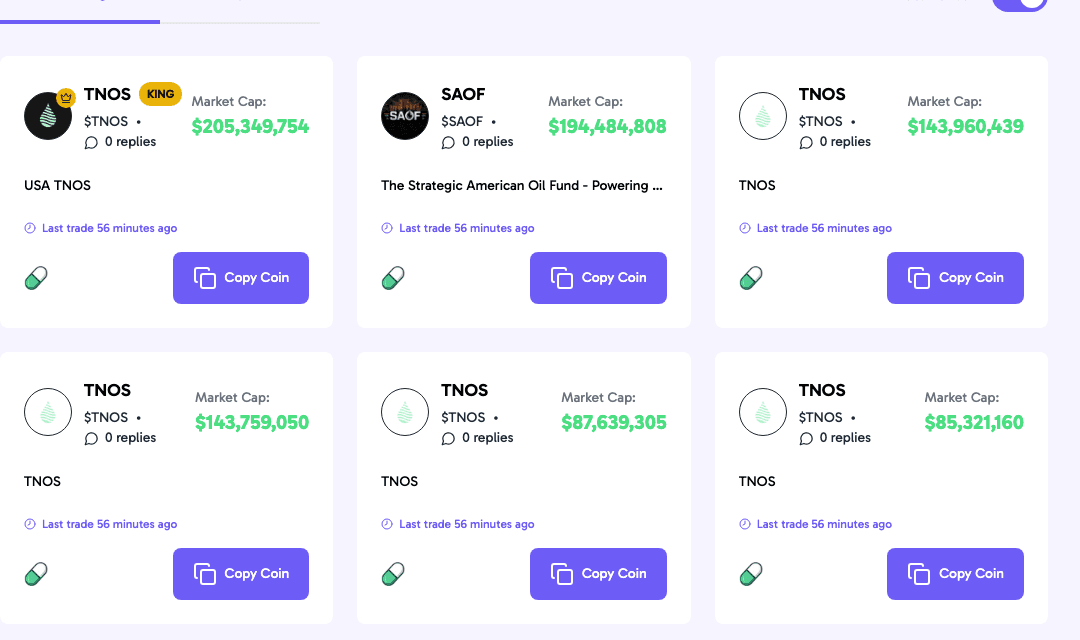
The board as it actually renders. Clicking Copy Coin costs nothing and signs nothing — it only fills the form.
The single most useful field is the last-trade timestamp. Market cap without recent trades is a stale number, and a coin whose last trade was two hours ago is not trending in any sense that helps you. Sort in your head by recency of activity first, size second.
Each card also links out to the coin's own Pump.fun page and its socials. Open the original if you want to see what the format actually is — whether the traction is the art, the ticker, the joke, or a single account amplifying it — because that is the thing you are about to reuse.
Step 3: Hit Copy Coin
One click. The button hands the card's metadata to the token creator and routes you there with a toast confirming the template loaded. Nothing touches the chain at this step: no wallet prompt, no signature, no SOL. You can click Copy Coin on six different cards in a row to see what each one produces and walk away without spending anything.
The image is where the click earns its keep. Pump.fun art is already pinned on IPFS, and the prefill carries that existing URI straight through — no right-click-save, no re-crop, no re-upload, no waiting on a pin. The artwork is in the preview pane by the time the page finishes loading.
Step 4: Change the four fields that matter
Name and ticker, image, description, socials. Full detail in the section below; if you read nothing else in this article, read that one. This is the step everybody skips and it is the step that decides whether your launch looks like a deliberate entry in a format or like an accident.
Step 5: Check the toggles and the total
The form itemizes every optional extra and shows your exact SOL total before your wallet is even connected. Mint-authority revocation arrives ticked — it is the one paid extra the copy template opts into for you, and you can clear it. The pump vanity address arrives unticked at 0.1 SOL; that is the box to find if you want your mint to end the way the board's coins do. Read the total line, decide what you actually want, then connect.
Fund the wallet with headroom above that number. A balance that exactly covers the total fails on network fees — the create flow checks your balance before it builds the transaction, so under-funding produces an insufficient-balance error rather than a half-finished mint.
Step 6: Sign once
One transaction creates the mint account, writes the Metaplex metadata account, mints the full supply to your wallet, pays the service fee, and — if you left the box ticked — revokes mint authority. Confirmation lands in one to two seconds. Copy the mint address and verify it on Solscan before you share it anywhere.
Mechanically that is under a minute from board to live mint. Doing the four edits properly adds two or three. Spend them.
Exactly what the prefill carries
This is the part no competitor can write, because it is a description of one specific shipped implementation rather than a generic account of token cloning.
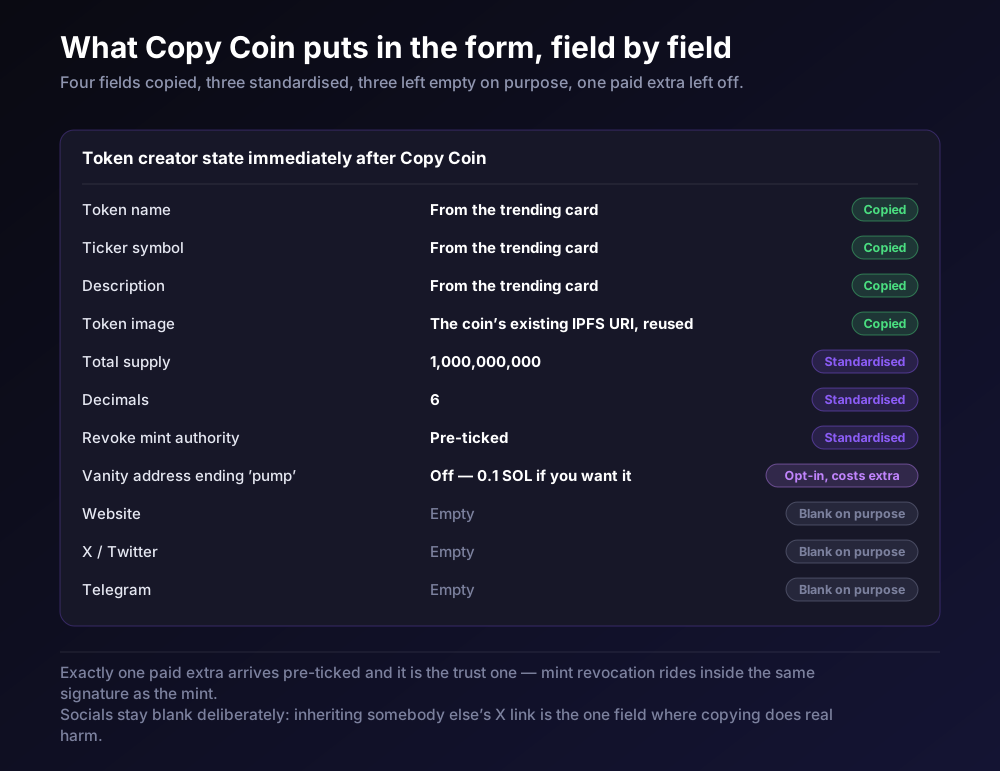
| Field | Where it comes from | Value after Copy Coin |
|---|---|---|
| Token name | The trending card | Copied verbatim |
| Ticker symbol | The trending card | Copied verbatim |
| Description | The trending card | Copied verbatim |
| Token image | The trending card | The coin's existing IPFS URI, reused as-is |
| Total supply | Memecoin default | 1,000,000,000 |
| Decimals | Memecoin default | 6 |
| Revoke mint authority | Memecoin default | Pre-ticked |
| Vanity mint address ending "pump" | Optional extra | Off — opt in for 0.1 SOL |
| Website | Deliberately blank | Empty |
| X / Twitter | Deliberately blank | Empty |
| Telegram | Deliberately blank | Empty |
Three design decisions in that table are worth calling out.
Exactly one paid extra is pre-ticked, and it is the trust one. Revoking mint authority arrives selected because it is what buyers check first and it rides inside the same signature as the mint. Everything else that costs SOL arrives off, including the "pump" suffix — a template that silently spends your money is a worse template. The suffix gets its own section below, because it is the one extra worth deciding on deliberately rather than inheriting.
Supply and decimals are not copied, they are standardized. They arrive at 1,000,000,000 and 6 because that is what effectively every memecoin on the board uses — 6 decimals matches USDC and renders readably on DexScreener, and a round billion prices the token into the fractional range traders associate with early entry. If your token genuinely needs something else, change them; the fields are ordinary inputs.
The socials are blank on purpose. They are the one category of metadata where inheriting the original's values would be actively harmful. A token whose X link points at somebody else's project is both a bad look and misleading to anyone who clicks it, so the handoff drops them rather than carrying them.
What does not carry — and why that is the whole point
Everything a chart shows you stays with the original coin:
- Price and market cap. Yours starts at whatever your first liquidity decision implies, which is usually a market cap in the low four figures.
- Holders. Zero. One wallet holds the entire supply the moment the transaction confirms: yours.
- Volume and trade history. None. The card you copied might be doing six figures a day; your mint has done nothing.
- Liquidity. None until you create a pool or a curve. Until then the token is not tradeable by anyone.
- The contract address. A brand-new mint address, unrelated to the original, permanently.
That list is not a limitation of the tool — it is what a token is. A mint address is the asset; metadata is a label attached to it. Copying the label copies exactly the label. This is why "copy the coin" is never a way to acquire someone else's market, and why any tool that implies otherwise is lying to you.
What you are copying is a format the market has already validated in the last few minutes: a visual style, a naming convention, a category of joke that is currently getting attention. That is genuinely valuable information, it decays fast, and being able to act on it in seconds instead of minutes is the entire advantage on offer here.
The four edits, in detail
1. Name and ticker. Change them unless you have a specific reason not to. A copy that reads as a distinct entry in the same format outperforms one that reads as a typo of the original, because the second one gets mentally filed as a scam attempt within about a second. Run the collision check you would run for any launch: search the name and ticker on X and on DexScreener before you commit. Two live tokens with the same ticker is a permanent, unfixable source of confusion for your own buyers.
2. Image. The prefill points your metadata at the original coin's existing pin. That is what makes the flow fast, and for a first draft it is fine, but understand what it means: the file is not yours, and you are relying on somebody else's pin staying up. A small edit — color swap, different crop, add a hat — takes thirty seconds, gives you a file you control, and makes the token visually distinguishable at the 32×32 pixels wallets actually render it at. Upload your own and Alchemii pins it for you as part of the same flow.
3. Description. This one is the classic self-inflicted wound. It arrives verbatim from the original coin, which means it still describes the original coin's premise, sometimes with the original's links embedded in the prose. Ship that unedited and the first person to read your token's metadata knows exactly what you did and how little care went into it. Rewrite it. Two sentences is enough.
4. Socials. Blank fields are not an oversight, they are a prompt. Fill them with yours or leave them empty deliberately. An empty socials section reads as "early"; somebody else's socials read as "fraud".
The combined failure mode — original description, original art, no links — is the most common way this workflow goes wrong, and it is entirely avoidable in about ninety seconds of typing.
The address your copy can wear
Open any card on the board and look at the mint address rather than the chart. Most of them end in the same four characters: pump. That tail is not part of Solana's address format — it is a vanity suffix, ground out by generating candidate keypairs until one lands on it — and it has become the tell of a Pump.fun launch. It is the first thing a buyer registers when your contract address gets forwarded into a group chat with nothing attached to it but the address.
Which creates an awkward asymmetry for anyone copying a format. You can match the art, the naming convention, and the joke, and then the one field a trader glances at first announces that your token came from somewhere else.
Ticking Pumpfun Token on the create form closes it. Alchemii hands your launch a mint keypair whose public key ends in pump, for a flat 0.1 SOL on top of the launch fee. Because the copy template already opts into the mint-authority revoke, a copied launch with the suffix lands at about 0.42 SOL — about 0.32 SOL if you clear the revoke, which for a copy you probably should not. The important part is what does not come attached: no bonding curve, no platform-set price, no fee tier you cannot choose, no LP held in someone else's escrow, and no wait for graduation before DexScreener and Jupiter will index your pool — they pick it up as soon as it exists.
Three specifics worth having before you tick it:
It works regardless of what you copied. The suffix is a property of the keypair your token is minted to, not something inherited from the card. A coin whose own address ends in pump, a coin minted somewhere else entirely, a format you invented this morning — all three can be minted to a pump address. Nothing else in this category ships that combination.
The address is verified before the transaction is built. The create flow asserts that the keypair it received actually ends in pump and aborts with an error if it does not. You cannot end up having paid 0.1 SOL for a suffix that did not materialise, because the transaction that charges you is never assembled in the first place.
It is cosmetic, and that boundary matters. The suffix signals which format you are playing in. It is not a claim of affiliation, your token did not come off Pump.fun's curve, and letting a buyer believe it did is the same fraud line the rest of this article draws — with the added problem that anyone can check the token's history on Solscan in one click and will.
The fee arithmetic against actually launching on the curve is worth doing yourself. Pump.fun costs 0 SOL to create (about 0.02 SOL for the first buy) and then takes 1.25% on every buy and every sell — 2.5% on a round trip — for as long as the token trades. Against a 0.32 SOL pump-suffix launch that is a 0.30 SOL difference, and 0.30 ÷ 0.02 = 15 SOL of buying and selling before the curve has taken more than the flat fee. With the revoke as well: (0.42 − 0.02) ÷ 0.02 = 20 SOL. Any copy that gets real attention clears either number on day one, and past it the percentage keeps running forever while the flat fee is already paid. The full working is in how to get a pump-suffix token without Pump.fun.
The fork after the mint: bonding curve or your own pool
Once the mint exists you have a decision that Copy Coin deliberately does not make for you: how the token becomes tradeable.
A bonding curve (Pump.fun's own model) costs almost nothing upfront and needs no seed capital, because the curve provides the liquidity. In exchange the platform takes 1.25% on every buy and every sell, for as long as the token trades. There is no upfront charge, which is exactly why it feels free and exactly why it is not. Full mechanics — the curve math, the graduation threshold, what the creator does and does not control — are in the Pump.fun platform guide.
Your own pool means minting a standard SPL token and pairing it against SOL on Raydium yourself. You pay one flat creation fee, you choose the launch price and fee tier, you decide when liquidity goes in, and you can burn the LP token whenever you want. You also have to fund the pool: 5 SOL is a realistic floor, and below that sniper bots can collapse the chart in minutes because the book is too thin.
The crossover is arithmetic rather than opinion. A flat launch fee of roughly 0.22 SOL costs less than a 2.5% round trip once cumulative trading volume passes about 9 SOL — a threshold any launch with real attention clears on day one. Below that, the curve is cheaper. Above it, the percentage compounds forever while the flat fee has already been paid once. The two fee models are laid out side by side in Alchemii vs Pump.fun.
Neither answer is universally right. If you are testing five formats in an afternoon to see which one catches, the curve's near-zero upfront cost is the correct tool. If one of them catches and you want control over price, fee tier, and the LP burn, your own pool is.
Trust config: what to switch on before you sign
The reason mint-authority revocation arrives pre-ticked is not that it is a nice feature to upsell. It is that in our 50,000-launch dataset, revoked mint authority correlates with a 4.2× higher 24-hour survival rate, and LP burned at minute zero correlates with 5.7× — the strongest on-chain signal we found in the entire study.
Two honest caveats on those numbers. They are correlations from observational data, not causal effects: deployers who revoke and burn are also the deployers who did everything else properly, and the config is partly a proxy for care. And neither one saves a token nobody wants. What they do is remove the two worst-case scenarios — an unlimited mint and a pulled pool — that experienced buyers price in during the first thirty seconds of looking at your chart.
For a copy launch specifically, that matters more than usual. A token whose art and name are visibly borrowed is starting from a trust deficit, and the on-chain receipts are the fastest way to close it. Revoked mint authority ships inside the same signed transaction as the mint itself, so there is no separate errand. The LP burn is the next step in the same flow rather than something you get to next week — burn the LP as soon as the pool is funded, and screenshot both the burn transaction and the Solscan page showing null mint authority for your announcement. The full post-mint sequence is in the Solana memecoin launch checklist.
What a copy launch actually costs
Quoted in SOL, because that is what you actually pay:
| Configuration | Cost |
|---|---|
| Standard launch, all-in | ~0.22 SOL |
| With mint authority revoked | ~0.32 SOL |
| Fully loaded, every optional extra ticked | up to ~0.52 SOL |
| Unavoidable on-chain protocol floor | ~0.0191 SOL |
| Raydium pool creation rent | ~0.4 SOL |
| Realistic seed liquidity | 5–25 SOL |
That protocol floor is worth internalizing because it settles a lot of arguments about "free" token creators. Mint rent is 0.00146 SOL, Metaplex metadata rent is 0.00562, the Metaplex protocol fee is 0.01, an associated token account is 0.00204, plus a signature. Nothing on Solana mints a token with metadata for less than roughly 0.0191 SOL, so any tool advertising free creation is recovering it somewhere else.
Where Alchemii actually sits, since a fee comparison is only useful if it is honest: cheaper than Smithii, which is 0.3 SOL flat before it charges again for each revocation, and cheaper than Orion Tools at a 0.4 SOL effective floor. Level with CoinFactory. Cheaper than Pump.fun above roughly 9 SOL of cumulative volume, because Pump.fun's 1% is charged on every buy and every sell forever while Alchemii's fee is charged once. And genuinely undercut on sticker price by several tools — Jumpbit, DEXArea, and Solr all list lower creation fees. Standalone cloners exist as well — cloneme.fun ships one as a Chrome extension — so the comparison worth making is not whether copying exists but how it is delivered: here it runs inside the create flow, with nothing to install and a Raydium pool whose LP tokens are yours at the end of it.
Every optional extra is itemized on the create form with your exact total shown before you connect a wallet. Read that line rather than trusting any number in a blog post, including this one.
Copy a coin that's already running. Mint an address that ends in pump.
- One-click Copy Coin —
- hit Copy Coin on the live Pump.fun board and this form reopens with that coin's name, image and memecoin settings already filled in. No extension to install, and the launch ends in a pool you own.
- The pump address, without the bonding curve —
- tick Pumpfun Token and your mint ends in pump on a launch you own outright, with nothing skimmed off every trade afterwards. How it works.
Copying a format is not copying a token
The line is not subtle and it is worth stating plainly.
Starting from a proven format is normal, permissionless, and how essentially every memecoin cycle has ever worked. Dog coins begat dog coins; every hat variant on Solana is a copy of the hat variant before it. There is nothing to apologize for in looking at what the market is rewarding right now and shipping your own entry in that category.
Passing your token off as the original is a different act. Your mint is a new address with zero holders and zero liquidity, verifiable in one Solscan click by anyone who bothers, and telling a buyer otherwise is fraud. It is also, separately, a losing strategy: the copies that go anywhere are the ones that add a twist, and the ones that rely on nobody checking the mint address get checked within minutes and dumped.
The honest framing of this feature, and the one we sell: the market just told you which format has attention, and this gets you from that signal to a live token of your own faster than anything else in the category. What happens to that token afterwards is entirely on what you do with it.
The reality check
87% of Solana memecoins lose 90% or more of their peak market cap within 24 hours. That figure is from our own observational sample of roughly 50,000 launches, it is the modal outcome rather than the failure case, and copying a trending coin does not move it. The full breakdown of how they die — the shape of the curve, the holder-count collapse, the five config decisions that correlate with survival — is in why 87% of Solana memecoins die in 24 hours.
Copy Coin is a speed tool. It is not an edge, and any launchpad telling you its product is a way to make money is describing its own business model rather than yours. If your motive is specifically financial, read how meme coin creators actually make money before you spend a lamport — it is written off the same dataset and it will save you more than any launch tool can.
What this workflow is genuinely good for: you are already watching the board, a format catches, and you want your own version live in seconds with the supply, the authorities, and the liquidity decisions in your hands instead of a curve's. That is a real advantage, it is narrow, and it is the one worth paying for.
Quick Facts (verifiable specifications)
| Specification | Value |
|---|---|
| Fields copied from the trending card | Name, symbol, description, image URI |
| Default supply after prefill | 1,000,000,000 |
| Default decimals after prefill | 6 |
| Pre-ticked at prefill | Mint-authority revocation only |
| Opt-in extra: "pump" vanity mint address | 0.1 SOL, unticked by default, verified before the transaction is built |
| Copy launch with the "pump" suffix | ~0.32 SOL, or ~0.42 SOL with mint authority revoked |
| Deliberately blanked | Website, X, Telegram |
| Never copied | Price, market cap, holders, volume, liquidity, contract address |
| Board refresh interval | ~8 seconds, paused in background tabs |
| Cost to click Copy Coin | 0 SOL, no signature |
| Standard launch cost | ~0.22 SOL all-in |
| Launch cost with mint authority revoked | ~0.32 SOL |
| On-chain protocol floor | ~0.0191 SOL |
| Transactions required to mint | 1 |
| Confirmation time | 1–2 seconds |
| Break-even vs a 2.5% round-trip fee model | ~9 SOL cumulative volume (standard launch); ~13 SOL with the "pump" suffix |
| Mint-authority revocation, 24h survival correlation | 4.2× |
| LP burned at minute zero, 24h survival correlation | 5.7× |
| Memecoins losing 90%+ of peak within 24h | 87% |
Limitations of this guide
- Mint-address cloners. This guide covers the board-to-creator path. Pasting a contract address into a clone tool is a different workflow with different ergonomics, and it is what most existing writing on this topic already describes.
- Copy-trading. Mirroring another wallet's buys is unrelated to duplicating token metadata, needs a bot rather than a creator, and is out of scope here.
- Marketing the copy. Getting attention onto your token once it exists is the hard part, it is not technical, and no prefill helps with it.
- Trademark and impersonation law. Copying a format is not the same as copying a branded asset, and where that line sits depends on your jurisdiction and the specific mark. This is not legal advice.
- Picking which coin to copy. No guide can tell you which format will still have attention in an hour. The board shows you what is moving; the judgement is yours.
FAQ
How do I copy a trending Pump.fun coin?
Open Alchemii's live Trending Pump.fun Coins board, find a coin with recent trades, and click Copy Coin on its card. The Solana token creator opens with that coin's name, ticker, description, and image already in the fields, plus memecoin defaults of 1,000,000,000 supply and 6 decimals. Nothing is signed and no SOL is spent at that point. Edit the name, ticker, description, and image, add your own social links, check the itemized total, then sign one transaction. The mechanical path takes under a minute; doing the edits properly takes two or three.
Does copying a coin copy its price, holders, or chart?
No. Copy Coin carries metadata only — name, symbol, description, and image. Price, market cap, holder count, trading volume, liquidity, and the contract address all stay with the original coin. Your token is a brand-new mint address with zero holders and zero liquidity from block one, and anyone can confirm that in a single Solscan lookup. You are starting from a proven format, not inheriting a market.
What does Alchemii's Copy Coin button prefill?
Four fields come straight from the trending card: token name, ticker symbol, description, and the image URI. Three more arrive as memecoin defaults: 1,000,000,000 total supply, 6 decimals, and mint-authority revocation pre-ticked — the only paid extra the template opts into, because it is the trust signal buyers check first. The vanity mint address ending in pump is left unticked at 0.1 SOL so you spend that on purpose rather than by default. Website, X, and Telegram are deliberately left blank because those links should be yours. Every one of those fields stays editable — the prefill is a starting point, not a lock.
Can my copy have a mint address ending in pump?
Yes, and the coin you copied does not need one for yours to have one. Tick Pumpfun Token on the create form and Alchemii mints your token to a keypair whose address ends in the characters pump, for a flat 0.1 SOL on top of the launch fee — taking a copy launch to roughly 0.32 SOL, or 0.42 SOL with mint authority revoked as well. The address is verified to actually end in pump before the transaction is built, so a failed grind stops the launch instead of charging you for a suffix you did not get. Everything else stays a direct launch: your price, your fee tier, an LP you hold and can burn at minute zero, and a Raydium pool DexScreener indexes and Jupiter routes as soon as you open it. The suffix signals the format, not an affiliation — your token did not come off Pump.fun's curve and claiming it did is fraud.
How much does it cost to launch a copy of a trending coin?
A standard launch is around 0.22 SOL all-in, and around 0.32 SOL with mint authority revoked, which is what most memecoin launches want. A fully loaded launch with every optional extra ticked tops out near 0.52 SOL. Every extra is itemized on the create form and your exact total is shown before you connect a wallet, so read that line and untick anything you do not want. For reference, the unavoidable on-chain floor for any Solana token — mint rent, Metaplex metadata rent, the Metaplex protocol fee, an associated token account, and a signature — is about 0.0191 SOL.
Is copying a trending memecoin allowed?
Copying a format is normal and permissionless on Solana: nothing stops you minting a token in the same visual style, naming convention, or category of joke as a coin the market is already rewarding. Passing your token off as the original is a different thing entirely, and it is both fraud and a bad strategy — the mint address is public, every buyer can check it in one click, and the copies that go anywhere are the ones that add a twist rather than the ones hoping nobody looks.
What should I change before I sign the transaction?
Four things. The name and ticker, so your token reads as a distinct entry in the format rather than a typo of the original. The image, because the prefill points at the original coin's existing pin rather than a file you control. The description, which arrives verbatim from the original coin and will still describe its premise. And your social links, which are blank on purpose. Shipping the prefill unedited means launching with a stranger's description and no socials, which is the single most common self-inflicted failure of this workflow.
Should I launch my copy on a bonding curve or my own liquidity pool?
A bonding curve costs almost nothing upfront and takes 1.25% on every buy and every sell for as long as the token trades. Your own mint plus a Raydium pool costs one flat fee at creation and takes no cut of volume afterwards, but you have to seed the liquidity yourself — 5 SOL is a realistic floor. The crossover is arithmetic: a roughly 0.22 SOL flat fee is cheaper than a 2.5% round trip once cumulative volume passes about 11 SOL, which any launch with real attention clears on day one.
The board is live right now. Open Trending Pump.fun Coins →, pick a format that is actually moving, and hit Copy Coin — the creator opens filled in, nothing is signed until you say so, and your version can be on-chain before the next refresh. Tick Pumpfun Token on the way through and the mint address ends in pump too, for 0.1 SOL and no bonding curve.
Prefer to start from a blank form with the memecoin defaults already set? Launch a meme coin on Solana →. Want every field yourself? Open the Solana token creator → — one signed transaction, a flat fee charged once, 0% of your trading volume forever.
Create your Solana token
Choose your token name, symbol, supply and image. Review the authority options and creation fee, then confirm the transaction in your wallet. Liquidity is a separate step.
Related Topics
More guides to Solana token creation, authorities, liquidity, and meme coin launches.
How to Find Trending Pump.fun Coins Fast (2026)
How to find trending pump.fun coins in 2026: the four signals that matter, where to look, and why a trending board is a receipt rather than a forecast.
Get a Pump Suffix Token Without Pump.fun (2026)
Create a Solana token ending in pump for 0.1 SOL. Gain memecoin-native recognition, keep direct-launch control, and preserve more creator upside.
Is the Crypto Bull Market Back? Meme Coin Launch Guide (2026)
Bitcoin just logged its biggest week in two years as meme volume returned. Read the data, then launch a Solana meme coin without waiting for migration.
Pump.fun Market Cap vs Replies: Read the Board (2026)
Two numbers sit on every pump.fun trending card. On one board: 14,017 replies at $128.1M, and $245.8M of market cap with zero replies. How to read the gap.
Solana Memecoin Narrative Clusters: How Theme Waves Form (2026)
Seven of nine cards on one live pump.fun board were one narrative. How memecoin theme waves form, what a cluster's cap curve means, and when it's spent.
How to Create a Meme Coin on Solana (2026 Guide)
Create a meme coin on Solana in 5 minutes: exact settings, launch steps, creator-income paths, liquidity, and trust signals for a credible launch.