Solana Memecoin Narrative Clusters: How Theme Waves Form (2026)
Seven of nine cards on one live pump.fun board were one narrative. How memecoin theme waves form, what a cluster's cap curve means, and when it's spent.

Ready to create your Solana token? Enter your token details, choose your authority options, and confirm in your wallet.
A Solana memecoin narrative cluster is a set of independently launched mints whose names, tickers and artwork encode the same theme, trading in the same window and competing for the same pool of attention. Trending boards are sorted by market cap, so they present as a ranking of nine unrelated coins. They rarely are. On the board snapshot below, seven of nine cards were the same idea — American energy production — spread across five tickers and seven mint addresses, carrying $245,802,984 of combined market cap against a board total of $381,440,850. The cluster, not the card, is the unit that actually explains what a board is doing.
This matters for one practical reason. If you read a board card by card, you conclude that seven different things are working. If you read it by cluster, you conclude that one thing is working, it has already picked a winner, and six other mints are dividing what is left. Those two readings lead to completely different decisions about what to launch.
Quick Facts
| Spec | Value |
|---|---|
| Board snapshot captured | 1 August 2026, Alchemii Trending Coins |
| Cards on the snapshot | 9 |
| Cards belonging to the US energy cluster | 7 (77.8%) |
| Distinct tickers in the cluster | 5 (TNOS, USUR, USON, USOX, SAOF) |
| Cluster combined market cap | $245,802,984 |
| Board total market cap | $381,440,850 |
| Cluster share of board cap | 64.4% |
| Cluster leader | Transnational Oil Supply, $78,783,533 |
| Leader-to-tail ratio inside the cluster | 8.8× |
| Top-three concentration inside the cluster | 69.5% |
| Mean / median cluster member | $35,114,712 / $33,437,111 |
| Replies across all 7 cluster members | 0 |
| Replies on the KING-badged coin | 14,017 (98.4% of every reply on the board) |
| Last-trade age on every card | 18 or 32 minutes |
| Board sort order | market cap, descending — KING badge marks rank 1 |
| Alchemii launch cost | ~0.22 SOL standard, ~0.32 SOL with mint authority revoked, up to ~0.52 SOL fully loaded |
| On-chain protocol floor for any Solana token | ~0.0191 SOL |
| 24-hour outcome, 50,000-launch observational sample | 87% lose 90%+ of peak market cap |
The board that made this obvious
Here is the snapshot, exactly as the board rendered it. Nothing is reordered — the board sorts by market cap descending, which is why the KING badge sits on row 1.
| # | Coin | Ticker | Market cap (USD) | Replies | Narrative group |
|---|---|---|---|---|---|
| 1 | Fartcoin (KING badge) | $Fartcoin | $128,143,052 | 14,017 | Platform-native meme |
| 2 | Transnational Oil Supply | $TNOS | $78,783,533 | 0 | US energy |
| 3 | Transnational Oil Supply | $TNOS | $46,832,525 | 0 | US energy |
| 4 | United States Uranium Reserve | $USUR | $45,173,939 | 0 | US energy |
| 5 | United States Oil (AI energy) | $USON | $33,437,111 | 0 | US energy |
| 6 | Transnational Oil Supply | $TNOS | $16,552,983 | 0 | US energy |
| 7 | United States Oil Exchange | $USOX | $16,105,792 | 0 | US energy |
| 8 | Strategic American Oil Fund | $SAOF | $8,917,101 | 0 | US energy |
| 9 | Cupsey (PumpFun mascot) | $Cupsey | $7,494,814 | 229 | Platform-native meme |
| — | Board total | 9 mints | $381,440,850 | 14,246 | — |
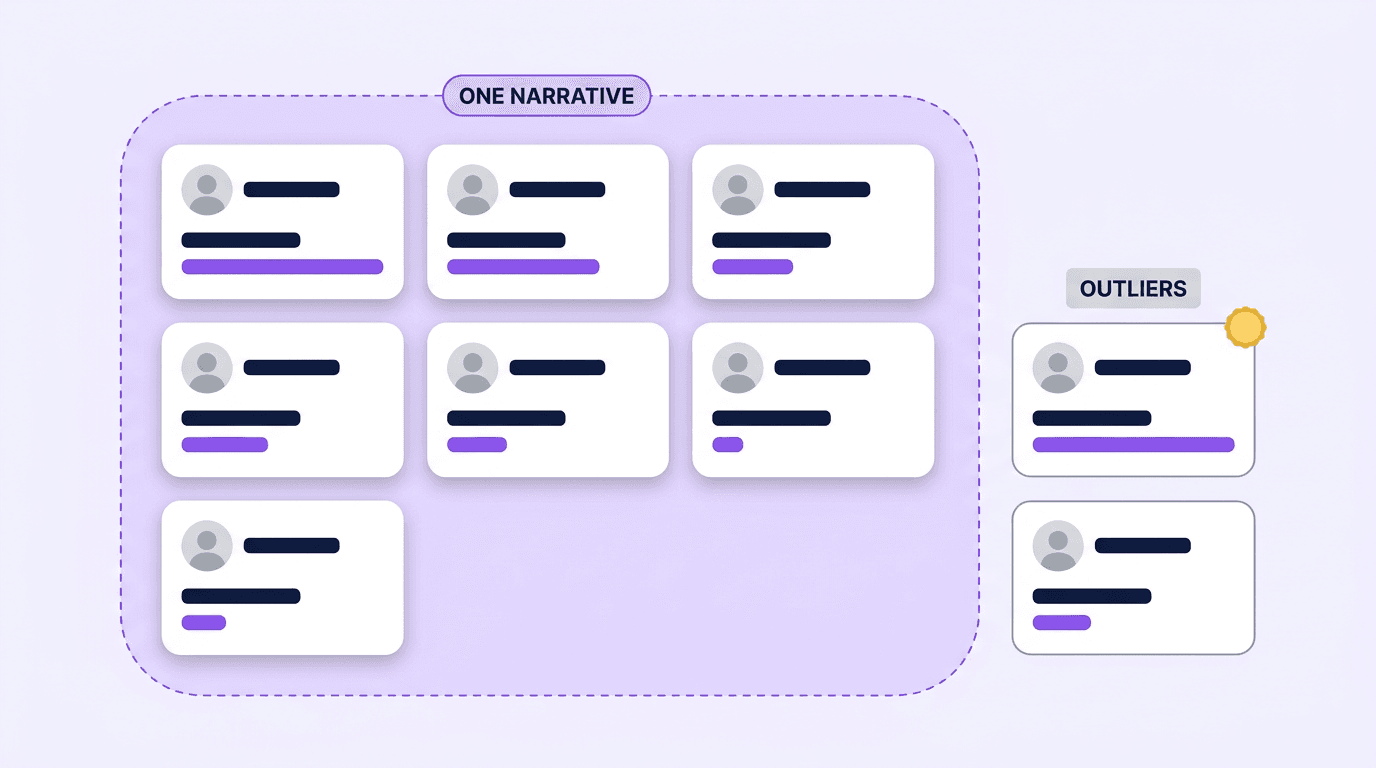
Read it card by card and it looks like a diversified board: a fart joke worth $128M, an oil token, a uranium token, another oil token, a mascot. Read it by theme and there are exactly three things on it — one energy narrative, one platform-native meme with the crown, and one platform mascot.
The energy cluster occupies ranks 2 through 8. Every single position between the KING and the bottom card belongs to the same idea.
What counts as one cluster, and why the rule has to be stated
Cluster analysis is easy to fake, because the analyst gets to draw the boundary. So here is the boundary, written down before the numbers.
Inclusion rule: a card joins the cluster when its name encodes US energy production — crude oil supply, uranium reserves, oil exchanges or funds, or domestic energy framed as the input to American AI. Fartcoin and Cupsey are platform-native memes with no thematic relationship to energy or to each other, so they stay out.
Under that rule the cluster is seven cards, not six. It is worth being pedantic about this, because the obvious count — "an oil supply, a uranium reserve, an oil exchange, an oil fund and an AI-energy play" — lists five names and quietly hides that the oil supply appears three separate times. Seven mints, five tickers, one narrative.
The second thing the rule has to settle is what to do about those duplicates, because the cluster's headline number moves by tens of millions depending on the answer:
- Every mint counted separately: $245,802,984 (64.4% of board cap). This is the rule used for the rest of the article, because a mint address is the thing that exists on-chain. Three TNOS mints are three tokens with three holder sets, three curves and three sets of buyers.
- Largest mint per ticker: $182,417,476 (47.8% of board cap). Defensible if you think duplicates are noise. It shrinks the cluster by $63,385,508 without a single trade occurring.
- Summed per ticker: $245,802,984 again, but the shape changes — TNOS now reads $142,169,041, which is 11% larger than the KING-badged coin.
Same board, same minute, three legitimate rules, and a conclusion that swings between "one narrative owns two thirds of the board" and "one narrative owns just under half." Anyone publishing a cluster percentage without saying which rule they used is publishing a number you cannot check.
The arithmetic, in full
The board total is the sum of all nine cards: $128,143,052 + $78,783,533 + $46,832,525 + $45,173,939 + $33,437,111 + $16,552,983 + $16,105,792 + $8,917,101 + $7,494,814 = $381,440,850. Strip the two non-energy cards and $245,802,984 remains, which is 64.4% of the board. The two cards outside the cluster carry $135,637,866 between them, so the cluster is 1.8× the rest of the board combined.
The shape of a cluster: one leader, one long tail
The interesting structure is not the cluster's size. It is the distribution inside it.
Run the concentration numbers and the pattern is unambiguous:
| Measure | Value | What it says |
|---|---|---|
| Leader share of cluster cap | 32.1% ($78.78M of $245.80M) | One mint holds a third of the theme |
| Top three share | 69.5% ($170,789,997) | The narrative is effectively three tokens deep |
| Bottom three share | 16.9% ($41,575,876) | Four mints are splitting scraps |
| Leader-to-tail ratio | 8.8× ($78,783,533 ÷ $8,917,101) | A defined king, not a contest |
| Mean vs median member | $35,114,712 vs $33,437,111 | Mean above median — right-skewed, as expected |
That right-skewed, winner-heavy shape is what a decided cluster looks like. Capital found the theme, sampled several expressions of it, and concentrated. The tail members are not early bets on the narrative — they are late entries into a narrative that had already been priced.
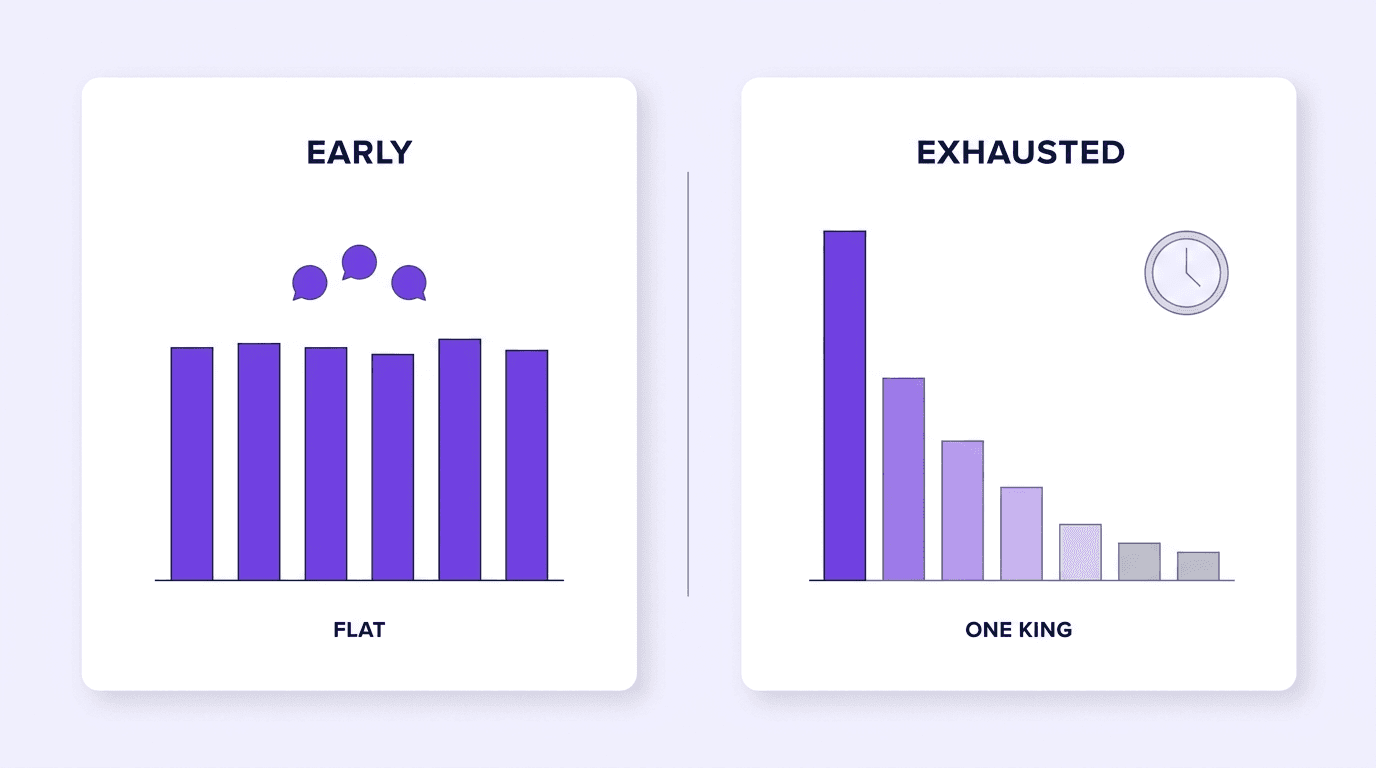
The distribution is the single most useful thing on the board, because it is the only field that tells you where in the lifecycle you have arrived. A cluster where the top member is 1.5× the smallest is a market still making up its mind. A cluster at 8.8× has made it up.
Duplicate tickers are a saturation signal, not a bug
Three cards on this board read $TNOS. Three different mint addresses, three different market caps: $78,783,533, $46,832,525 and $16,552,983.
This surprises people who expect a symbol to be unique. It is not, and it structurally cannot be. On Solana the symbol lives in the Metaplex metadata account attached to a mint, not in the token program's identity model. There is no registry, no reservation, no collision check. Two mints can both be TNOS the same way two people can both be called Chris.
What makes duplicates informative is when they appear. Nobody launches the third token with an already-taken ticker at the start of a wave — at that point the naming space is wide open and copying a symbol exactly buys you nothing. Duplicates cluster at saturation, once the good names are gone and the derivative names have started to sound like prospectuses. Look at the naming drift across this cluster: Supply, then Reserve, then Exchange, then Strategic Fund. The vocabulary migrates from the thing to the financial instrument wrapped around the thing. That drift is the linguistic fingerprint of a late wave.
The operational consequence is simple and non-negotiable: identify coins by mint address on Solscan, never by symbol. This is also the mechanism behind most impersonation scams, and the boundary between building on a format and impersonating a live project is covered in is cloning a memecoin legal. What a duplicate ticker does not give you is the other token's holders, liquidity or chart — that is spelled out in what happens when you clone a Solana token.
How a narrative cluster forms: five phases
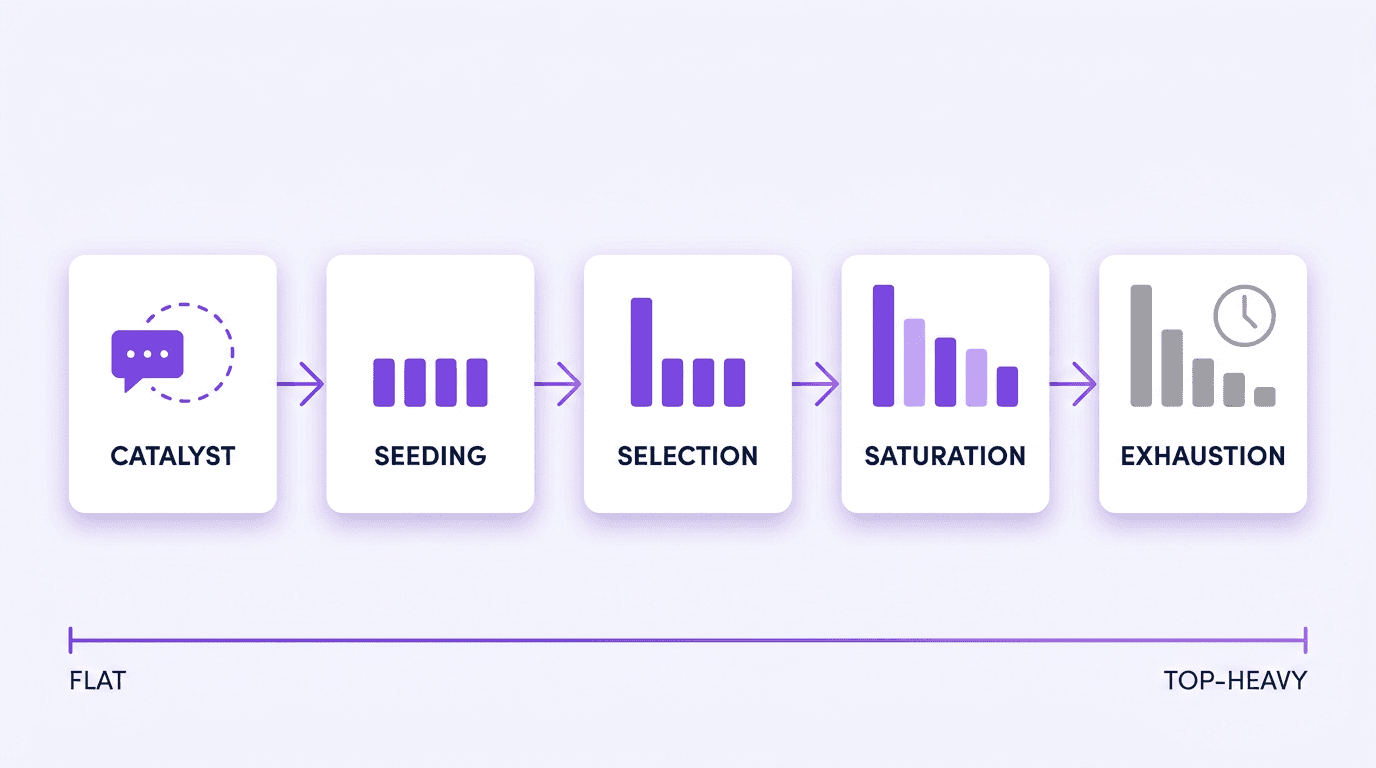
Phase 1 — Catalyst. The theme exists off-chain first. A news cycle, a video, a policy announcement, a screenshot. Nothing on-chain has happened yet, and no board can show you this phase. It is the only genuinely forward-looking input, and it is the one the board cannot give you.
Phase 2 — Seeding. Several mints appear within minutes of each other, usually on a New feed rather than a Trending one. Names are literal and overlapping. Caps are small and close together. Nobody knows which one becomes the cluster, including the people who launched them. This is the phase where a flat distribution is diagnostic: if five mints are all inside a 2× band of each other, selection has not happened.
Phase 3 — Selection. Capital concentrates. One member pulls away, the leader-to-tail ratio blows out from roughly 1-2× to 5× or more, and the leader starts appearing on Trending boards where everyone else can see it. The cluster is now public.
Phase 4 — Saturation. The naming goes derivative and institutional, duplicate tickers appear, and the tail lengthens with mints that are late expressions of a theme the market already priced. On our snapshot this is visible in plain text: United States Oil Exchange, Strategic American Oil Fund.
Phase 5 — Exhaustion. Trades slow, replies stop arriving, caps freeze in place. The board still shows big numbers, because market cap is an accumulated quantity that does not decay when attention does. This is the trap: an exhausted cluster and a live one look identical if you only read the market-cap column.
Early wave or exhausted wave: six readings
Every one of these is visible on a card without leaving the board.
| Signal | Early wave reads | Exhausted wave reads | 1 Aug snapshot |
|---|---|---|---|
| Leader-to-tail ratio | under 3× | 5× or more | 8.8× — late |
| Naming vocabulary | literal, one obvious name | institutional synonyms, derivative wrappers | Exchange, Strategic Fund, Reserve — late |
| Duplicate tickers | rare | common | 3 mints on TNOS — late |
| Reply flow | replies arriving on several members | zero or frozen | 0 across 7 members — late |
| Last-trade recency | seconds | many minutes | 18 and 32 minutes — late |
| Top-three concentration | under 50% | 65%+ | 69.5% — late |
Six for six. The board on 1 August 2026 was showing $245.8M of energy narrative that had already happened.
Two honest caveats before anyone treats that table as a law. First, the thresholds are heuristics from watching boards, not parameters fitted to a labelled dataset — they are written down so you can disagree with a specific number instead of a vibe. Second, this is one board on one day. A single snapshot can demonstrate that clusters have structure and that the structure is readable; it cannot establish how often the readings are right. Treat the method as reusable and the specific verdict as a case study.
Capital was in one place, attention in another
The reply column on this snapshot is the most counterintuitive thing on it.
| Group | Market cap | Replies | Market cap per reply |
|---|---|---|---|
| Fartcoin (KING) | $128,143,052 | 14,017 | ~$9,142 |
| Cupsey | $7,494,814 | 229 | ~$32,728 |
| US energy cluster (7 mints) | $245,802,984 | 0 | no replies at any cap |
Two cards carried 100% of the board's 14,246 replies while holding 35.6% of its market cap. The cluster holding 64.4% of the market cap had no conversation at all. Fartcoin was roughly 3.6× denser in replies per dollar than Cupsey, and the energy cluster does not appear on that scale because you cannot divide by zero replies.
That gap describes two genuinely different kinds of memecoin. Community memes accumulate conversation, which is slow to build and slow to leave. Sector-rotation memes accumulate capital fast from people trading a theme, and the capital leaves the moment the theme does — with nothing behind it, because nothing was ever built. Neither is better. They fail differently, and they are enterable at different speeds. The full treatment of that relationship, including where reply counts mislead, is in pump.fun market cap vs replies.
One more reading on the same snapshot: every card, including the crowned one, showed a last trade 18 or 32 minutes old. On a board that repolls every eight seconds, a uniform multi-minute gap across all nine cards is not a coincidence about any single coin. It is a statement about the board.
So what do you actually launch?
Four responses to a live cluster. None of them is a way to make money, and this article is not going to imply otherwise — the honest version of that question is here.
1. Enter the leader's cluster at saturation. This is what most people do and it is the most common failure mode on this list. The tail of the 1 August cluster exists because people did it: the smallest member sat at $8.9M against a leader at $78.8M, with zero replies, competing for attention that had already been allocated. If the six readings above come back late, this is the option you are actually choosing.
2. Take the adjacent theme instead of the crowded one. The cluster's own composition hints at this. Uranium sat at $45.2M without being oil, and the AI-energy crossover at $33.4M was neither a pure energy play nor a pure AI play. Adjacency is less crowded by construction. It is also one observation on one board, so treat it as a hypothesis worth testing rather than a rule.
3. Be in phase 2 next time. The highest-variance option, and the only one where the distribution is still flat when you arrive. It requires watching a New feed rather than a Trending one, which is the practical argument in how to find trending pump.fun coins, and it requires being able to go from decision to live mint in the time it takes to fill a form.
4. Ignore clusters entirely. Build something with a reason to exist past the 24-hour window. Slower, harder, and the only path where the narrative timing stops mattering.
Options 2 and 3 both come down to elapsed time between spotting something and having a token live. That is a tooling problem, and it is the one piece of this we actually fixed.
Copy Coin: the mechanics, stated plainly
Every card on the live board carries a Copy Coin button. Clicking it opens Alchemii's Solana token creator with the form already populated. Here is the observed state of that form, field by field, from a real handoff:
| Field | State after Copy Coin |
|---|---|
| Token Name | Carried over from the copied coin |
| Symbol | Carried over; the field shows "4/8 characters left" — 8 is the ticker limit |
| Decimals | 6, labelled "default recommended 6" |
| Supply | 1,000,000,000 |
| Description | Carried over verbatim from the copied coin |
| Token Image | Carried over, with a "Change image" control |
| Revoke Freeze | Labelled "(required) — Required to create a liquidity pool (0.1 SOL)", ticked and locked |
| Revoke Mint | Labelled "Prevents further token minting (0.1 SOL)", ticked by default |
| Every other paid extra | Left unticked, so the template never spends more than the launch needs |
| Social links | Blank — those should be yours |
Two clarifications the form's own labels do not make, both verifiable on-chain after you launch:
- Nothing is signed and no SOL moves at Copy Coin time. It is a prefill and a redirect. Every field stays editable until you connect a wallet and approve a single transaction.
- "Revoke Freeze" describes an outcome, not an instruction. Alchemii initialises the mint with the freeze authority set to
nullfrom the start, so there is no freeze authority in existence to revoke. The only conditional authority change in the transaction is mint authority. Update authority is never revoked and the metadata account ships withisMutableset totrue— check that byte on Solscan rather than trusting any tool's description of what it did, ours included.
Solana blocks are roughly 400 ms and confirmation takes one to two seconds, so the chain was never the slow part. The slow part was the clerical work: find the coin, save the logo, open a creator, retype the name, retype the ticker, paste a description, re-upload the image, set supply, set decimals, check the toggles. Two or three minutes of typing, during the only window where minutes matter. That is the part Copy Coin deletes. The step-by-step version is in how to copy a trending pump.fun coin.
And the thing worth repeating, because it is where copies actually fail: your mint is a new address with no holders, no liquidity and no price. You inherit the format, not the token. Change the name, edit the art, rewrite the description, add your own socials — the copies that go anywhere add a twist, and a copy trades on its own merits from block one.
Open the live board and try Copy Coin →
What a cluster entry costs
A standard launch on Alchemii is ~0.22 SOL all-in, ~0.32 SOL with mint authority revoked, and up to ~0.52 SOL fully loaded. Every extra is itemised on the form with your exact total shown before you connect a wallet. The unavoidable on-chain floor for any Solana token is about 0.0191 SOL — mint account rent ~0.00146, Metaplex metadata rent ~0.00562, the Metaplex protocol fee of 0.01, associated token account rent ~0.00204, plus the 5,000-lamport signature fee. Nothing can be cheaper than that floor, on any tool.
We are not the cheapest tool in this category and will not claim to be — Jumpbit at 0.05 SOL, DEXArea at 0.09 and Solr at 0.1 all undercut us on the signature-prompt number. What is verifiable: we sit below Smithii (0.3 SOL flat, plus 0.1 per revocation) and Orion Tools (0.4 SOL effective floor), level with CoinFactory, and ahead of pump.fun past roughly 11 SOL of cumulative trading volume, because pump.fun takes 1.25% on every buy and every sell for as long as the token trades while a flat fee is charged once. Full line-by-line breakdown in cost to create a Solana token.
The reality check
The dataset is the most credible thing we own, so it gets to contradict the marketing.
Alchemii's observational sample of roughly 50,000 Solana launches shows 87% of memecoins lose 90% or more of their peak market cap within 24 hours. Launching into a live narrative does not move that number. Two configuration choices correlate with better 24-hour survival in that sample — revoked mint authority at 4.2× and LP burned at minute zero at 5.7× — and both are correlations in observational data rather than causal guarantees. The method is documented at our launch-data methodology, with the underlying figures published in the open 50,000-launch dataset. The failure modes themselves are catalogued in why most Solana memecoins die in 24 hours.
Read the six-for-six verdict on that snapshot honestly. A cluster with a defined king, three duplicate tickers, zero replies and a 30-minute-old last trade is not an opportunity that happens to be well documented. It is a documented ending.
After the mint
The token existing is not the launch. The sequence that follows is separate and deliberate: create a Raydium pool, seed it with liquidity you can genuinely afford to lock, burn the LP tokens, and publish the on-chain receipts so buyers can verify rather than trust. If you left mint authority alone at creation, revoking it is a separate transaction. The full order of operations is in the Solana memecoin launch checklist, and the vocabulary is in the memecoin glossary.
Limitations of this guide
- One board, one moment. Every figure here comes from a single snapshot captured on 1 August 2026. It demonstrates that clusters have readable structure; it does not establish base rates.
- No causal claim about the catalyst. The board shows that an energy narrative existed. It cannot show what started it. Verifying the off-chain half needs Google Trends, news, or social listening — not a coin card.
- Market cap is a board field, not an audited figure. It derives from bonding-curve position, and curve position can be manufactured by co-funded wallets buying their own launch. The check is the Holders tab on Solscan, not the board.
- Reply counts are gameable. Reply farms are cheap. A zero is more informative than a large number.
- No trading advice. Nothing here says which coin to buy, or that any cluster will continue. It is written for someone deciding what to launch.
- No pre-graduation aggregator coverage. Pre-graduation pump.fun coins have no liquidity pair, so DexScreener and GeckoTerminal cannot see them at all. Cluster analysis has to happen on the board.
- Third-party feed. The board proxies a public pump.fun data feed. Upstream outages degrade the list to empty and it refills on the next poll.
- Not legal advice. Building inside a theme is not the same as impersonating a live project, and where that line sits depends on your conduct and jurisdiction.
FAQ
What is a memecoin narrative cluster?
A narrative cluster is a group of separately launched mints whose names, tickers and artwork encode the same theme, trading at the same time and competing for the same attention. On Alchemii's live board on 1 August 2026, seven of nine cards were US energy tokens — an oil supply mint repeated three times, a uranium reserve, an oil exchange, an oil fund and an AI-energy play — with a combined market cap of $245,802,984 against a board total of $381,440,850. The cluster is the real unit of analysis on a trending board, not the individual card.
How do you tell an early narrative wave from an exhausted one?
Six readings, all visible on the card itself. Early waves are flat (no member far ahead of the others), literally named, free of duplicate tickers, actively replied to, traded seconds ago, and not concentrated at the top. Exhausted waves are top-heavy (leader 5x or more above the tail), institutionally named, full of duplicate tickers, silent, last traded many minutes ago, and heavily concentrated. The 1 August snapshot read late on all six: an 8.8x leader-to-tail ratio, three mints sharing one ticker, zero replies across the whole cluster, and a last trade of 18 or 32 minutes ago on every card.
Why do several tokens share the same ticker on a trending board?
Because Solana has no ticker namespace. The symbol lives in the Metaplex metadata account, not in the token program's identity model, so nothing prevents two mints from both calling themselves TNOS. On the 1 August board, three separate mint addresses shared that ticker at $78,783,533, $46,832,525 and $16,552,983. Duplicate tickers cluster at the saturation stage of a narrative, once the obvious names are taken. Always identify a coin by its mint address on Solscan, never by its symbol.
What does the market cap distribution inside a cluster look like?
One leader and a long tail. In the 1 August energy cluster the leader held $78,783,533, which was 32.1% of the cluster's $245,802,984; the top three members held 69.5%; the bottom three held 16.9%; and the smallest member was 8.8x below the leader. The mean member sat at $35,114,712 against a median of $33,437,111. A flat distribution means the market has not chosen yet. A steep one means it has, and it did not choose you.
Is it a good idea to launch into a crowded narrative cluster?
Late entry into a saturated cluster is the single most common way this goes wrong, and we are not going to pretend otherwise. By the time a theme fills most of a trending board it has a defined leader, derivative naming, duplicate tickers and, in the 1 August case, zero replies across a quarter of a billion dollars of combined market cap. Alchemii's observational sample of roughly 50,000 launches shows 87% of Solana memecoins lose 90% or more of their peak market cap within 24 hours, and a live narrative does not change that number. Launch for speed and control, not for an expected return.
How fast can you launch into a narrative wave?
The chain is not the bottleneck — Solana blocks are about 400 ms and confirmation is 1-2 seconds. The form is. Alchemii's Copy Coin button on the live board opens the token creator with the name, symbol, description and image already carried over, 6 decimals, 1,000,000,000 supply and Revoke Mint ticked, so the clerical work between spotting a theme and signing a transaction is one click plus your edits. Nothing is signed and no SOL moves until you review the form and approve a single transaction.
Does copying a coin from a cluster give me its holders or chart?
No. A copy is a brand new mint address with zero holders, zero liquidity and no price. It inherits the format — the naming convention, the visual style, the category of joke — and nothing else. Anyone can confirm in one Solscan click that your mint is not the one on the board, which is why the copies that go anywhere add a visible twist: your own name, your own art, your own description, your own socials. A copy trades on its own merits from block one.
Sources and how to re-check them
- Alchemii Trending Coins board (primary source for this article) — AlchemiiThe nine-row snapshot analysed here was captured from this board on 1 August 2026. The page is server-rendered from the live pump.fun feed with a 5-minute cache and an 8-second browser poll, so the board you open will not match the snapshot — the method will. (accessed 2026-08-01)
- Pump.fun board (pump.fun/board) — Pump.funThe upstream feed. Same coins, same market-cap sort, no Copy Coin handoff. (accessed 2026-08-01)
- Pump.fun documentation (pump.fun/docs) — Pump.funBonding-curve mechanics, the 1.25% buy / 1.25% sell fee, and the graduation event that ends a coin's pre-pool life.
- Pump.fun launch and graduation dashboard — Dune AnalyticsPublic daily launch counts and graduation rates — the base rate against which any single cluster should be read.
- Pump.fun protocol fees and volume — DefiLlamaIndependent volume aggregate, useful for sanity-checking how much of a day's activity a single narrative represents.
- Solscan — token and holder explorer — SolscanWhere you confirm that two cards sharing a ticker are different mint addresses, and where the Holders tab exposes a cap built by a handful of co-funded wallets.
- DexScreener — Solana pairs — DexScreenerPair indexer. Blind to pre-graduation pump.fun coins, which is why cluster analysis has to happen on the board rather than on an aggregator.
- GeckoTerminal — Solana pools — GeckoTerminalSecond pair indexer, same structural blind spot; used here to confirm the cluster members had no indexable pool at snapshot time.
- Birdeye — Solana token analytics — BirdeyeHolder-count and volume cross-checks once a cluster member graduates and acquires a pool.
- SPL Token Program — Solana LabsThere is no ticker namespace on Solana. Three mints can share the symbol TNOS because the symbol lives in metadata, not in the program's identity model.
- Metaplex Token Metadata — Metaplex FoundationThe account that stores the name, symbol and image every card on the board renders — and the account Alchemii ships with isMutable set to true.
- Solana clusters and block time — Solana docs~400 ms block time and 1-2 second confirmation: the reason the form, not the chain, is the bottleneck when a narrative is live.
- Solana transaction fees — Solana docs5,000 lamports per signature — one component of the ~0.0191 SOL on-chain floor quoted in the cost section.
- Solana rent-exempt minimums — Solana docsMint account ~0.00146 SOL and associated token account ~0.00204 SOL of rent-exempt deposit.
- Alchemii launch-data methodology — AlchemiiHow the ~50,000-launch observational sample was assembled, and why the survival figures in this article are correlations rather than causal claims.
- Open Solana launch-cost dataset — AlchemiiThe underlying published figures behind the 87% / 4.2× / 5.7× numbers cited in the reality-check section.
- Google Trends — GoogleThe cheapest way to test the off-chain half of a narrative — whether the theme exists outside the board or only inside it.
Clusters are readable in about ten seconds once you know which four numbers to look at: leader-to-tail ratio, duplicate tickers, reply flow, last-trade age. Go read a live one — open Trending Coins, and if a format is still worth acting on, Copy Coin opens the Solana meme coin creator with the name, image and memecoin settings already filled. Review, make it yours, sign once.
Create your Solana token
Choose your token name, symbol, supply and image. Review the authority options and creation fee, then confirm the transaction in your wallet. Liquidity is a separate step.
Related Topics
More guides to Solana token creation, authorities, liquidity, and meme coin launches.
How Many Meme Coins Are Created Every Day? 35,700+ (2026)
We counted 1,048 Solana launches in 42 minutes — a new meme coin every 2.4 seconds, about 35,705 a day. Who makes them, what they earn, and what we got wrong.
Crypto FOMO in Memecoins: The Price of Waiting for Proof
Crypto FOMO has a price you can calculate. The median pump.fun winner graduates in 4.4 minutes — and $2,210 of buying takes 56% of the cheap supply.
How to Copy a Trending Pump.fun Coin in 2026 (60 Seconds)
Copy a trending Pump.fun coin in under a minute: one click prefills the token creator with name, ticker, image and settings — plus an optional pump-suffix mint.
How to Find Trending Pump.fun Coins Fast (2026)
How to find trending pump.fun coins in 2026: the four signals that matter, where to look, and why a trending board is a receipt rather than a forecast.
Pump.fun Market Cap vs Replies: Read the Board (2026)
Two numbers sit on every pump.fun trending card. On one board: 14,017 replies at $128.1M, and $245.8M of market cap with zero replies. How to read the gap.
Get a Pump Suffix Token Without Pump.fun (2026)
Create a Solana token ending in pump for 0.1 SOL. Gain memecoin-native recognition, keep direct-launch control, and preserve more creator upside.