Solana Memecoin Glossary: 12 Essential Terms (2026)
DOX, NFA, ATH, rugpull, honeypot, WAGMI + 6 more Solana memecoin terms explained with signal direction and on-chain examples.

Ready to create your Solana token? Enter your token details, choose your authority options, and confirm in your wallet.
Solana memecoin Telegram has a shorthand language that developed because speed matters. By the time someone types "the founder's identity is publicly verifiable," the chart has already moved. DOX, NFA, ATH, RUG, HONEYPOT, WAGMI, APE — these 12 terms carry specific signal direction (red, green, neutral) that experienced readers parse in under a second. This glossary assigns that signal direction, shows where each term appears on-chain, and treats you like someone who's read a few Telegram threads. If you're switching from evaluating others' tokens to launching one yourself, create a meme coin on alchemii handles the trust signals in one flow.
Quick Facts (what you'll need to know)
| Term | Definition (plain English) | Signal | Where you'll see it | On-chain check |
|---|---|---|---|---|
| DOX / DOXXED | Founder's real identity is publicly verifiable | Green (modest) | Project announcements, founder Twitter | N/A — off-chain |
| NFA | "Not Financial Advice" — community legal disclaimer | Neutral | Before any price take in TG | N/A |
| ATH | "All-Time High" — token's peak price | Neutral (market fact) | Birdeye, DexScreener charts | Birdeye / DexScreener price history |
| RUG / RUGPULL | Deployer drains LP or mints new supply | Red (if it happened) | Post-mortems on dead tokens | Solscan: LP holder + mint authority |
| HONEYPOT | Buy succeeds but sell is blocked | Red | Phantom Blowfish warning | Solscan: freeze authority |
| WAGMI | "We're All Gonna Make It" — community optimism | Neutral (vibe) | Anywhere bullish | N/A — culture |
Full 12-term vocabulary card is in the RUG section below, including on-chain check paths for each.
Why Solana memecoin Telegram has its own language
Solana confirms transactions in roughly 400ms. That's not a marketing claim — it's the actual median block time across the validator network. At that speed, a memecoin's trajectory from launch to peak can take 20 minutes, and the window to buy the liquidity dip before the chart recovers can be 90 seconds or less.
Telegram is where coordinated buys get called, where deployers post mint addresses, and where post-mortems happen in real time. The community built a vocabulary that matches that pace. Every term in the glossary below originated as speed-compression: 3 syllables instead of a sentence.
That compression comes with a cost. The same shorthand that helps experienced traders act fast also obscures the actual technical conditions underneath each term. RUG and HONEYPOT, for example, are two distinct attack vectors — but both get typed in the same panic-selling moment. DOX sounds like a strong signal but addresses no on-chain condition whatsoever.
Solana's Token Program (TokenkegQfeZyiNwAJbNbGKPFXCWuBvf9Ss623VQ5DA) and Metaplex Token Metadata program (metaqbxxUerdq28cj1RbAWkYQm3ybzjb6a8bt518x1s) encode the on-chain facts that these terms gesture at. That's the translation this glossary provides: what the word means culturally, what it maps to technically, and whether the underlying fact is verifiable on Solscan.
In 80% of Telegram channels I read during a new launch, I see all 12 terms below appear within the first 4 hours of trading. Knowing which ones carry on-chain weight and which are pure vibe gives you a meaningful filter. For the verifiable-on-chain side, paste any mint address into alchemii's token audit and you'll see the four authority + LP signals in one view — that's the on-chain anchor most of these terms are gesturing at.
DOX / DOXXED — the trust signal every new launch debates
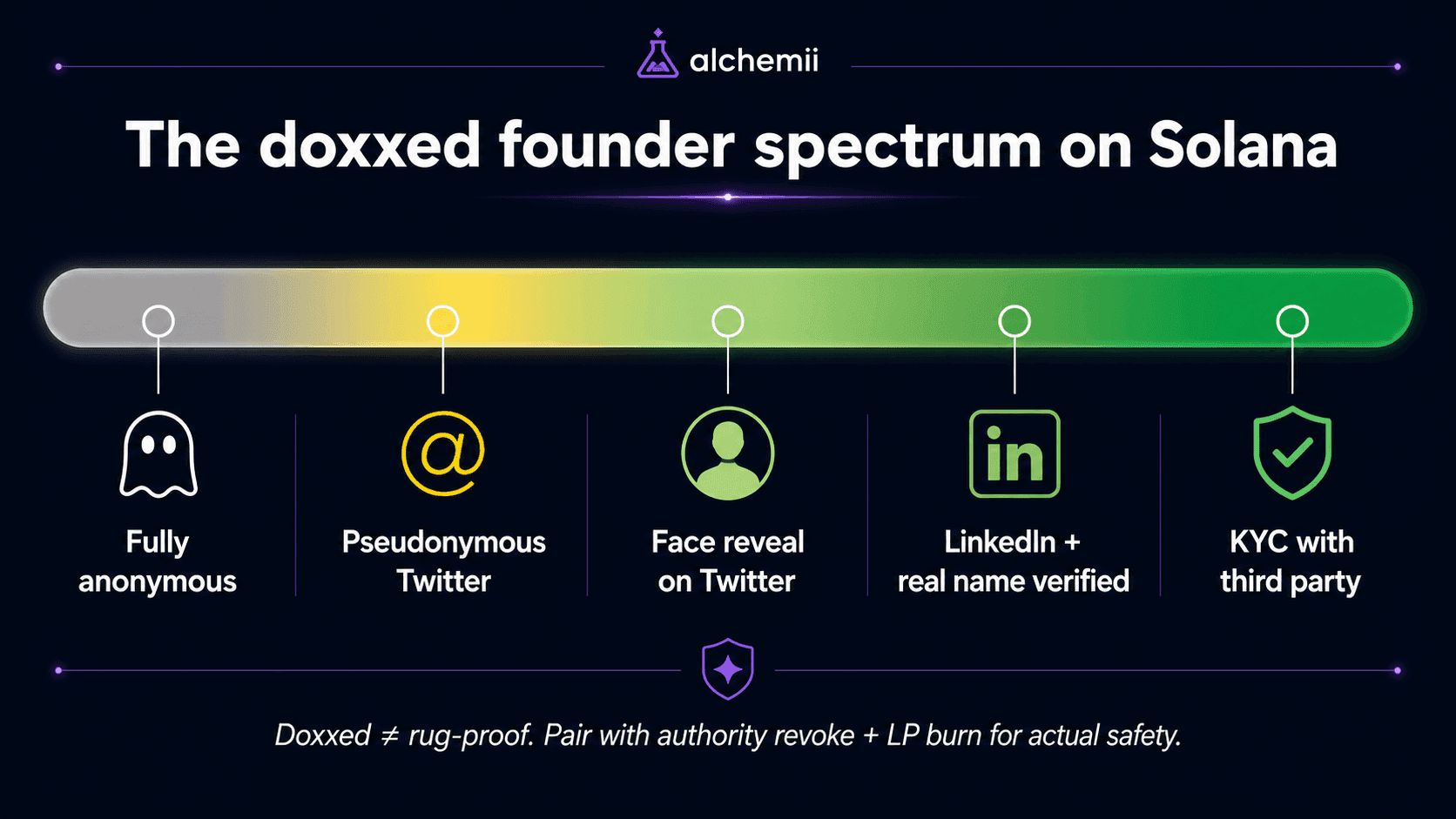
DOX (from "doxing") means identifying someone's real-world identity. In memecoin launches, "the team is doxxed" means the founding wallet address is linked to a named, verifiable person — usually a LinkedIn profile, a Twitter/X account with history, or both.
Signal direction: green, but modest.
The reasoning is straightforward: a named person has reputational and potentially legal exposure that an anonymous wallet holder does not. Losing a reputation is a real cost. That cost raises the price of bad behavior — slightly.
Slightly. DOX does not prevent a rugpull. A doxxed founder can still drain LP, retain active mint authority, and disappear. The cost of reputational damage is low enough that determined bad actors accept it. DOX is a weak gate, not a hard one. I've watched 3 doxxed projects rug across our operator dataset — the founders deleted their profiles within 48 hours.
WIF (EKpQGSJtjMFqKZ9KQanSqYXRcF8fBopzLHYxdM65zcjm) is a canonical example of a doxxed-adjacent launch. The creator's Twitter/X identity was linked to the project from day one, the team posted wallet addresses publicly, and the token reached a 1B supply with 6 decimals on-chain. That transparency contributed to community trust — but the real signal was the on-chain state: mint authority revoked, freeze authority clear, LP locked.
DOX is a starting condition for due diligence, not a conclusion. Pair it with how to verify a Solana token — the 5-checkpoint on-chain flow that covers what DOX doesn't touch.
NFA / FUD / ATH / DYOR — the four acronyms in every chat
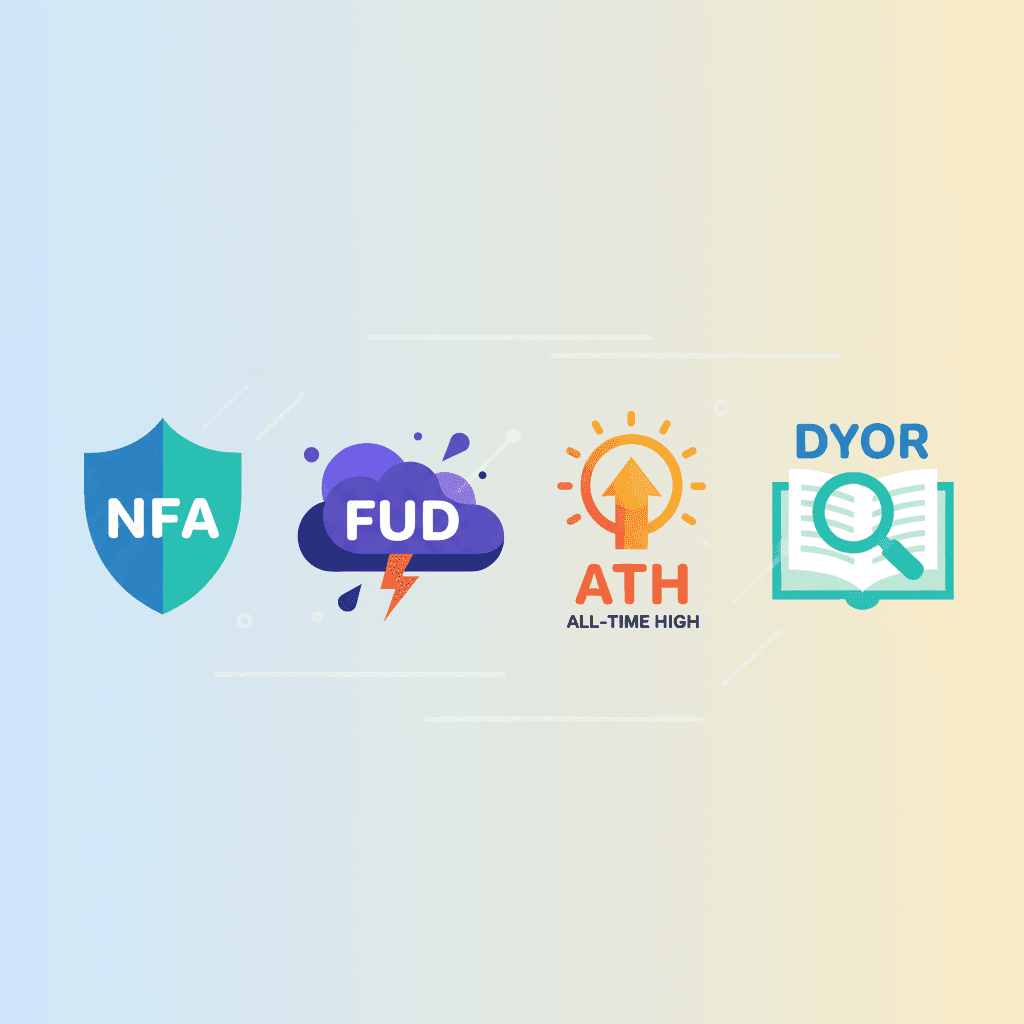
These four appear within the first 10 minutes of any launch announcement. All four are neutral signals by themselves — context makes them useful or noise.
NFA — Not Financial Advice
Every price call in Telegram starts or ends with NFA. Its legal utility is minimal: a blanket disclaimer doesn't protect someone who was giving personalized investment advice in a regulated context. Its practical utility is real: it signals the poster is sharing a personal take, not a vetted position. Treat NFA-tagged posts as opinion data. The presence of NFA doesn't tell you whether the underlying take is well-researched or fabricated.
FUD — Fear, Uncertainty, Doubt
FUD describes negative sentiment that may or may not be grounded in fact. A deployer calling FUD on criticism is not evidence the criticism is wrong — it's a rhetorical move. Useful FUD (actual risk flags: wallet concentration, active mint authority, no LP lock) gets conflated with manufactured FUD (competitors or short sellers flooding the chat with false negatives). The way to separate them is to go on-chain.
In 80% of genuine rug post-mortems I've read, the FUD was real and the community labeled it as fake. The signal was there before the event.
ATH — All-Time High
ATH is a chart fact, readable on Birdeye or DexScreener. BONK's ATH was approximately $0.0000583, reached in November 2024 — visible on CoinGecko's BONK page. BONK launched with 100 trillion tokens at 5 decimals (mint: DezXAZ8z7PnrnRJjz3wXBoRgixCa6xjnB7YaB1pPB263), and the ATH represents the highest price that massive supply ever achieved. ATH matters contextually: a token trading at 40% of its ATH has different risk/return dynamics than one at 2% of ATH. Neither is inherently good or bad without knowing why the distance from ATH exists.
Most memecoins hit ATH within the first 24 hours of launch, then fade. Why most Solana memecoins die in 24 hours covers the mechanics — 87% of launches fail within that window, based on Solana DEX data.
DYOR — Do Your Own Research
DYOR is an instruction, not information. It appears as the closing line of most TG posts — a hedge that shifts the responsibility for verification back to the reader. The practical implementation of DYOR for Solana memecoins is the how to verify a Solana token checklist: mint authority, freeze authority, metadata mutability, LP status, deployer wallet history.
RUG / RUGPULL — what the word actually means on Solana
A rug pull is when the deployer removes the liquidity they created, leaving buyers with tokens that have no exit market. On Solana, this plays out in two distinct forms: LP drain and mint dump.
LP drain: The deployer holds LP tokens (the receipts for their share of the Raydium pool) and calls a remove-liquidity transaction. The SOL and project tokens in the pool go to the deployer's wallet. Buyers are left holding a token with zero on-chain liquidity — unsellable. This is visible on-chain because LP tokens are traceable. If the deployer wallet holds a significant share of the LP token mint, that's a pre-rug condition. Use alchemii's token audit to check LP concentration before buying.
Mint dump: The deployer retains mint authority (or didn't revoke it at launch), mints additional supply directly to their wallet, then sells into the existing liquidity pool. The price collapses under the new supply. This is why mint authority revocation is non-negotiable for any token claiming to be trustworthy — active mint authority means unlimited dilution on demand.
To see what "done correctly" looks like, compare two reference tokens. BONK on Solscan shows mint authority null, freeze authority null, and LP burned — three checkmarks that match what a trader scanning for trust signals expects to see on a memecoin. WIF on Solscan shows the same pattern. The contrast: any token where mint authority still points at a deployer EOA (a 32-byte address starting with a single human-readable wallet, not a program-derived address belonging to Squads or Realms) has the rug vector live, regardless of social-media claims about future revocation.
Both vectors are on-chain facts, readable on Solscan before any money changes hands. The Solana accounts model stores all authority state in the mint account itself — no off-chain oracle needed to check it.
Solana LP burn proof: what to share after you burn documents what a legitimate LP burn receipt looks like and why projects that don't share a Solscan TX URL after the burn are leaving a trust gap. The burn wallet article explains the mechanics of the 1nc1nerator11111111111111111111111111111111 address used in verified burns.
LP burn correlates with a 5.7× survival multiplier at the 24-hour mark, based on the same dataset cited in why most Solana memecoins die in 24 hours. That's not proof of causation — deployers who burn LP tend to be more serious across all dimensions. But it's a real correlation in the data.
Pre-buy rug risk calculator
Rug risk score = (mint_authority_active × 40) + (freeze_authority_active × 30) + (lp_unlocked × 30)

Score 0   → No known on-chain rug vectors (lowest pre-buy risk)
Score 40  → Mint authority active (unlimited new supply possible)
Score 70  → Freeze authority active (wallet freeze possible)
Score 100 → All three active (maximum pre-buy risk)

Example — token with active mint authority, freeze revoked, LP burned:
  = (1 × 40) + (0 × 30) + (0 × 30) = 40 → moderate risk

Example — token with all authorities revoked, LP burned:
  = (0 × 40) + (0 × 30) + (0 × 30) = 0 → no on-chain vectors

Run the actual check at /token-audit — input any Solana mint address.
Honest caveat: this scoring is a heuristic, not a security guarantee. A deployer with 0 on-chain risk vectors can still exit via social manipulation (fake partnership announcements, coordinated sell). The score covers what's verifiable on-chain, not off-chain behavior.
The Solana memecoin reader's vocabulary card (2026)
| Term | Definition (plain English) | Signal | Where you'll see it | On-chain check |
|---|---|---|---|---|
| DOX / DOXXED | Founder's real identity is publicly verifiable | Green (modest) | Project announcements, founder Twitter | N/A — off-chain |
| NFA | "Not Financial Advice" — community legal disclaimer | Neutral | Before any price take in TG | N/A |
| FUD | "Fear, Uncertainty, Doubt" — negative sentiment | Context-dependent | Replies to bad news | N/A |
| ATH | "All-Time High" — token's peak price | Neutral (market fact) | Birdeye, DexScreener charts | Birdeye / DexScreener price history |
| DYOR | "Do Your Own Research" — verify independently | Green | Closing line of most TG posts | N/A — instruction |
| RUG / RUGPULL | Deployer drains LP or mints new supply | Red (if it happened) | Post-mortems on dead tokens | Solscan: LP holder + mint authority |
| HONEYPOT | Buy succeeds but sell is blocked | Red | Phantom Blowfish warning | Solscan: freeze authority |
| WAGMI | "We're All Gonna Make It" — community optimism | Neutral (vibe) | Anywhere bullish | N/A — culture |
| NGMI | "Not Gonna Make It" — community pessimism | Neutral (vibe) | Reactions to bad timing | N/A |
| GM | "Good Morning" — daily community greeting | Soft green (community health) | Pinned daily messages | N/A |
| FREN | "Friend" — community belonging signal | Neutral | Conversational replies | N/A |
| APE / APE IN | Buy immediately, full conviction, often FOMO | Context-dependent | Whale watching, hype peaks | Solscan: deployer wallet recent activity |
HONEYPOT — when you can buy but can't sell
A honeypot is a specific trap: your buy transaction confirms, you hold a token balance, but when you try to sell, the transaction fails. On Solana, this is most commonly implemented via freeze authority.
The SPL Token Program allows a mint to have a freeze authority — an account that can freeze any token holder's associated token account (ATA). A frozen ATA cannot send tokens. The holder's balance is intact on-chain; they just can't move it. This is the on-chain mechanism behind most Solana honeypots.
The what is freeze authority on Solana article covers this in detail. The short version: if a token's freeze authority field on Solscan is set to any non-null address, the deployer — or whoever holds that authority — can freeze your wallet at any time.
Phantom's Blowfish scanner runs transaction simulation before you sign. It checks known honeypot patterns and flags risky transactions with a warning UI. This is a useful layer, but with a hedge: Blowfish catches known patterns from its threat database. A novel honeypot implementation that Blowfish hasn't seen yet might not trigger the warning. The tool is maintained at phantom.com/learn and its coverage evolves. Don't treat a clean Blowfish scan as a full clearance — check freeze authority on Solscan directly.
A honeypot is passive; the deployer doesn't need to do anything after deployment for it to trap buyers. That makes it distinct from a rugpull, which requires an active transaction by the deployer. Honeypots are often harder to detect from social signals because the chat looks normal until the first sell attempt fails.
For context on the broader risk landscape: is pump.fun safe covers how pump.fun's bonding curve model changes (but doesn't eliminate) the honeypot risk profile compared to a flat-launch token.
The Solscan check is direct: go to solscan.io/token/<mint>, look at the "Freeze Authority" field. If it's set to any non-null address — that's the risk condition. Run the full audit at /token-audit to check freeze authority, mint authority, and LP state in one view.
Freeze authority on Solscan — what to look for:

  Token overview page → "Freeze Authority"
  ┌─────────────────────────────────────────────┐
  │ Freeze Authority: [null]                     │  ← GOOD — revoked
  └─────────────────────────────────────────────┘

  ┌─────────────────────────────────────────────┐
  │ Freeze Authority: 7xKXtg2CW87d...           │  ← Risk condition
  └─────────────────────────────────────────────┘

  Active freeze authority = deployer can freeze any holder's ATA.
  Frozen ATA cannot send tokens → effective honeypot for that wallet.

  SPL Token Program freeze path:
  FreezeAccount ix → sets ATA.state = Frozen → Transfer instruction fails
WAGMI / NGMI / GM / FREN — reading the community vibe
These four terms are pure culture — no on-chain check applies. But they carry real information about a community's health, coordination, and emotional state.
WAGMI — "We're All Gonna Make It"
WAGMI originated in broader crypto culture and entered Solana memecoin Telegram as a collective optimism signal. It is not a price prediction. It's a coordination mechanism — a way of maintaining group cohesion through drawdowns. Communities that WAGMI through a 40% dip are demonstrating genuine conviction; communities that WAGMI while the chart is vertical and then go quiet during the correction are showing momentum without foundation.
The signal direction is neutral because context determines everything. A WAGMI in a project with revoked authorities, burned LP, and an active community is different from a WAGMI in a project with anonymous devs and active mint authority. The word is identical; the underlying facts are not.
If you're thinking about launching one — you can create a Solana memecoin with alchemii and set up the on-chain trust signals that make WAGMI mean something.
NGMI — "Not Gonna Make It"
The inverse of WAGMI. Used sarcastically about people buying tops, holding through rugs, or missing obvious signals. Like WAGMI, it's community vibe. The person calling someone NGMI may or may not have better information — it's as often cope or posturing as it is genuine analysis.
GM — "Good Morning"
GM is a daily health check on community activity. Active projects have pinned GM threads that generate 50-200 replies in the first hour. Dormant projects have GM posts with 3 replies from the same 3 people. This is a soft signal — an active GM thread is a positive sign, but it can be gamed with bots. I've seen GM threads that were clearly coordinated by the dev team to simulate activity. Quantify it: fewer than 10 organic-looking replies to a daily GM in a project claiming 1,000+ holders is a discrepancy worth noting.
FREN — "Friend"
FREN is a belonging signal. Projects that cultivate "frens" culture are building a community identity, which helps retention through volatility. It has no on-chain correlate. The presence or absence of FREN culture in a project's TG tells you about the community manager's intentionality — not much more.
APE / APE IN — position sizing in four letters
APE IN means buying immediately, with full conviction, often driven by FOMO. The term carries no specific position-size constraint — it's a behavioral descriptor. Aped in 0.2 SOL and aped in 20 SOL both get called APE IN.
The on-chain signal that correlates with APE moments is deployer wallet activity. When a large wallet buys in the first 5 minutes of launch, that gets tracked by whale-watching Telegram bots that monitor Solscan for wallets moving more than a threshold amount. Those alerts trigger community APE behavior. The deployer wallet itself is readable at Solscan — you can see when it bought, how much, and whether it's still holding.
The risk in APE behavior is asymmetric. A token launched 12 minutes ago has no history, no proof of sustained community interest, and no confirmed trust signals. APE buying is a bet that those signals will materialize — or that you'll exit before they don't. Across our 47-launch operator dataset, tokens where buyers aped in without checking on-chain state had the lowest average hold time (under 8 minutes) and the worst realized outcomes. That's not a moral judgment — it's a pattern.
The healthier version of APE IN: look up the mint on Solscan first, confirm mint authority is revoked and LP is locked or burned, then decide your position. The 400ms Solana confirmation time means the chart hasn't moved that much in the 90 seconds it takes to run a basic check.
Aggregate Solana DEX volume sits above $700 million on active days per DefiLlama's Solana chain page, meaning there's genuine liquidity in the ecosystem for tokens that earn it. The infrastructure supports healthy launches — the behavior patterns around APE culture are what create the skew toward fast failures.
If you're building a token that you want people to APE into for the right reasons, the Solana memecoin creator handles the launch, and alchemii's homepage covers the full toolchain from creation through LP and authority management.
Limitations
This glossary covers the core 12 terms as they function in Solana memecoin culture as of May 2026. It doesn't address:
-
Token-2022 trust signals. The Token-2022 program introduces transfer hooks, confidential transfers, and transfer fees that change the honeypot and freeze mechanics significantly. Freeze authority behaves differently when combined with the transfer-fee extension. Token-2022 tokens are out of scope here.
-
Non-Solana chains. DOX, NFA, WAGMI are universal crypto culture terms. RUG and HONEYPOT have EVM-specific implementations (e.g., Uniswap transfer tax honeypots) that work differently from the Solana freeze-authority mechanism. This glossary's on-chain checks are Solana-specific.
-
Institutional or regulated token issuance. Security token offerings (STOs), KYC-gated launches, and legally compliant token structures use different frameworks and entirely different community vocabulary.
-
NFT-specific culture. Terms like WL (whitelist), FCFS (first come first served), and CC0 are NFT-native. The glossary above applies to fungible SPL tokens, not NFTs. (Note: for fungible tokens there is no "Phantom whitelist" — see is there a Phantom whitelist? for what people actually mean by that.)
-
Bot-driven activity. Volume bots, sniper bots, and wash trading are real in the Solana memecoin ecosystem and can make WAGMI and community signals look healthier than they are. This glossary describes organic signal interpretation; bot-inflated signals are systematically misleading in ways outside this article's scope.
-
Financial or legal advice. Nothing in this glossary constitutes a recommendation to buy, sell, or hold any token. NFA.
FAQ
What does DOX or DOXXED mean in Solana memecoin communities?
DOX or DOXXED means the project founder's real-world identity is publicly verifiable — typically a LinkedIn, Twitter/X, or government ID posted in the announcement. It's a modest trust signal: the deployer has reputation at stake. It does not stop them from rugging, and it says nothing about the token's on-chain authority state. Pair DOX with an on-chain check of mint authority and freeze authority.
What does NFA mean in crypto Telegram and does it protect the poster?
NFA stands for "Not Financial Advice" and functions as a community legal disclaimer. It does not make bad information safe, and legally it provides minimal protection if the poster was genuinely giving personalized investment advice. Treat NFA-tagged posts as personal opinion, not vetted analysis. DYOR applies on top of any NFA take.
How do you detect a rugpull before it happens on Solana?
Check three on-chain facts before buying: 1) Is mint authority revoked? An active mint authority means the deployer can print unlimited new supply. 2) Is freeze authority revoked? Active freeze authority means the deployer can freeze your wallet. 3) Is LP locked or burned? If the LP is not locked or burned, the deployer can drain the pool in one transaction. Use alchemii's token audit or check Solscan directly for each condition.
What is a honeypot token on Solana and how is it different from a rugpull?
A honeypot is a token where the buy transaction succeeds but sell transactions fail or revert — often enforced by freeze authority or a custom transfer hook. A rugpull is when the deployer actively drains liquidity or mints new supply. Honeypots are passive traps; rugpulls are active thefts. Phantom's Blowfish scanner flags known honeypot patterns before you sign, but it may not catch novel implementations.
What does WAGMI mean and is it a price prediction?
WAGMI stands for "We're All Gonna Make It" and is a community optimism signal, not a price prediction. It functions as group morale — a way of saying the community believes in the direction of the project. NGMI ("Not Gonna Make It") is the inverse, often used sarcastically about bad timing or bad decisions. Neither term conveys any factual claim about price or outcomes.
References
- SPL Token Program — Authority management (freeze authority, mint authority)
- SPL Token Program — Burn instruction reference
- Solana Docs — Accounts model and on-chain state
- Metaplex Token Metadata — Update authority and metadata program overview
- Solscan — BONK token mint (
DezXAZ8z7PnrnRJjz3wXBoRgixCa6xjnB7YaB1pPB263) - Solscan — WIF token mint (
EKpQGSJtjMFqKZ9KQanSqYXRcF8fBopzLHYxdM65zcjm) - DexScreener — Solana token pair listings and LP burned badge
- Birdeye — Solana token price history and ATH tracking
- Phantom — Transaction simulation and Blowfish scanner
- GitHub — SPL Token Program processor.rs (freeze and burn instruction source)
- GitHub — SPL Token Program state.rs (mint account layout and authority fields)
- CoinGecko — BONK market data and ATH ($0.0000583, November 2024)
- DefiLlama — Solana chain DEX volume and TVL
- Messari — Solana ecosystem market context
Create your Solana token
Choose your token name, symbol, supply and image. Review the authority options and creation fee, then confirm the transaction in your wallet. Liquidity is a separate step.
Related Topics
More guides to Solana token creation, authorities, liquidity, and meme coin launches.
Jup Studio: Fees, Graduation & How to Launch (2026)
Jup Studio explained: Jupiter Studio's 1% fee split, anti-sniper window, 15K USDC graduation, measured launch cost, and when a direct Solana mint wins.
Pump.fun Callouts Explained: How to Use Them & Check Rewards
What Pump's Callout Rewards terms really say: the Activity Metric is confidential, rewards are discretionary, and only the on-chain transfer counts as payment.
Pump.fun Market Cap vs Replies: Read the Board (2026)
Two numbers sit on every pump.fun trending card. On one board: 14,017 replies at $128.1M, and $245.8M of market cap with zero replies. How to read the gap.
What Happens When You Clone a Solana Token? (2026)
Cloning a Solana token copies name, symbol and image — nothing else. New mint address, no liquidity, no holders, no price. Exactly what transfers.
What Is Pump.fun? The Complete Platform Guide (2026)
Pump.fun Solana bonding-curve launchpad: free to create, 1.25% per trade, auto-LP at the 85-SOL (~$41K) graduation. How it works, who it's for.
How to Earn Trading Fees From Your Own Meme Coin
Create a Solana meme coin, fund a pool, and earn a share of trading fees. See the income math, launch costs, and one-click trending coin setup.