Raydium Token Launch: The 5-Step Playbook (2026)
End-to-end Raydium token launch flow: mint your SPL, configure metadata, seed a Raydium pool, burn LP, and get listed on Jupiter. Total cost ~0.72 SOL.

Ready to create your Solana token? Enter your token details, choose your authority options, and confirm in your wallet.
A Raydium token launch is the five-step on-chain sequence that turns a fresh SPL mint into a tradable, aggregator-routed token: (1) mint SPL with metadata (~0.22 SOL all-in), (2) revoke mint + freeze authority (flat optional extras, taking steps 1-2 to ~0.32 SOL for the typical memecoin config), (3) seed a Raydium CPMM pool (~0.4 SOL plus 5-25 SOL seed), (4) burn LP at minute zero (~0.01 SOL), and (5) qualify for Jupiter strict-list. Total cost lands near 0.72 SOL excluding seed liquidity — up to ~0.92 SOL if you tick every optional extra at the mint step; mechanical steps run in ~10 minutes, Jupiter adds a 7-day wait. For steps 3-4 in one signed transaction, alchemii's Raydium LP Builder wraps the SDK into a no-code flow.
Quick Facts
| Spec | Value |
|---|---|
| Steps | 5: mint → metadata + revoke → seed pool → burn LP → listings |
| Cost excluding seed liquidity | ~0.72 SOL typical (~0.31 mint + metadata + revoke, ~0.4 pool, ~0.01 burn); up to ~0.92 SOL with every optional extra |
| Wallet funding before you start | ~1 SOL on top of seed liquidity |
| Seed liquidity (memecoin) | 5-25 SOL |
| Pool creation fee | ~0.4 SOL, non-refundable |
| Fee tier (memecoin standard) | 1% CPMM |
| Mechanical time | ~10 minutes, plus ~7-day Jupiter strict-list wait |
Before you launch: utility token or memecoin?
Picking the wrong launch shape is the most expensive mistake in the sequence, because two of the steps below behave differently. A utility token (governance, payments, NFT side-asset) usually wants retained authorities and a paid market-maker. A memecoin wants revoked authorities and a burned LP at minute zero. The decision tree:
- Utility / project token. You keep mint authority (you'll re-mint into vesting), freeze authority stays on for compliance hooks, LP stays in a multisig, fee tier 0.25%, seed liquidity often 50+ SOL. Raydium CLMM is acceptable if your price band is predictable.
- Memecoin / community launch. Revoke both authorities before the pool exists, burn LP at minute zero, fee tier 1%, seed 5-25 SOL. Raydium CPMM only. Skip CLMM entirely.
For the memecoin branch, alchemii's Raydium LP Builder handles steps 3 and 4 in one no-code flow: pool creation plus LP burn in a single signed bundle. The utility-token branch typically wants the manual Raydium UI because you'll want to keep LP and stage in liquidity rather than burn it. If you're not sure which branch you're on yet, the memecoin creation flow presets the right authority + fee-tier defaults.
The rest of this guide assumes the memecoin path. Utility-token launchers should read how to add liquidity to Raydium for the CLMM + retained-LP variant.
Step 1 — Mint the SPL token (~0.22 SOL)
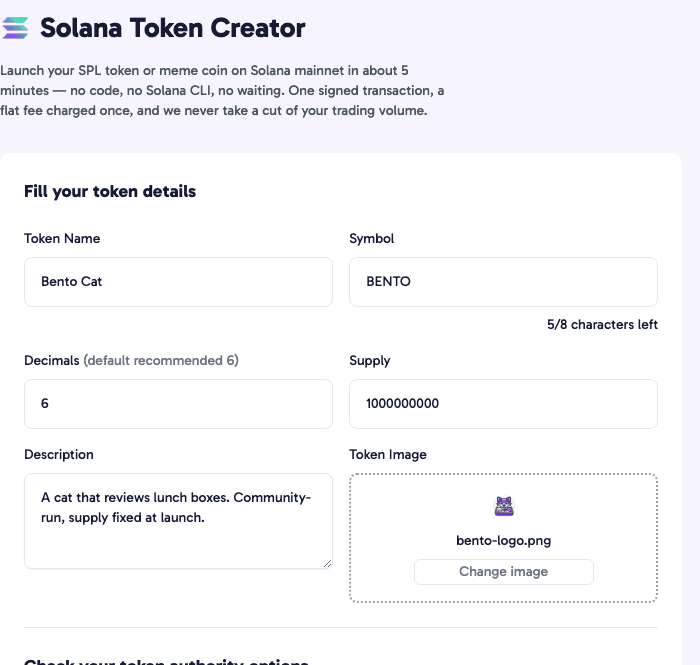
The SPL token is a mint account inside Solana's shared SPL Token Program at address TokenkegQfeZyiNwAJbNbGKPFXCWuBvf9Ss623VQ5DA. Creating one writes three on-chain accounts: the mint itself (82 bytes), an associated token account for your wallet, and a Metaplex metadata PDA (we cover that in Step 2). Rent-exempt minimums add up to ~0.0014 SOL; the rest of the ~0.22 SOL is the flat, one-time no-code service fee — charged once, with no cut of your trading volume afterwards.
What you set at this step:
- Name + symbol. UTF-8, displayed in wallets and explorers.
- Decimals. 9 is the SPL default. Use 6 if you want USDC parity (USDC at
EPjFWdd5AufqSSqeM2qN1xzybapC8G4wEGGkZwyTDt1vis 6 decimals). Memecoins frequently use 5 (BONKDezXAZ8z7PnrnRJjz3wXBoRgixCa6xjnB7YaB1pPB263, 100T supply) or 6 (WIFEKpQGSJtjMFqKZ9KQanSqYXRcF8fBopzLHYxdM65zcjm, 1B supply). - Supply. Minted at creation to your wallet. Common patterns: 1B for memecoins, 100M-10B for utility tokens, 100T for BONK-style hyper-supply plays.
One thing I keep seeing first-time launchers get wrong: decimals are immutable. Pick 9. Actually, 6 if you want USDC parity for any aggregator price math. You can't change it later without minting a new token. For the full step-by-step on this piece alone, see how to create a Solana SPL token; the no-code path lives at the Token Creator.
| Setting | Memecoin default | Utility token default |
|---|---|---|
| Decimals | 5 or 6 | 6 or 9 |
| Supply | 1B or 100T | 100M-10B |
| Service fee | 0.2 SOL flat | 0.2 SOL flat |
| On-chain rent + signature | ~0.0191 SOL | ~0.0191 SOL |
| Total step cost | ~0.22 SOL | ~0.22 SOL |
Step 2 — Attach metadata, revoke mint + freeze authority (flat optional extras)
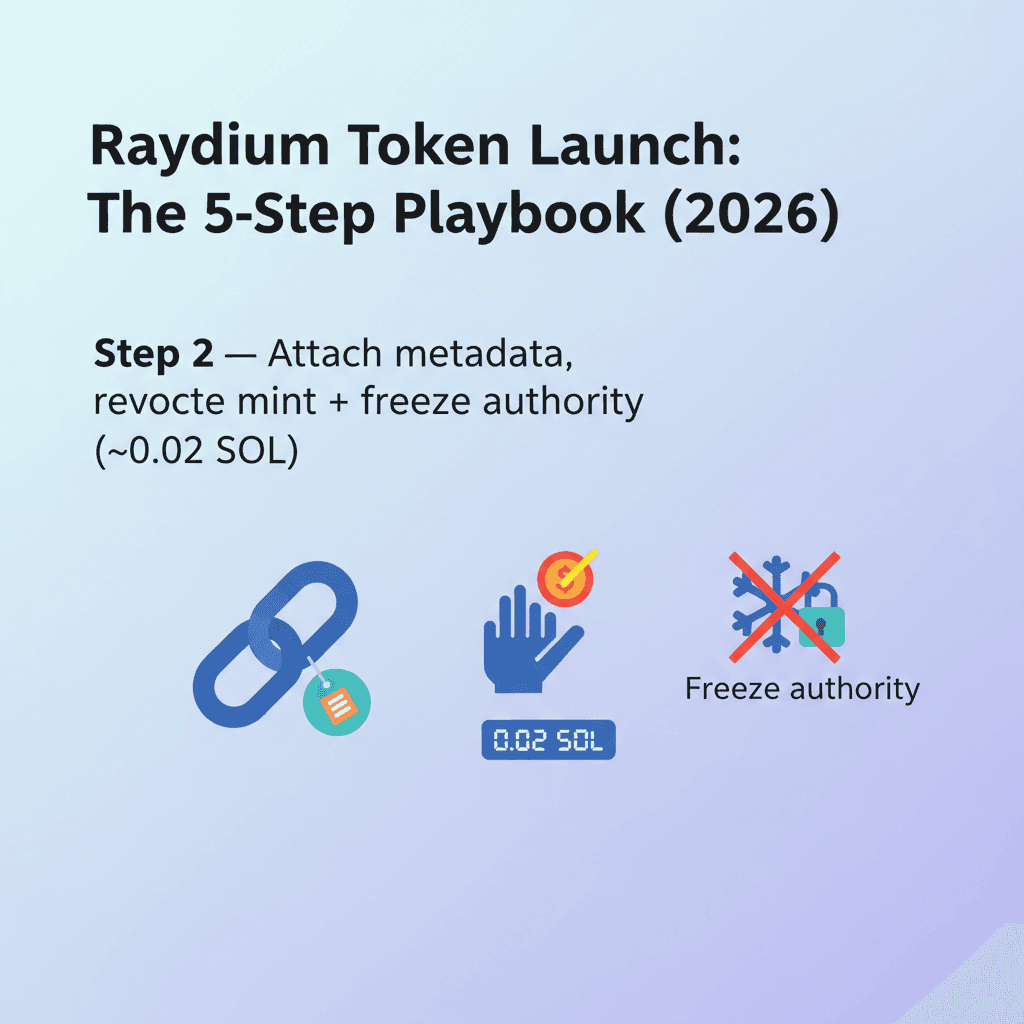
The metadata PDA is what wallets read to show your token's name, image, and ticker. Without it, Phantom and Solflare display the raw mint address. DOA for a memecoin. Metadata is written via the Metaplex Token Metadata program at metaqbxxUerdq28cj1RbAWkYQm3ybzjb6a8bt518x1s. The metadata account itself is ~679 bytes and costs ~0.012 SOL of rent.
You'll upload:
- Image (PNG or JPEG, ≤200KB recommended, hosted on Arweave or IPFS via Pinata)
- External URL (your project site, optional)
- Description (≤500 chars, optional but Jupiter strict-list checks this)
After metadata is written, revoke mint authority and revoke freeze authority in the same transaction batch. This is non-negotiable for any memecoin launch. Solscan displays "Mint Authority: null" and "Freeze Authority: null" as the green-flag pair that traders check before buying. If either field still shows a wallet address, sophisticated buyers walk. Full mechanics in how to revoke mint authority on Solana.
The revoke instructions themselves are immediate and cost almost nothing in raw network gas (~0.000005 SOL each), but on a no-code flow each revocation is a paid option — a flat amount, itemized on the form before you connect a wallet. Budget roughly 0.32 SOL for steps 1-2 with mint authority revoked, and up to ~0.52 SOL if you tick every extra. Once revoked, neither you nor anyone else can mint more tokens or freeze a trader's balance, which is exactly the trust signal you're trying to create.
flowchart TD
  A[Mint account created] --> B[Metadata PDA written via Metaplex]
  B --> C{Authority decisions}
  C -->|Memecoin path| D[Revoke mint authority]
  D --> E[Revoke freeze authority]
  E --> F[Solscan shows null/null]
  C -->|Utility path| G[Keep both, document in docs]
One scar from 2024: pre-Metaplex-v2 immutable metadata meant you couldn't edit the image after launch even if you wanted to. Current v2 lets you mark metadata mutable or immutable at write time. Memecoins: set it immutable. Utility tokens with evolving branding: keep it mutable.
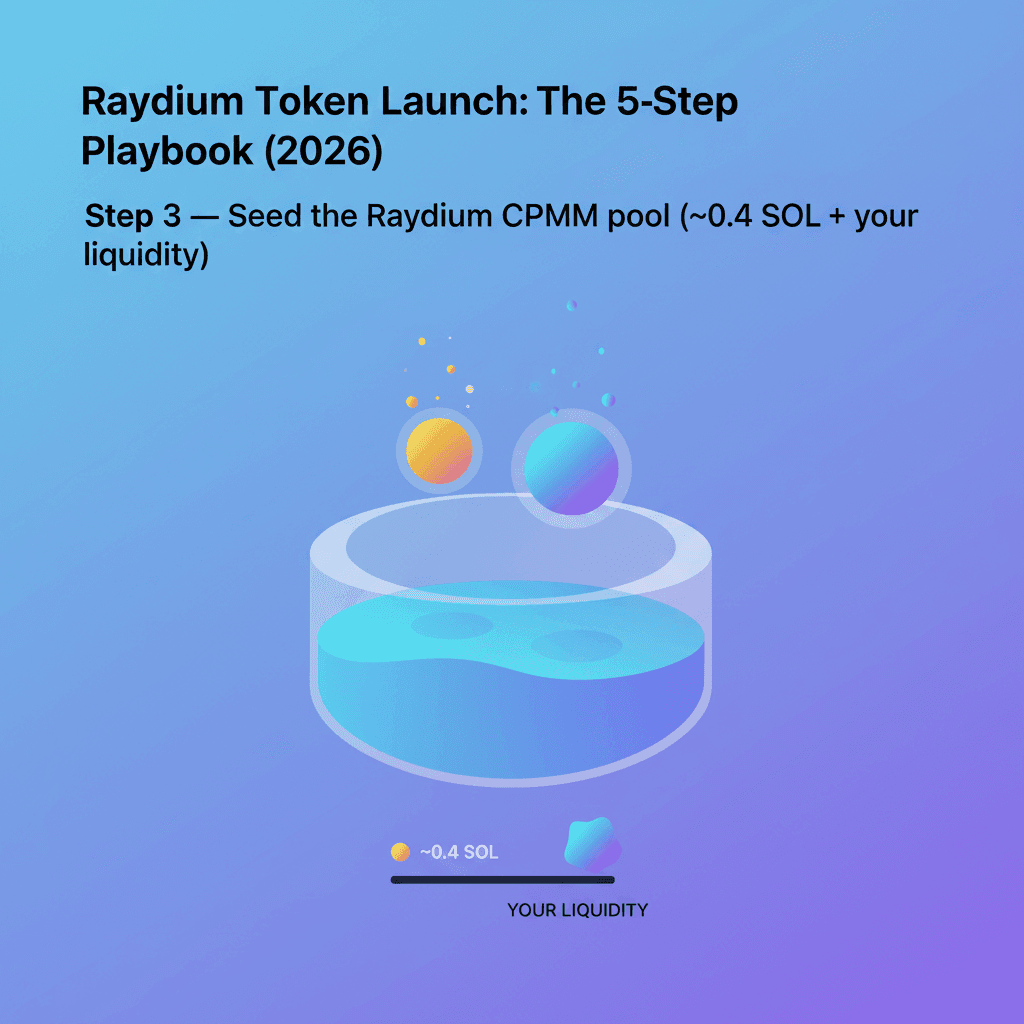
Step 3 — Seed the Raydium CPMM pool (~0.4 SOL + your liquidity)
flowchart LR
  A[Token minted + authorities revoked] --> B{Pool type}
  B -->|Memecoin| C[Raydium CPMM, 1% fee]
  B -->|Stable pair| D[Raydium CLMM, 0.05% fee]
  C --> E[Set initial price + seed]
  D --> E
  E --> F[Pool live, LP token in wallet]
This is the step the whole guide is built around. The Raydium AMM v4 program at 675kPX9MHTjS2zt1qfr1NYHuzeLXfQM9H24wFSUt1Mp8 accepts a one-shot pool-creation transaction that writes the pool's program-derived addresses, sets the initial price, and deposits your seed amounts. Pool creation costs ~0.4 SOL. Most of that is rent for the pool accounts; the rest is the protocol fee. This 0.4 SOL is non-refundable. Get the config right the first time.
Step 1 → Mint SPL token         (~0.22 SOL all-in, incl. metadata)
Step 2 → Authority revokes      (flat extras; steps 1-2 ≈ 0.32 SOL typical)
Step 3 → Raydium CPMM pool      (~0.4 SOL + seed liquidity 5-25 SOL)
         ├─ utility / large mcap → CLMM acceptable (rare)
         └─ memecoin / new launch → CPMM only
Step 4 → Burn LP token          (~0.01 SOL)
Step 5 → Jupiter strict-list    (~0 SOL, 7-day age + auth revoked)
─────────────────────────────────────────────
Total: ~0.72 SOL excl. seed liquidity (~0.92 SOL with every extra)
What you set when creating the pool:
- Base token. Your mint address from Step 1.
- Quote token. SOL (typical for memecoins) or USDC (more common for utility tokens).
- Initial price. Derived from your seed amounts. 1B tokens + 10 SOL = 0.00000001 SOL/token = ~$1K implied market cap at SOL=$100.
- Fee tier. 1% for memecoins (Pump.fun graduates use the same tier, which keeps trader expectations consistent), 0.25% for stable-pair utility tokens.
Seed liquidity sizing matters more than launchers expect. People assume 5 SOL is plenty of seed because every 2023 guide says so — it's not, not anymore. Sniper bot infrastructure has gotten cheaper and faster since 2024 and 5 SOL pools regularly get drained in the first block now. The real minimum for any launch with even minor public attention has shifted to 10-15 SOL. With under 5 SOL of seed, a single 1 SOL buy creates 16-20% price impact and snipers can collapse the chart in the first few blocks. Standard memecoin seed is 5-25 SOL; serious launches with active sniper resilience seed 25-50 SOL. The math:
| Seed (SOL) | Implied mcap (1B supply) | Price impact on 1 SOL buy | Sniper resilience |
|---|---|---|---|
| 2 | ~$600 | ~40% | None |
| 5 | ~$1,500 | ~17% | Minimum viable |
| 10 | ~$3,000 | ~9% | Standard |
| 25 | ~$7,500 | ~4% | Strong |
| 50 | ~$15,000 | ~2% | Very strong |
For the no-code path on this step, the Raydium LP Builder wraps the AMM v4 SDK into one signed transaction. Manual route: Raydium's pool creation UI. Deep-dive on the LP mechanics: how to add liquidity to Raydium. If you're still deciding between Raydium and Orca for your launch DEX, see Raydium vs Orca for new tokens. Raydium wins on memecoin discoverability, Orca on CLMM UX.
Step 4 — Burn the LP token at minute zero (~0.01 SOL)
Once the pool exists, you hold an LP token in your wallet that represents 100% of the pool. Burning it (sending it to the incinerator address 1nc1nerator11111111111111111111111111111111) permanently locks the underlying liquidity. The LP token is irretrievable; the SOL and your token inside the pool can never be pulled. That's the trust signal traders look for on DexScreener: "🔥 LP burned" is the second green flag after revoked authorities.
The transaction itself is cheap (~0.01 SOL including gas + ATA close). You can burn via alchemii's Burn Liquidity tool in one click, or send a manual transfer:
spl-token transfer <LP_MINT> <ALL_AMOUNT> 1nc1nerator11111111111111111111111111111111
Test before you burn. Always do a 0.05 SOL buy and 0.05 SOL sell first to confirm the pool routes correctly. We've seen launches where the initial price was 10× off and the launcher burned LP anyway. That capital is gone, and the only recovery is launching a fresh token. There is no undo on a burn.
A specific scar from a paid client in late 2024: they seeded a 1B-supply pool at 10 SOL but accidentally entered 100 SOL as the quote-token amount instead of 10. Initial price came out 10× too high, ~$0.30 per token at $3 implied mcap. They burned LP at minute zero before testing. Within 90 minutes a single 0.5 SOL buy moved the price 47% upward against a thin order book, and the pool became effectively un-tradeable because no buyer would touch a chart that spiky. The 0.41 SOL pool fee plus 10 SOL seed plus brand momentum — all gone. Now I tell every client: 0.05 SOL buy + 0.05 SOL sell + chart check on DexScreener, in that order, before the LP burn signature.
People also assume burning LP makes the pool immediately rug-proof. It doesn't — for the first 24-48 hours your token is still vulnerable to wash-trading attacks where a wallet runs price up against thin depth and dumps into the inflated bid. The burn locks the underlying liquidity from withdrawal; it doesn't lock the price action. The defense isn't the burn alone, it's the burn plus enough seed depth (≥10 SOL these days) that wash trading is too capital-intensive to be profitable.
Per our memecoin launch checklist, LP burn correlates with ~5.7× higher 24-hour survival in our 50K-launch dataset. The full mechanics, edge cases, and the "burned-but-still-showing-liquidity" Phantom display bug live in how to burn LP tokens on Solana.
Step 5 — Get listed on Jupiter + DexScreener (~0 SOL, hours of waiting)
flowchart TD
  A[Pool created on Raydium] --> B[DexScreener auto-index in 5-15 min]
  A --> C[Phantom indexing window starts]
  B --> D{Jupiter strict-list criteria met?}
  D -->|>$1K TVL + 7d age + auth null + LP burned| E[Strict-list inclusion in 7-10 days]
  D -->|Missing criteria| F[Token shows with low-confidence warning]
  C --> G[Token surfaces in non-holder Phantom search by day 30]
This step costs no SOL but takes the longest wall-clock time. Two listings matter:
DexScreener auto-indexes Raydium pools within 5-15 minutes of creation. No application needed. Your token appears at dexscreener.com/solana/<pool-address> with chart, holder count, and LP-burn badge. If it doesn't show after 30 minutes, the pool's initial liquidity might be too low for their indexing threshold (they soft-filter pools with under $500 of TVL). Add liquidity to cross the bar.
Jupiter strict-list is the hard one. Jupiter's aggregator routes ~80% of Solana memecoin trades, and routing-quality depends on strict-list inclusion. The common assumption is that strict-list is the only thing that matters for routing. It's the most-discussed thing, but DexScreener auto-index actually drives more day-one trades because Jupiter's aggregator also pulls from non-strict-list pools with a "low confidence" flag — buyers still trade, they just see a yellow badge. The DexScreener listing matters as much because it's where 60-70% of memecoin discovery happens in the first 48 hours.
Their public criteria (see jup.ag/verify):
-
$1K liquidity (you'll have this if you seeded ≥5 SOL)
- 7-day age (this is the long wait)
- Mint authority revoked
- Freeze authority revoked
- LP token burned or locked
Strict-list inclusion typically happens 7-10 days post-launch if all criteria are met. Until then your token shows up in Jupiter searches but with a "low confidence" warning that scares off retail. Jupiter strict-list explained walks through the inclusion request flow if you need to escalate after day 10.
Honest hedge: 87% of Solana memecoins die within 24 hours regardless of how clean the LP, authority, and listing setup is. Clean mechanics are necessary but not sufficient. Distribution, community, narrative, and timing matter more than the on-chain config. The post-mortem lives in why most Solana memecoins die in 24 hours.
Phantom indexing is a separate gotcha: even after DexScreener and Jupiter pick up your pool, Phantom's wallet display takes up to 30 days to surface your token in non-holder wallets' search. During that window your token is "visible but untradeable". Holders see it, prospective buyers searching by ticker may not. Workaround: share the mint address directly in your launch post.
Limitations
This guide covers the mechanical Raydium launch sequence. It deliberately does not cover:
- T-7 to T-0 social prep. Telegram, X, narrative seeding, and influencer coordination are covered in launch Solana memecoin checklist.
- Post-launch operations. T+24h watching, holder analytics, organic trade defense are out of scope here. Same checklist link.
- Bonding-curve launches. Pump.fun, Moonshot, and four.meme use a curve-then-graduate model that bypasses manual Raydium pool creation. See Pump.fun vs Raydium.
- Orca and Meteora. This guide is Raydium-specific. Orca CLMM is the cleaner UX for utility tokens; Meteora's dynamic-LP model is interesting for active LPers. We compare in Raydium vs Orca for new tokens.
- Doing it manually to skip the service fee. Going through the Raydium UI plus the Solana CLI drops the no-code service fee entirely and leaves you paying on-chain costs plus Raydium's ~0.4 SOL pool fee — in exchange for writing CLI commands, handling keys at the terminal, and building the metadata JSON yourself. Full breakdown in cost to create a Solana token.
- Tax treatment. Jurisdiction-specific and not tax advice.
- Non-Solana launches. Uniswap (Ethereum), PancakeSwap (BSC), Aerodrome (Base) use entirely different tooling and economics.
FAQ
How much does it cost to launch a token on Raydium?
About 0.72 SOL for the typical memecoin config, excluding seed liquidity: ~0.32 SOL to mint the token with metadata and revoke authority, ~0.4 SOL Raydium pool creation fee, ~0.01 SOL LP burn. Tick every optional extra at the mint step and the total runs closer to 0.92 SOL. Seed liquidity is separate and typically runs 5-25 SOL for a memecoin launch.
Is the Raydium pool creation fee refundable?
No. The ~0.4 SOL pool creation fee is consumed even if you misconfigure the pool, pick the wrong quote token, or set a bad starting price. It is the single largest network-side line item in the launch, so double-check the pair and price before signing.
How much liquidity do I need for a Raydium token launch?
5 SOL is the practical floor for a memecoin. Below that, snipers can collapse the chart within minutes of the pool going live. Typical memecoin seeds run 5-25 SOL; utility-token launches with market-making plans often seed 50+ SOL.
Should I burn LP after launching on Raydium?
On the memecoin path, yes, at minute zero: the ~0.01 SOL burn is the green flag traders check on DexScreener before buying. On the utility-token path, a multisig or vesting contract is the standard alternative, since you may need to manage liquidity later.
How long does a Raydium token launch take?
The mechanical steps run in about 10 minutes: mint, metadata, revokes, pool, burn. DexScreener indexes the new pool within minutes. Jupiter strict-list inclusion is the slow tail, adding roughly a 7-day wait before your token routes in Jupiter's default UI.
References
- Raydium docs, Constant Product Pool creation
- Solana program model and rent
- SPL Token Program reference
- Metaplex Token Metadata v2 standard
- Jupiter strict-list inclusion criteria
- DexScreener indexing reference
- Raydium SDK on GitHub (AMM v4 pool init reference)
- solana-program-library (SPL token source)
- mpl-token-metadata source repository
- Phantom token-display learn article
- BONK token on Solscan (5 decimals, 100T supply reference)
- WIF token on Solscan (6 decimals, 1B supply reference)
Ready to run the sequence? alchemii's Raydium LP Builder handles Steps 3 and 4 in one signed transaction, and the Burn Liquidity tool closes the trust loop. Haven't minted the token yet? Start at the Solana SPL Token Creator. Five minutes from idea to mainnet mint, then come back here for the Raydium half. Going the memecoin route specifically? The memecoin creation flow presets the right authority and fee-tier defaults.
Create your Solana token
Choose your token name, symbol, supply and image. Review the authority options and creation fee, then confirm the transaction in your wallet. Liquidity is a separate step.
Related Topics
More guides to Solana token creation, authorities, liquidity, and meme coin launches.
How to Create a Solana SPL Token (2026 Guide)
Step-by-step guide to create a Solana token: every form field explained, which authorities to revoke, what it costs to mint an SPL token in 2026.
Create a Solana Token With the spl-token CLI (2026)
The full spl-token CLI path to a Solana token: the commands, the post-rent-cut cost of 0.0163 SOL verified on-chain, why your mint shows as Unknown Token.
How to Trade Solana Meme Coins: Buy, Sell, Survive (2026)
How to buy and trade Solana meme coins in 2026: where to buy, the five-step swap, the pre-buy rug checklist, real fee math, and the survival stats nobody prints.
How to Launch a Token on Solana That Isn't a Memecoin
Launch a Solana token built to last: authority strategy, decimals, supply, vesting and liquidity for game, governance, loyalty and creator tokens in 2026.
How to Copy a Trending Pump.fun Coin in 2026 (60 Seconds)
Copy a trending Pump.fun coin in under a minute: one click prefills the token creator with name, ticker, image and settings — plus an optional pump-suffix mint.
How to Find Trending Pump.fun Coins Fast (2026)
How to find trending pump.fun coins in 2026: the four signals that matter, where to look, and why a trending board is a receipt rather than a forecast.