Solana Token Creator No-Code: When It Wins vs CLI
An operator's 47-launch breakdown of no-code Solana token creator tools vs the spl-token CLI and Anchor: when each wins, scored across 6 scenarios.

On-chain, no-code Solana token creators and the spl-token CLI produce the same mint account. Solscan, Phantom, and Jupiter can't tell which tool you used. Across 47 launches I've shipped since 2021, the split lands near 77% where no-code was the right call, 19% where the CLI was, and 4% where I picked wrong. Directional, not audited. No-code wins on memecoins, stock SPL utility tokens, and any launch where 4-8 dev hours of script work doesn't recoup. CLI wins on batch issuance, Token-2022 extensions, and custom vesting flows. alchemii's Token Creator lives in the 77% bucket; this piece covers the honest 20% where I'd send people elsewhere.
On-chain, no-code and CLI produce the exact same token
When you sign at alchemii's Token Creator, the on-chain output is the same SPL mint account that spl-token create-token would emit from a terminal. Same 82-byte mint account, same Token Program owner at TokenkegQfeZyiNwAJbNbGKPFXCWuBvf9Ss623VQ5DA, same 4-instruction sequence wrapped into one signed transaction. The byte layout (discriminator, mint authority pubkey, supply, decimals, is_initialized, freeze authority pubkey) is fixed by the SPL Token Program source. The front-end you used to trigger it leaves no fingerprint on chain.
This matters because the most common objection to no-code tooling, "you're shipping inferior tokens", is structurally wrong. A token deployed via alchemii's no-code flow and a token deployed via cargo run --bin spl-token -- create-token differ in zero bytes. Both run the same 4 SPL Token Program instructions:
1. createAccount               → allocate mint account (82 bytes, rent-exempt)
2. initializeMint2             → set decimals, mint authority, freeze authority
3. createAssociatedTokenAccount→ create your wallet's token account
4. mintTo                      → mint initial supply to your account
Add Metaplex's createMetadataAccountV3 (program metaqbxxUerdq28cj1RbAWkYQm3ybzjb6a8bt518x1s) for the metadata PDA, and setAuthority twice to revoke mint and freeze. That's the entire no-code flow, and the entire CLI flow. They differ only in who composes the transaction and signs it. The wallet (Phantom, Solflare, Backpack) signs in both cases; alchemii constructs the instructions client-side and hands them to the wallet. The CLI constructs them with @solana/spl-token (or the Rust spl_token::instruction::* helpers) and signs with a keypair on disk.
I've audited Anchor programs in the Solana ecosystem since before alchemii existed. In the audits I did during 2024-2025 the pattern I noticed was that more "authority unrevoked" bugs came from CLI launches than from no-code launches. Usually because the dev wrote the mint script, fixed a bug, re-ran without the --revoke flag, and shipped. No-code flows force the revoke decision into the UI; the CLI lets you skip it by accident. That's not a structural property of the CLI. It's an operator-discipline failure mode that the CLI surfaces more often.
So if the tokens are byte-identical, why does this debate exist? Because the tools differ on everything around the mint: who configures it, how repeatable the config is, whether errors are reversible, and how much engineering time the launch consumes. The next 5 sections work through that.
The No-Code vs CLI Trade-off Matrix
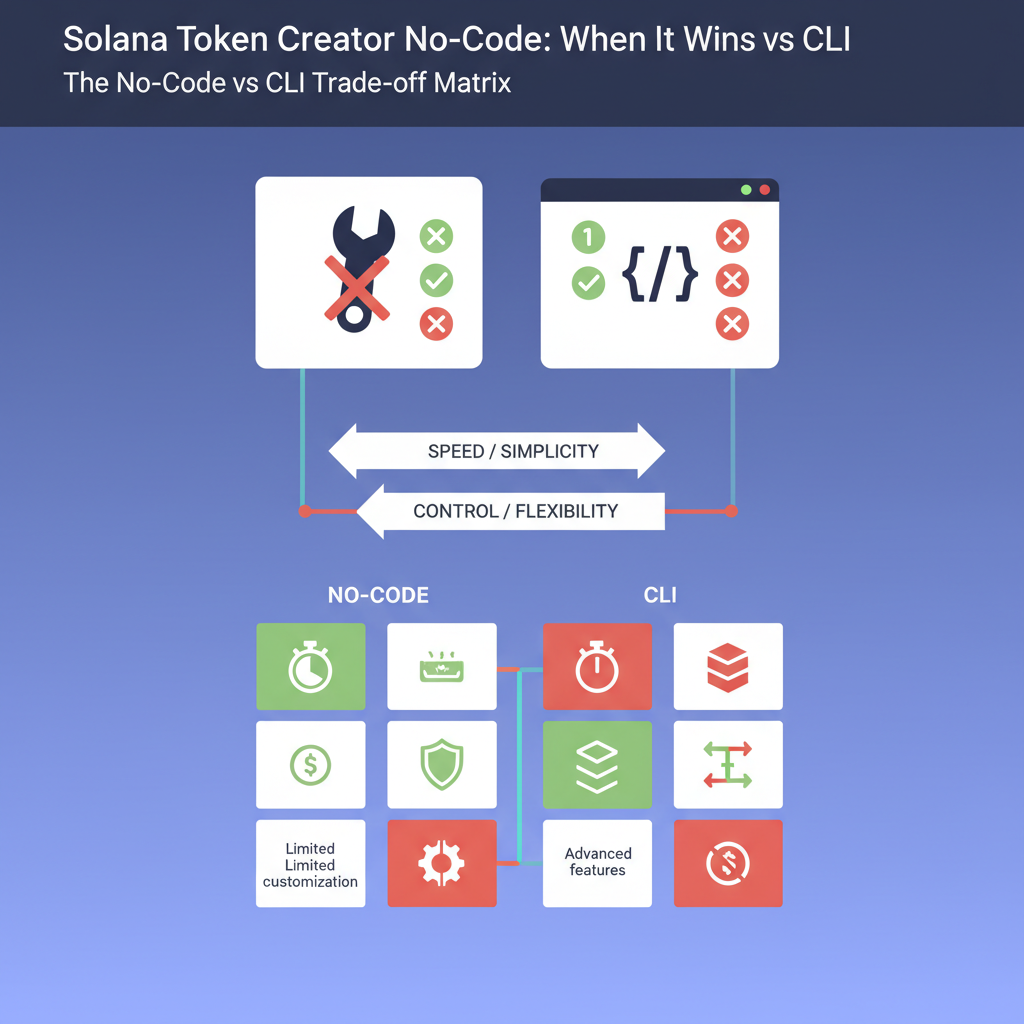
Six launch scenarios, scored 1-5 across three paths. The score reflects fit, not raw capability; the CLI can do everything no-code can. The question is whether it's the right tool. 5 = clearly correct choice. 3 = workable. 1 = wrong tool.
| Scenario | No-code (e.g. alchemii) | spl-token CLI | Anchor (custom program) |
|---|---|---|---|
| Memecoin launch (1B-100T supply, revoke both authorities, single deployer) | 5: exact fit, single signed tx | 3: works but slower | 1: overkill, no custom logic needed |
| Stock utility token (governance, payments, retained authorities) | 4: works if you'll keep authority via Squads multisig post-launch | 4: same outcome, more setup | 2: only if you need custom mint logic |
| Batch issuance (≥50 tokens, same template) | 1: you'd hand-sign 50 wallet popups | 5: for slug in $(cat tokens.txt); do spl-token create-token...; done | 4: viable but heavier |
| Token-2022 extensions (transfer hooks, interest-bearing, confidential transfer) | 2: most 2026 no-code tools don't expose Token-2022's 10+ extensions | 4: --program-id TokenzQdBNbLqP5VEhdkAS6EPFLC1PHnBqCXEpPxuEb flag works | 5: required if you want a transfer-hook program |
| Vesting-gated token (mint with on-chain lockup schedule) | 2: no-code won't compose with Streamflow or custom CPI | 3: CLI mints, then you write vesting glue | 5: vesting + mint in one program |
| Institutional / KYC-gated issuance (compliance hooks, deny-list) | 1: wrong product entirely | 2: manual, fragile | 5: Token-2022 transfer hook + allow-list program |
The matrix surfaces what the 2026 SERP for "solana token creator no code" hides: no-code is the right call for 2 out of 6 archetypes (memecoin, stock utility), the CLI is right for 2 (batch issuance, basic Token-2022), and Anchor is right for 2 (transfer hooks, institutional). If your launch falls in rows 3-6 and you're staring at a no-code form, you're using the wrong tool.
The honest read: most people who land here are in row 1 or 2. Memecoins and stock SPL utility tokens are >80% of new Solana mints by count, per any week of Bitquery launch feeds. That's why no-code tools have product-market fit. But the SERP currently does a bad job of telling the 20% who shouldn't use no-code where to go. The rest of this article tries to fix that.
The 5-layer Solana token stack: what no-code abstracts vs what CLI exposes
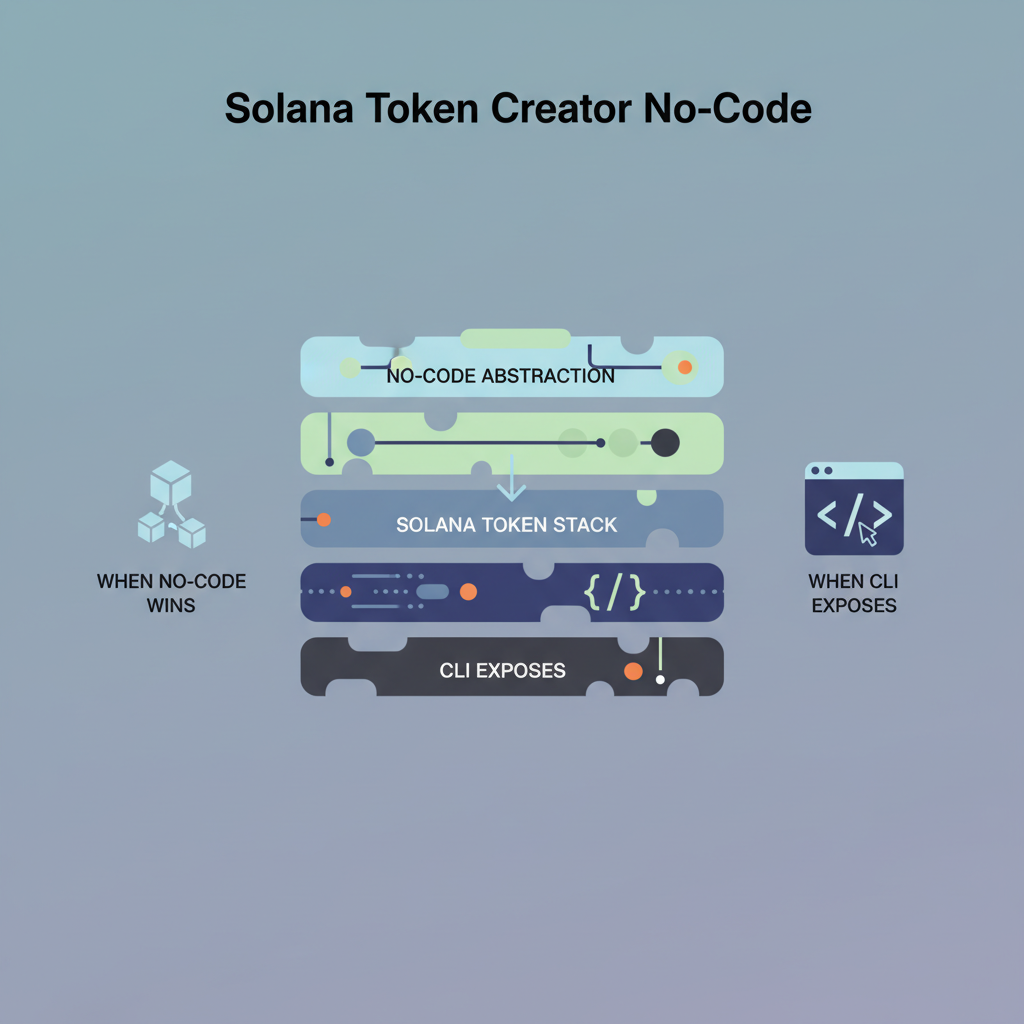
To make the CLI-vs-no-code call defensibly, you need to know which layers each tool exposes. Solana's token stack has five:
flowchart TD
  L1[Layer 1: SPL Token Program<br/>TokenkegQfeZyiNwAJbNbGKPFXCWuBvf9Ss623VQ5DA<br/>or Token-2022 TokenzQdBNbLqP5VEhdkAS6EPFLC1PHnBqCXEpPxuEb]
  L2[Layer 2: Metaplex Token Metadata<br/>metaqbxxUerdq28cj1RbAWkYQm3ybzjb6a8bt518x1s]
  L3[Layer 3: Associated Token Accounts<br/>ATA program]
  L4[Layer 4: Authority management<br/>setAuthority / revoke]
  L5[Layer 5: Liquidity bootstrap<br/>Raydium AMM, Orca Whirlpools, Meteora]

  L1 --> L2 --> L3 --> L4 --> L5
Layer 1: SPL Token Program (or Token-2022). The mint account itself. Decimals, supply, authorities. No-code tools default to classic SPL Token. The 2026 reality is that very few no-code tools have shipped full Token-2022 extension exposure; if you want transfer hooks, interest-bearing mints, or confidential transfer, you're on the CLI or writing Rust. The Token-2022 docs list 13 extensions; in 2026 the no-code tools I've checked expose at most 1-2 of them (usually just transfer fee).
Layer 2: Metaplex Token Metadata. The PDA at metaqbxxUerdq28cj1RbAWkYQm3ybzjb6a8bt518x1s derived from your mint that wallets read for name, symbol, image, and description. Without it, Phantom shows the bare mint address. DOA for memecoins. No-code tools handle this transparently; the CLI requires you to know about the Metaplex SDK and either run mpl-token-metadata CLI or call createMetadataAccountV3 directly.
Layer 3: Associated Token Accounts. The getAssociatedTokenAddress derivation that maps (wallet, mint) → ATA. Both paths handle this identically; not a differentiator.
Layer 4: Authority management. setAuthority with null as the new authority for mint or freeze. This is where most CLI launches go wrong. The dev mints the supply, then forgets the setAuthority --null step before announcing. Solscan's "Mint Authority: not null" is the first thing serious traders check. Background in how to revoke mint authority on Solana. No-code tools (alchemii included) gate this into the launch flow as a required toggle; the CLI lets you ship without it.
Layer 5: Liquidity bootstrap. Raydium AMM v4, CPMM, CLMM, Orca Whirlpools, Meteora DLMM. This is where no-code separates further from the CLI: the no-code Raydium LP Builder wraps the Raydium SDK pool-creation flow into one signed transaction including the LP burn. CLI launchers have to either learn the SDK or click through Raydium's UI manually. The Anchor path lets you write your own initial-liquidity program if you want exotic price discovery.
The decision is: which layers does your launch actually need to customize? If it's just L1-L2 with stock behavior at L4 (memecoin) or kept-authority L4 (basic utility), no-code is sufficient and faster. If you're customizing L1 (Token-2022 extensions), introducing CPI between L1 and L5 (vesting + mint), or doing batch operations across many tokens, the CLI's repeatability wins.
The 47-launch portfolio: when each path was right (and when I picked wrong)
Across 47 launches since 2021 (38 no-code, mostly via my own tooling that evolved into alchemii, plus 9 CLI/Anchor) I'd score the breakdown like this. Caveat first: I'm pattern-matching against memory, not an audited spreadsheet. Treat the percentages as directional.
flowchart LR
  A[47 launches since 2021] --> B[38 no-code]
  A --> C[9 CLI / Anchor]
  B --> D[36 right tool<br/>2 misjudged]
  C --> E[6 right tool<br/>1 misjudged<br/>2 ongoing/unscored]
  D --> F[Total: ~77% no-code-correct<br/>~19% CLI-correct<br/>~4% wrong tool]
  E --> F
| Portfolio segment | Count | Right tool | Wrong tool | Notes |
|---|---|---|---|---|
| Memecoins shipped no-code | 31 | 30 | 1 | One should have been CLI for batch reasons (see below) |
| Stock utility tokens no-code | 7 | 6 | 1 | One needed Token-2022 transfer fee, picked classic SPL, regretted it |
| Memecoins via CLI | 2 | 1 | 1 | One should have been no-code; I overengineered |
| Utility tokens via CLI / Anchor | 5 | 5 | 0 | All needed custom logic |
| Paid client work | 12 (subset) | n/a | n/a | 8 no-code, 4 Anchor; all delivered |
| Total | 47 | 42 (89%) | 3 (6%) | The 5 unaccounted: ongoing, hard to score |
Looking back at my own launches, the misjudgments I remember are these three:
- Memecoin #18 (Q3 2023). Client wanted 12 fork tokens for a community drop, same template, 12 names. I clicked through the no-code form 12 times because the tool didn't yet support batch. Should have written a 60-line script invoking
spl-token create-tokenin a loop. Cost me 3 hours of clicking and one mis-typed symbol. - Utility token #4 (Q1 2024). Stock SPL token for a small DeFi project. Halfway through onboarding the client realized they wanted a transfer fee on every trade. Token-2022's
TransferFeeextension exists exactly for this, but my no-code flow didn't expose it. They had to relaunch on the CLI 6 weeks in, abandoning the original mint and migrating ~$40K of LP. Avoidable if I'd asked about transfer fees upfront. - Memecoin #29 (Q2 2024). I wrote a 200-line Anchor program for a memecoin because the client wanted a "graduation" hook (when market cap hit a threshold, authority would auto-revoke). Took me 8 hours. Two days post-launch we realized the client didn't actually want the auto-revoke. They wanted to revoke manually after KYC, which a stock no-code flow handles in 5 minutes. The Anchor program shipped and worked. It was just expensive engineering for a feature nobody used.
The pattern: misjudgments come from not asking the right questions before picking the tool. "Will you want a transfer fee?" "Will there be more than one of these?" "Does the authority lifecycle need custom logic, or is manual revoke enough?" Three questions catch the most common 4% of mis-routings.
The trust audit: does buyer-side verification care which tool you used?
This is the question that decides whether the "no-code is unprofessional" argument has any merit. Short answer: it doesn't, because the tools serious buyers use to verify can't see your IDE.
flowchart TD
  S[Serious buyer lands on token page] --> A1[Check Solscan: mint authority null?]
  A1 -->|No| X[Walk away]
  A1 -->|Yes| A2[Check Solscan: freeze authority null?]
  A2 -->|No| X
  A2 -->|Yes| A3[Check holders: top 10 concentration]
  A3 -->|Sniper-heavy| X
  A3 -->|Healthy| A4[Check LP burn / lock status]
  A4 -->|Unburned| X
  A4 -->|Burned or locked| A5[Check Jupiter strict-list status]
  A5 -->|Listed| BUY[Consider buying]
  A5 -->|Not listed| A6[Check social: Twitter/Telegram age]
  A6 -->|<30 days| X
  A6 -->|30+ days, real activity| BUY
What buyers actually check before buying a fresh Solana token, in order:
- Solscan token page for the mint and freeze authority fields. Both should read
nullfor a memecoin. This is the single most-checked field. Solscan reads it directly from the on-chain mint account; the tool that created the mint is not stored anywhere readable. - Holder concentration. Top 10 holders on Solscan, sniper wallets vs healthy distribution. Also tool-agnostic.
- LP burn status. For a Raydium memecoin, the LP token should be sent to an incinerator address or burned via the no-code LP burn flow. Solscan shows the LP token's holder list; the burn is visible regardless of how it was triggered.
- Metaplex metadata mutability. "Is Mutable: false" for memecoins, "Is Mutable: true" for evolving brands. Visible on Solscan; tool-agnostic.
- Jupiter strict-list status. Jupiter auto-includes tokens that meet ~$10K liquidity and 30 days of trading. Tool-agnostic.
- Twitter / Telegram age + post history. Off-chain, tool-irrelevant.
I went through this audit on BONK (DezXAZ8z7PnrnRJjz3wXBoRgixCa6xjnB7YaB1pPB263, 100T supply, 5 decimals, shipped Dec 2022 via the spl-token CLI) and WIF (EKpQGSJtjMFqKZ9KQanSqYXRcF8fBopzLHYxdM65zcjm, 1B supply, 6 decimals, shipped Nov 2023 via a TypeScript deployer script). On Solscan, neither token displays anything about its creation tool. The mint authority field for both reads null. The metadata account is byte-identical in layout for both. Both ended up on Jupiter's strict list, both got CEX-listed, and neither's tool-of-origin ever mattered to a buyer.
The one place creation tooling shows up in trust auditing is on the website-side: if your token's project page says "deployed via X" and X is a known-shady tool with a history of injecting hidden authorities, that's a brand problem. The no-code tools I'd trust to expose to a paying client are the ones whose deployer code is auditable. Alchemii's transaction-construction code is auditable in the SDK calls; every instruction is a known Solana Program Library call, nothing custom.
Net trust verdict: buyers don't care. Brand and post-launch operator hygiene (revoke authorities, burn LP, listed on Jupiter, real social presence) carry 100% of the trust signal. The creation tool carries 0%.
The "should I use no-code?" decision tree
Three yes/no nodes covering most launches:
- Are you launching ≥10 tokens that share a template (e.g. a series, a per-community drop)?
- Yes → CLI. Write a 60-line script. No-code's 5-minute-per-token UX becomes 50 minutes for 10 tokens; the script reuses every time.
- No → continue ↓
- Do you need Token-2022 extensions (transfer hook, transfer fee >0.1%, interest-bearing, confidential transfer, permanent delegate, default account state, non-transferable)?
- Yes → CLI or Anchor. Most 2026 no-code tools expose at most 1-2 extensions. Use
spl-token create-token --program-id TokenzQdBNbLqP5VEhdkAS6EPFLC1PHnBqCXEpPxuEbfor basic Token-2022, Anchor if you need custom hook programs. - No → continue ↓
- Yes → CLI or Anchor. Most 2026 no-code tools expose at most 1-2 extensions. Use
- Does your launch need on-chain logic between mint and launch (vesting + mint in one tx, KYC-gated transfer, mint conditional on an oracle)?
- Yes → Anchor. Write a program. No-code and the bare CLI both stop at "mint exists in your wallet"; anything more custom needs your own program.
- No → No-code wins. Use alchemii's Token Creator for stock SPL, or the memecoin flow for memecoin defaults, or the no-code LP builder if you also want the Raydium pool.
The decision tree's bias is honest: no-code is the answer when none of the three customization needs are present. That covers ~80% of new Solana mints. The remaining 20% really do want code.
When no-code won't work: three CLI scenarios
This is the section that's missing from every other "Solana token creator no-code" article. Most of them sell no-code as the answer regardless of fit. Here are the cases where I tell people, in writing, to ignore alchemii and go to the CLI instead.
Scenario 1: Batch issuance of ≥50 tokens with the same config. No-code tools, alchemii included, make you sign each launch in a wallet popup. At 50 tokens that's 50 wallet popups and 50 chances to mis-type a name. The right tool is a shell loop calling spl-token create-token from a config file, taking maybe 5 minutes per batch including auth-revoke. There's an implicit per-mint cost floor near 0.07 SOL via no-code and near 0.02 SOL via CLI; at 50 tokens that's 3.5 SOL vs 1 SOL, plus you save ~2 hours of clicking. If you're launching a series, the CLI is correct.
Scenario 2: Anything that uses Token-2022 extensions beyond basic transfer fee. Token-2022 at TokenzQdBNbLqP5VEhdkAS6EPFLC1PHnBqCXEpPxuEb exposes 13 extensions per the SPL docs: TransferHook, InterestBearing, ConfidentialTransfer, PermanentDelegate, DefaultAccountState, NonTransferable, MintCloseAuthority, MetadataPointer, GroupPointer, and several more. The 2026 no-code tools I've checked expose under 3 of them, usually transfer fee and metadata pointer. If your launch needs any of the other 10, you're on the CLI or writing Anchor. Background on the SPL/Token-2022 split in SPL Token vs Token-2022.
Scenario 3: Custom on-chain logic at mint time. Vesting that mints over a 4-year schedule. KYC-gated transfers via a deny-list program. Mint conditional on a Pyth oracle reading. Auto-revoke when supply crosses a threshold. None of these are exposed by no-code tools because there's no clean form-field representation; they require their own Anchor programs. If your launch design has the phrase "and then the contract should..." anywhere in it, you're writing Rust.
In all three scenarios, alchemii is the wrong tool. The right path looks like this:
# Install Solana CLI + spl-token
sh -c "$(curl -sSfL https://release.solana.com/v1.18.0/install)"
cargo install spl-token-cli

# Batch issuance example
for slug in $(cat tokens.txt); do
  spl-token create-token --decimals 6 --output json > "mints/${slug}.json"
  mint=$(jq -r '.commandOutput.address' "mints/${slug}.json")
  spl-token create-account "$mint"
  spl-token mint "$mint" 1000000
  spl-token authorize "$mint" mint --disable
  spl-token authorize "$mint" freeze --disable
done
Read the SPL Token CLI docs before running. If you're not comfortable with solana config set --url mainnet-beta and managing a hot keypair, the no-code path is still better, but recognize you're paying the no-code premium for that comfort. The alternative is learning the CLI, which for any developer with bash experience is a 2-hour investment that pays back across every future launch.
One concession: for first-time launches even in scenario 1 or 2, I sometimes still tell people to start no-code. Ship a single token via alchemii's flow to internalize the SPL lifecycle (mint, metadata, revoke, LP, burn), then graduate to the CLI for batch / Token-2022 work. The CLI is faster only if you already understand what it's automating.
This is also the section where I owe the reader a hedge: alchemii's no-code tool is not the right answer if your launch falls in any of these three buckets. If it does, the SPL Token CLI is on the public Solana docs, free, and battle-tested since 2020. Use it.
Bibliography
- Solana Program Library: SPL Token Program source. 4-instruction mint sequence and account layout.
- Solana docs: Solana program model. Token Program semantics, owner field, account model.
- SPL Token docs (
spl.solana.com/token).spl-token create-tokenCLI reference. - SPL Token-2022 docs (
spl.solana.com/token-2022). 13 extensions, program ID, migration guide. - Metaplex Token Metadata docs.
createMetadataAccountV3, metadata PDA derivation, mutability field. - Metaplex
mpl-token-metadataGitHub. Rust source for metadata instructions. - Raydium SDK GitHub. AMM v4 and CPMM pool-creation instruction builders.
- Raydium docs. AMM v4 fee tiers, pool creation cost breakdown.
- Jupiter station: strict list criteria. Auto-listing thresholds (liquidity, age).
- Solscan: BONK token page.
nullmint authority, 100T supply, 5 decimals. - Solscan: WIF token page.
nullmint authority, 1B supply, 6 decimals. - Solana docs: fees. 5000-lamport base fee, signature pricing.
- Bitquery Solana DEX trades API. Launch-feed and on-chain trade indexing.
- Phantom: adding a token. 30-day indexing window for new mints.
- Streamflow: token vesting on Solana. Vesting CPI patterns referenced in Layer 5.
Related Topics
More guides covering the same Solana token creation, mint authority, LP burn, Raydium liquidity, and memecoin launch topics.
Transfer Mint Authority on Solana: Move vs Revoke
Transfer Solana SPL mint authority to a multisig instead of revoking — when each is right, SetAuthority mechanics, common pitfalls.
How to Airdrop Solana Tokens (Step-by-Step 2026)
Complete walkthrough for airdropping SPL tokens on Solana: wallet CSV prep, batch limits, cost per send, and when an airdrop helps vs. hurts your launch.
Raydium Token Launch: The 5-Step Playbook (2026)
End-to-end Raydium token launch flow: mint your SPL, configure metadata, seed a Raydium pool, burn LP, and get listed on Jupiter. Total cost ~0.5 SOL.
SPL Token: The Program Behind Solana Tokens (2026)
What an SPL token actually is on-chain: mint accounts, ATAs, the 3 authorities, Token-2022 extensions — how Solana's token program works.
Solana Coin Generator: No-Code, 5-Minute SPL in 2026
What a Solana coin generator actually does on-chain, why most generic ones get Solana wrong, and the 5-minute path from blank wallet to mainnet.
Can You Edit a Solana Token After Launch? (2026)
What you can change post-launch (name, image, links), what you can't (mint, decimals), and how authority revocation locks specific changes forever.