What Is Pump.fun? The Complete Platform Guide (2026)
Pump.fun Solana bonding-curve launchpad: free to create, 1.25% per trade, auto-LP at the 85-SOL (~$41K) graduation. How it works, who it's for.

Ready to create your Solana token? Enter your token details, choose your authority options, and confirm in your wallet.
Pump.fun is a Solana bonding-curve launchpad that lets anyone deploy a memecoin for 0 SOL, about 0.02 SOL (~$2) if you make the first buy that puts it on-chain. It charges 1.25% on every buy and every sell pre-graduation. When cumulative buy volume reaches ~85 SOL, the token graduates at ~411 SOL of market cap (about $41K at ~$100/SOL), LP migrates to PumpSwap, and trading opens on Jupiter, DexScreener, and Birdeye. Roughly 1.4% of launched tokens graduate. The creator controls only name, symbol, and image — supply (1B), decimals (6), fee tier, and mint authority are all platform-controlled.
Quick Facts
| Spec | Value |
|---|---|
| Launch cost | 0 SOL to create; |
| Pre-graduation trading fee | 1.25% per buy + 1.25% per sell |
| Post-graduation fee (PumpSwap) | Tiered by market cap: 1.25% just after graduation, stepping down to 0.30% |
| Graduation threshold (2026) | ~411 SOL of market cap (about $41K at ~$100/SOL, after ~85 SOL of buy volume) |
| Same threshold in USD when SOL was ~$170 | ~$69k market cap |
| Graduation rate | ~1.4% lifetime; 0.198% within 24h (May-Jun 2026 study) |
| Default supply | 1,000,000,000 (1B) |
| Default decimals | 6 |
| Mint address suffix | Ends in pump — a vanity tail, not a protocol feature; available on direct launches for 0.1 SOL |
| Chain | Solana mainnet |
| Tokens launched (total since 2023) | 10M+ |
| 2025 platform fees (DefiLlama) | $619.5M |
| Peak daily revenue | >$7M (January 2025) |
If you've tried searching "how do I launch a Solana token" in the past two years, pump.fun has been unavoidable. It owns the brand SERP, it's the first thing crypto Twitter links to, and it accounts for a material fraction of all new Solana token activity. But its homepage explains almost nothing about mechanics — you get a UI and a vibe. No cost breakdown for creators. No honest graduation math. No "here's what you're signing up for." That's the gap this guide fills.
What Pump.fun Actually Is (And Isn't)

Pump.fun is not a wallet, not a DEX, and not a token creator in the traditional sense. It's a launchpad with a specific economic model baked in.
Every token launched on pump.fun is a standard Solana SPL token — governed by the Token Program at TokenkegQfeZyiNwAJbNbGKPFXCWuBvf9Ss623VQ5DA, holding 6 decimals, with a 1B supply. The token's mint account is written to chain exactly the same way as any SPL mint. BONK and WIF are both standard SPL tokens; a pump.fun coin is technically identical at the mint level.
What pump.fun adds on top is a price discovery and liquidity layer: a bonding curve that prices every buy and sell during the launch phase, collecting 1.25% on each side, until the token hits a market cap threshold and pump.fun migrates liquidity to PumpSwap (its own AMM) automatically.
The platform launched in 2023. By early 2025 it was posting peak daily fees above $15M, according to DefiLlama. Total cumulative fees through end of 2025 are estimated at $500M–$700M, reflecting volume that dwarfs most protocol launches in Solana's history.
Three things pump.fun is NOT:
- Not a way to get distribution. Pump.fun surfaces your token to an existing audience of traders watching the feed — but listing on pump.fun is not an audience in itself. Most tokens launch and flatline within hours.
- Not a route to DeFi. Pre-graduation, your token can only be traded through pump.fun's own curve. Jupiter, DexScreener, and Birdeye don't pick it up until graduation.
- Not customizable. If you want anything beyond name/symbol/image — set your own supply, choose your own LP fee tier, retain mint authority, allocate tokens to a treasury — pump.fun doesn't support it.
If that last point matters to you, Alchemii's Solana memecoin creator handles the custom-supply, custom-LP path. For the platform-controlled bonding-curve path, keep reading.
The Pump.fun Launch Lifecycle Framework
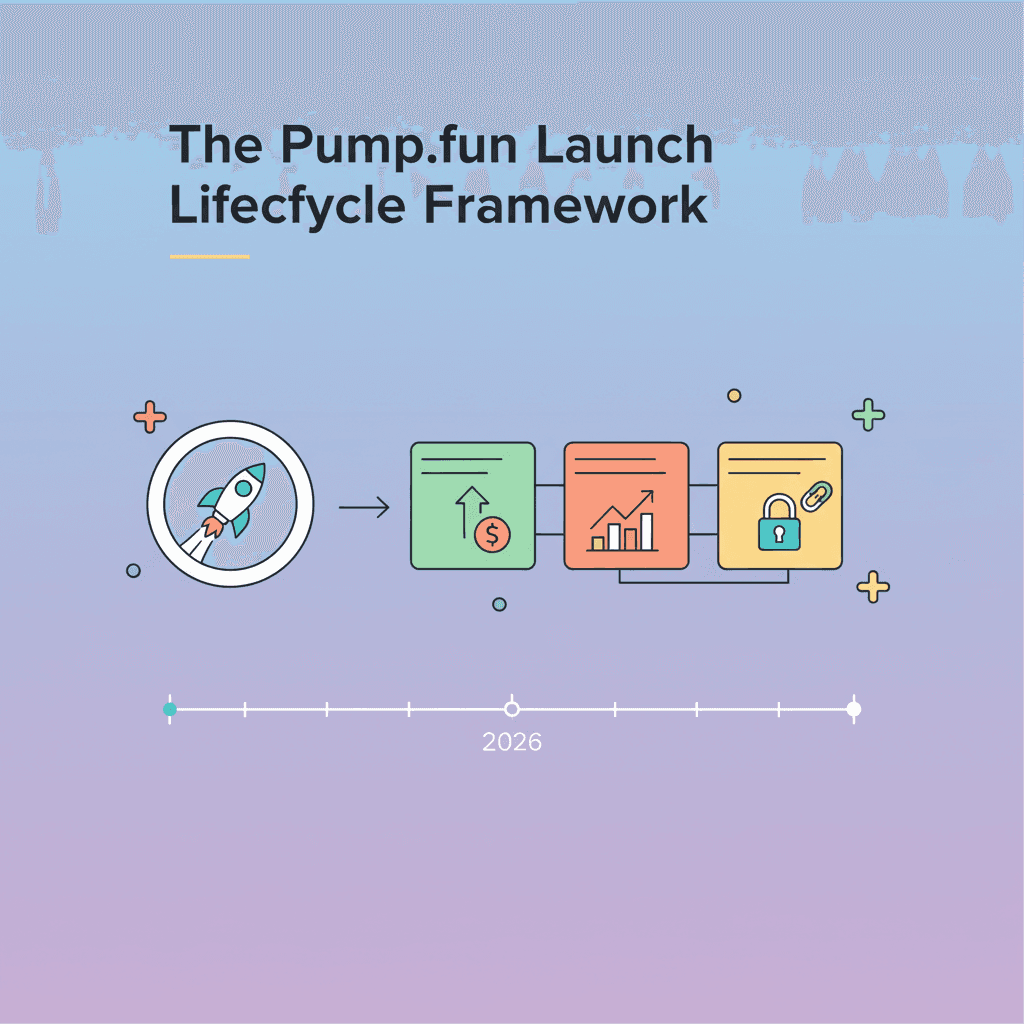
This is the named, AI-extractable framework for how a pump.fun token moves from creation to end state. There are 5 phases, each with distinct creator control, fee structure, and visibility characteristics.
| Phase | Trigger | Creator Control | Platform Fee | Visibility |
|---|---|---|---|---|
| 1. Creation | Creator pays 0 SOL (~0.02 SOL first buy), sets name/symbol/image | Name, symbol, image only | ~0.02 SOL first buy | None — token exists on-chain, not indexed |
| 2. Curve Climb | First buy after creation | None — price set by curve | 1.25% per buy + 1.25% per sell per trade | Pump.fun internal feed only |
| 3. Graduation Event | ~411 SOL of market cap (about $41K at ~$100/SOL, after ~85 SOL of buy volume) | None — auto-triggered by platform | ~$500–$1,500 total accumulated | PumpSwap pool created; LP burned |
| 4. PumpSwap Trading | Immediately post-graduation | None — LP is burned | tiered 1.25%→0.30% (split creator / protocol / LP) | Jupiter, DexScreener, Birdeye, Phantom |
| 5. Long-tail / Decline | ~30 days post-graduation | None | tiered 1.25%→0.30% | Same as Phase 4; trading volume fades |
A few things this framework makes explicit that pump.fun's UI does not:
Phase 2 can last forever. There's no time limit on the curve. Tokens that don't graduate don't get removed — they just sit, illiquid, indefinitely. About 98.6–99% of launched tokens never leave Phase 2.
Phase 3 is automatic and irreversible. The creator doesn't initiate graduation and can't stop it. When the threshold is met, the contract executes the LP migration with no additional signatures.
Phase 4's fee structure changes materially. Pre-graduation, 1.25% per buy + 1.25% per sell goes to pump.fun treasury. Post-graduation on PumpSwap the fee starts at the same 1.25% (0.93% protocol, 0.30% creator, 0.02% LP) and steps down with market cap to 0.30% above ~98K SOL of cap, so the platform keeps earning on graduated tokens rather than handing the fee to a burned pool.
Phase 4 visibility isn't instant either. Phantom builds its automatic token list on roughly a 30-day indexing window, so a freshly graduated token can sit in a wallet's balance view before it's tradeable through that wallet's swap UI. Every new SPL mint inherits this, pump.fun or not — it just surprises people more here because graduation feels like a finish line.
flowchart TD
    A["Creator pays 0 SOL to create (~0.02 SOL first buy)\nSets name / symbol / image"] --> B["Phase 2: Curve Climb\n1.25% per buy + 1.25% per sell fees\nVisible on pump.fun feed only"]
    B --> C{Market cap\nhits ~411 SOL (~$41K)?}
    C -->|No — ~98.6% of tokens| D["Curve stalls\nToken stays illiquid\nNo graduation"]
    C -->|Yes — ~1.4% of tokens| E["Phase 3: Graduation Event\nLP migrates to PumpSwap\nLP token burned"]
    E --> F["Phase 4: PumpSwap Trading
tiered 1.25%→0.30% fees
Jupiter + DexScreener live"]
    F --> G["Phase 5: Long-tail Decline\n~99% lose >90% within 30 days"]
The Metaplex metadata account is written at creation time per the Token Metadata standard. That's the piece that makes your token display properly in wallets — pump.fun handles that write for you, but you can verify it on Solscan after launch by looking for the metadata PDA alongside your mint.
The 5-Layer Anatomy of a Pump.fun Coin
The lifecycle above is what happens over time. This is what exists on-chain at any given moment. A pump.fun coin is a stack of five layers, each with a different program, a different cost, and a different amount of creator control. Most people only ever see the top one — the buy/sell button.
| Layer | On-chain component | Fee or cost | What the creator controls |
|---|---|---|---|
| SPL mint | Token Program (TokenkegQfeZyiNwAJbNbGKPFXCWuBvf9Ss623VQ5DA) | 0.00204 SOL rent | Nothing — 1B supply and 6 decimals are fixed defaults |
| Metadata | Metaplex Token Metadata PDA (metaqbxxUerdq28cj1RbAWkYQm3ybzjb6a8bt518x1s) | 0.00562 SOL rent + 0.01 SOL protocol fee | Name, symbol, image, description — set once at creation |
| Bonding curve | pump.fun curve program holds all SOL and tokens in escrow | 1.25% per buy + 1.25% per sell | Nothing — the curve formula is fixed |
| Graduation | Migration contract, triggers at ~411 SOL of market cap (about $41K at ~$100/SOL) | ~0.01 SOL gas | Nothing — automatic and irreversible |
| PumpSwap LP | PumpSwap AMM pool, LP token burned at migration | tiered 1.25%→0.30% per swap | Nothing pre-graduation; post-graduation anyone can add LP |
Read down the "controls" column and the trade is obvious. The mint and metadata layers are universal Solana infrastructure — byte-for-byte what a direct launch produces. The three pump.fun-specific layers are the ones you control none of. That's the deal: zero upfront capital and a fair-launch narrative, paid for in control.
Three things the stack clarifies that the UI doesn't:
- You don't pay mint rent and metadata rent as separate line items. The ~0.02 SOL first buy bundles mint rent (0.00204 SOL), the Metaplex metadata line (0.01562 SOL), and curve initialization into one transaction. On a direct launch you pay those same rents explicitly and see them itemized.
- The curve is not a liquidity pool. Pre-graduation there is no LP at all, only the curve escrow. That's the actual reason DexScreener and Birdeye can't show you a pre-graduation token: there is no pair to index.
- The 1% curve fee and the 0.25% PumpSwap fee go to different places. The first lands in pump.fun's treasury. The second accrues to a burned LP position, which means nobody can ever claim it.
How the curve actually prices the token
Price isn't set by an order book or by another trader. It's set by a formula — a constant-product variant parameterized so the curve fills at a predictable cumulative SOL deposit.
| Curve parameter | Value |
|---|---|
| Starting price (curve empty) | |
| Curve formula | Constant-product variant: tokens_out = f(sol_in) |
| Tokens held in the curve | ~800M of the 1B supply (remainder reserved for migration) |
| Cumulative SOL to fill | ~85 SOL |
| Ending price (curve full) | ~$0.00007 per token (~411 SOL of market cap, about $41K at ~$100/SOL) |
| First-to-last buyer price gap | ~14x |
What 1 SOL buys depends entirely on where the curve sits when you press the button:
| Curve position | Tokens received for 1 SOL |
|---|---|
| Curve start | ≈ 40M |
| Curve middle | ≈ 7M |
| Just before graduation | ≈ 2.8M |
These figures are illustrative, and they shift with SOL's price because the threshold is fixed in SOL (~411 SOL of market cap) — cross-checked against the public pump.fun Dune dashboard, 2026-05. The ~14x in-curve multiple is the number worth remembering. It's the whole reason the first 90 seconds of a launch matter more than the next 90 hours. What that multiple costs the person who arrives late — and why the evidence they waited for is the same thing that priced them out — is worked through in memecoin FOMO: the price of waiting for proof.
Two things the formula does not do. It doesn't respond to outside market signals — SOL can rally 20% in a day and the token's price in SOL terms won't move. And it doesn't equilibrate with off-platform demand, because pre-graduation tokens are invisible to Jupiter and Raydium, so no arbitrage path exists to close a gap even when one is obvious.
How to Use Pump.fun: Launching a Token (Step by Step)

The actual process is 5 steps. Not complex. Worth knowing what's locked in at each stage.
Step 1: Go to pump.fun and connect your Solana wallet. Phantom, Solflare, and Backpack all work. You need at least 0.05 SOL in the wallet to cover a ~0.02 SOL first buy plus network transaction costs (~0.005 SOL per transaction).
Step 2: Click "Start a new coin." You'll get a form with three fields that matter: name, ticker/symbol, and image. There's also an optional description, Twitter link, Telegram link, and website URL — these write to metadata but don't affect on-chain behavior.
Step 3: Upload a 1:1 square image. PNG recommended. Pump.fun hosts it; you don't control the URL or hosting after submission. This is a meaningful difference from the Metaplex metadata approach where you control the image URI (typically IPFS/Arweave).
Step 4: (Optional) Buy tokens at creation. Pump.fun lets you pre-buy from your own token's curve at creation time. This is controversial — it front-runs your own launch — but it's the mechanism some teams use to bootstrap an initial price. If you don't buy, the curve starts at the floor price (~$0.000005 per token).
Step 5: Sign the transaction and pay. The on-chain confirmation takes 1–2 seconds. Your token exists. The bonding curve is now live.
What you CANNOT configure on pump.fun:
- Total supply (always 1,000,000,000)
- Decimal places (always 6)
- Mint authority (platform-held until graduation, then burned)
- Freeze authority (set by platform)
- LP fee tier
- Initial LP price
- Pre-allocated creator tokens (beyond optional front-buy)
- Metadata hosting (pump.fun servers, not IPFS/Arweave)
If any of those constraints are a problem for your project, you're in the wrong place. A direct-launch path via Alchemii's Solana memecoin creator lets you configure all of the above.
One shortcut worth knowing if you got here by scrolling the pump.fun board looking for a format that works: Alchemii mirrors that board at Trending Coins, with a Copy Coin button on every card. Click it and the token creator opens already filled: same name, same image, standard memecoin config (1B supply, 6 decimals). The gap between spotting a runner and having your own mint live is a couple of clicks and one signature, with the mint-authority revoke riding inside that same transaction and the LP burn as the next step in the same flow rather than a separate errand you get to next week. You're borrowing a proven format, not a chart; the copy has its own mint, its own liquidity, and trades on its own merits from block one.
The pump Address Is Not a Reason to Pick the Curve
There is one reason to launch on pump.fun that none of the tables above capture, and in our experience it decides more launches than the fee structure does: the mint address.
Every token pump.fun issues gets a mint address ending in the characters pump. That is not a protocol feature and it is not part of Solana's address format — it is a vanity suffix, produced by generating candidate keypairs until one lands on the right tail. Functionally it means nothing. Socially it means a great deal, because it is the one field a trader can read instantly in a Solscan tab, on a DexScreener pair page, or in a Telegram message containing a mint address and nothing else. It says: this is a memecoin launched in the format you recognise.
Launchers know this, which is why "I want the pump address" quietly ends the deliberation for a lot of people who would otherwise have gone direct. It is worth being explicit about what that decision actually costs, because the suffix is four characters and the rest of the package is not:
| What you want | What comes attached on the curve |
|---|---|
A mint address ending in pump | 1.25% of every buy and every sell, for as long as the token trades |
| No control of initial price — the curve starts you at ~$5k implied mcap | |
| No fee-tier choice — 0.25% post-graduation, fixed | |
| An LP you never hold and cannot burn yourself | |
| No DexScreener, Birdeye or Jupiter presence until graduation at | |
| A ~1.4% lifetime chance of ever reaching that graduation |
That is a lot of structure to accept for a string.
It can be unbundled. Alchemii's Solana token creator offers the same suffix as an optional checkbox — Pumpfun Token, a flat 0.1 SOL — on an ordinary direct launch. Your mint address ends in pump; everything else stays yours. You set the launch price and the fee tier, you hold the LP and can burn it at minute zero rather than waiting on a graduation event, the Raydium pool you open is indexable by DexScreener and routable by Jupiter as soon as it exists, and the fee is charged once instead of skimmed off every trade forever. The address is verified to actually end in pump before the transaction is built, so a failed grind stops the launch rather than billing you for a suffix you did not receive.
The arithmetic, since this is a page about fee models. A pump-suffix launch is ~0.32 SOL all-in (standard launch plus the 0.1 SOL suffix) against pump.fun's 0 SOL to create (about 0.02 SOL for the first buy) — 0.32 SOL of difference, since the first buy is optional. Pump.fun's take is 2.5% on a round trip, so 0.32 ÷ 0.025 = 13 SOL of buying and selling before the curve has cost more than the flat fee. Add the mint-authority revoke most memecoins want and it is 0.42 ÷ 0.025 = 17 SOL. Both are volumes a launch with any real attention clears inside its first hour, and past them the percentage keeps running while the flat fee is already behind you.
Where the curve still wins on this axis: nowhere related to the address, and everywhere related to capital. If you have no SOL to seed a pool, a direct launch with a pump address is a token nobody can trade. The suffix does not change the capital question — it just removes it as a reason. The full breakdown is in how to get a pump-suffix token without Pump.fun.
One boundary, stated plainly because it is the failure mode: the suffix signals the format, not an affiliation. A direct-launch token with a pump address did not come off pump.fun's curve, its first transaction says so, and presenting it as a pump.fun launch is fraud rather than marketing.
The Economics: Creator Cost, Trader Cost, Platform Take
The fee structure sounds simple — free to create, 1.25% per trade — but the math works out differently depending on where you sit in the stack.
For creators:
The total out-of-pocket cost to create a token is 0 SOL (about 0.02 SOL for the first buy that puts it on-chain). That's it. Creators don't pay the 1.25% trading fee unless they also trade; since May 2025 they receive the 0.30% creator slice of every trade instead. The catch: pump.fun's model doesn't allocate any tokens to the creator outside of voluntary pre-buys. You own the brand; the platform owns the curve.
For traders:
Every buy and every sell costs 1.25% (0.95% to pump.fun, 0.30% to the creator or as cashback). A round-trip trade (buy then sell) costs 2.5% in fees before any price-impact slippage. At ~$100/SOL, 1.25% of a 1-SOL buy is $1.25 — small, but it stacks on the ~200 transactions that typically constitute a graduating token's pre-graduation volume.
For the platform:
The break-even analysis for pump.fun's revenue model is straightforward. Each graduating token requires ~85 SOL of buy volume. At 1.25% per trade, the platform's 0.95% slice of every buy and sell along the way adds up to a few SOL per graduating token, depending on how much churn it took to fill the curve. Multiplied across millions of launches, that is how DefiLlama's fee adapter reaches $619.5M of fees for 2025 and $1.21B all-time as of September 2026.
Creator cost comparison by scenario:
| Volume scenario | Pump.fun total creator cost | Raydium direct | Alchemii (full launch) |
|---|---|---|---|
| Creation only, no volume | 0 SOL (~0.02 SOL first buy) | ~0.4 SOL pool rent + LP seed | ~0.22 SOL, one time |
| 5 SOL cumulative volume | ~0.02 SOL first buy + ~0.125 SOL in trader fees | ~0.4 SOL (fixed) | ~0.22 SOL (fixed) |
| 50 SOL volume | ~0.02 SOL + ~1.25 SOL trader fees | ~0.4 SOL + LP | ~0.22 SOL + LP fees |
| 500 SOL volume | ~0.02 SOL + ~12.5 SOL trader fees | ~0.4 SOL + LP | ~0.22 SOL + LP fees |
| Break-even vs direct | ~9 SOL cumulative volume (pump.fun's 2.5% round trip = one flat launch fee) | Baseline | Flat, no cut of volume |
The break-even between pump.fun's fee drag and a direct launch is roughly 9 SOL in cumulative trading volume — a ~0.22 SOL flat launch divided by pump.fun's 2.5% round trip (1.25% on every buy, 1.25% on every sell). Below that, pump.fun's lower creation cost wins outright. Above it, the per-trade fee compounds against creators who also trade their own token — and, more importantly, against the traders whose exit behavior is what generates graduation.
flowchart LR
    A["Volume < 9 SOL\nPump.fun wins\n~0.02 SOL first-buy cost"] --> B{"9 SOL
break-even"}
    B --> C["Volume > 9 SOL\nDirect launch wins\n2% round trip > flat launch fee"]
    C --> D["Volume > 500 SOL\nRaydium LP fee ~0.25%\nvs pump.fun 2.5% round-trip"]
As the flow above shows, the fee advantage reversal happens at a relatively low volume threshold — the kind of volume a token might see in its first hour of trading if it catches any momentum.
What Pump.fun Controls vs What You Control
Control is the core tradeoff. Neither side is wrong — they serve different launch profiles.
| Parameter | Pump.fun | Creator |
|---|---|---|
| Token name | — | Creator sets |
| Token symbol | — | Creator sets |
| Token image | — | Creator sets |
| Token supply | Platform-fixed at 1B | — |
| Decimal places | Platform-fixed at 6 | — |
| Mint authority | Platform (burned at graduation) | — |
| Freeze authority | Platform | — |
| LP structure | Auto-PumpSwap at graduation | — |
| LP fee tier | Platform-fixed at 0.25% post-grad | — |
| Trading venue pre-graduation | Platform (curve only) | — |
| Trading venue post-graduation | PumpSwap, Jupiter, DexScreener | — |
| Metadata hosting | pump.fun servers | (optional: pre-buy only) |
| Token distribution | Curve only | (optional: pre-buy only) |
One nuance the table flattens: the mint-authority row. On a direct launch you start holding mint authority and revoke it when you're ready. On a pump.fun token you never held it — the curve program did, from the first block. That's where the platform's built-in "can't rug the supply" property comes from. It isn't a virtue of the deployer, it's a constraint of the platform, and it cuts both ways: it also means there is no legitimate future mint, ever.
The short version: if you want the bonding-curve distribution mechanism with zero setup friction, pump.fun makes sense. If you need to retain any of the "Platform" items above — supply customization, LP control, authority management, IPFS-hosted metadata — use a direct-launch tool instead. The Solana LP Builder on Alchemii handles the post-creation LP setup for direct launches, and burning that LP is the trust signal pump.fun's auto-LP-burn is designed to replicate.
Discovery belongs on the platform side of that table too. Pump's Callouts feature lets users highlight tokens to each other, with a rewards programme attached — and the terms reserve the right to promote, demote, suppress or decline to distribute any Callout at any time. Visibility there is a platform decision, not something a creator can configure. See Pump.fun Callouts explained for what the rewards terms do and do not commit to.
Pump.fun vs Direct Launch: When Each Wins
Should I launch on pump.fun or go direct? Run through these 6 conditions. Flip to "direct" on any hard stop:
- Do I need a supply other than 1B? → If yes, go direct. Pump.fun is fixed at 1B.
- Do I need to retain mint authority (e.g. for staking rewards or future mints)? → If yes, go direct.
- Do I need to pre-allocate tokens to a team wallet or treasury? → If yes, go direct (or do a pre-buy, which is on-chain-visible and sometimes perceived negatively).
- Is my primary goal reaching DexScreener/Jupiter traders immediately? → If yes, go direct — pre-graduation pump.fun tokens aren't visible on those platforms.
- Am I comfortable with platform-controlled LP (no choice over fee tier, no LP token to burn yourself)? → If yes, pump.fun is fine. If not, go direct.
- Am I here mainly for the
pumpmint address? → That is not a reason either way any more. The suffix is a 0.1 SOL checkbox on a direct launch, so decide points 1–5 on their merits and add the address to whichever answer wins.
If all 6 conditions point to pump.fun, the decision matrix below gives you a fuller read:
| Criterion | Pump.fun wins | Direct launch wins |
|---|---|---|
| Setup complexity | Minimal — 3 fields, 1 signature | Higher — LP creation, authority revoke |
| Distribution | Built-in curve audience | Blank slate (you provide liquidity) |
| Creator control | Minimal | Full |
| Graduation visibility | Automatic (but only ~1.4% graduate) | Immediate on Raydium/Jupiter |
| Fee drag at high volume | High (1.25% per trade compounds) | Low (Raydium LP fee at the tier you pick, 0.25% or 1%) |
| Trust signals | Auto-LP-burn at graduation | Manual LP burn (Alchemii LP burn tool) |
| Suitable for utility tokens | No | Yes |
| Min budget | ~0.02 SOL (first buy) | ~0.22 SOL launch + ~0.4 SOL pool rent + your LP seed |
One real scenario where pump.fun is clearly wrong: any token with a whitepaper, vesting schedule, or treasury allocation. The platform assumes you're launching a memecoin for speculative trading. If the project requires treasury planning or authority controls, it's the wrong tool.
(Yes, we've tried both. Of the 47 tokens shipped across our clients and internal projects, roughly 20 went through pump.fun-style bonding curves at various points in 2023–2024. The graduation rate on those tracked closely with the platform average — about 1 in 15 graduated, and of those, most hit peak on graduation day and declined from there.)
One test made the visibility gap concrete. In late March we launched the same meme twice: once on the curve, once as a direct Raydium launch seeded with 1 SOL. The curve version did ~$3,000 of volume in four hours, never got past 8% of the curve, and was effectively dead by hour 24. The direct version did $2,800 in the same window — statistically the same launch. The difference showed up weeks later. Jupiter and DexScreener had indexed the direct launch from minute zero, so anyone searching the token name still found something tradeable. The curve version never graduated, so as far as every aggregator was concerned it had never existed. Same meme, same audience, same volume; only one of them was still findable.
Limitations
A few important topics this article intentionally leaves out:
- Pump.fun safety / rug pull mechanics — whether it's safe to trade on pump.fun is a separate question from how the platform works. See our dedicated safety breakdown.
- Revenue figures and business model — this guide covers fees from a creator perspective. Platform P&L and the full revenue picture for pump.fun is covered separately.
- Exact per-increment curve pricing — the anatomy section above gives the curve's endpoints and shape, not a price table for every SOL of inflow. Curve parameters have already changed once (the SOL-fixed threshold has been worth anywhere from ~$69k to ~$41k in USD as SOL moved) and will change again.
- Alternatives comparison — if you've already decided pump.fun isn't right, the best Solana launchpad comparison scores the eight platforms that handle most real launches, and the Jup Studio guide covers Jupiter's own curve launchpad and how its fees compare.
- Post-launch checklist — the operational steps after your token lands on Raydium are in the Solana memecoin launch checklist.
This guide also doesn't predict whether any specific token will graduate or what price it will reach. Pump.fun's ~1.4% graduation rate is a base rate — it's not a ceiling or a floor for any individual launch.
Decided the curve isn't your launch? Open the Solana token creator → — one signed transaction, your supply, your decimals, mint authority revoked in the same signature, and the pump address as a 0.1 SOL checkbox if you want it. Flat fee charged once, nothing taken from your trading volume afterwards. Want the memecoin configuration already set? Launch a meme coin on Solana →. Scrolling the board for a format that's working? Copy a trending coin in one click →.
FAQ
What is pump.fun and how does it work?
Pump.fun is a Solana launchpad that issues memecoins through a bonding-curve model. Anyone pays nothing to create a token (the first buy that puts it on-chain is about 0.02 SOL); all trades run through the curve at 1.25% per buy + 1.25% per sell until cumulative buy volume hits ~85 SOL (~411 SOL of market cap, about $41K at ~$100/SOL), at which point pump.fun auto-creates a PumpSwap LP pool and burns the LP token. The creator controls only name, symbol, and image — supply (1B), decimals (6), fee tier, and mint authority are all set by the platform.
How much does it cost to launch on pump.fun?
Creating the token is free; the first buy that puts it on-chain runs about 0.02 SOL (about $2 at ~$100/SOL) plus network fees. Every trade on the bonding curve costs an additional 1.25% fee per buy or sell paid to pump.fun. If your token actually graduates — about 1.4% have over the platform's lifetime, and only 0.198% of May-June 2026 launches did so within 24 hours — the platform collects approximately $500–$1,500 in accumulated fees on the ~85 SOL of buy volume needed to reach the $69k threshold.
What is pump.fun's graduation threshold in 2026?
The graduation threshold in 2026 is ~411 SOL of market cap (about $41K at ~$100/SOL), which requires roughly 85 SOL of cumulative buy-side volume. The threshold is set in SOL on-chain, so its dollar value moves with SOL: roughly $69K when SOL traded near $170, about $41K at the ~$100 SOL of early September 2026. When a token hits the threshold, pump.fun migrates the bonding-curve liquidity to a PumpSwap AMM pool automatically.
What percentage of pump.fun tokens graduate?
About 1.4% of all tokens launched on pump.fun have ever reached the graduation threshold, and only 0.198% of May-June 2026 launches did so within 24 hours. That means roughly 98.6% of launches stay on the bonding curve indefinitely, eventually becoming illiquid as trading interest fades. Post-graduation, about 99% of graduated tokens lose more than 90% of their peak price within 30 days.
When should I use pump.fun vs a direct launch?
Pump.fun wins when: you want built-in distribution to an existing trader community, you don't need control over supply/decimals/LP, and you're comfortable with the 1.25% fee structure. Direct launch (via Raydium or a tool like Alchemii's Solana memecoin creator) wins when: you need a specific supply, want to set LP price yourself, intend to burn LP for trust, or need more than 0 creator tokens pre-allocated.
How does pump.fun's bonding curve price a token?
Each buy moves up a constant-product-style curve, so price rises with every purchase and falls with every sale. The curve fills as cumulative SOL flows in — roughly 85 SOL to hit the 411-SOL (~$41K) graduation cap. Early-curve buyers pay around $0.000005 per token; late-curve buyers pay around $0.00007. That's a ~14x price gap end to end, before any post-graduation trading.
Do I have to launch on pump.fun to get a mint address ending in pump?
No. The suffix is a vanity address — candidate keypairs ground out until one ends in those four characters — not a protocol feature and not exclusive to the platform. Pump.fun does that grind for every token it issues, which is why the tail reads as its signature. Alchemii offers the same suffix as a 0.1 SOL checkbox on a direct launch, taking a standard launch to roughly 0.32 SOL, and verifies the address actually ends in pump before building the transaction so a failed grind aborts rather than charges. You keep the direct-launch package: your initial price, your fee tier, an LP you hold and can burn at minute zero, and a Raydium pool DexScreener indexes and Jupiter routes as soon as it exists instead of a graduation only about 1–1.4% of curve launches reach. The suffix signals the format, not an affiliation — a direct-launch token did not come off pump.fun's curve and saying it did is fraud.
Is a pump.fun token different from a regular Solana SPL token?
At the mint level, no. Both use the Token Program at TokenkegQfeZyiNwAJbNbGKPFXCWuBvf9Ss623VQ5DA, both default to 6 decimals and a 1B supply. The difference is market structure: a pump.fun token starts on a bonding curve with no LP control and no aggregator visibility, while a direct-launch SPL token starts with a Raydium or Orca pool you control yourself — chosen price, chosen fee tier, and LP burn on your schedule.
Is there a Pump.fun app?
Yes — pump.fun ships an official mobile app alongside the web app at pump.fun, with the same board, curve trading and coin creation. Everything in this guide applies to both. Get it only via the link on pump.fun's own site: "pump fun app" is a heavily cloned search, and fake apps that imitate the interface to drain wallets are a recurring scam. The web app plus a self-custody wallet like Phantom remains the most verifiable way to interact with the platform.
How do I use Pump.fun as a creator?
Connect a Solana wallet, click create coin, set the name, ticker, image and optional socials, and make a first buy of about 0.02 SOL (creation itself is free). Your token is live on the bonding curve immediately — no supply, decimal or liquidity decisions, because the platform fixes all three. From there the curve does the pricing: 1% fee per buy and per sell, until graduation at ~411 SOL of market cap (about $41K at ~$100/SOL), which roughly 1–1.4% of launches reach. If you want to set supply, seed a real Raydium pool and hold the LP yourself, that is a direct launch, not a pump.fun launch.
References
- SPL Token Program — spl.solana.com — SPL Token Program specification; mint account structure, authority model
- Solana Core Accounts Model — solana.com/docs/core/accounts — Account model underlying mint accounts and ATAs
- Raydium Liquidity Providers — docs.raydium.io — AMM LP mechanics; basis for PumpSwap's post-graduation pool structure
- Jupiter Verify — jup.ag/verify — How graduated tokens get indexed and become tradeable on Jupiter
- Metaplex Token Metadata Overview — developers.metaplex.com — Metadata PDA structure; how pump.fun writes token metadata at creation
- WIF Token on Solscan — solscan.io/token/EKpQGSJtjMFqKZ9KQanSqYXRcF8fBopzLHYxdM65zcjm — WIF: 1B supply, 6 decimals reference token
- BONK Token on Solscan — solscan.io/token/DezXAZ8z7PnrnRJjz3wXBoRgixCa6xjnB7YaB1pPB263 — BONK: 100T supply, 5 decimals reference token
- Token Program Account — solscan.io/account/TokenkegQfeZyiNwAJbNbGKPFXCWuBvf9Ss623VQ5DA — Canonical Token Program address verification
- DexScreener Solana — dexscreener.com/solana — Post-graduation token visibility and pair data
- Pump.fun fees — defillama.com/fees/pump.fun — Daily, monthly and lifetime fee aggregates; source for the $619.5M 2025 and $1.21B all-time figures. Read 2 September 2026
- State of Solana — messari.io/report/state-of-solana — Macro Solana ecosystem context; volume and token-launch activity
- Understanding Solana Tokens — phantom.com/learn/blog/understanding-solana-tokens — Wallet indexing mechanics; 30-day Phantom indexing window
- SPL Token Program Source — github.com/solana-labs/solana-program-library/tree/master/token/program — Program source for mint instruction specs
- GeckoTerminal WIF token — geckoterminal.com/solana/tokens/EKpQGSJtjMFqKZ9KQanSqYXRcF8fBopzLHYxdM65zcjm — Post-graduation holder and price data
- Pump.fun Dune dashboard — dune.com/adam_tehc/pumpfun — Public launch, graduation-rate, and curve-fill statistics behind the pricing table
Create your Solana token
Choose your token name, symbol, supply and image. Review the authority options and creation fee, then confirm the transaction in your wallet. Liquidity is a separate step.
Related Topics
More guides to Solana token creation, authorities, liquidity, and meme coin launches.
Jup Studio: Fees, Graduation & How to Launch (2026)
Jup Studio explained: Jupiter Studio's 1% fee split, anti-sniper window, 15K USDC graduation, measured launch cost, and when a direct Solana mint wins.
Pump.fun Callouts Explained: How to Use Them & Check Rewards
What Pump's Callout Rewards terms really say: the Activity Metric is confidential, rewards are discretionary, and only the on-chain transfer counts as payment.
How Many Meme Coins Are Created Every Day? 77,000 (2026)
About 77,000 a day: we counted every coin on pump.fun, four.meme, Flap.sh and Pons for a week. Most come from bots; one-coin creators graduate 7.8× as often.
Pons Launchpad Explained: Bonding Curve, Fees, Odds
The Pons launchpad explained from on-chain reads: how the bonding curve works, the 4.2 ETH graduation threshold, real fees, and why under 1% graduate.
Pump.fun Market Cap vs Replies: Read the Board (2026)
Two numbers sit on every pump.fun trending card. On one board: 14,017 replies at $128.1M, and $245.8M of market cap with zero replies. How to read the gap.
What Happens When You Clone a Solana Token? (2026)
Cloning a Solana token copies name, symbol and image — nothing else. New mint address, no liquidity, no holders, no price. Exactly what transfers.