Pump.fun Market Cap vs Replies: Read the Board (2026)
Two numbers sit on every pump.fun trending card. On one board: 14,017 replies at $128.1M, and $245.8M of market cap with zero replies. How to read the gap.

Ready to create your Solana token? Enter your token details, choose your authority options, and confirm in your wallet.
Every pump.fun trending card shows you two numbers — market cap and reply count — and the relationship between them carries more information than either number alone. Market cap is expensive to move and describes the past. Replies are free to produce and accumulate over a coin's whole life. Dividing one by the other gives you a rough measure of how much talking each dollar of buying has generated, and the places where that ratio collapses or explodes are the places worth investigating.
This article is built on one specific board, captured on one specific day, from our own live pump.fun feed. Nine cards. $381,440,850 of combined market cap. 14,246 replies, 98.4% of which sat on a single coin. The rest of the board — nearly two thirds of the money — had nothing to say at all.
What follows is a framework for reading that, and an unusually large number of caveats about what the framework cannot tell you. The caveats are the point. Most guides on this topic read like horoscopes: high replies good, low replies bad, buy the runner. The board does not support conclusions that confident, and pretending otherwise is how people lose money.
The board this article is built on
Captured 1 August 2026 from Alchemii's Trending Coins page, which reads pump.fun's live feed and sorts by USD market cap. The last two columns are ours — everything else is what the card displayed.
| Coin | Ticker | Market cap | Replies | Replies per $1M cap | Share of board cap |
|---|---|---|---|---|---|
| Fartcoin (KING badge) | $Fartcoin | $128,143,052 | 14,017 | 109.39 | 33.6% |
| Transnational Oil Supply | $TNOS | $78,783,533 | 0 | 0.00 | 20.7% |
| Transnational Oil Supply | $TNOS | $46,832,525 | 0 | 0.00 | 12.3% |
| United States Uranium Reserve | $USUR | $45,173,939 | 0 | 0.00 | 11.8% |
| United States Oil (AI energy) | $USON | $33,437,111 | 0 | 0.00 | 8.8% |
| Transnational Oil Supply | $TNOS | $16,552,983 | 0 | 0.00 | 4.3% |
| United States Oil Exchange | $USOX | $16,105,792 | 0 | 0.00 | 4.2% |
| Strategic American Oil Fund | $SAOF | $8,917,101 | 0 | 0.00 | 2.3% |
| Cupsey (pump.fun mascot) | $Cupsey | $7,494,814 | 229 | 30.55 | 2.0% |
| All nine cards | — | $381,440,850 | 14,246 | 37.35 | 100% |
The inclusion rule, stated up front, because it changes the headline number. I count a card as part of the "US energy cluster" if its name references American energy production, reserves, or trading. That is seven of the nine cards: three separate mints all called Transnational Oil Supply ($TNOS), plus United States Uranium Reserve ($USUR), United States Oil ($USON, pitched as powering American AI with American-made energy), United States Oil Exchange ($USOX), and Strategic American Oil Fund ($SAOF).
Seven cards, five distinct tickers, six distinct concepts. It is easy to eyeball that list and say "six" — that is the number of ideas — but three of the cards are the same ticker at three different market caps, which means three different mint addresses. Cards are what you are actually choosing between, so cards are what I count: seven, totalling $245,802,984, which is 64.4% of the board.
Why a single narrative eats two thirds of a trending board, and how those clusters form and decay, is its own subject — we take it apart in Solana memecoin narrative clusters. This article stays on the two numbers printed on each card.
The arithmetic, longhand
The metric is deliberately boring: reply count divided by market cap in millions of dollars.
- Fartcoin: 14,017 ÷ ($128,143,052 ÷ 1,000,000) = 14,017 ÷ 128.143052 = 109.39 replies per $1M
- Cupsey: 229 ÷ ($7,494,814 ÷ 1,000,000) = 229 ÷ 7.494814 = 30.55 replies per $1M
- US energy cluster: 0 ÷ 245.802984 = 0.00 replies per $1M
- Whole board: 14,246 ÷ 381.440850 = 37.35 replies per $1M
Inverting the ratio makes it more intuitive — dollars of market cap per reply:
- Fartcoin: $128,143,052 ÷ 14,017 = $9,142 per reply
- Cupsey: $7,494,814 ÷ 229 = $32,728 per reply
- Whole board: $381,440,850 ÷ 14,246 = $26,775 per reply
So Fartcoin generates a reply for roughly every $9,100 of market capitalisation, and Cupsey needs roughly $32,700 of cap per reply — Fartcoin's engagement density is 3.58 times Cupsey's. And the counterfactual that makes the energy cluster legible: the two non-energy cards between them run 14,246 replies against $135,637,866 of cap, a rate of 105.03 replies per $1M. Apply that rate to the energy cluster's $245,802,984 and you would expect roughly 25,800 replies across those seven cards. Observed: zero.
That empty fourth bar is not a rendering bug. It is the single most interesting thing on the board.
What each number actually measures
Before reading anything into the ratio, it helps to be precise about what you are dividing by what. Market cap vs replies is not a comparison of two versions of the same signal — the two numbers are different kinds of measurement on different clocks, and most bad analysis starts by pretending they are interchangeable.
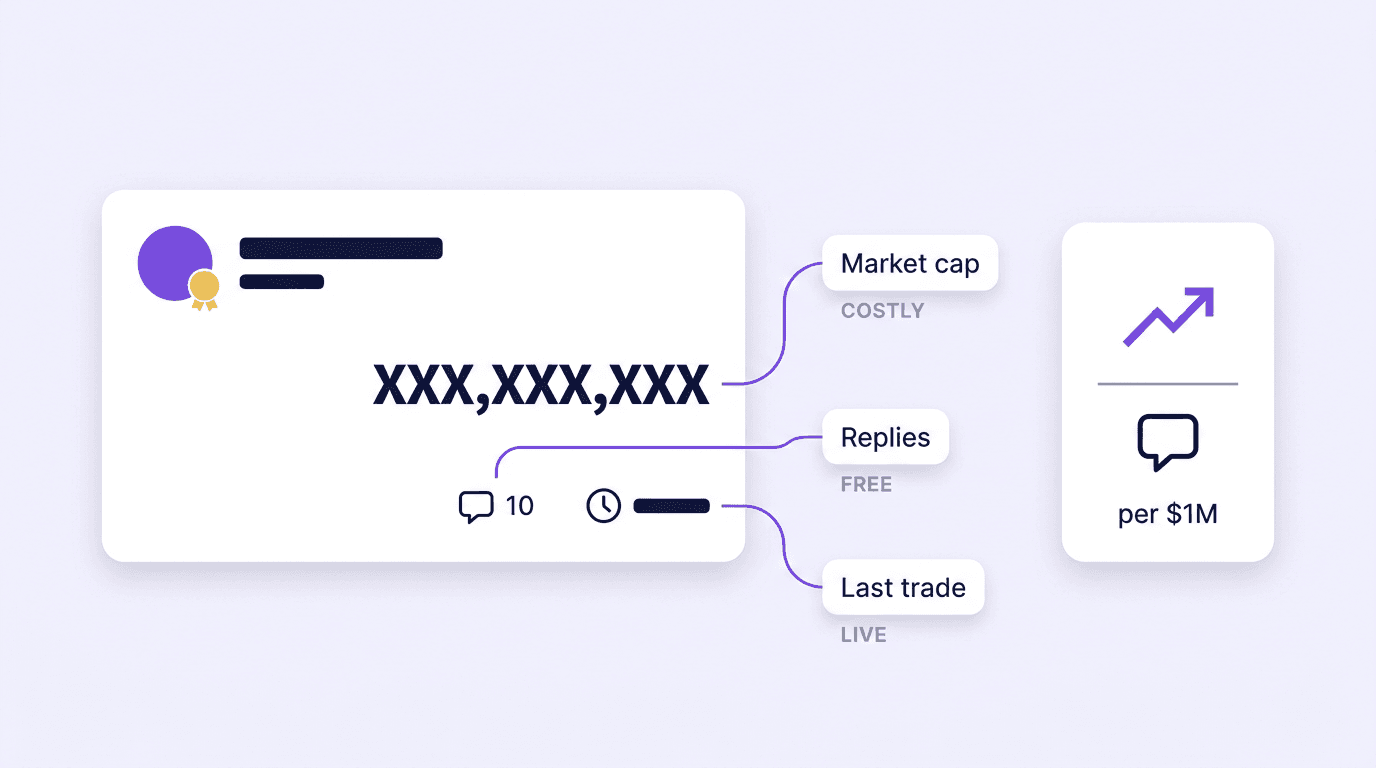
Market cap is a costly signal on an instantaneous clock. It is price multiplied by supply at the instant the feed refreshed. Price only moves when someone spends real SOL, which makes cap the most expensive number on the card to manufacture — not impossible to manufacture, but it costs fees and it risks capital. It is also strictly backward-looking: a cap of $45M is a record of buying that has already finished. Nothing about it is a forecast. (On pump.fun specifically, the cap of a pre-graduation coin is derived from the bonding curve rather than from a pool; the full mechanic is in our pump.fun platform guide.)
Reply count is a free signal on a cumulative clock. A reply costs nothing but an account. It never decrements. A thread with 14,017 posts might have earned all of them in the last hour or accumulated them over months, and the card gives you no way to tell which. That is the structural weakness of the metric: you are dividing a lifetime total by a point-in-time stock.
The practical consequence is important enough to state as a rule:
A replies-per-$1M comparison is only apples-to-apples between coins of similar age. Across coins of different ages, a higher ratio may simply mean the thread has been open longer.
Which is exactly the confound sitting in the Fartcoin figure. Fartcoin is an established coin with a long history; Cupsey is the pump.fun mascot coin. Neither is a launch from this morning. If engagement density were purely a function of current attention, you would expect the much smaller coin to score higher — small caps usually have more talkers per dollar. It scores 3.58x lower, which is a hint that thread lifetime, not present-tense excitement, is doing most of the work in that number.
Two more properties worth internalising:
| Property | Market cap | Reply count |
|---|---|---|
| Cost to produce one unit | Real SOL, plus fees and slippage | Zero |
| Cost to fake | High but finite — wash trading burns fees | Trivial |
| Time behaviour | Point-in-time; can halve in a minute | Cumulative; never decreases |
| What it proves | Someone spent money at some point | Someone typed at some point |
| Independently verifiable? | Yes — pool reserves and holders on-chain | Only by reading the thread |
The asymmetry in the "cost to fake" row is why you should never rank coins by replies alone, and why a coin whose only strong signal is its reply count deserves more scepticism than one whose only strong signal is its cap. It is also why the ratio matters more than either input: manufacturing a convincing ratio means faking both sides in proportion, which is meaningfully harder than faking either.
The four quadrants
Plot the two numbers against each other and you get four cells. This is the whole framework, and the honest version of it labels each cell with a question rather than a verdict.
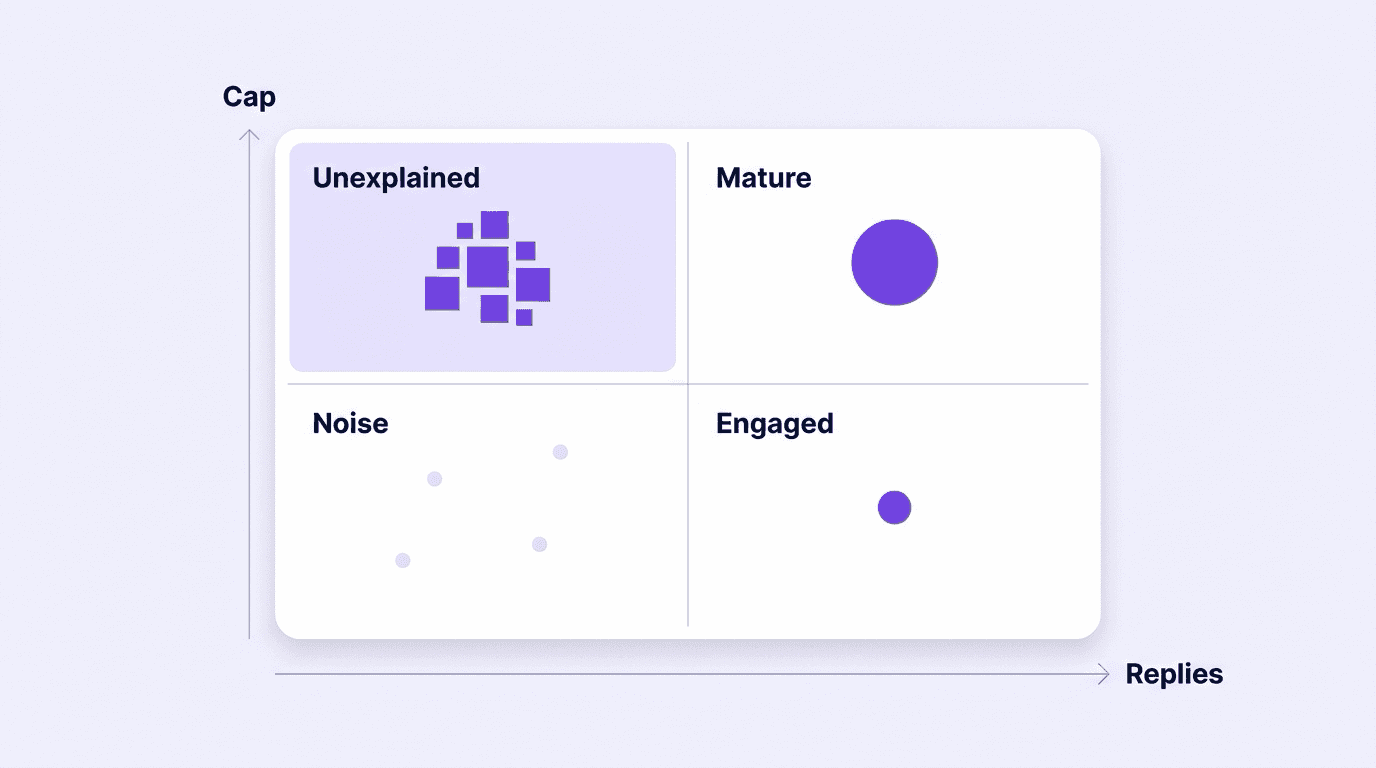
| High replies | Low or zero replies | |
|---|---|---|
| High cap | Mature. Money and talking agree. Ask: how old is the thread, and when was the last trade? Board example: Fartcoin. | Unexplained. The most information-dense cell on the board. Ask: is it new, is the crowd elsewhere, or is the cap thin? Board example: the entire $245.8M energy cluster. |
| Low cap | Engaged and small. Talking is ahead of money. Ask: is the attention converting, and is the thread real people or one person with many accounts? Board example: Cupsey. | Noise. Neither signal has fired. Nothing to read yet; most cards on any board live here before they either move or die. |
The reason the top-right cell is the interesting one is that it is the only cell where the two signals actively disagree. Agreement is cheap information — when cap and chatter both say the same thing, you have learned one thing, not two. Disagreement means at least one of your assumptions about how these coins work is wrong, and finding out which one is where the actual edge is.
The high-ratio case: what Fartcoin's 109.39 does and does not tell you
What it supports. A social surface exists and has persisted. 14,017 posts is a large amount of accumulated human (or at least account-driven) activity, and threads that size are not spun up in an afternoon. The coin has been around long enough, and been interesting enough, to keep a thread alive. In a category where 87% of tokens are dead inside 24 hours — a figure from our own 50,000-launch dataset, and a correlation from observational data rather than a law of nature — mere survival is genuinely informative.
What it does not support. Four things, specifically:
- It is not a price forecast. The replies happened. The cap happened. Neither tells you what the next hour does. Anyone who tells you a ratio predicts price is selling you something.
- It does not prove the replies are people. Free signal, trivially inflatable. A high ratio raises the odds that something real is happening; it does not establish it.
- It does not mean the coin is active right now. This particular card, KING badge and all, read "last trade 18 minutes ago". More on that below, because it is the trap most readers fall into.
- It does not travel across ages. Comparing a months-old thread to a two-hour-old one on this metric is comparing a total to a snapshot.
If you want the ratio to be age-fair, normalise it: divide replies by hours since the mint was created (visible on Solscan) to get replies per hour, then compare that against cap. The board does not give you mint age, which is precisely why the board is the beginning of the work rather than the end of it.
Zero replies at a nine-figure cap
Now the interesting part. Seven cards, $245,802,984, five tickers, one narrative, and not a single reply between them.
Here is the discipline that separates this from horoscope writing: enumerate every explanation consistent with the observation before you pick one. Zero replies at a high cap is consistent with at least five different worlds, and the board cannot distinguish between them.
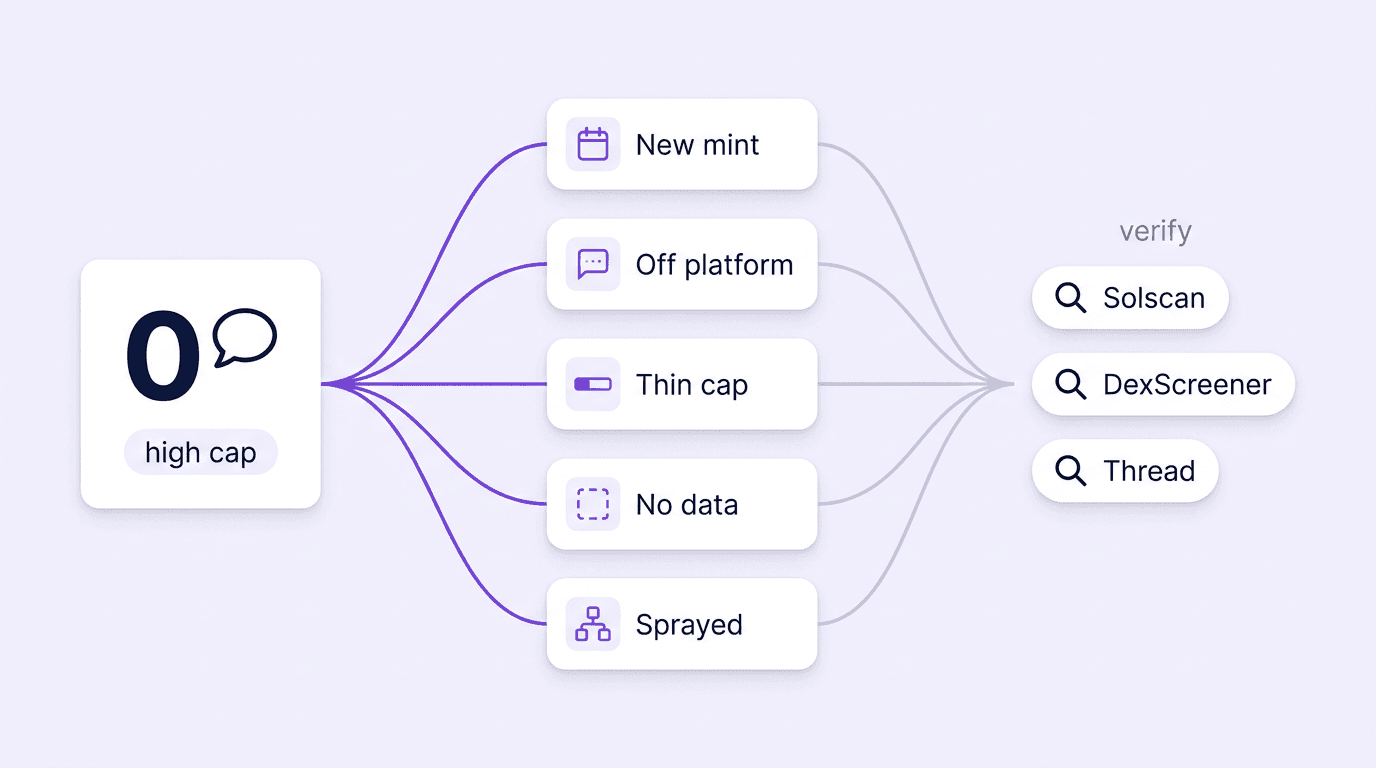
| What zero replies could mean | How to test it in two minutes | What would confirm it | What would rule it out |
|---|---|---|---|
| The mint is minutes old and the thread has not caught up | Open the mint on Solscan and read the account creation time; check the age of the first trade on the pair | A mint created inside the last hour or two | A mint that is days old with a thread nobody has ever posted in |
| The community lives on X or Telegram, not the pump.fun thread | Click the card's X and Telegram icons; search the ticker and the full mint address on X | An active account posting around the same timestamps as the trades | No socials on the card and no search results for the mint address anywhere |
| The quoted cap is thin or manufactured — few wallets, few trades | Open the pair on DexScreener and read 24h transactions, unique buyers and sellers, and liquidity against the quoted cap; then read top holders on Solscan | A nine-figure quoted cap sitting on a shallow pool and a handful of wallets | Thousands of distinct traders and pool liquidity proportionate to the cap |
| The reply number is missing from the feed rather than genuinely zero | Open the coin's own page on pump.fun and count the thread yourself | A populated thread on pump.fun against a 0 on the board | An empty thread on pump.fun as well |
| One deployer sprayed a narrative and buyers arrived before talkers did | Compare deployer and funding wallets across the same-ticker mints on Solscan | The same deployer or the same funding wallet behind several cards | Unrelated deployers funded from unrelated wallets |
A few notes on the harder ones.
On the "missing data" hypothesis, we have a first-party disclosure to make. Our board normalises the upstream feed at the boundary: any reply count that arrives non-numeric, negative or absent is floored to 0 before it renders. That is the correct defensive behaviour for a page we server-render and index — the alternative is a crash or a NaN on a public page — but it means a displayed zero is genuinely ambiguous between "no replies" and "no data". We would rather tell you that than have you over-read our own UI. The fix takes ten seconds: open the coin on pump.fun and count the thread yourself.
On the "thin cap" hypothesis, be careful what you conclude. A cap resting on few wallets is a fact about distribution, not a confession. Concentrated holdings are normal in the first hours of any launch, and plenty of legitimate coins have ugly holder charts early. What makes concentration meaningful is combination: a nine-figure quoted cap, a shallow pool, a double-digit holder count, and no thread is a pattern worth stepping back from. Any one of those alone is not.
On the "sprayed narrative" hypothesis. Three mints sharing the ticker $TNOS at $78.8M, $46.8M and $16.6M is a striking observation, but it is not proof of a single deployer. Tickers are not owned on Solana — nothing in the SPL Token Program enforces uniqueness — so independent people copying a hot format naturally collide. The test is deployer wallets and their funding sources, and it is a Solscan lookup, not an inference from the board.
And what zero replies definitively does not prove: that the coin is a scam, that the market cap is fake, that the buyers are bots, or anything whatsoever about the next candle. Every one of those is a claim that requires evidence the board does not contain. The correct posture toward the top-right quadrant is curiosity plus a verification pass, not a verdict.
"Last trade 18 minutes ago" — and what the KING badge actually is
Every card on this snapshot carried a last-trade label of 18 or 32 minutes. Including the one wearing the crown.
That matters more than any ratio on the page, because it is the only field on the card written in the present tense. Market cap is an accumulated record. Reply count is an accumulated record. The last-trade timestamp is the single field that answers "is anything happening right now", and on a $128M coin, eighteen minutes of nothing is a meaningful silence. It means the price you are looking at is a price nobody has tested for eighteen minutes — the buyers who set that number have already finished.
Read recency first, and read it as a veto rather than as a picker: a stale card is disqualified regardless of how good its other numbers look. The four-signal ordering for the discovery step itself is covered in how to find trending pump.fun coins; this article is about what to do once the cards are in front of you.
Now the disclosure about our own KING badge, because you should know exactly what you are looking at. Alchemii's board sorts coins by USD market cap, descending, and renders the crown and the KING label on the card at index zero. That is all it is: the largest market cap on this board at this refresh. It is not an award, not a pump.fun designation, not a measure of momentum, and not a claim about quality. A coin can hold that badge while trading nothing at all, which is precisely what the snapshot shows. Any board that decorates its top row is doing something similar; ours just tells you.
Board freshness, in exact numbers, so you can calibrate how much to trust a timestamp. The server-rendered page revalidates every 300 seconds. Once it is in your browser, the client polls the feed every 8 seconds while the tab is visible, and the relative-time labels re-render on a 5-second clock. The last trade value itself originates upstream from pump.fun, so it inherits whatever lag that feed has. Practical translation: a freshly loaded label is accurate to within seconds, a server-rendered first paint can be up to five minutes stale, and no board anywhere is a substitute for opening the pair and looking at the actual trades.
Sanity-check any of it in five minutes
A board is a lead, not a source. Everything above can be confirmed or demolished with three tabs. Work by mint address, never by ticker — this snapshot has three different mints answering to $TNOS, and address-first discipline is also the habit that protects you from impersonation tokens and address-poisoning tricks the FBI's IC3 has issued public advisories about.
1. Mint age and authorities — Solscan. Paste the mint address. Read the account creation time (this is your denominator if you want an age-fair engagement rate), then the mint authority and freeze authority fields. null mint authority means supply is fixed; the mechanics are in what is mint authority on Solana.
2. Holder distribution — Solscan holders tab. Holder count and top-10 concentration. The question you are answering is whether the quoted cap rests on a crowd or on a handful of wallets.
3. Real trading — DexScreener. 24-hour transaction count, unique buyers versus unique sellers, pool liquidity, and how liquidity compares to the quoted market cap. A useful and rarely stated fact: every coin on this snapshot is far past pump.fun's roughly 411-SOL (~$41K) graduation threshold — the smallest, Cupsey at $7,494,814, is about 108 times it — so all nine have migrated to real pools and are indexable. Pre-graduation coins are not on DexScreener at all, because a bonding curve is not a pair; that limitation and its consequences are covered in DexScreener vs CoinGecko and in our PumpSwap explainer.
4. The thread itself — pump.fun. Open the coin's page and read the last twenty replies. You are checking two things: whether the count on the board matches reality, and whether the posts read like a conversation or like the same three lines from thirty accounts.
5. Off-platform — X and Telegram. Search the ticker and the full mint address. A real community that has moved off the thread leaves a trace; a manufactured one usually has an account with follower counts that do not match its engagement.
If the coin passes all five, you have learned that the format has genuine attention behind it. That is the actual deliverable of this exercise — not a buy signal, but a decision about which format is worth building on. The broader verification checklist is in how to verify a Solana token.
The $TNOS problem: three mints, one ticker
Worth isolating because it is the clearest practical lesson on the board. Three cards, all called Transnational Oil Supply, all trading as $TNOS, at $78,783,533, $46,832,525 and $16,552,983. Combined: $142,169,041, or 37.3% of the entire board — more than the KING-badged coin.
Solana has no ticker namespace. The SPL Token Program stores supply, decimals and authorities; the human-readable name and symbol live in a separate Metaplex metadata account; neither enforces uniqueness. Duplicate tickers are not an anomaly to be explained, they are the default state of the system, and every serious surface resolves by address for exactly that reason.
Three operational consequences:
- Any ticker-based search you run is ambiguous. Searching "$TNOS" on DexScreener or X on this day returns at least three different assets with a 4.8x spread in market cap between the largest and the smallest.
- If you launch into a live ticker collision, the confusion is permanent and it is your buyers who pay for it. Run the collision check before you commit to a symbol, not after.
- A copy is not an impersonation, but the line is real. Building on a format the market is rewarding is normal and permissionless; claiming to be another token is fraud, and it is also a losing strategy because the mint address is public and takes one click to check. The full treatment is in is cloning a memecoin legal.
What none of this predicts
The uncomfortable paragraph, and the one most articles on this keyword skip.
None of these signals forecasts price. A board ranks by market cap, and market cap is the record of buying that already happened, which makes any trending list a receipt rather than a forecast. The ratio work above tells you where to look, and the verification pass tells you what is true, and neither tells you what happens next.
Callout counts belong in the same category, with one extra wrinkle: a Callout's author may be earning from an activity metric Pump explicitly declines to publish, so the number in front of you is shaped by an incentive you cannot inspect. It is still a signal about attention. It is not a signal about quality, and a leaderboard position is not a payment record — see Pump.fun Callouts explained.
The base rate is brutal: 87% of Solana memecoins die within 24 hours, measured across our own 50,000-launch dataset. Two configuration choices correlate with surviving that window — revoked mint authority at 4.2x and LP burned at minute zero at 5.7x — but those are correlations from observational data, not causal levers. Deployers who revoke and burn are also the deployers who did everything else properly, so the config is partly a proxy for care. Neither one saves a token nobody wants. What they do is remove the two failure modes experienced buyers price in during their first thirty seconds of looking at your chart. The full breakdown of the failure modes is in why most Solana memecoins die in 24 hours.
And if the honest reason you are reading a page about engagement metrics is that you want to make money, read how meme coin creators actually make money first. It is a clear-eyed accounting of where the money in this category actually goes, and it will serve you better than any ratio on this page.
What reading the board well genuinely buys you is narrower and more defensible: a better-informed choice of which format to build on, and a few hours of lead time on a narrative before it saturates. That is a real edge. It is just a smaller one than the horoscopes promise.
From judgement to a live token: Copy Coin
Here is where the framework stops being an analysis exercise. Once you have decided which format on the board is worth learning from, the constraint becomes execution speed — narratives on this surface decay in hours, and a format you can only act on tomorrow is a format you cannot act on.
Every card on our trending board has a Copy Coin button. Clicking it opens Alchemii's Solana token creator with the form already filled from that card. Nothing is signed, no wallet is connected, and no SOL moves at that point. This is the observed state of the form immediately after the handoff:
| Field | State after Copy Coin | What you should do with it |
|---|---|---|
| Token Name | Carried over from the copied coin | Change it. A distinct entry in the same format beats a near-duplicate of the original |
| Symbol | Carried over; the field counts down from an 8-character limit | Change it, and collision-check it on DexScreener and X first |
| Decimals | 6, labelled "default recommended 6" | Leave it — 6 matches the memecoin standard and renders readably on charts |
| Supply | 1,000,000,000 | Leave it unless you have a specific reason |
| Description | Carried over verbatim from the copied coin | Rewrite it. Shipping someone else's description is the most common self-inflicted wound in this workflow |
| Token Image | Carried over, with a "Change image" control | Replace it. Thirty seconds of editing gives you a file you control |
| Revoke Freeze | Shown as required and locked on | Nothing to do — see the note below |
| Revoke Mint | Ticked by default | Leave it ticked unless you have a real reason not to |
| Other paid extras | Left unticked | Opt in deliberately, or not at all |
Two things in that table deserve elaboration.
The freeze note, stated precisely. The form presents Revoke Freeze as required and locked. In the transaction that actually gets built, the initializeMint instruction passes null as the freeze authority, so the mint is created without a freeze authority in the first place — there is never one to revoke. The end state is what buyers check for on Solscan either way: freeze authority null. The only conditional authority change in that transaction is mint authority, and update authority stays on your wallet, which is what lets you fix the name or image later if you need to. Do not take that from a blog post, including this one — open your own mint on Solscan after it lands and read the fields.
Why Revoke Mint is the one extra that arrives pre-ticked. Because it is the trust signal buyers actually look at, and because of the 4.2x survival correlation above. Every other paid option stays opt-in, so the template never spends more of your SOL than the launch needs. Every extra is itemised on the form with your exact total shown before you connect a wallet — read that line rather than trusting any figure written down elsewhere.
Cost, in SOL, because SOL is what you pay. A standard launch is around 0.22 SOL all-in; around 0.32 SOL with mint authority revoked, which is what most memecoin launches want; up to about 0.52 SOL fully loaded. The unavoidable on-chain floor underneath all of that is roughly 0.0191 SOL — mint rent 0.00146, Metaplex metadata rent 0.00562, the Metaplex protocol fee 0.01, an associated token account 0.00204, plus a signature. Nothing on Solana mints a token with metadata for less, which settles most arguments about "free" token creators. Full line-by-line accounting: cost to create a Solana token.
Where we honestly sit on price. We are not the cheapest tool in the category and we do not claim to be — Jumpbit at 0.05 SOL, DEXArea at 0.09 and Solr at 0.1 all undercut us on sticker price. We are below Smithii (0.3 SOL flat, plus 0.1 per revocation) and Orion Tools (0.4 SOL effective floor), level with CoinFactory, and cheaper than Pump.fun past roughly 11 SOL of cumulative volume, because Pump.fun takes 1.25% on every buy and every sell forever while our fee is charged once. That comparison is worked through in Alchemii vs Pump.fun. The cheaper tools sell you a mint form and stop there. What this article is actually about is the board in front of it — a live trending feed with one-click copy wired straight into the creator, no extension to install, ending in a Raydium pool whose LP is yours.
And the thing worth repeating because people get it wrong in both directions: a copy inherits the format, not the market. New mint address, zero holders, zero liquidity, no price, no chart, no history — all verifiable in one Solscan lookup by anyone who bothers. It trades entirely on its own merits with its own buyers. That is exactly why starting from a validated format is legitimate, and exactly why claiming to be the original is not. Mechanics in full: what happens when you clone a Solana token and the 60-second copy walkthrough.
Quick Facts (verifiable specifications)
| Specification | Value | Source |
|---|---|---|
| Snapshot date | 1 August 2026 | Alchemii Trending Coins board |
| Cards on the board | 9 | Snapshot |
| Combined market cap | $381,440,850 | Sum of the nine rows |
| Combined replies | 14,246 | Sum of the nine rows |
| Board-wide engagement | 37.35 replies per $1M (one per $26,775) | 14,246 ÷ 381.440850 |
| Fartcoin | $128,143,052 / 14,017 replies | Snapshot |
| Fartcoin engagement | 109.39 per $1M (one per $9,142) | 14,017 ÷ 128.143052 |
| Cupsey | $7,494,814 / 229 replies | Snapshot |
| Cupsey engagement | 30.55 per $1M (one per $32,728) | 229 ÷ 7.494814 |
| Fartcoin-to-Cupsey engagement ratio | 3.58x | 109.39 ÷ 30.55 |
| US energy cluster | 7 cards, 5 tickers, $245,802,984, 0 replies | Snapshot, inclusion rule stated above |
| Energy share of board cap | 64.4% | 245,802,984 ÷ 381,440,850 |
| Duplicate-ticker $TNOS mints | 3, totalling $142,169,041 (37.3% of board) | Snapshot |
| Last-trade label on every card | 18 or 32 minutes ago | Snapshot |
| Board server revalidation | 300 seconds | Alchemii /trending |
| Board client poll interval | 8 seconds while the tab is visible | Alchemii /trending |
| Pump.fun graduation threshold | ~411 SOL of market cap (about $41K at ~$100/SOL) | Pump.fun docs |
| Standard launch via Alchemii | ~0.22 SOL all-in | Alchemii create form |
| Launch with mint authority revoked | ~0.32 SOL | Alchemii create form |
| On-chain protocol floor | ~0.0191 SOL | Solana + Metaplex docs |
| 24-hour memecoin death rate | 87% | Alchemii 50,000-launch dataset |
| Revoked mint authority survival correlation | 4.2x | Alchemii 50,000-launch dataset |
| LP burned at minute zero survival correlation | 5.7x | Alchemii 50,000-launch dataset |
Limitations of this guide
Stated plainly, because a page arguing for rigour should hold itself to it.
- This is one snapshot of one board on one day. Nine cards is a small sample and a single narrative cycle. The ratios are exact; their generalisability is unproven.
- Reply counts are lifetime totals, market caps are instantaneous. Every ratio here inherits that units mismatch. Treat cross-coin comparisons as directional unless you normalise by mint age.
- We did not resolve the zero-reply cluster. We enumerate five hypotheses and the tests for each; we do not claim to know which is true for these specific mints. Any article that claims to know, from board data alone, is guessing.
- We do not have the upstream feed's methodology. Market cap and reply figures are what pump.fun's feed returned. How it computes cap for a given coin, and how promptly reply counts propagate, is not something we control or can audit.
- Nothing here is trading advice or a price prediction, and no ratio on this page has predictive power that we have measured.
- Bot and sybil detection is out of scope. Distinguishing thirty real posters from one poster with thirty accounts needs graph analysis on wallets and accounts, not a reply count.
- Legal and tax questions are out of scope — see is cloning a memecoin legal for the boundary between derivative and impersonation, which is not legal advice either.
Sources & references
- Alchemii Trending Coins board (primary data) — AlchemiiThe nine-card snapshot analysed in this article was captured here on 1 August 2026. Server-rendered every 300 seconds, polled every 8 seconds in the browser. (accessed 2026-08-01)
- Alchemii launch-data methodology — AlchemiiHow the 50,000-launch dataset is collected and why its survival figures are correlations rather than causal effects.
- Pump.fun documentation — fees, bonding curve, graduation (pump.fun/docs) — Pump.funBonding-curve mechanics, the ~411-SOL (~$41K) graduation threshold, the 1.25% per-trade fee, and migration to a PumpSwap pool.
- Pump.fun live board (pump.fun/board) — Pump.funThe upstream surface these market-cap and reply numbers originate from; useful for reading an individual coin's thread in full.
- Solscan — mint accounts, holders, authorities, creation time — SolscanPrimary verification surface for mint age, holder concentration, mint and freeze authority state, and deployer wallet history.
- Solana Explorer — Solana FoundationIndependent second explorer — worth cross-checking when one indexer's numbers look wrong.
- DexScreener — Solana pairs — DexScreenerTransaction counts, unique buyers and sellers, pool liquidity and FDV for any graduated pair. Pre-graduation pump.fun coins have no pair and cannot appear here.
- Birdeye — Solana token analytics — BirdeyeHolder history and trader-count views used to sanity-check whether a quoted market cap rests on many wallets or a few.
- GeckoTerminal — CoinGeckoThird independent pool-level data source for cross-checking liquidity and volume figures.
- SPL Token Program source — Solana Labs / GitHubThe program that owns supply, decimals and authorities. It stores no name, ticker or reply count — which is why duplicate tickers are structurally normal.
- Metaplex Token Metadata — Metaplex FoundationWhere a token's name, symbol, description and image URI actually live, and why nothing enforces uniqueness across mints.
- Solana rent-exempt minimums — Solana docsMint account ~0.00146 SOL, associated token account ~0.00204 SOL — two components of the ~0.0191 SOL protocol floor quoted here.
- Solana transaction fees — Solana docsBase fee of 5,000 lamports per signature, plus prioritization fees during congestion.
- Jupiter — get your token listed — JupiterThe strict-list criteria most downstream trust surfaces, including Phantom's verified badge, derive from.
- FBI IC3 public service announcements — FBI Internet Crime Complaint CenterSource for the impersonation-token and address-poisoning advisories referenced when discussing why address-first verification is the habit that matters.
- Chainalysis research — ChainalysisBackground reading on wash trading and manufactured volume — the mechanism behind hypothesis three in the zero-replies table.
- Helius — Solana RPC and account APIs — HeliusPractical route to pulling holder counts and transaction histories yourself rather than trusting any dashboard's summary.
FAQ
What do market cap and replies mean on a pump.fun trending card?
Market cap is price multiplied by supply at the moment the board refreshed — a costly, point-in-time number that only moves when somebody spends SOL. Reply count is the total number of posts in that coin's pump.fun thread since it launched — a free, cumulative number that anyone with an account can add to. They measure different things on different clocks, which is why the ratio between them is informative and why neither is a verdict on its own.
Does a high reply count mean a pump.fun coin is real?
No. Replies cost nothing to post, so a reply count is the cheapest signal on the card to manufacture. What a high reply-to-cap ratio does indicate is that a social surface exists and has existed for a while — a thread with 14,017 posts took time to accumulate. That is evidence of age and attention, not of honesty, and definitely not of future price. Check the last-trade timestamp before you treat any of it as live.
What does it mean when a pump.fun coin has zero replies at a high market cap?
It means the board cannot tell you, and that is the honest answer. Zero replies at a nine-figure cap is equally consistent with a mint that is minutes old, a community that lives on X or Telegram instead of the pump.fun thread, a cap resting on very few wallets, a missing value in the data feed, or a narrative that buyers reached before talkers did. Each of those has a two-minute test on Solscan, DexScreener or the coin's own pump.fun page. None of them is proved by the number zero.
How do I calculate replies per million dollars of market cap?
Divide the reply count by the market cap expressed in millions. On the 1 August 2026 snapshot: Fartcoin is 14,017 ÷ 128.143052 = 109.39 replies per $1M, and Cupsey is 229 ÷ 7.494814 = 30.55. Inverting gives dollars per reply — $128,143,052 ÷ 14,017 = $9,142 for Fartcoin and $7,494,814 ÷ 229 = $32,728 for Cupsey. The seven US-energy cards score 0.00 because zero divided by anything is zero.
Why does "last trade 18 minutes ago" matter on the top coin?
Because market cap records buying that already happened while the last-trade timestamp is the only field on the card describing right now. A coin can sit at the top of a board on nine figures of accumulated cap with nothing trading against it, and eighteen minutes of silence is a long time on a surface where most tokens do not survive their first day. Read recency first as a disqualifier, then the ratio, then the cap.
How do I verify any of this on Solscan and DexScreener?
Copy the mint address, not the ticker. On Solscan, read the account creation time, the holder count, the top-10 holder concentration, and the mint and freeze authority fields. On DexScreener, read 24-hour transactions, unique buyers versus sellers, and pool liquidity against the quoted market cap. Every coin on this snapshot sits far above pump.fun's roughly 411-SOL (~$41K) graduation threshold, so each one has a real pool and is checkable there — pre-graduation coins are not, because they have no pair to index.
Once I've picked a coin worth learning from, how fast can I launch my own?
Minutes. Every card on Alchemii's Trending Coins board has a Copy Coin button that opens the token creator prefilled with that coin's name, symbol, description and image, at 1,000,000,000 supply and 6 decimals, with mint-authority revocation already ticked and other paid extras left off. Clicking it signs nothing and spends nothing. Change the name, ticker, art and description before you sign — your mint is a new address with its own holders and liquidity, and it trades on its own merits.
Read the two numbers as a question, run the five-minute verification pass, then move fast on the format the market has already validated. Open the live Trending Coins board → and hit Copy Coin on the card that survives your checks — the Solana token creator opens prefilled with mint authority revoke already ticked, around 0.32 SOL all-in, one signature, no cut of your volume. Then work the launch checklist so the token you just minted has the on-chain receipts buyers look for.
Create your Solana token
Choose your token name, symbol, supply and image. Review the authority options and creation fee, then confirm the transaction in your wallet. Liquidity is a separate step.
Related Topics
More guides to Solana token creation, authorities, liquidity, and meme coin launches.
Pump.fun Callouts Explained: How to Use Them & Check Rewards
What Pump's Callout Rewards terms really say: the Activity Metric is confidential, rewards are discretionary, and only the on-chain transfer counts as payment.
How to Copy a Trending Pump.fun Coin in 2026 (60 Seconds)
Copy a trending Pump.fun coin in under a minute: one click prefills the token creator with name, ticker, image and settings — plus an optional pump-suffix mint.
How to Find Trending Pump.fun Coins Fast (2026)
How to find trending pump.fun coins in 2026: the four signals that matter, where to look, and why a trending board is a receipt rather than a forecast.
Get a Pump Suffix Token Without Pump.fun (2026)
Create a Solana token ending in pump for 0.1 SOL. Gain memecoin-native recognition, keep direct-launch control, and preserve more creator upside.
Solana Memecoin Narrative Clusters: How Theme Waves Form (2026)
Seven of nine cards on one live pump.fun board were one narrative. How memecoin theme waves form, what a cluster's cap curve means, and when it's spent.
What Happens When You Clone a Solana Token? (2026)
Cloning a Solana token copies name, symbol and image — nothing else. New mint address, no liquidity, no holders, no price. Exactly what transfers.