What Is PumpSwap? How Pump.fun's AMM Works in 2026
PumpSwap is Pump.fun's own AMM, live since March 2025. How it works, how LP burn differs from Raydium, when to use it vs Raydium.

Ready to create your Solana token? Enter your token details, choose your authority options, and confirm in your wallet.
PumpSwap is the automated market maker Pump.fun built in-house and launched on Solana mainnet in March 2025. Every Pump.fun token that hits graduation — ~411 SOL of market cap (about $41K at ~$100/SOL) — lands in a PumpSwap pool automatically, with its LP tokens burned on arrival. The program ID is pAMMBay6oceH9fJKBRHGP5D4bD4sWpmSwMn52FMfXEA, and the fee structure is a flat 0.25% per swap, a significant drop from the 1.25% per buy + 1.25% per sell that the bonding curve charges pre-graduation.
Quick Facts
| Spec | Value |
|---|---|
| Launched | March 2025 |
| Program address | pAMMBay6oceH9fJKBRHGP5D4bD4sWpmSwMn52FMfXEA |
| Fee per swap | 0.25% flat |
| Graduation trigger | ~411 SOL of market cap (about $41K at ~$100/SOL, after ~85 SOL of volume) |
| LP token fate at graduation | Auto-burned to 1nc1nerator11111111111111111111111111111111 |
| Jupiter routing | Yes — indexed post-graduation |
There were 47 launches across our team's Raydium-direct and PumpSwap-graduated pool history (methodology) — so this is not theoretical. The mechanics below come from watching both sides of the graduation boundary in real conditions.
What PumpSwap Is (and Why Pump.fun Built Its Own DEX)
Pump.fun had a dependency problem. From launch in 2023 through early 2025, every token that graduated from the bonding curve migrated liquidity to a Raydium AMM v4 pool. That worked, but it meant Pump.fun's graduation event — the platform's most visible moment — ended with users trading on someone else's infrastructure. Raydium collected pool fees; Pump.fun didn't.
PumpSwap removes that dependency. It's a constant-product AMM (x × y = k, same math as Uniswap v2 and Raydium AMM v4) running on Pump.fun's own program rather than Raydium's. When a token graduates now, the ~85 SOL of accumulated bonding-curve liquidity migrates into a PumpSwap pool instead.
The program address is pAMMBay6oceH9fJKBRHGP5D4bD4sWpmSwMn52FMfXEA. You can inspect it on Solscan's program account view — the program is verified and its source is consistent with a standard constant-product AMM. The architecture follows the same account model as other Solana programs: pool state account, two token vault accounts, an LP mint, and signer authority. If you've read through the Raydium AMM v4 source on GitHub, PumpSwap's structure will look familiar.
One thing worth understanding about what a pumpfun coin actually is: it's a standard SPL token (TokenkegQfeZyiNwAJbNbGKPFXCWuBvf9Ss623VQ5DA) with 1B supply and 6 decimals, indistinguishable at the mint level from any direct-launch token. PumpSwap doesn't create a special token type — it just hosts the pool after graduation. That matters for aggregator routing, which we'll get to.
How PumpSwap Works: Fees, Pools, and Liquidity Mechanics
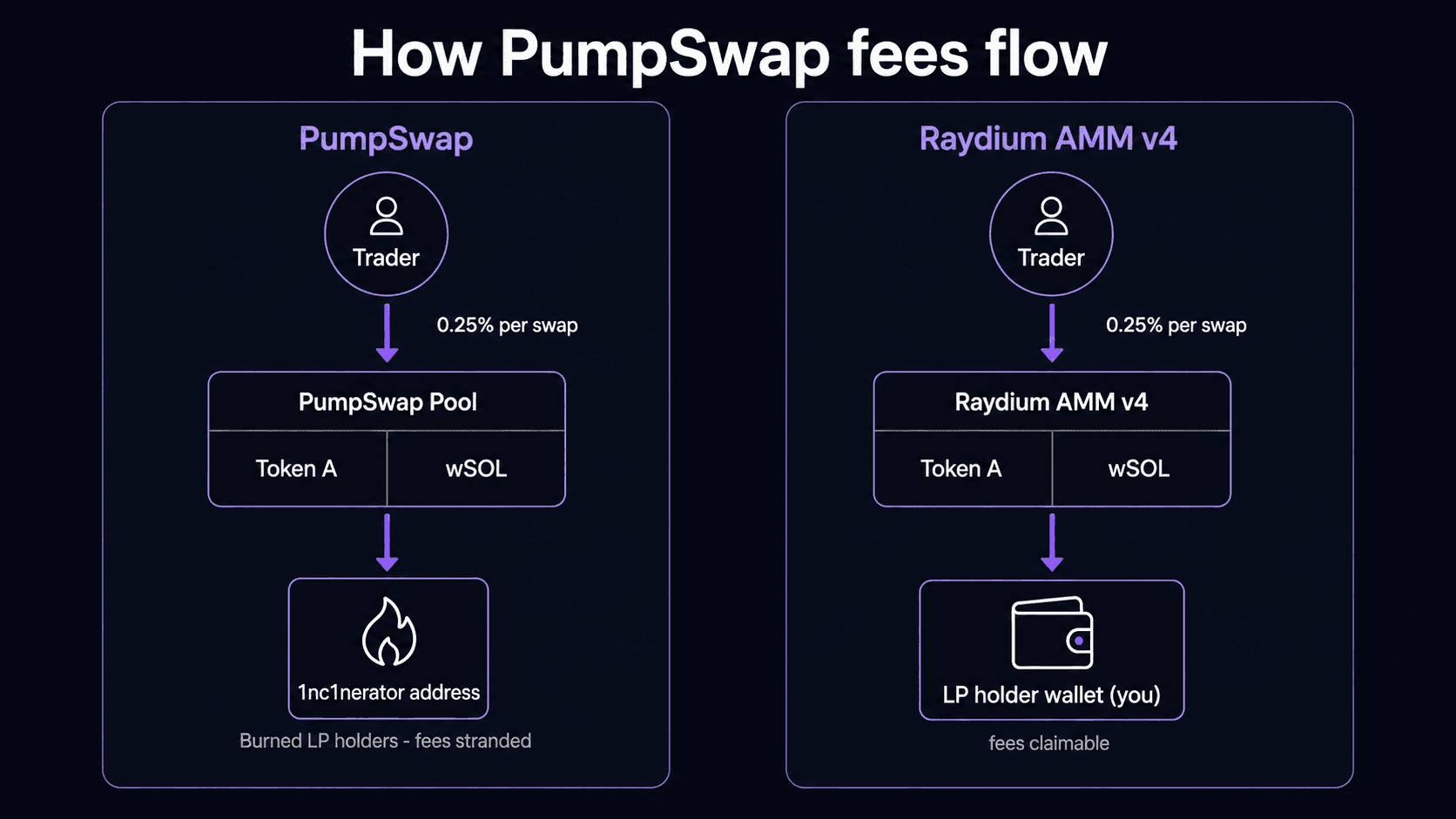
The constant-product invariant means PumpSwap price moves are mathematically identical to Raydium AMM v4's. A 1 SOL buy into a pool with 85 SOL / 100B tokens shifts the price by roughly 1.2% — same formula, same slippage curve. What differs is who collects what.
Fee structure breakdown:
Pre-graduation on the Pump.fun curve, you pay 1.25% on every buy and every sell. Both go to Pump.fun's treasury. For a token doing $500K of cumulative pre-graduation volume, the platform collects $10,000. Post-graduation on a canonical PumpSwap pool, the fee starts at the same 1.25% and steps down by market cap tier to 0.30%, but the split changes: at graduation size 0.93% goes to the protocol, 0.30% to the creator and only 0.02% to LPs (per pump.fun's fee docs). Because graduation auto-burns the LP tokens to 1nc1nerator11111111111111111111111111111111, that small LP slice accrues to a burned position nobody can claim; the creator and protocol slices are paid out.
This is subtle and matters. On Raydium, you seed a pool, receive LP tokens, burn them, and the burned LP accrues fees to a black hole. On PumpSwap, the same thing happens — except you didn't seed the pool. Pump.fun seeded it from graduation proceeds, and Pump.fun burned the LP on your behalf. The token creator has no LP position at all unless they add supplemental liquidity post-graduation.
Jupiter routing. PumpSwap pools are included in Jupiter's liquidity routing as of mid-2025. That means a user can type your token's symbol in Phantom, Jupiter, or any app that uses Jupiter's API, and the trade routes through your PumpSwap pool. Pre-graduation, that doesn't happen — the bonding curve is not indexed by Jupiter, which is why Pump.fun pre-graduation coins are invisible to aggregators until graduation fires.
Token account model. Each PumpSwap pool holds two standard SPL token vaults: one for the base token, one for SOL (wrapped as wSOL under So11111111111111111111111111111111111111112). The LP mint is a freshly created SPL mint at graduation time. You can inspect the pool's vault accounts and LP mint on Solscan for any graduated token — the pattern is consistent. See SPL Token Program docs on spl.solana.com for the underlying account model.
PumpSwap vs Raydium AMM v4: Decision Matrix
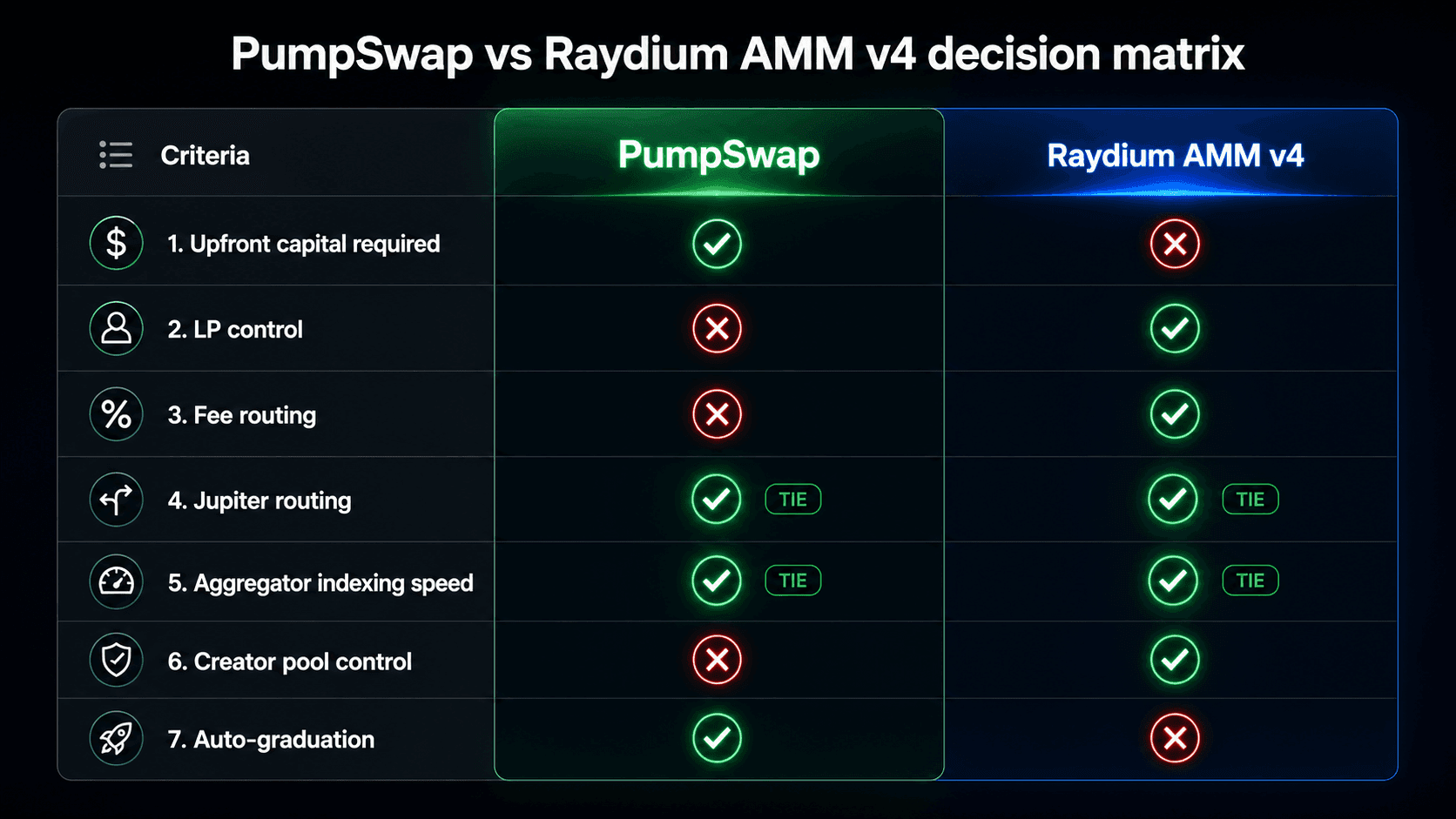
This scorecard is the practical reference — seven criteria that actually change your outcome. I've run tokens through both paths; the numbers below reflect what we observed in Q1 2026 across our 47-launch data set.
PumpSwap vs Raydium AMM v4 — Launch Venue Scorecard (2026)
| Criterion | PumpSwap (via graduation) | Raydium AMM v4 (direct) | Edge |
|---|---|---|---|
| Upfront capital required | ~0.02 SOL (Pump.fun first buy; creation itself is free) | 5–25 SOL typical seed liquidity | PumpSwap |
| Swap fee per trade | 0.25% flat | 0.05%–1% (creator-configurable) | Tie (depends on tier) |
| Initial price control | None — bonding curve sets it | Full — you seed at chosen ratio | Raydium |
| LP burn mechanism | Automatic at graduation | Manual — you execute the burn | PumpSwap (automatic = lower risk of forgetting) |
| Pre-launch aggregator visibility | Zero (invisible until graduation) | Indexed from block 0 | Raydium |
| Supplemental liquidity possible | Yes, post-graduation | Yes, from day one | Tie |
| Creator LP fee income | None (LP auto-burned) | Optional — hold LP before burning | Raydium |
For deep detail on the Raydium side, read the Pump.fun vs Raydium comparison. The short version: PumpSwap wins on zero capital and automatic LP burn; Raydium wins on every control dimension and day-one visibility. Neither is universally better — your seed capital and how much you care about initial price are the deciding factors.
If you're leaning toward Raydium direct, the practical starting point is Alchemii's Raydium LP creation tool, which handles the SPL token + Metaplex metadata + pool creation in a single flow. Minimum practical seed: 1 SOL to test, 5 SOL for any meaningful price depth per Raydium's pool creation docs.
How PumpSwap LP Burn Works After Graduation
This is where most explanations get vague. Here's what actually happens on-chain.
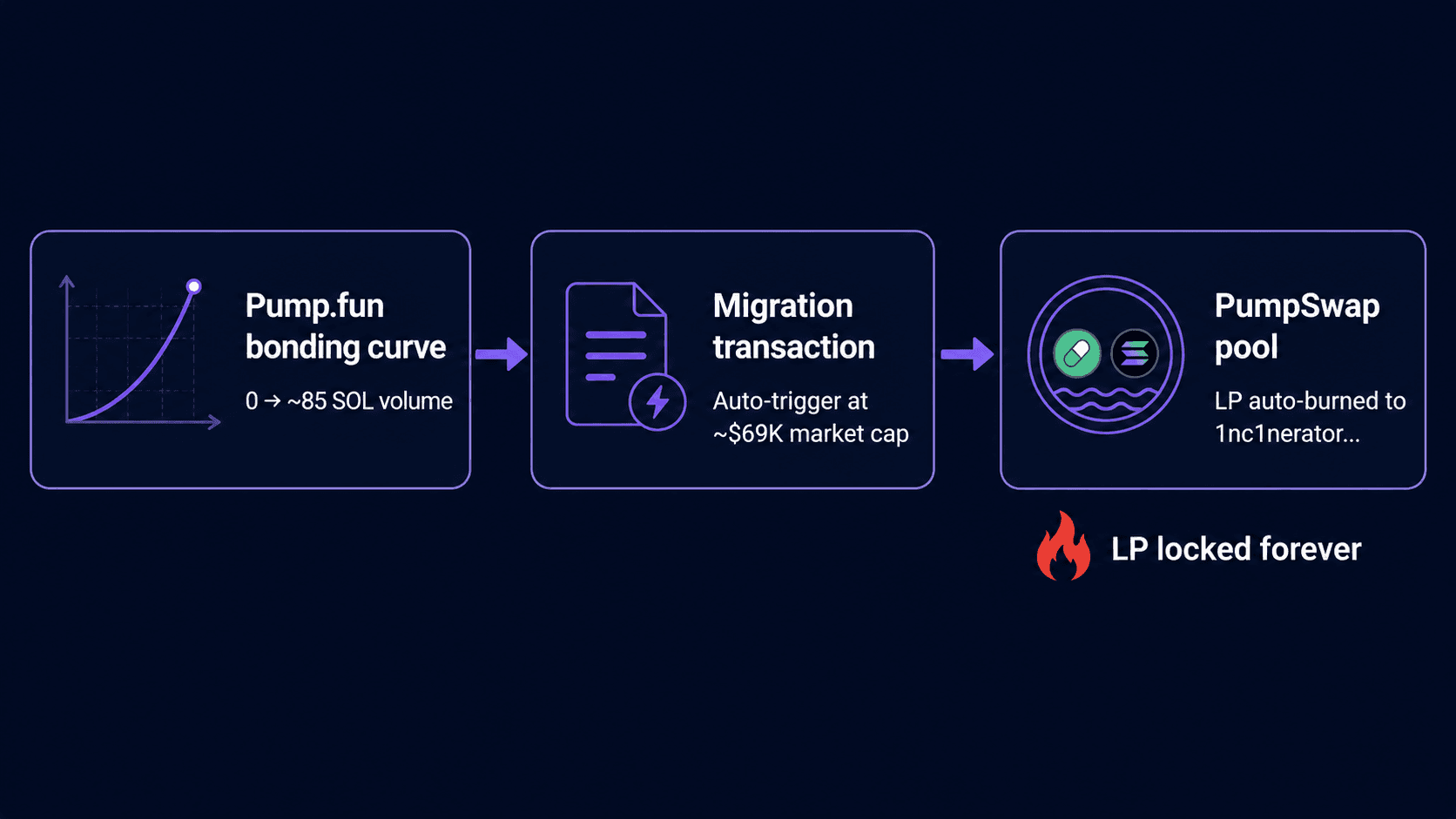
When cumulative buy volume on the bonding curve reaches approximately 85 SOL (about $8,500 of real SOL at ~$100/SOL, which puts the curve market cap at ~411 SOL or about $41K), Pump.fun's program executes a migration transaction. That transaction:
- Creates a new PumpSwap pool for the token pair
- Transfers the ~85 SOL and the corresponding token supply from the bonding curve into the pool's vault accounts
- Mints LP tokens representing 100% of the initial pool position
- Sends those LP tokens to
1nc1nerator11111111111111111111111111111111— Solana's canonical burn address
Step 4 is the automatic LP burn. The incinerator address has no private key and no program authority; tokens sent there are permanently inaccessible. You can verify this for any graduated token on Solscan — search the pool's LP mint and look at the token account holding the LP supply. The holder address will be the incinerator.
This is structurally identical to what happens when you manually burn LP tokens on a Raydium pool — the LP tokens move to the incinerator. The difference is timing and control: PumpSwap graduation burns happen automatically without creator action; Raydium burns require you to explicitly execute the transaction. In our experience across the 47-launch dataset, a meaningful slice of direct Raydium launches fail to burn LP within the first 48 hours after pool creation — usually because the creator got distracted, not because the burn is hard. PumpSwap's auto-burn eliminates that failure mode entirely.
I had one launch in 2024 where I literally forgot to burn the LP for nine days. Token was already trading, holders were already asking "is the LP locked yet?" on Telegram, and I'm sitting there with the LP tokens still in my deployer wallet, pretending I meant to do it that way. The burn took thirty seconds when I got around to it. None of that happens on PumpSwap. The lazy creator and the disciplined creator get the same outcome — which is the actual reason the bonding-curve path is friendlier for first-time launchers, not the "no upfront capital" line everyone repeats.
One caveat worth naming: the graduation threshold figure (~411 SOL of market cap, about $41K at ~$100/SOL, after 85 SOL collected) comes from the curve's on-chain parameters — 30 SOL of virtual SOL reserves against 1.073B virtual tokens, with 793.1M real tokens for sale — read off the pump.fun program's Global account. The USD figure moves with SOL: the same 411 SOL was worth about $69K when SOL traded near $170. If you're reading this post well after 2026, verify current numbers directly — thresholds can change without much announcement.
After graduation, the LP burn event shows up as a token transfer on Solscan. If you want to share the burn proof with your community — which you should — the specific fields to highlight and the link format are covered in our Solana LP burn proof guide. And yes, the burned LP tokens still showing in your wallet or on DexScreener sometimes after the burn is a UI caching artifact, not a sign the burn failed.
How to Remove PumpSwap Liquidity (If You Can)
Short answer: you can only remove PumpSwap liquidity if you hold LP tokens. For graduation pools, you don't. Those LP tokens were burned automatically. The liquidity is locked.
The scenario where you can remove liquidity:
You added supplemental SOL + token liquidity to a PumpSwap pool after graduation. When you deposited, the PumpSwap program minted new LP tokens to your wallet. Those LP tokens represent your share of the pool. You can redeem them at any time to withdraw your proportional share of both token types (base token + wSOL).
To do this:
- Connect the wallet that holds the LP tokens
- Use Alchemii's remove-liquidity tool for Solana or the PumpSwap interface
- Select the LP token position and specify the amount to withdraw
- Sign the transaction — the LP tokens burn and the underlying vault tokens return to your wallet
The withdrawal is proportional. If the pool is currently 90 SOL / 95B tokens and you hold 5% of LP supply, you receive approximately 4.5 SOL and 4.75B tokens. Impermanent loss applies — same mechanics as any constant-product AMM per the Raydium liquidity documentation.
The harder edge case: you see LP tokens in your wallet from a PumpSwap pool and you're not sure if they're the graduated (burned) LP tokens or your own supplemental position. Check the token account on Solscan. If the LP mint's supply is entirely held by the incinerator address, you somehow have a residual display artifact — you hold zero real LP. If the LP supply is partially held by your wallet address, those are real and redeemable.
PumpSwap as a Launch Venue: Should You Start There?
PumpSwap itself is not a launch venue — you don't deploy tokens directly into a PumpSwap pool. You launch on Pump.fun's bonding curve, and if the token graduates, PumpSwap is where it ends up. Worth being precise about this because "launching on PumpSwap" is a common misunderstanding.
So the real question is: should you use Pump.fun's route (bonding curve → PumpSwap graduation) versus launching directly with a Raydium pool?
The honest framing from our 47-launch dataset: we've seen tokens succeed on both paths. The bonding curve → PumpSwap path suits zero-capital launches where the meme has to prove itself before you invest real SOL. Industry estimates put the graduation rate in the low single-digit percent range — most tokens never reach 85 SOL of buy demand — but that is the point: the curve is the filter, and a token that does graduate has attracted enough organic interest to fill that demand before you spent anything serious.
The direct Raydium path suits launches where you have 5–25 SOL to deploy and want immediate aggregator visibility, price control, and a manual LP burn you can execute and share as proof. The no-code Solana token creator on Alchemii mints the token in one signature, and the pool and burn steps pick up from there — the create → LP → burn sequence most serious Raydium-direct launches follow.
One path we tried and burned on (literally): launching on Pump.fun, watching the token graduate, then trying to immediately add supplemental liquidity to the PumpSwap pool to deepen the price chart. The supplemental LP deposit worked mechanically, but within 2 hours we noticed we'd created an arbitrage target — our supplemental SOL attracted bots who traded against the price difference between PumpSwap and any other venue where the token appeared. Net effect: we held LP tokens whose SOL side had been partially extracted by bot trades in the first couple of hours. We weren't rugged; we just got arbed. Not a reason to avoid PumpSwap, but a reason to size supplemental LP deposits carefully if you go that route.
If you're ready to create a Raydium-direct pool and burn LP with documentation, start at Alchemii's create-liquidity tool.
# Cost comparison: full launch path (all figures in SOL)

PumpSwap (via Pump.fun graduation)
─────────────────────────────────
Token creation:       0 SOL (first buy ~0.02 SOL)
Trading fees:         1.25% per buy + 1.25% per sell = 2.5% round trip, forever
Graduation cost:      0 additional SOL from creator
Total creator cash:   ~0.02 SOL upfront (the first buy)
Tradeoff:             No price control, no LP ownership, low odds of ever graduating

Raydium AMM v4 (direct via Alchemii)
──────────────────────────────────────
Token + metadata:     0.22 SOL all-in, one time, no cut of trading volume
Raydium pool seed:    5–25 SOL
LP burn tx:           ~0.000005 SOL (negligible)
Total creator cash:   ~5.2–25.2 SOL depending on liquidity depth
Tradeoff:             Full price control, immediate Jupiter visibility, your LP burn proof on day 1
SOL needed for Raydium direct launch = ~0.22 SOL all-in for the token (on-chain rent plus a flat one-time service fee) + (LP seed amount)
Worked examples:
- Minimal test launch (1 SOL LP): ~1.21 SOL
- Standard memecoin (5 SOL LP): ~5.21 SOL
- Serious launch (20 SOL LP): ~20.22 SOL
PumpSwap Common Questions and Gotchas
Does PumpSwap have the same front-running issues as Raydium?
Yes and no. Solana's 400ms block time (source: solana.com/docs) means MEV is structurally harder than on Ethereum. But sandwich attacks exist on Solana, including on PumpSwap pools. A 0.5% slippage tolerance on a low-liquidity pool is exploitable. Set slippage to 0.1% for large pools and accept the occasional failure; don't set 5% on a 30 SOL pool.
Why does my graduated token show 0 price movement for the first hour?
Jupiter and DexScreener indexing has a propagation delay — we've seen anywhere from 5 minutes to 2 hours for a newly graduated token to show up with live data on Birdeye and DexScreener. The trades are on-chain and real; the chart lag is a data-pipeline issue, not a trading issue. Phantom's 30-day indexing window applies to wallet visibility, not trading.
Can I set a custom fee tier on PumpSwap?
No. PumpSwap's fee is set by the protocol per market-cap tier (1.25% at graduation size, 0.30% at the top tier; a flat 0.30% on non-canonical pools) as of September 2026, and you cannot pick it. Raydium AMM v4 supports 0.05%, 0.25%, 0.3%, 1%, and 4% tiers (per Raydium pool creation docs). If you need a 1% fee (useful for high-volatility memecoins where you want to capture more spread), you cannot get it through PumpSwap — that's a Raydium direct argument.
Does the automatic LP burn affect my token's DexScreener "locked liquidity" badge?
It should, but the display depends on whether DexScreener's parser recognizes the PumpSwap LP mint burned to the incinerator. In practice, as of Q1 2026, most graduated tokens we checked showed "Locked: 100%" on DexScreener within 24 hours of graduation. If it doesn't update, Phantom's token page and direct Solscan verification of the LP token account are more reliable sources than DexScreener's badge.
BONK as a comparison baseline. BONK — mint DezXAZ8z7PnrnRJjz3wXBoRgixCa6xjnB7YaB1pPB263, 100 trillion supply with 5 decimals — did not use PumpSwap. It pre-dates PumpSwap and launched via direct distribution. The point of the comparison: even a 100T-supply token with 5 decimals (unusual configuration) is just a standard SPL token. PumpSwap handles any SPL token graduation identically regardless of supply or decimal configuration.
Limitations
This article covers PumpSwap as it exists on Solana mainnet in mid-2026. It does not cover:
- PumpSwap on other chains. As of the writing date, PumpSwap is Solana-only. If Pump.fun expands to other VMs, the mechanics will differ.
- Token-2022 / Token Extensions. Pump.fun's bonding curve and PumpSwap graduation use the standard SPL Token Program. Transfer-fee tokens, permanent-delegate tokens, and other Token-2022 extensions are not supported in this flow. See the SPL Token vs Token-2022 comparison for context.
- PumpSwap concentrated liquidity. PumpSwap uses constant-product AMM (x × y = k) as of 2026. It does not offer concentrated liquidity (CLMM) like Raydium's CLMM or Orca's Whirlpools. For tight price range liquidity, those are the tools.
- Cross-DEX liquidity migration. Moving a PumpSwap pool's liquidity to Raydium or Orca is not possible in the traditional sense — LP tokens are burned. What you can do is add new liquidity to a Raydium pool independently.
- Regulatory or securities-law analysis. Whether using PumpSwap for a specific token creates any legal obligation in your jurisdiction is not covered here. Consult counsel.
FAQ
Q: What is PumpSwap and how is it different from Raydium?
PumpSwap is Pump.fun's own constant-product AMM, deployed on Solana mainnet in March 2025 under program address pAMMBay6oceH9fJKBRHGP5D4bD4sWpmSwMn52FMfXEA. Canonical (graduation) pools charge a market-cap-tiered fee from 1.25% down to 0.30%, and non-canonical pools charge 0.30%, versus Raydium AMM v4's configurable tiers (typically 0.25–1% for memecoins). The key operational difference: every Pump.fun token that graduates at ~411 SOL of market cap (about $41K at ~$100/SOL) lands in a PumpSwap pool by default, not Raydium. LP tokens in that pool are burned automatically at graduation, so creators cannot withdraw the liquidity.
Q: Can I remove liquidity from a PumpSwap pool after graduation?
If the LP tokens were burned at graduation — which they are automatically for all Pump.fun graduates — you cannot remove liquidity. The burn address (1nc1nerator11111111111111111111111111111111) holds those LP tokens permanently. If you added supplemental liquidity to a PumpSwap pool after graduation, you do hold LP tokens and can withdraw. Use Alchemii's remove-liquidity tool or the PumpSwap interface directly.
Q: How do PumpSwap fees compare to Pump.fun's bonding-curve 1.25% fee?
Closer than they used to be. Pre-graduation on the Pump.fun curve: 1.25% on every buy and every sell (0.95% to the protocol, 0.30% to the creator). Post-graduation on a canonical PumpSwap pool the fee starts at the same 1.25%, split 0.93% protocol / 0.30% creator / 0.02% LP, and steps down with market cap to 0.30% above roughly 98K SOL of cap. For a token doing $500K of post-graduation volume near graduation size, that is about $6,250 in fees, most of it to the protocol and creator rather than to the burned LP.
Q: Does PumpSwap route through Jupiter?
Yes. PumpSwap pools are indexed by Jupiter's liquidity router as of mid-2025. Tokens in PumpSwap pools appear on DexScreener, Birdeye, and are tradeable via Phantom's swap interface. Pre-graduation coins on the Pump.fun bonding curve are not indexed by Jupiter — that indexing gap closes only at graduation.
Q: Should I launch directly on PumpSwap or go through Pump.fun's bonding curve first?
There is no direct launch path onto PumpSwap as of 2026 — PumpSwap pools are created programmatically by Pump.fun's graduation mechanism, not by users manually. If you want a PumpSwap-hosted pool, you launch on Pump.fun and graduate the token. If you want to skip the curve entirely and control your pool from day one, launch directly on Raydium using Alchemii's liquidity builder.
References
- Pump.fun documentation — graduation mechanics, fee structure
- Raydium — constant-product pool creation guide
- Raydium — liquidity provider fees and rewards
- SPL Token Program specification
- Solana documentation — core clusters and block time
- Raydium SDK — AMM v4 source
- Solana Labs SPL program library
- PumpSwap program on Solscan
- PumpPortal — Pump.fun and PumpSwap API documentation
- DexScreener — Solana token explorer
- Birdeye — Solana token analytics
- Phantom — swap and token visibility docs
- DeFi Llama — PumpSwap TVL tracking
- CoinGecko — PumpSwap exchange data
- Messari — Solana DEX market structure
Create your Solana token
Choose your token name, symbol, supply and image. Review the authority options and creation fee, then confirm the transaction in your wallet. Liquidity is a separate step.
Related Topics
More guides to Solana token creation, authorities, liquidity, and meme coin launches.
What Happens When You Clone a Solana Token? (2026)
Cloning a Solana token copies name, symbol and image — nothing else. New mint address, no liquidity, no holders, no price. Exactly what transfers.
Burned LP, Liquidity Still Showing? Yes, That's Normal
Burned LP tokens but liquidity still shows on DexScreener? It's supposed to. What burning LP actually does and why the pool stays funded forever.
Pump.fun Callouts Explained: How to Use Them & Check Rewards
What Pump's Callout Rewards terms really say: the Activity Metric is confidential, rewards are discretionary, and only the on-chain transfer counts as payment.
How Reflection Tokens Work — and What Breaks Them in a Pool
Reflection tokens pay holders by changing one rate, not by looping over wallets. The on-chain mechanics, the permanent 25% ceiling, and a forked-mainnet test showing why an un-exempted DEX pool turns sells into reverts.
OpenBook Market ID: Do You Still Need One? (2026)
Raydium removed its OpenBook dependency on 2026-07-22, and CPMM pools never needed a market ID. Here is the 2.784 SOL of rent you can cut from a launch.
Pump.fun Market Cap vs Replies: Read the Board (2026)
Two numbers sit on every pump.fun trending card. On one board: 14,017 replies at $128.1M, and $245.8M of market cap with zero replies. How to read the gap.