Solana Token Creator Reviews (2026): 7 Tested
Seven Solana token creators and coin generators reviewed for 2026 — cost, control and authority hygiene on a 6-axis rubric. Author's bias disclosed.

Ready to create your Solana token? Enter your token details, choose your authority options, and confirm in your wallet.
There is no single "best" Solana token creator — the right tool depends on your funding model: seed the liquidity yourself, or run a zero-capital fair-launch experiment. For direct, full-control launches with 5+ SOL of seed liquidity, Alchemii costs ~0.22 SOL all-in, charged once, with no platform fee on volume and dedicated LP-burn and authority-revocation tooling. That is not the lowest price in the category — the budget tier starts near 0.05 SOL — but it is the tier that settles the authorities in the mint signature itself and puts the LP burn one click away once the pool is open. For zero-capital memecoin experiments, Pump.fun's bonding curve is the right call: 0 SOL to create (about 0.02 SOL for the first buy), but 1.25% on every buy and every sell and no control over price or fee tier until graduation (~411 SOL of market cap, about $41K at ~$100/SOL). MoonShot is a mobile-first Pump.fun alternative; Smithii adds EVM chains at 0.3 SOL flat plus 0.1 SOL per revocation. Disclosure: this list runs on Alchemii's own blog — read it as a biased starting point.
There's no objective "best" Solana token creator. There's the right tool for the launch you're shipping today, and that depends entirely on your seed-liquidity budget and how much control you want over the launch mechanics. Below is the breakdown across the four tools most launches actually use, the rest of the field, and the scorecard we used to rank them.
Heads up: we make Alchemii — this list is biased. We've tried to be straight about Pump.fun, MoonShot, and Smithii's actual strengths, and to flag where Alchemii loses, but read accordingly. The decision matrix at the bottom is the part to skim if you're in a hurry.
Token maker, coin generator, coin factory — one category, several names
Four names, one job. A token maker, a coin generator, a coin factory, and a "token creator" all describe the same thing: a no-code UI that, in one signed transaction, creates a mint account, writes Metaplex metadata, mints your supply, and settles the authority question — revoking the mint authority, or never setting a freeze authority in the first place. Nothing is deployed — on Solana every token is an account owned by the one shared SPL Token Program at TokenkegQfeZyiNwAJbNbGKPFXCWuBvf9Ss623VQ5DA, which is why a Solana token costs a fraction of a SOL while an ERC-20 costs $50–300 in gas.
Three product modes hide under those names, and confusing them is how people pick the wrong tool:
- Flat-launch creators — form, signature, standard SPL token under your control from transaction one. Alchemii, CoinFactory, Smithii.
- Bonding-curve launchpads — the curve program holds mint and freeze authority until graduation (~411 SOL of market cap on Pump.fun, about $41K at ~$100/SOL), then liquidity migrates to PumpSwap. Pump.fun, MoonShot.
- Compliance / B2B platforms — subscription billing, KYC hooks, EVM-side ERC-20 issuance. Bitbond TokenTool.
Underneath all three sits one more fork: online vs offline. The tools above are hosted UIs charging somewhere between 0.05 and 0.4 SOL to build the transaction for you. The offline path is the spl-token CLI plus a one-shot Metaplex metadata script, run on your own machine for nothing beyond the on-chain floor. The mint is identical either way.
How we scored: 6 axes, 18 points
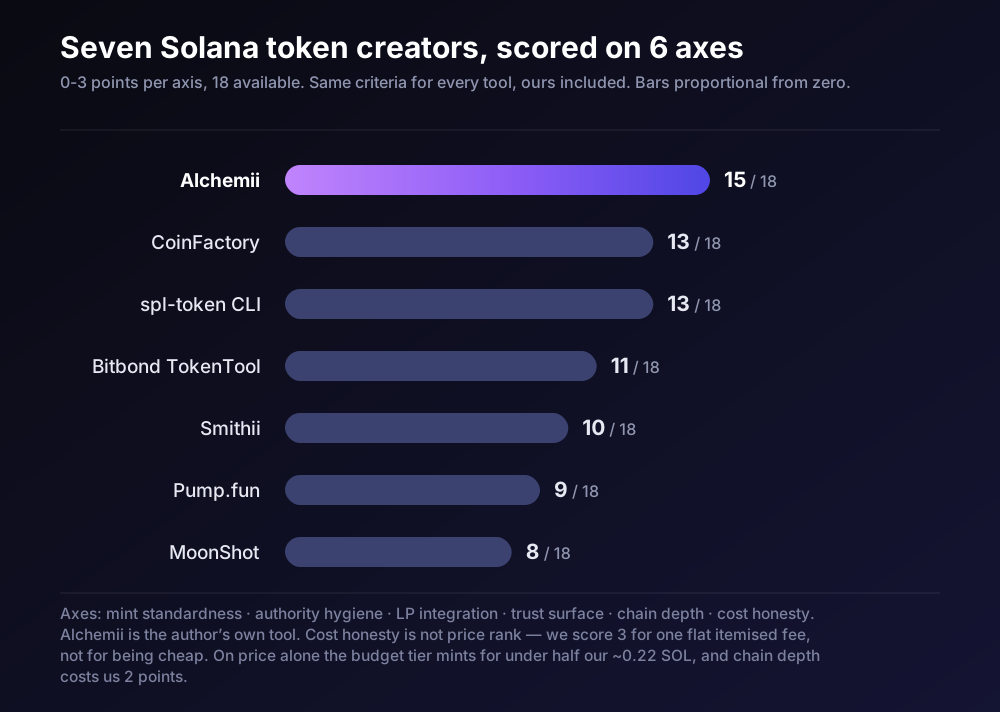
Price, control, trust signals, and chain support are what matter, but "control" and "trust" are too coarse to compare with — so we split them into six axes worth 0–3 points each. Scored by hand, same criteria for every tool, ours included.
| Tool | Mint standardness | Authority hygiene | LP integration | Trust surface | Chain depth | Cost honesty | Total /18 |
|---|---|---|---|---|---|---|---|
| Alchemii | 3 | 3 | 3 | 2 | 1 | 3 | 15 |
| CoinFactory | 3 | 2 | 2 | 2 | 3 | 1 | 13 |
spl-token CLI | 3 | 3 | 0 | 3 | 1 | 3 | 13 |
| Bitbond TokenTool | 3 | 2 | 1 | 3 | 2 | 0 | 11 |
| Smithii | 2 | 2 | 2 | 1 | 2 | 1 | 10 |
| Pump.fun | 2 | 1 | 3 | 2 | 0 | 1 | 9 |
| MoonShot | 2 | 1 | 3 | 1 | 0 | 1 | 8 |
Where the points went: mint standardness (canonical token program?) and authority hygiene (does the token end up with no mint authority and no freeze authority, settled inside the same flow rather than as a later errand?) are where curve platforms lose — pre-graduation tokens behave non-standardly and the curve program holds the authorities, which is the model working as designed, not malice. LP integration (create and burn a pool without leaving the product) is the CLI's zero. Trust surface (team, code, support channel findable) is Bitbond's win as a regulated German B2B company and Smithii's loss: no team page we could verify. Chain depth goes to CoinFactory's Solana + 7 EVM chains. Cost honesty punishes Pump.fun's 1%-buy-plus-1%-sell tax behind a free creation, and Bitbond's subscription that bills you in months you ship nothing.
Cost honesty is not price rank, and it's worth being explicit about that because the two get conflated constantly. Alchemii scores 3 for charging one flat fee, once, itemized before you connect a wallet, with no cut of trading volume — not for being cheap. On price alone we don't win: the budget tier mints for less than half our ~0.22 SOL all-in.
So what does the 15 actually rest on? Four things the scorecard can defend line by line: your token is born with no freeze authority and the optional mint-authority revoke rides in the same signed transaction, so the hygiene step can't be forgotten later; LP burn and LP removal live in the same product rather than as a separate paid errand; the fee is flat and one-time, with zero cut of trading volume for the life of the token; and the two configuration choices that bundling protects are the two our 50,000-launch dataset ties hardest to survival — revoked mint authority correlates with 4.2× the 24-hour survival rate, LP burned at minute zero with 5.7×.
Alchemii's 15 is a scope decision, not perfection: the two points dropped on chain depth are real, and if your audience trades on EVM chains the rubric is telling you to pick something else. Nothing in that 15 is a claim to be the cheapest tool here.
The ranking
🥇 Alchemii (us)
- Pricing: ~0.22 SOL all-in for a standard launch, charged once. A typical memecoin that also revokes mint authority lands near 0.32 SOL; with every optional extra switched on it tops out around 0.52 SOL. Each extra is a flat amount shown on the form before you connect a wallet. No subscription. No platform fee on volume.
- Control: Full. You set decimals, supply, fee tier, quote token, and whether to revoke mint authority.
- Trust signals: Your mint is initialized with no freeze authority at all — there is nothing to revoke later, and nobody can ever freeze a holder's balance. Mint-authority revocation is an optional toggle that executes inside the same signed transaction as the mint itself. Update authority stays with your wallet, so your metadata remains yours to fix. Plus a dedicated LP burn tool and LP removal tool in the same product.
- Support: Solana + BSC (BEP20 + PancakeSwap).
- Best for: Serious launches where you have ≥5 SOL of liquidity to seed and want full control over price, fee tier, and authority decisions.
- Honest weakness: No bonding-curve mode for zero-capital experiments. If you don't have SOL to seed liquidity, Pump.fun is the right choice. And we're mid-table on price, not bottom — the budget tier undercuts us.
🥈 Pump.fun
pump.fun
- Pricing: ~0.02 SOL upfront, but platform takes 1.25% on every buy and sell.
- Control: Minimal. Fixed bonding curve, fixed graduation threshold (~411 SOL of market cap, about $41K at ~$100/SOL), fixed post-graduation PumpSwap fee schedule.
- Trust signals: Strong. Automatic LP burn at graduation. No insider allocation possible (platform-enforced).
- Support: Solana only.
- Best for: Zero-capital fair-launch experimentation. Pure memecoin culture plays where the meme matters more than the tokenomics.
- Honest weakness: No control. The 1.25% platform fee adds up at scale. Pre-graduation tokens are invisible on DexScreener / Jupiter.
🥉 MoonShot
moonshot.cc
- Pricing: Variable, similar to Pump.fun.
- Control: Bonding curve, similar to Pump.fun.
- Trust signals: Platform-managed.
- Support: Solana.
- Best for: Pump.fun-style launches with mobile-first UX. MoonShot built a strong mobile app for launch + trading flow.
- Honest weakness: Newer than Pump.fun, smaller discovery network. The bonding curve mechanics give you the same lack of control.
Smithii
smithii.io
- Pricing: 0.3 SOL flat, inclusive of on-chain cost, plus 0.1 SOL for each authority revocation. A mint with all three revoked runs 0.6 SOL.
- Control: Full, similar to Alchemii.
- Trust signals: Standard authority revoke.
- Support: Solana, plus a few EVM chains. ~370 URLs across 11 locales — the widest language coverage in the category.
- Best for: Non-English-first teams. If your community speaks Spanish, Portuguese, or Korean, Smithii's localized landings out-convert anything English-only.
- Honest weakness: Costs about 0.1 SOL more than Alchemii on a bare mint, and the gap widens by 0.1 SOL for every authority you revoke. Less integrated with Raydium LP burn flow, and the team behind it is hard to identify.
The rest of the field
Those four get the long treatment because they're what most Solana launches use. Three more win a case none of the four do:
- CoinFactory — the widest net in the category: ~300 URLs across Solana + 7 EVM chains and 4 languages. The only tool here that ships the same token on BSC, Base, and Solana from one dashboard. The Solana service fee is 0.2 SOL with revoke-update included — level with ours — and per-chain depth is thin (their Solana landing page is about 179 words). The full head-to-head is in Alchemii vs CoinFactory.
spl-tokenCLI — free, open source, the reference implementation every UI wraps: install Rust and the CLI, runcreate-token,create-account,mint, pay only network fees. The catch is that it doesn't write Metaplex metadata, so your token reads "Unknown Token" with no logo everywhere until you drive the Metaplex SDK yourself. Worth it if you're building tooling, not for a one-off launch.- Bitbond TokenTool — EVM-first and compliance-leaning: €99–499/month plus gas, with vesting, KYC hooks, and ERC-1400 paths. Wrong tool for a sub-1-SOL memecoin, right for a regulated B2B token program.
Smaller names — imintify, Guarda, TokenTool, Bullx, WalletGuide — fold into one of the three modes. imintify bundles a memecoin website template with the mint; Guarda is a wallet with token creation grafted on and no Solana support at all. Score them on the same six axes and the picture resolves fast.
How the costs actually compare
Cost is the easiest dimension to quantify objectively. Below is total upfront cost (token creation only — not seed liquidity) across the four mainstream no-code platforms, in SOL.
The headline number is misleading without context. A Pump.fun token doing 1,000 SOL of cumulative trading volume costs its holders about 25 SOL in platform fees — 1.25% on the buy plus 1.25% on the sell — while a flat fee stays where it started. Break-even against a ~0.22 SOL flat fee lands at roughly 9 SOL of cumulative volume (0.21 ÷ 0.02), which any token with momentum crosses in its first few minutes and most dead-on-arrival tokens never reach at all. The right comparison isn't upfront cost vs upfront cost; it's "total cost over the token's lifetime" vs your launch budget.
Where that money actually goes
Part of every quoted price isn't the tool's at all. Every Solana token pays the same on-chain floor first:
| Line item | Cost |
|---|---|
| Mint account rent | 0.00146 SOL |
| Metaplex metadata rent | 0.00562 SOL |
| Metaplex protocol fee (non-refundable) | 0.01000 SOL |
| Associated Token Account rent | 0.00204 SOL |
| Signature + base network fee | ~0.000005 SOL |
| Protocol floor (unavoidable, any tool) | ~0.0191 SOL |
Everything above ~0.0191 SOL is service fee: take any tool's quoted price, subtract the floor, and the remainder is what the UI costs you — except Pump.fun, which charges zero upfront and 1.25% of every trade instead. Any tool advertising a total below the floor is either skipping the Metaplex call — your token then won't render in Phantom — or not counting rent. Across the hosted tools that spread runs from about 0.05 SOL to 0.4 SOL (Orion Tools, whose freeze revocation is mandatory); once you're seeding 5 SOL of liquidity, even the top of that range is under a tenth of launch spend. Itemized version: cost to create a Solana token, or the Solana token cost calculator.
What each tool unlocks (feature coverage)
Toggle: explore by what you optimize for
Different launchers have different priorities. Switch the view below to see which tool fits each goal best.
Decision matrix
| Your situation | Use |
|---|---|
| I have $0 to spend, just want to test a meme | Pump.fun |
| I have 5+ SOL and want full control | Alchemii |
| I want no freeze authority, mint authority revoked, and LP burned without leaving one product | Alchemii |
| I want a mobile-first bonding-curve UX | MoonShot |
| I'm launching a BSC token | Alchemii (BEP20 supported) |
| I'm shipping the same token on Solana and 3 EVM chains | CoinFactory (Solana + 7 EVM chains) |
| My community isn't English-speaking | Smithii (11 locales) |
| I need vesting, KYC hooks, or regulated EVM issuance | Bitbond TokenTool |
| I'm a developer who wants Solana CLI / open SDK | Build with spl-token CLI directly |
| I'm launching a utility token with planned tokenomics | Alchemii (you control everything) or build custom |
Two things no comparison table catches
Token-2022 and Raydium still don't get along. In March I tried to ship a Token-2022 mint with a 2% transfer fee through our own tool. Mint and metadata went through fine; Raydium AMM v4 then refused the LP pair because its pool program doesn't accept the transfer-fee extension. We ended up on Orca Whirlpools, which supports it on the CLMM side. If you want transfer fees, plan for Orca — no tool here handles that nuance well. See SPL Token vs Token-2022.
Phantom's ~30-day indexing window. A new mint can be live on Solscan and swappable on Jupiter while Phantom still shows it as an unknown token for weeks — re-confirmed on a mainnet launch in April. No creator solves this; structurally, none can. Knowing the window exists saves a day of debugging a bug that isn't yours.
Red flags, and the 90-second check that catches them
Regardless of which platform you use, watch for:
- Hidden subscription fees. A legitimate Solana token creator charges per token, not a monthly subscription. SPL token creation is a one-time on-chain action — if a tool wants ongoing payments, ask why.
- Custodial flows. A real creator never holds your SOL, never asks for your seed phrase, and only signs transactions you initiate from your wallet. If a "creator" asks you to send SOL to their address first, walk away.
- Authority revocation that "isn't supported." Authority revocation is a basic SPL feature. If a tool doesn't support it, that's either lazy engineering or active rug-pull design.
Whatever the marketing says, the output settles it. Three checks on Solscan, about 90 seconds, and they work on every tool here including the CLI:
- Token program. The owning program must read
TokenkegQfeZyiNwAJbNbGKPFXCWuBvf9Ss623VQ5DA— orTokenzQdBNbLqP5VEhdkAS6EPFLC1PHnBqCXEpPxuEbif you deliberately picked Token-2022 for transfer fees. Anything else means the tool shipped a custom program. Walk away. - Mint and freeze authority. Both should read
nullby the time you're done: mint authority after you revoke it, freeze authority either revoked or — as with our own mints — never set at initialization, so there is nothing to revoke. If either points at an address you don't recognize, the tool kept control. Highest-signal check on the list. - Decimals and silhouette. 6 for USDC parity, 9 for general utility, 5 for BONK-style optics — pick deliberately instead of defaulting to 9, then compare against BONK: 100T supply, 5 decimals, both authorities null. Full flow: how to verify a Solana token.
Quick Facts (verifiable specifications)
| Specification | Value | Source |
|---|---|---|
| Alchemii token creation cost | ~0.22 SOL all-in, one time (~0.32 SOL with a mint revoke) | alchemii.io |
| Alchemii ceiling with every optional extra | up to ~0.52 SOL | alchemii.io |
| Freeze authority on Alchemii mints | Never set — null from initialization | Article body |
| Hosted service-fee range in the category | ~0.05-0.4 SOL | Vendor sites, checked 2026-08-01 |
| 24-hour survival lift, mint authority revoked | 4.2× | 50,000-launch dataset |
| 24-hour survival lift, LP burned at minute zero | 5.7× | 50,000-launch dataset |
| Pump.fun upfront cost | 0 SOL to create (~0.02 SOL first buy) | pump.fun |
| Pump.fun per-trade fee | 1.25% on every buy/sell (2.5% round trip) | Article body |
| Pump.fun break-even vs a 0.22 SOL flat fee | ~9 SOL of cumulative volume | Article body |
| Pump.fun graduation threshold | ~411 SOL of market cap (about $41K at ~$100/SOL) | Article body |
| Smithii cost | 0.3 SOL flat, +0.1 SOL per authority revoke | Article body |
| CoinFactory cost (Solana) | 0.2 SOL service fee, revoke-update included | Article body |
| Solana protocol floor (any tool) | ~0.0191 SOL | Solana rent docs |
spl-token CLI cost | Network fees only (~0.0191 SOL, CLI plus a one-shot Metaplex metadata script) | solana-program-library |
| Tools scored on the 6-axis rubric | 7 (top: Alchemii, 15/18) | Article body |
| Alchemii chain support | Solana + BSC (BEP20 + PancakeSwap) | Article body |
| Pump.fun chain support | Solana only | Article body |
| Underlying SPL Token Program | TokenkegQfeZyiNwAJbNbGKPFXCWuBvf9Ss623VQ5DA | spl.solana.com/token |
| Standard token authority slots | mint, freeze, update | SPL Token spec |
| KYC required for vanilla SPL creation | None of the major creators require it | Article body |
Limitations of this guide (what it doesn't cover)
This guide compares the leading no-code Solana token creators, makers, and coin generators in 2026. It does not cover:
- Every smaller / regional tool. They fall into the three modes above — score them on the same six axes for a comparable number.
- NFT minting. Every tool here ships fungible tokens; NFTs are a different stack.
- Custom on-chain programs. Bespoke transfer logic, vesting, or governance baked into the token means writing Rust against the SPL Token Program or using Token-2022 extensions. See SPL Token vs Token-2022.
- Paid "fast-track listing" services. Scams regardless of the tool you used; CoinGecko / CMC submissions are always free.
- Post-launch marketing. The tool you pick doesn't decide whether your launch survives — distribution does. See How to market a Solana memecoin.
- CEX listings, and other chains. Binance and Coinbase are a different process entirely. And this ranking scores tools on their Solana output — CoinFactory, Smithii, Guarda, and Bitbond all score differently on Ethereum, Base, Arbitrum, or Polygon.
- Securities / regulatory classification. Whether your token configuration is a security in your jurisdiction is a legal question, not a tooling one.
Sources & references
- Pump.fun official docs — fee structure and bonding curve (pump.fun/docs) — Pump.fun1.25% curve fee (0.95% protocol + 0.30% creator), 0.015 SOL graduation fee, PumpSwap fees tiered from 1.25% to 0.30%.
- Alchemii Solana Token Creator — AlchemiiLive pricing page and tool flow — ~0.22 SOL all-in for a standard launch, flat and one-time, no per-volume cut.
- MoonShot launch platform (moonshot.cc) — MoonShotPump.fun-style bonding curve with mobile-first UX.
- Smithii Token Tools (smithii.io) — SmithiiDirect creator with multi-EVM-chain support — 0.3 SOL flat, inclusive of on-chain cost, plus 0.1 SOL per authority revocation.
- SPL Token Program — Solana LabsUnderlying token program — every Solana token shares this same on-chain program.
- SPL Token Program source — GitHub / Solana ProgramOpen-source SPL Token Program implementation.
- Metaplex Token Metadata — Metaplex FoundationThe metadata standard that gives your token a name, symbol, and image.
- Solana Foundation — Solana FoundationSolana Foundation does not endorse third-party token creators — base SPL Token Program is open infrastructure.
- Raydium AMM v4 docs — RaydiumAMM and pool creation reference for direct-launch flows.
- Pump.fun token volume dashboard (cryptokoryo) — Dune AnalyticsPublic dashboard tracking Pump.fun token launches, graduations, and platform fees.
- DexScreener — Solana new pairs — DexScreenerReal-time view of newly created Solana pools across all major DEXes.
- Birdeye Solana data — BirdeyeSolana token discovery and analytics; cross-references token launch data.
- Bitquery Solana DEX API — BitqueryProgrammatic access to swap data on Pump.fun, Raydium, PumpSwap, used to verify per-tool volumes.
- Jupiter strict list (jup-ag/token-list) — Jupiter / GitHubVerification standard most Solana wallets reference — required for non-spam display.
- Phantom wallet — token display rules — PhantomHow Phantom decides what tokens to show, hide as spam, or mark verified.
- Pump.fun program account on Solscan — SolscanOn-chain Pump.fun program — every token launch and graduation is visible here.
- BSC BEP20 token standard — Binance AcademyBEP20 spec for cross-chain token comparison; relevant if evaluating multi-chain tools.
- PancakeSwap V2 docs — PancakeSwapBSC AMM that pairs with Alchemii's BEP20 token launches.
- TRUMP token launch — Pump.fun event — SolscanHighest-revenue Pump.fun launch event — Jan 2025.
- Token-2022 program (token extensions) — Solana LabsNewer token program with extensions — relevant for projects that need transfer fees.
- Solscan SPL Token explorer — SolscanVerify any Solana token's mint authority, freeze authority, supply, holders, and metadata.
- Helius RPC pricing benchmarks — HeliusSolana RPC infrastructure pricing — informs the cost-side analysis of running a token creator.
If you want the same seven tools as a side-by-side table rather than a written review, the Solana token creator comparison lays out cost, authority handling and LP control per tool on one screen.
FAQ
What is the best Solana token creator in 2026?
There is no single best — the right tool depends on your seed-liquidity budget. Alchemii suits direct full-control launches with at least 5 SOL of seed liquidity: ~0.22 SOL all-in, charged once, with no cut of trading volume and LP-burn and authority-revoke tooling in the same flow. Pump.fun is best for zero-capital fair-launch experiments, accepting 1.25% on every buy and every sell. MoonShot mirrors Pump.fun with mobile-first UX. Smithii covers Solana plus a few EVM chains at 0.3 SOL flat plus 0.1 SOL per authority revocation.
Which Solana token creator is the cheapest?
Cheapest of the hosted no-code tools is the budget tier, where service fees start around 0.05 SOL. Alchemii is ~0.22 SOL all-in, level with CoinFactory and below Smithii (0.3 SOL flat) and Orion Tools (0.4 SOL effective). Pump.fun is cheapest upfront at 0 SOL to create (~0.02 SOL first buy) but takes 1.25% on every buy and every sell, so it passes a 0.22 SOL flat fee at roughly 9 SOL of cumulative volume. Cheapest of all is the spl-token CLI plus a one-shot Metaplex metadata script at the bare ~0.0191 SOL protocol floor — the CLI alone writes no metadata, so without that script your token renders as "Unknown Token".
Do I need 5 SOL to use Alchemii?
No. Around 0.22 SOL covers a standard token creation, all-in — budget ~0.32 SOL if you also revoke mint authority. The 5+ SOL recommendation is for seed liquidity in your Raydium pool — without enough liquidity, sniper bots collapse the chart in minutes. If you cannot seed 5 SOL of liquidity, Pump.fun's bonding curve is the better fit because it handles liquidity until graduation.
Can I use Pump.fun without being a Solana developer?
Yes. Pump.fun and Alchemii are both no-code: you fill in a form (name, ticker, image, description) and the platform handles the SPL Token Program calls. Neither requires Rust, Anchor, or any Solana CLI tooling. Pump.fun additionally hides the liquidity step entirely.
Are these Solana token creators safe to use?
All four platforms ranked above (Alchemii, Pump.fun, MoonShot, Smithii) operate transparently on-chain with verifiable smart contracts. The risk is not the tool — it is launch configuration. In our 50,000-launch dataset, tokens with mint authority revoked survived their first 24 hours at 4.2× the rate of tokens that kept it, and tokens with LP burned at minute zero at 5.7×. Use whichever tool you like, but make sure the token ends up with no mint authority and no freeze authority, and burn the LP at minute zero.
What is the difference between an online token creator and the spl-token CLI?
An online creator (token maker, coin generator, coin factory — same category, different names) is a hosted UI that builds the transaction for you and charges roughly 0.05–0.4 SOL on top of the on-chain floor, depending on the tool. The offline path is the spl-token CLI plus a one-shot Metaplex metadata script, run on your own machine for nothing beyond the ~0.0191 SOL floor. The mint is identical either way; the fee buys the Metaplex metadata call and authority toggles you would otherwise write yourself — roughly 50 lines of TypeScript.
Have a Solana token to launch? Try Alchemii's Token Creator — or the no-code Solana token maker walkthrough if you want the short version of what the tool does before connecting a wallet, or the Solana meme coin creator for a memecoin with all the right defaults pre-set. Want zero-capital memecoin testing? Pump.fun is the right call. Need the full launch playbook? Read the Solana memecoin launch checklist.
Is the cheapest tool always best?
No — and we'd say that either way, since we aren't the cheapest. The whole flat-fee field spans about 0.05 to 0.4 SOL, a 0.35 SOL spread against a total launch budget of roughly 5-25 SOL. Optimize for fit (control vs zero-capital, LP and revoke tooling, support for your chain) first; on a 5 SOL launch the fee difference between the cheapest and priciest tool here is a rounding error next to a badly sized pool.
Do any of these tools require KYC?
None of the major Solana token creators require KYC for token creation itself. Some integrated launchpads (presale platforms) do. For pure creation, no.
Which is the most "official" / Solana Foundation endorsed?
None. The Solana Foundation doesn't endorse third-party token creators. The base SPL Token Program is open infrastructure — anyone can build a UI for it. Don't assume endorsement matters.
Will my token's success depend on which creator I used?
No. The token is just SPL bytes on-chain. Once created, the source platform is irrelevant. Success depends on the meme, the community, and the launch execution.
Is Alchemii open source?
The frontend is closed-source for now. The on-chain operations (SPL token creation, Metaplex metadata, authority revocation) are standard Solana primitives — not custom contracts. You can verify what we do by inspecting the transaction Alchemii submits before signing.
Create your Solana token
Choose your token name, symbol, supply and image. Review the authority options and creation fee, then confirm the transaction in your wallet. Liquidity is a separate step.
Related Topics
More guides to Solana token creation, authorities, liquidity, and meme coin launches.
Alchemii vs CoinFactory App: Solana Compared (2026)
Alchemii vs coinfactory.app for Solana: both 0.2 SOL base, but CoinFactory bills 0.1 SOL per authority revoke. 7 axes scored, bias disclosed, checked 2026-08-04
LaunchTool.io Review: Legit, But Fading (2026)
We read launchtool.io's bundle and traced its fee wallet on 2026-08-04. Real tool, 0.082 SOL base fee, but not one paid launch through it in July 2026.
Best Solana Launchpad 2026: 8 Platforms Compared
8 Solana launchpads scored on cost, authority control, LP integration and trust signals. alchemii finishes first at 30/35. Full per-axis table.
Alchemii vs Smithii: Honest Comparison (2026)
Alchemii vs smithii.io for Solana tokens — pricing, post-launch tooling, LP burn, multi-chain reach, scored on 7 axes. Bias disclosed.
What Is the FOMO App? Legit Check, Fees & Chains (2026)
Is the FOMO app legit? fomo.family explained: six chains, official Solana fee tiers, and why a 4 USDC order costs 2.5%, not 0.5%. Checked September 12, 2026.
Best Robinhood Coin Creator in 2026: Only Two Pass Verification
We checked every Robinhood Chain coin creator we could find against the chain itself. Two are verifiable — here are their live fees, tools and trade-offs.