Alchemii vs Smithii: Honest Comparison (2026)
Alchemii vs smithii.io for Solana tokens — pricing, post-launch tooling, LP burn, multi-chain reach, scored on 7 axes. Bias disclosed.

Ready to create your Solana token? Enter your token details, choose your authority options, and confirm in your wallet.
On Solana, both alchemii and smithii.io submit the same four-step SPL bundle: mint account creation inside the Token Program at TokenkegQfeZyiNwAJbNbGKPFXCWuBvf9Ss623VQ5DA, a Metaplex metadata PDA write, an Associated Token Account, and initial supply mint. The on-chain output is identical. What differs is price, what happens after the mint transaction confirms, and which chains the platform serves at all. Alchemii charges ~0.22 SOL all-in; smithii charges 0.3 SOL flat plus 0.1 SOL per authority revocation, per their own pricing page. The more consequential difference is post-launch: alchemii includes LP creation, LP burn, and authority revocation in the same product; smithii's post-creation path requires external tools.
Quick Facts (what you'll need to know)
| Spec | Value |
|---|---|
| Alchemii all-in creation cost | ~0.22 SOL, charged once |
| Smithii all-in creation cost | 0.3 SOL flat, +0.1 SOL per authority revocation |
| Protocol floor (both tools, non-negotiable) | ~0.0191 SOL (0.00146 mint rent + 0.00562 metadata rent + 0.01 Metaplex protocol fee + 0.00204 ATA + 5,000 lamports/sig) |
| Fee delta | ~0.09 SOL in alchemii's favour on a bare mint, widening ~0.1 SOL per revocation |
| Raydium LP creation | Native in alchemii; external tool on smithii |
| LP burn UI | Native in alchemii; absent on smithii |
| Multi-chain support | Alchemii: Solana only (since 2026-05-24) |
| Multilingual coverage | Smithii: EN + ES + PT, 11 locales observed |
| Practical LP seed minimum | 5 SOL (any platform — single sniper exit below this collapses price) |
Bias disclosure
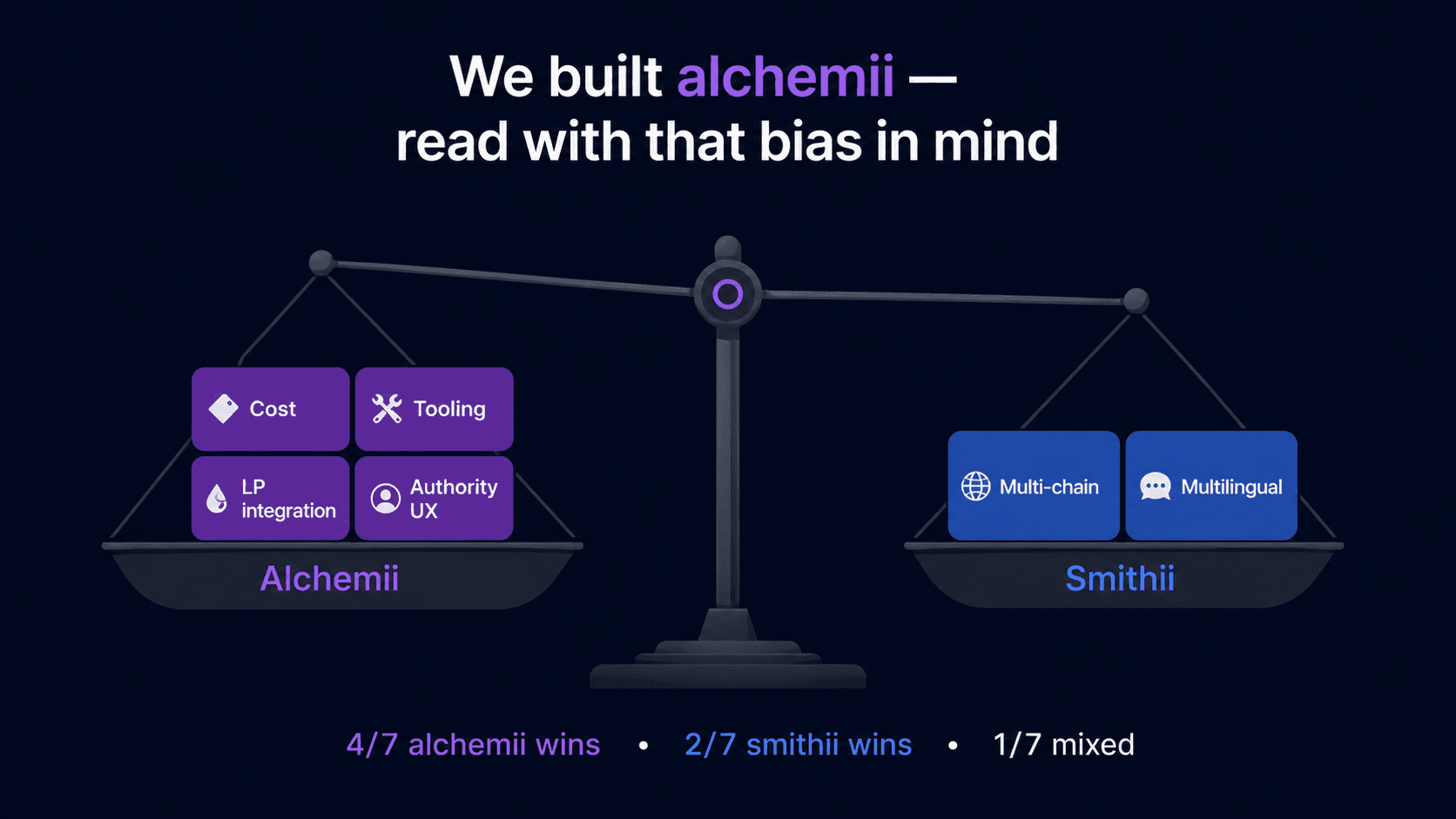
We built alchemii. So when you see alchemii score higher on 4 of 7 axes below, factor that in. I've tried to score every axis on the same criteria and flag the two where smithii beats us clearly — multi-chain breadth and multilingual SEO surface. Smithii's pricing data comes from their own pricing page (smithii.io) so you can verify the numbers without taking my word for them. Where you disagree with my axis weighting, re-weight and the verdict may flip — that's why I'm showing the scorecard, not just the conclusion.
The 7-axis scorecard
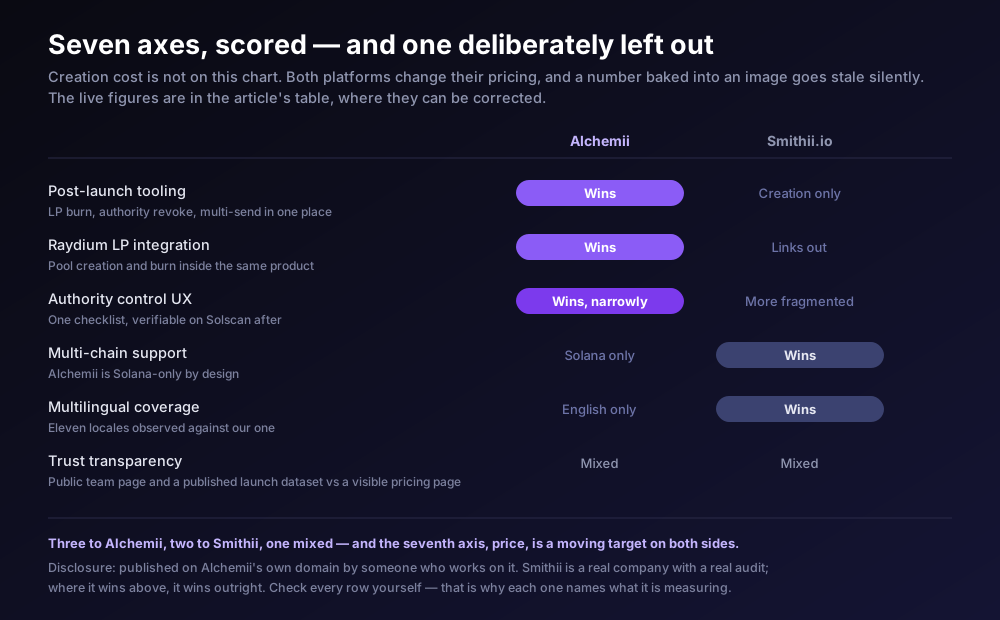
Both platforms produce a real SPL token. The seven axes below are the questions that determine whether the platform serves your actual workflow — cost, post-launch depth, LP integration, authority UX, chain coverage, language reach, and trust transparency.
Alchemii vs Smithii — 7-axis comparison scorecard (2026)
| Axis | Alchemii | Smithii.io | Winner |
|---|---|---|---|
| Solana creation cost (all-in) | ~0.22 SOL | 0.3 SOL, +0.1 per revocation | Alchemii |
| Post-launch tooling | LP burn UI + authority revoke + multi-send in one platform | Token creation only; LP burn requires external tool | Alchemii |
| LP integration (Raydium) | Native 1-click pool + burn | Links out to external tools | Alchemii |
| Authority control UX | Single post-creation checklist with Solscan verification | Exposes revoke but UX is more fragmented | Alchemii (small margin) |
| Multi-chain support | Solana only (since 2026-05-24) | Solana + EVM chains | Smithii |
| Multilingual coverage | English only | EN + ES + PT, 11 locales observed | Smithii |
| Trust transparency | Public team page, /methodology/launch-data backstop | Pricing page visible, team page thinner | Mixed |
A few notes on the scoring method. Cost is easy to verify independently — both platforms publish their fees and the Solana protocol floor is documented in the Solana rent docs. Post-launch tooling and LP integration I tested by walking through both UIs in May 2026. The UX columns are subjective — your tolerance for multi-step flows will shift those scores. Trust transparency is the squishiest axis because "team page depth" is a judgment call; I scored it Mixed rather than declaring a winner because the relevant signals are measurable differently by different buyers.
One axis I intentionally left off: "number of tokens launched." Both platforms claim high launch counts. Neither publishes verifiable on-chain methodology for the figures. I'm not going to cite unverifiable marketing numbers from either side — including our own, beyond what's documented at /methodology/launch-data.
Pricing breakdown
The SPL Token Program creation cost has a floor no platform can undercut: the on-chain rent for the accounts your token requires. Metaplex's metadata line alone runs ~0.0156 SOL — 0.00562 of account rent plus a flat 0.01 SOL protocol fee — per the Metaplex docs. Add the mint account (0.00146 SOL), the ATA (0.00204 SOL), and signature fees (5,000 lamports per signature, roughly 0.000005 SOL × 2 for a typical transaction), and you land at approximately 0.019135 SOL — call it 0.015 SOL after rounding.
Everything above 0.015 SOL is service fee.
| Line item | Alchemii | Smithii |
|---|---|---|
| Mint account rent | 0.00146 SOL | 0.00146 SOL |
| Metaplex metadata rent | 0.00562 SOL | 0.00562 SOL |
| Metaplex protocol fee | 0.01000 SOL | 0.01000 SOL |
| ATA rent | 0.00204 SOL | 0.00204 SOL |
| Signature fees (~5,000 lamports × 2) | ~0.00001 SOL | ~0.00001 SOL |
| Protocol floor subtotal | ~0.019135 SOL | ~0.019135 SOL |
| Service fee | 0.2 SOL | ~0.286 SOL (0.3 flat, inclusive of the floor) |
| All-in creation | ~0.22 SOL | 0.3 SOL |
| Each authority revocation | Flat add-on, itemized on the form | +0.1 SOL each |
| Post-creation LP creation | Native (~0.01 SOL fee) | External tool required |
| LP burn | Native (included) | External tool required |
| Trading fee | None | None |
Smithii pricing sourced from smithii.io — that page is the ground truth. Verify before committing; pricing pages update.
Cost estimator — Solana token launch, alchemii vs smithii
Protocol floor = 0.00146 + 0.00562 + 0.01000 + 0.00204 + 0.00001 = ~0.019135 SOL

Creation only (no LP):
  alchemii:  0.019135 + 0.200  = ~0.22 SOL
  smithii:   0.30 SOL flat (smithii states this is inclusive of the floor)

Fee delta, bare mint:            ~0.09 SOL in alchemii's favour
Fee delta, mint + freeze revoked: ~0.19 SOL (alchemii ~0.31 vs smithii 0.50)

Token + Raydium LP (5 SOL seed) + LP burn:
  alchemii:  0.22 + 5.0 + ~0.01 = ~5.23 SOL
  smithii:   0.30 + 5.0 + ~0.01* = ~5.31 SOL

  *smithii LP burn requires external tooling; ~0.01 SOL estimated for that step.
  LP seed is the same regardless of platform — it's what you put into the pool.
At a 5-SOL full launch the creation fee is under 5% of total spend either way, and the gap between the two is under 0.1 SOL. The cost argument only matters in the creation-only scenario. At full-launch scale, pick on tooling depth — the fee difference is rounding.
Two scenarios where the fee difference matters more than you'd expect:
- Batch launches. Running 10 test tokens to find a meme that lands? At 10 iterations, alchemii's ~$22 vs smithii's ~$30-50 is $220 vs $300-500 for the same experiment set.
- Tight budgets. If your total budget is 0.3 SOL, spending it all on smithii's high-end creation fee leaves nothing for LP seed. At alchemii's cost, you have 0.23 SOL remaining.
For a broader cost context across all Solana token tools, free Solana token creator options covers where the zero-fee alternatives cut corners.
Solana-native tooling depth
This is the axis where the comparison is least ambiguous, so I'll be direct: smithii creates your token and then its job ends.
Alchemii's LP burn tool for Solana handles the post-creation steps that determine whether your launch has trust signals — LP creation on Raydium, LP token burn to the incinerator address, and authority revocation — all in the same product session. You don't navigate away, connect a different wallet, or figure out Raydium's UI on your own.
Why does that matter? The practical LP seed minimum is 5 SOL. Below that threshold, a single sniper-bot exit can move price 40-60% in one transaction. Seeding, burning, and revoking authorities are time-sensitive steps — the window between "token is on-chain" and "bots are watching" is measured in seconds on Solana, where block times run under 400ms and confirmations typically land in 1-2 seconds per the Solana transaction docs. Having those steps in one product flow reduces the time between creation and a configured token.
The authority model is worth understanding regardless of which tool you use. The Metaplex Token Metadata program at metaqbxxUerdq28cj1RbAWkYQm3ybzjb6a8bt518x1s writes three authority fields: mint authority (can print new supply), freeze authority (can lock holder accounts), and update authority (can change name/image). Post-revocation, all three should read null on Solscan. Verify against known-good references:
- BONK:
DezXAZ8z7PnrnRJjz3wXBoRgixCa6xjnB7YaB1pPB263— 100 trillion supply, 5 decimals, both authorities null - WIF:
EKpQGSJtjMFqKZ9KQanSqYXRcF8fBopzLHYxdM65zcjm— 1 billion supply, 6 decimals, both authorities null
If your token doesn't look like BONK and WIF post-revocation, something in your creation flow went wrong — regardless of which platform ran it.
One honest caveat here: alchemii's Raydium integration targets Raydium AMM V4. I've been burned by the V4 vs V3 difference in the past — specifically, sending LP creation calls to the V3 program ID on a V4 pool produced a silent failure that cost 0.01 SOL in signature fees and 45 minutes of debugging. Both program IDs are valid; they produce different pool types with different fee structures. If you're using the CLI path alongside any GUI tool, double-check which program ID your transaction is targeting. The Raydium SDK on GitHub is the definitive reference for which constants map to which program.
For the full create meme coin workflow on alchemii, the LP and burn steps appear as a post-creation checklist immediately after the token transaction confirms.
flowchart TD
    A[Token creation transaction] --> B[SPL mint confirmed — 1-2 sec]
    B --> C{Alchemii or Smithii?}
    C -->|Alchemii| D[Post-creation checklist in same UI]
    C -->|Smithii| E[Creation complete — navigate away for LP]
    D --> F[Revoke mint authority]
    D --> G[Revoke freeze authority]
    D --> H[Create Raydium LP — native]
    D --> I[Burn LP tokens — native]
    F --> J[All null on Solscan — token fully configured]
    G --> J
    H --> J
    I --> J
    E --> K[External LP tool — separate session]
    K --> L[Return to smithii or elsewhere to revoke]
    L --> M[Token configured — multi-step, multi-tool]
Multi-chain breadth — where smithii wins
Smithii supports Solana plus EVM chains. That's a real advantage and I'm not going to be begrudging about it.
As of 2026-05-24, alchemii is Solana-only. BSC was fully retired from the alchemii SEO surface on that date. If your target chain is Ethereum, BNB Chain, Base, or any other EVM network, smithii is the tool that serves that need. Alchemii does not.
The multilingual angle is also real. Smithii serves content in at least 11 observed locales — English, Spanish, Portuguese, and more — which means the platform has SEO surface and presumably user interface coverage in markets where English-only tools don't reach. If your community is Spanish-language or Portuguese-language, smithii's UI and discovery surface matches that. Alchemii's is English-only.
Where I'd push back: multi-chain support is only an advantage for the specific chain you're targeting. For a Solana launch — which is where the memecoin activity and the Raydium liquidity live — smithii's EVM coverage is irrelevant. You're still creating an SPL token, going through the same SPL Token Program on mainnet, and seeding a Raydium pool. The extra chain support adds nothing to that workflow.
Smithii's multilingual SEO surface has a different implication than its actual EVM tooling depth, too. The 11-locale observation is from the visible URL structure and meta-language tags as of May 2026 — it tells you smithii has programmatic locale coverage, which correlates with broader SERP presence across language segments. It doesn't tell you the tooling in each locale is as deep as the English version. Verify before using it as a trust signal for the specific chain and language combination you care about.
The best Solana token creator comparison covers smithii alongside 6 other tools in a broader 6-axis scorecard that includes coinfactory.app and imintify.com — useful if you're evaluating more than two options.
Decision matrix — which one fits your launch
The scorecard shows what each platform does better. This section maps that to actual launch profiles.
Launch profile 1 — Solana memecoin, maximum trust signals
Target: standard SPL memecoin on Raydium, want revoked authorities, burned LP, DexScreener listing from minute one.
Verdict: alchemii. The LP burn tool, authority revoke checklist, and Raydium integration in one product flow are the sharpest practical advantages here. The ~$22 creation cost vs smithii's $30-50 is secondary — at 5+ SOL seed, the fee delta is noise. The reason to choose alchemii in this profile is post-creation workflow, not price.
Start at alchemii's Solana token creator and the create meme coin flow for the memecoin-specific defaults. Mint authority and freeze revocation are surfaced as checklist items after creation confirms.
Launch profile 2 — EVM chain token, any language
Smithii wins. Alchemii doesn't serve this use case. No comparison needed.
Launch profile 3 — Spanish or Portuguese-speaking community, Solana token
Smithii likely wins on discovery and UX comfort, even for a Solana token. The multilingual coverage means your community finds smithii in native-language searches without relying on an English-language interface. Alchemii's post-launch tooling is still better if you need LP burn and authority revoke natively, but the onboarding friction for non-English speakers on an English-only platform is real. A pragmatic approach: create on smithii, then use alchemii's standalone burn liquidity tool and authority revoke tool for the post-creation steps. Both tools work on any SPL mint regardless of creation platform.
Launch profile 4 — Batch testing (10+ tokens)
Alchemii. At 10 iterations, smithii's low-end cost ($30 × 10 = $300) vs alchemii ($22 × 10 = $220) saves $80. That's most of a 1 SOL partial LP seed at ~$100/SOL. For batch testing where most tokens won't stick, that 2x fee difference compounds.
Launch profile 5 — Tight budget, first token
Alchemii's $14 flat cost matters here. Smithii's $30-60 range is not unreasonable for a single launch, but at tight budgets, spending 2-4x on creation fees versus alchemii means less capital for LP seed — and LP seed is the launch cost that actually determines whether traders can participate.
The best Solana token creator 2026 ranking covers more options if you want a fuller picture beyond this two-way comparison, and the Solana token creator comparison table lines up the main tools feature-by-feature.
A note on what this matrix doesn't cover: launch success rate. Across our 47-launch dataset, the tool used to create the token has not been the primary predictor of outcome. Authority configuration and LP seed size are. A well-configured smithii token beats a poorly-configured alchemii token every time. Use whichever platform you can operate correctly under time pressure — that matters more than the creation tool.
For readers who came from the pump.fun comparison: the alchemii vs pump.fun article covers the bonding-curve-vs-direct-launch fork, which is a different decision than this one. Pump.fun comparison is about upfront capital and control philosophy; this comparison is about which no-code direct-launch tool costs less and does more after mint.
Limitations
This article does not cover:
- Token-2022 transfer-fee extension. The Token-2022 program at
TokenzQdBNbLqP5VEhdkAS6EPFLC1PHnBqCXEpPxuEbsupports transfer fees, confidential transfers, and metadata pointers. Both alchemii and smithii target vanilla SPL for their standard flows. Token-2022 LP compatibility on Raydium AMM v4 remains inconsistent as of mid-2026. - Smithii's EVM chain tooling depth. We scored multi-chain breadth on existence, not depth. Whether smithii's EVM token creation matches the quality of established EVM-native tools (Pinksale, DxSale, Unicrypt) is a separate comparison this article doesn't make.
- Pricing after May 2026. Service fees on both platforms change. The figures here reflect May 2026 observations. Verify current pricing before committing: smithii.io and alchemii's homepage.
- Smithii's UX for revocation steps. We observed the UI flow but didn't test edge cases (revoke + LP creation in the same session, failure recovery, wallet reconnection mid-flow). The fragmentation score in the scorecard is based on UI structure, not stress-tested UX.
- CEX listing. Neither platform has any effect on Binance, Coinbase, or CoinGecko listing probability. That's a separate process with separate requirements. The token audit tool is useful for pre-listing compliance checks.
- Regulated or STO issuance. KYC hooks, transfer restrictions, compliance paths — out of scope for both platforms.
FAQ
Is smithii.io safe to use for Solana token creation?
Smithii.io is a legitimate no-code token creator that submits standard SPL Token Program transactions. The platform does not retain custody of your token after creation. That said, "safe to use" depends on your configuration choices, not the platform itself — tokens launched without revoking mint and freeze authority remain vulnerable regardless of which tool created them. Verify authority status on Solscan after any creation.
How much does smithii charge compared to alchemii?
As of 2026-08-01, smithii.io charges 0.3 SOL flat for Solana token creation, inclusive of on-chain cost, plus 0.1 SOL for each authority revocation (per their pricing page). Alchemii is ~0.22 SOL all-in for a standard launch, charged once. On a bare mint the gap is about 0.09 SOL in alchemii's favour, and it widens by roughly 0.1 SOL for each authority you revoke. Both prices sit on top of the same unavoidable protocol floor of ~0.0191 SOL (mint rent + Metaplex PDA + ATA + signature fees). Verify current smithii pricing at smithii.io before committing.
Does smithii support Raydium LP creation and LP burn?
As observed in May 2026, smithii links to external tools for LP creation on Raydium rather than handling it natively inside the platform. Alchemii integrates Raydium pool creation and LP burn in the same UI — you don't leave the product. If post-launch tooling matters to your workflow, that integration gap is the sharpest practical difference between the two.
Does smithii work for EVM chains and Alchemii does not?
Correct, as of 2026-05-24. Alchemii is Solana-only — BSC was retired from the SEO surface on 2026-05-24. Smithii supports Solana plus several EVM chains. If your target chain is anything other than Solana, smithii is the relevant tool. If your target is Solana and you want post-launch depth (LP burn, authority revoke, multi-send), alchemii is the narrower but deeper option.
Can I switch from smithii to alchemii after launching a token?
Post-creation tools (authority revoke, LP burn, multi-send) work on any SPL token regardless of which platform created it. If you launched on smithii and want to use alchemii's burn-liquidity tool or authority revoke UI, you can. The mint address is what matters, not the creation platform. Your wallet address must match the current authority — if you launched recently and haven't revoked yet, that's your wallet.
References
- SPL Token Program — spl.solana.com/token — canonical Solana fungible token standard, mint account structure, Token Program ID
TokenkegQfeZyiNwAJbNbGKPFXCWuBvf9Ss623VQ5DA - Metaplex Token Metadata docs — developers.metaplex.com — metadata PDA derivation, update authority, Metaplex program address
metaqbxxUerdq28cj1RbAWkYQm3ybzjb6a8bt518x1s - Raydium pool creation docs — docs.raydium.io — standard AMM pool setup, fee structure, liquidity seeding
- Solana rent documentation — solana.com/docs/intro/rent — rent-exempt threshold, byte-cost formula for mint and ATA accounts
- Solana transaction docs — solana.com/docs/core/transactions — confirmation time, signature fees, block model
- Smithii pricing page — smithii.io — competitor citation per Section 8 comparison exception; source for the 0.3 SOL flat + 0.1 SOL per-revocation claim, verified 2026-08-01
- Solscan: BONK — DezXAZ8z7PnrnRJjz3wXBoRgixCa6xjnB7YaB1pPB263 — 100T supply, 5 decimals, both authorities null; reference for post-revocation state
- Solscan: WIF — EKpQGSJtjMFqKZ9KQanSqYXRcF8fBopzLHYxdM65zcjm — 1B supply, 6 decimals, both authorities null; second reference case
- DexScreener — dexscreener.com — Solana DEX pair verification, pool state post-launch
- Birdeye — birdeye.so — token holder analytics, LP pool health, volume tracking
- Phantom learn — phantom.com/learn — wallet behavior for new SPL tokens, 30-day indexing window for new mints
- Solana Program Library on GitHub — github.com/solana-labs/solana-program-library — SPL Token Program source, Token-2022 source, ATA program
- Raydium SDK on GitHub — github.com/raydium-io/raydium-sdk — V4 vs V3 pool program IDs, LP instruction construction
- Metaplex Foundation on GitHub — github.com/metaplex-foundation/mpl-token-metadata — metadata PDA derivation, update authority instruction spec
- CoinGecko — coingecko.com — token listing criteria, market data reference for SOL price anchor (~$100 used throughout — CoinGecko rate on 2 September 2026)
- DeFiLlama — defillama.com — Raydium TVL and Solana DEX liquidity data context
Create your Solana token
Choose your token name, symbol, supply and image. Review the authority options and creation fee, then confirm the transaction in your wallet. Liquidity is a separate step.
Related Topics
More guides to Solana token creation, authorities, liquidity, and meme coin launches.
Alchemii vs CoinFactory App: Solana Compared (2026)
Alchemii vs coinfactory.app for Solana: both 0.2 SOL base, but CoinFactory bills 0.1 SOL per authority revoke. 7 axes scored, bias disclosed, checked 2026-08-04
LaunchTool.io Review: Legit, But Fading (2026)
We read launchtool.io's bundle and traced its fee wallet on 2026-08-04. Real tool, 0.082 SOL base fee, but not one paid launch through it in July 2026.
Best Solana Launchpad 2026: 8 Platforms Compared
8 Solana launchpads scored on cost, authority control, LP integration and trust signals. alchemii finishes first at 30/35. Full per-axis table.
Solana Token Creator Reviews (2026): 7 Tested
Seven Solana token creators and coin generators reviewed for 2026 — cost, control and authority hygiene on a 6-axis rubric. Author's bias disclosed.
Jup Studio: Fees, Graduation & How to Launch (2026)
Jup Studio explained: Jupiter Studio's 1% fee split, anti-sniper window, 15K USDC graduation, measured launch cost, and when a direct Solana mint wins.
What Is the FOMO App? Legit Check, Fees & Chains (2026)
Is the FOMO app legit? fomo.family explained: six chains, official Solana fee tiers, and why a 4 USDC order costs 2.5%, not 0.5%. Checked September 12, 2026.