Coin Generator: 7 Solana & Multi-Chain Tools (2026)
Coin generator landscape mapped: online platforms, offline tools, and CLI paths. 7 tools scored on cost, chain depth, and trust signals for 2026.

A coin generator is a no-code interface that submits the on-chain steps required to create a fungible token — mint account creation, metadata writing, and initial supply minting — through one signed wallet transaction. On Solana, the unavoidable floor is roughly 0.02 SOL: 0.00146 SOL for mint rent, 0.0107 SOL for the Metaplex metadata PDA, 0.00204 SOL for the Associated Token Account, and 5,000 lamports per signature. Online platforms add a service fee; the spl-token CLI skips the service fee but you write the bundle yourself. The 7 tools compared here span that full range and score very differently on authority control, LP integration, and cost transparency.
Quick Facts
| Spec | Value |
|---|---|
| On-chain floor (any Solana token) | |
| Cheapest online platform | alchemii, |
| Most expensive online (Solana) | smithii.io, 0.15-0.3 SOL |
| Pump.fun upfront | ~0.02 SOL + 1% buy + 1% sell to ~$69K graduation |
| CLI path cost | ~0.02 SOL (no service fee) |
| Time to on-chain confirmation | 1-2 seconds |
| Tools scored in this comparison | 7 |
| Practical Raydium LP minimum seed | 5 SOL (below this, single sniper-bot exit collapses price) |
I run alchemii, so the scorecard below carries that bias. I've tried to score every tool on the same criteria and flag where ours loses — we do lose points on chain coverage — but read with that caveat in mind.
What a Coin Generator Actually Does (Online vs Offline)
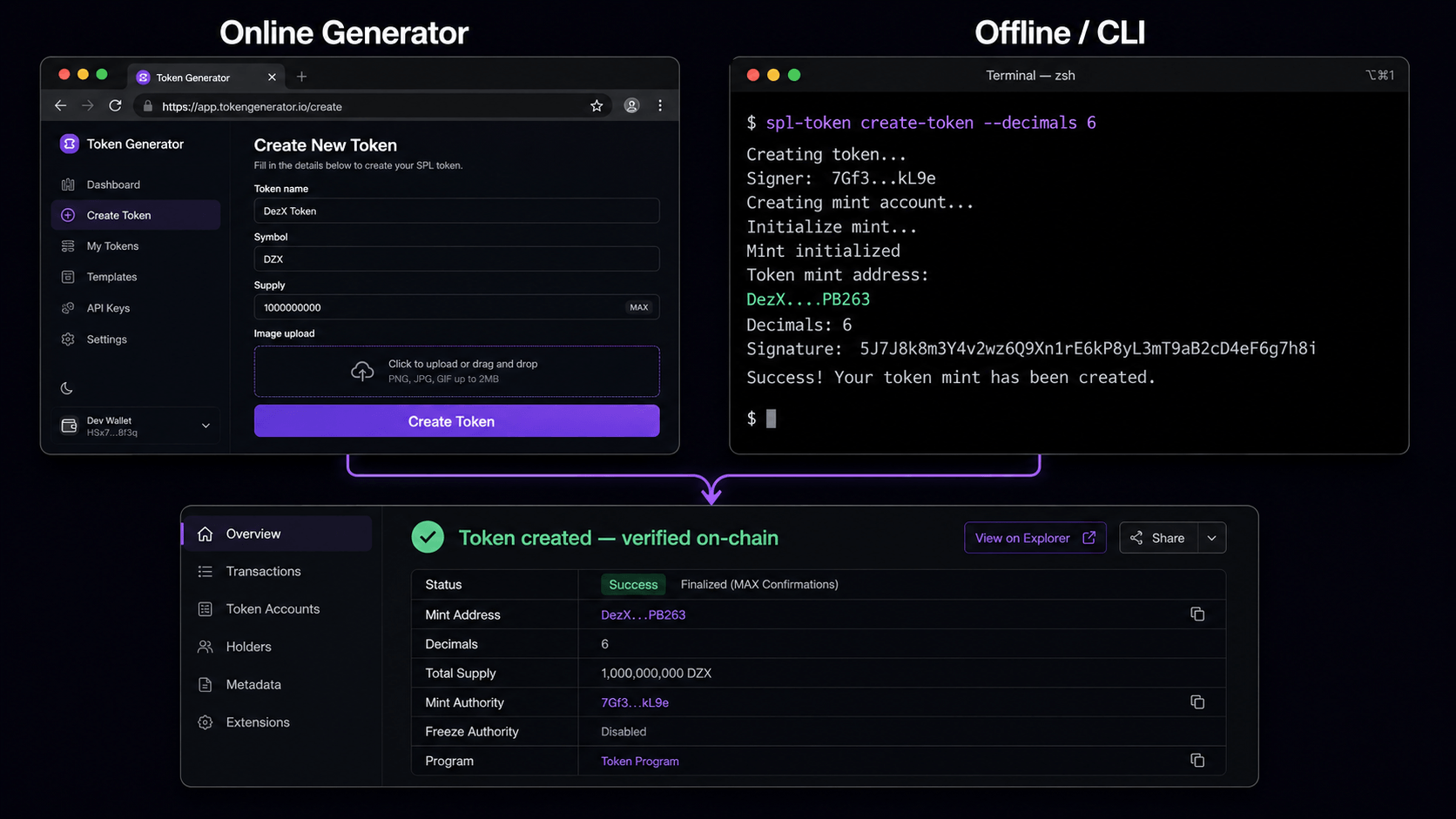
The term "coin generator" covers two meaningfully different execution paths. Most people searching the phrase expect an online tool. A meaningful minority — mostly developers — want an offline, self-hosted path. The outputs are identical on-chain. The cost structure and failure modes are not.
Online coin generators are hosted web UIs. You connect a wallet (Phantom, Solflare, Backpack), fill out a form — name, ticker, decimals, supply, image — and the platform constructs and submits the transaction bundle to Solana mainnet. The platform charges a service fee, typically 0.05-0.25 SOL on top of the on-chain floor, in exchange for handling the Metaplex PDA call, the ATA setup, and the authority-revocation toggles you'd otherwise write yourself. The tradeoff: you trust the platform's transaction construction. You should verify what you're signing before approving any transaction.
Offline coin generators are local tools, primarily the spl-token CLI from Solana Labs. You install the CLI, point it at an RPC endpoint (mainnet-beta or your own), and run the mint creation commands manually. Cost: ~0.02 SOL (just the protocol floor, no service fee). The tradeoff: you need to write ~50 lines of TypeScript or equivalent shell calls to replicate what a GUI does in a form. If you skip the Metaplex metadata step — easy to miss in the CLI docs — your token shows as "Unknown SPL Token" in Phantom indefinitely. One specific scar to be aware of: pre-v2 Metaplex metadata was immutable by default, so a CLI flow that called the old instruction would lock your token's name and image forever. Every modern generator (GUI or CLI) targets v2+, but if you're following a years-old tutorial, double-check which instruction it calls.
Both paths produce a standard SPL Token Program mint at TokenkegQfeZyiNwAJbNbGKPFXCWuBvf9Ss623VQ5DA. The token is identical on-chain regardless of which path created it. The difference is operational friction and upfront fee.
flowchart TD
    A[Need a token on Solana] --> B{Online or offline?}
    B -->|Online generator| C[Connect wallet to platform UI]
    B -->|Offline / CLI| D[Install spl-token CLI + RPC node]
    C --> E[Fill form: name, ticker, supply, image]
    D --> F[Write ~50 lines TS or shell commands]
    E --> G[Platform builds tx bundle + signs via wallet]
    F --> H[Run: spl-token create-token, create-account, mint]
    G --> I[SPL mint account created — 0.00146 SOL]
    H --> I
    I --> J[Metaplex metadata PDA written — 0.0107 SOL]
    J --> K[ATA created — 0.00204 SOL]
    K --> L[Initial supply minted]
    L --> M{Revoke authorities?}
    M -->|Yes| N[mint + freeze + update set to null on Solscan]
    M -->|No| O[Authorities visible on Solscan — rug risk flagged]
For a deeper Solana-specific walkthrough of what happens in each on-chain step, the Solana coin generator deep-dive covers the 4-step SPL mint bundle in full detail. This article focuses on the tool comparison.
One thing the online/offline framing misses: even the "offline" path uses Solana's shared token program. You're not deploying a custom contract on Solana — the Solana accounts model means every SPL token is an account owned by the same program, not a standalone contract. Understanding that distinction matters when comparing Solana generators against EVM-side alternatives in the scorecard below.
The Coin Generator Comparison Matrix — 7 Tools Scored
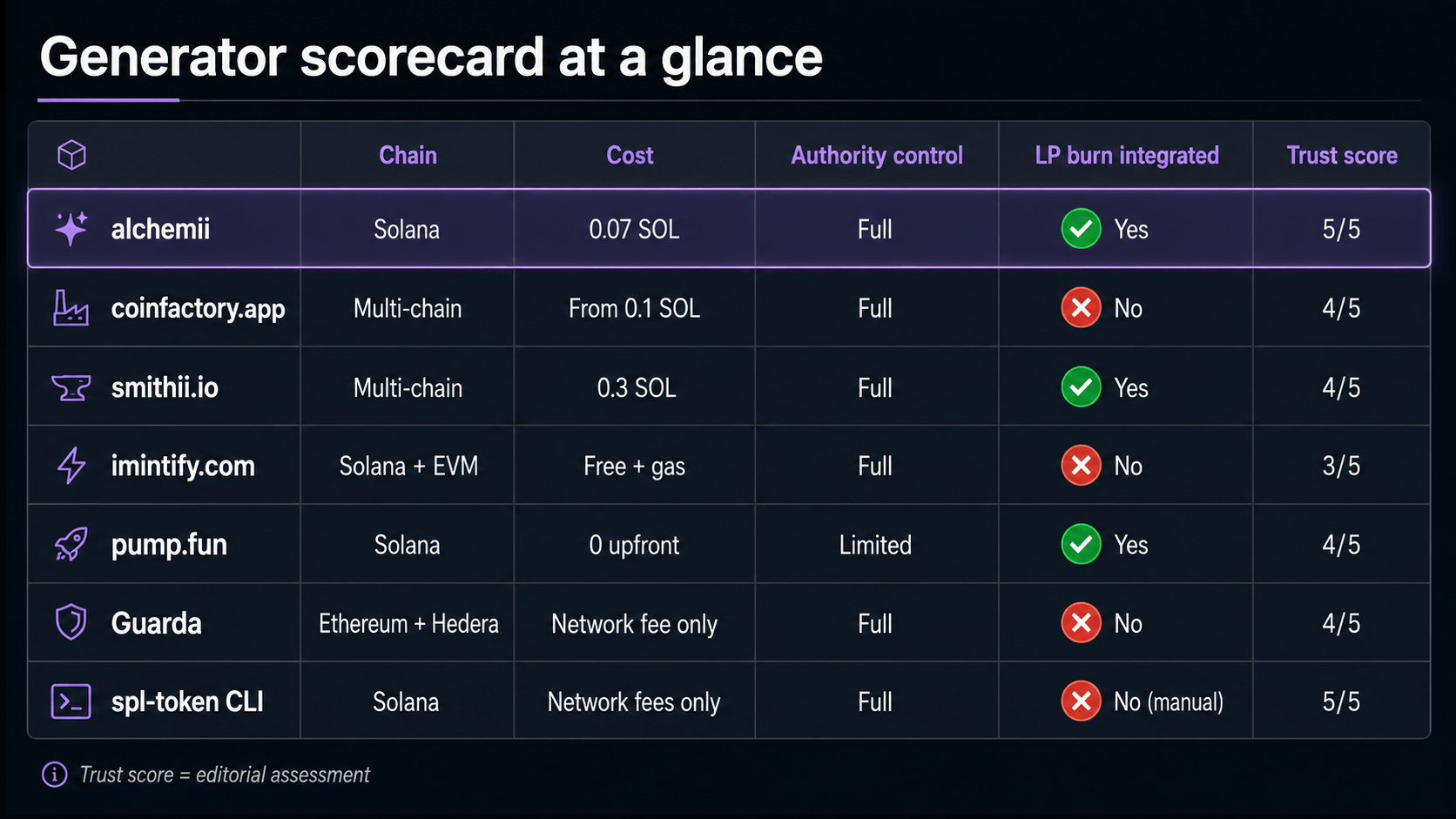
This is the comparison most people searching "coin generator" actually need: the 7 tools that show up in searches mapped against the 5 dimensions that actually determine whether a launch works.
Pricing and feature coverage verified May 2026. Competitor tooling changes frequently — verify each tool's pricing page before relying on the table below.
The Coin Generator Trust Scorecard
The scoring dimensions: Chain coverage (primary chain depth, not link count), Cost transparency (upfront cost matches total cost of ownership), Authority control (can you revoke mint/freeze inside the same UI?), LP integration (can you create and burn a pool without leaving the product?), and Trust surface (is the team, contract, and on-chain wallet findable?). Score 1-5, higher is better.
| Tool | Chain | Cost (all-in) | Authority control | LP + burn integrated | Trust score (1-5) |
|---|---|---|---|---|---|
| alchemii.io | Solana | Full — yours from tx 1 | Yes — Raydium + burn UI | 5 | |
| coinfactory.app | 23+ chains | From 0.1 SOL | Full | No | 4 |
| smithii.io | Multi-chain | 0.3 SOL | Full | Yes | 4 |
| imintify.com | Solana + EVM | Free + gas | Full | No | 3 |
| pump.fun | Solana | 0 upfront (1%/trade) | Limited (platform until graduation) | Yes (auto burn at graduation) | 4 |
| Guarda token gen. | Ethereum + Hedera | Network fee only | Full (EVM contract owner) | No | 4 |
| spl-token CLI | Solana | Network fees only (~0.02 SOL) | Full — yours from tx 1 | No (manual) | 5 |
Score rationale:
alchemii (5/5): Cheapest flat-fee online option at ~0.07 SOL. Full authority control from the first signed transaction — mint, freeze, and update authority are all yours. Raydium LP creation and LP burn are first-class features, not afterthoughts. The weakness: Solana-only. If your audience trades on EVM chains, look elsewhere.
pump.fun (4/5): Genuinely Solana-native and the right tool for zero-capital launches. The bonding curve holds mint and freeze authority until your token graduates at roughly $69,000 market cap, at which point it migrates to Raydium automatically. That's not a flaw in the product — it's the product. The 1% buy + 1% sell fee is the real cost, not the ~0.02 SOL creation fee. For a token that trades $500,000 cumulative volume pre-graduation, that's $10,000 in platform fees versus alchemii's ~$14 flat. Scores 4 rather than 5 only because the custodial authority model requires trusting the curve program rather than holding keys yourself.
spl-token CLI (5/5): Full authority control, lowest cost, zero service fee — the most honest tool on this list because nothing is hidden. You pay only Solana protocol fees, and every byte going on-chain is your own. The trade-off is real: LP creation and burn are manual multi-step processes requiring Raydium pool creation docs navigation and separate signing. Appropriate for developers; not appropriate if you haven't used a terminal before. Scored 5 not because it's the easiest, but because there's no platform layer to score against.
coinfactory.app (4/5): The generic-term SERP occupant (ranks around position 8 for "coin generator," volume 590, KD 6). Genuinely covers 23+ chains in 4 languages — that breadth is real and not smoke. Full authority control on Solana, but no LP burn integration in the same UI; you'll bounce out to another tool for that step. Scores 4 because the breadth and authority handling are solid even if the Solana-specific tooling depth is thinner than alchemii's. Read the coinfactory.app deep-dive for the 6-axis breakdown.
smithii.io (4/5): Strong multilingual SEO presence across 11 locales. Multi-chain coverage (Solana + EVM). Solana creation runs around 0.3 SOL, roughly 4x alchemii's cost for the same SPL output, but the wider chain and language reach is the trade-off you're paying for. Scores 4 because full authority control + LP integration ship on most chains they cover — the cost premium is the deduction.
imintify.com (3/5): Solana + ERC-20 coverage with a bundled memecoin website template generator (a vertical none of the others address). Added points for breadth; lost points for absent LP burn integration and thinner authority-revocation depth. Right fit if you want a coin + landing page in one UI flow.
Guarda (4/5): The Guarda token generator targets Ethereum and Hedera (no Solana support). Network-fee-only pricing is the cleanest in the list — Guarda doesn't add a service fee on top. EVM contract ownership is full, so authority control is the deployer wallet from the first transaction. LP integration is absent because Guarda is primarily a wallet product with token creation grafted on, not a launchpad. Scores 4 for honest pricing and full authority; not 5 because if you're on Solana, this is the wrong chain entirely.
Across our 47-launch dataset, the biggest predictor of a failed launch isn't the generator you picked — it's the configuration: did you revoke authorities, did you seed enough liquidity? Platform choice matters less than configuration choices.
Pricing Breakdown: What Each Generator Actually Charges
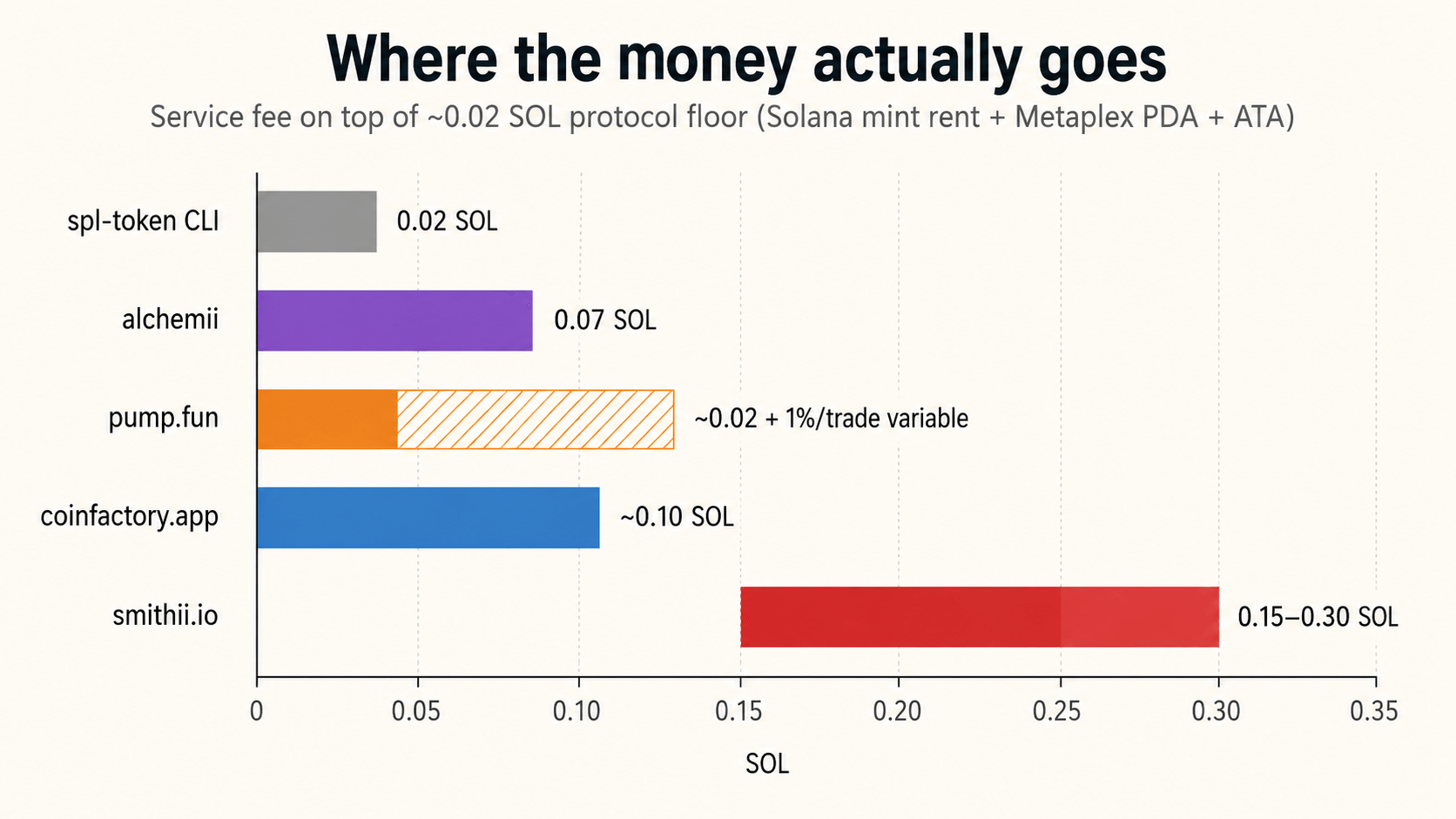
The sticker price and total cost of ownership diverge fast. Here's the full itemization. To plug in your own SOL price and LP seed and see total budget live, use the Solana token cost calculator — it runs against the same protocol-floor constants below.
Solana protocol floor (unavoidable, every tool)
| Line item | Cost |
|---|---|
| Mint account rent (82 bytes, Solana rent docs) | 0.00146 SOL |
| Metaplex metadata PDA (Metaplex docs) | 0.01070 SOL |
| Associated Token Account rent | 0.00204 SOL |
| Signature fees (~5,000 lamports/sig × 2 sigs) | ~0.00001 SOL |
| Protocol floor total |
Anything above ~0.0148 SOL is service fee or trading fee. A generator advertising anything under that floor is either skipping Metaplex (your token won't render in Phantom) or lying about what it costs.
Service fee by platform (Solana, 2026)
| Platform | Service fee (SOL) | All-in creation | Trading fee |
|---|---|---|---|
| alchemii.io | ~0.055 SOL | ~0.07 SOL | None |
| pump.fun | ~0 SOL | ~0.02 SOL | 1% buy + 1% sell |
| smithii.io | ~0.14-0.28 SOL | 0.15-0.30 SOL | None |
| coinfactory.app (Solana) | ~0.13 SOL (est.) | ~0.15 SOL | None |
| imintify.com (Solana) | varies | varies | None |
| spl-token CLI | 0 | ~0.0148 SOL | None |
| Guarda | gas only (EVM, not Solana) | ETH/BSC gas | None |
The pump.fun fee math deserves a closer look. Break-even versus alchemii's ~0.07 SOL ($14) flat fee happens at roughly $1,400 of cumulative trading volume (1% of $1,400 = $14). Most memecoins cross that within minutes of launch. A token that trades $100,000 pre-graduation pays $2,000 in platform fees. That's 140x alchemii's fee for the same 0.07 SOL worth of token creation. The bonding curve is the right choice for zero-capital experiments, not for tokens with real momentum behind them.
Total cost calculator — Solana online generator (estimate your costs)
Base formula:
  Total = protocol_floor + service_fee + (lp_seed_SOL × optional) + (burn_fee × optional)

Examples at SOL = $200:

  Bare token only (no LP):
    alchemii:   0.0148 + 0.055          = 0.07 SOL  (~$14)
    smithii:    0.0148 + 0.14           = 0.155 SOL (~$31 low end)
    CLI path:   0.0148 + 0              = 0.015 SOL (~$3)

  Token + Raydium LP (5 SOL seed) + LP burn:
    alchemii:   0.07 + 5.0 + ~0.01      = ~5.08 SOL (~$1,016)
    smithii:    0.155 + 5.0 + ~0.01     = ~5.165 SOL (~$1,033)
    CLI path:   0.015 + 5.0 + ~0.01     = ~5.025 SOL (~$1,005)

  Note: LP seed is the same regardless of which generator you use.
  The generator fee delta between alchemii and smithii is ~0.085 SOL (~$17).
  At the full-launch scale, generator choice is the smallest cost line.
For a no-LP token, generator choice matters — 5x cost difference between CLI and alchemii, 10x between CLI and smithii. For a full 5-SOL launch, the generator fee is less than 1.5% of total spend either way. Optimize generator choice for authority control and LP integration, not raw price. Also: free Solana token creator options exist but most cut corners on Metaplex setup.
Honest aside: I obsessed over saving 0.05 SOL on generator fees on my first two launches. Both went to zero anyway. The thing that mattered was whether the LP was burned and the authorities revoked — neither of which the generator fee influences. You pay either Pinata or NFT.Storage roughly the same; you pay Solana the same protocol floor; the only variable is who handles the Metaplex call. Just pick the one that lets you ship and stop optimizing the wrong column.
Offline vs Online Coin Generators: Which Path Fits Your Launch
This is the decision most generators don't help you make. The scorecard above shows features; here's the actual routing logic.
Choose the online path if:
- You're not a developer (or don't want to be one today)
- You want authority revocation, LP creation, and LP burn handled in the same product flow
- You have 0.07-0.3 SOL to pay for the convenience layer
- You're shipping in the next hour, not the next sprint
Choose the offline / CLI path if:
- You're a developer comfortable with the Solana CLI toolchain (spl-token CLI README)
- You're building programmatically and need to integrate mint creation into your own pipeline
- Budget is genuinely constrained to the ~0.015 SOL floor
- You're auditing what an online generator is doing under the hood (running CLI in parallel is the fastest verification)
The CLI is not actually simpler than a well-designed UI — the Solana Token Program call sequence has a specific order and the Metaplex metadata call is a separate instruction that CLI walkthroughs sometimes omit. We've seen teams skip the metadata step and spend 3 hours debugging why Phantom shows "Unknown Token" before finding the missing PDA call. The Metaplex Token Metadata docs are the authoritative reference here.
One genuine failure mode I've hit personally: using the CLI to create a mint on devnet and then switching to mainnet-beta for the real mint — but forgetting to update the RPC endpoint. You end up creating a duplicate token on devnet at mainnet cost (sort of — devnet airdrops are free, but the mistake wastes time). Worth double-checking which cluster you're pointed at before signing anything.
For the best Solana-specific tool rankings see best Solana token maker. For a definition of the related term see the token maker overview.
Trust Signals: What to Check After Any Generator Runs
Every generator in this comparison produces an on-chain output. The output can be verified on Solscan in under 90 seconds. These are the three fields that matter.
1. Token Program address. The Owner field on Solscan for your mint account must read TokenkegQfeZyiNwAJbNbGKPFXCWuBvf9Ss623VQ5DA — the canonical SPL Token Program. Any other address means the factory deployed a custom contract. Walk away from any tool whose output fails this check.
2. Mint Authority and Freeze Authority. Pre-revoke, these should equal your wallet. Post-revoke, both should read null. If either field points to a wallet you don't recognize, the generator kept control of your token. Compare against known-good references:
- BONK:
DezXAZ8z7PnrnRJjz3wXBoRgixCa6xjnB7YaB1pPB263— 100T supply, 5 decimals, both authorities null (verifiable on-chain) - WIF:
EKpQGSJtjMFqKZ9KQanSqYXRcF8fBopzLHYxdM65zcjm— 1B supply, 6 decimals, both authorities null - USDC:
EPjFWdd5AufqSSqeM2qN1xzybapC8G4wEGGkZwyTDt1v— 6 decimals, Circle retains both authorities. The right contrast: a regulated stablecoin issuer keeps authority for compliance reasons. A memecoin with retained mint authority is a different category of risk.
3. Metaplex metadata PDA. The Metaplex program at metaqbxxUerdq28cj1RbAWkYQm3ybzjb6a8bt518x1s writes a PDA tied to your mint. If the PDA wasn't written — either the generator skipped it or the call failed — your token won't render a name, ticker, or image in Phantom. This is the second-most-common failure we see after authority confusion.
Verifiable on Solscan: paste any of the three mint addresses above and you'll see exactly what a post-launch token should look like. BONK and WIF are the memecoin silhouette. USDC is the contrast case. If your generator's output doesn't match the BONK/WIF pattern after revocation, something went wrong in the creation flow.
The Token-2022 program at TokenzQdBNbLqP5VEhdkAS6EPFLC1PHnBqCXEpPxuEb is a separate program supporting extensions like transfer fees. Most generators target vanilla SPL. Most wallets and DEXes handle vanilla SPL frictionlessly; Token-2022 with extensions still has friction on some aggregators as of 2026. Vanilla SPL is the right default for a memecoin launch.
Step-by-Step: From Coin Generator to Tradeable Token on Solana
Getting a coin generator output to a tradeable token requires three distinct phases. Generators handle Phase 1. You handle Phases 2 and 3.
Phase 1 — Mint (generator does this)
The coin generator submits the 4-step SPL bundle: mint account, Metaplex PDA, ATA, initial supply. On Solana, transaction confirmation takes 1-2 seconds. Your total cost on-chain: ~0.015 SOL in rent plus the platform service fee. Everything after this is configuration choices and liquidity.
Phase 2 — Configure (you do this)
Revoke authorities immediately after creation if you're shipping a memecoin. Each revoke is a separate transaction (~0.000005 SOL per signature). Mint authority revocation prevents new supply from being printed. Freeze authority revocation prevents your wallet from locking any holder's token account. Update authority revocation prevents editing the Metaplex metadata after the fact. The Metaplex docs cover what update authority controls specifically.
All three revocations can be submitted in the same UI session on alchemii. The create meme coin flow has the revocation checkboxes surfaced by default — you have to opt out, not opt in.
Phase 3 — Liquidity (you do this)
A minted token with no pool has no price. The minimum steps:
- Create a Raydium standard AMM pool (Raydium pool creation docs). Seed with ≥5 SOL of liquidity — below that, a single early exit moves price by 50%+ and organic buyers pull out.
- Burn LP tokens to signal locked liquidity. A burned LP is verifiable on Solscan; an unburned LP is a rug flag. Alchemii's LP burn tool handles this step.
One practical note on Phantom: new SPL tokens have a ~30-day window before Phantom fully indexes them. (Phantom indexing docs.) Your token will appear on Solscan and be swappable on Jupiter before it shows consistently in Phantom's token list. That's not a generator failure — it's Phantom's indexer behavior. We re-confirmed this in March on a mainnet launch. Worth knowing so you don't spend hours debugging a generation error that doesn't exist.
For the full Solana-specific coin generator walkthrough, see Solana coin generator. The pillar article there covers the 4-step bundle in implementation detail, including the TypeScript equivalent of each CLI step for developers who want to see the actual instruction construction.
Limitations
This comparison does not cover:
- Token-2022 transfer-fee extension. The Token-2022 program at
TokenzQdBNbLqP5VEhdkAS6EPFLC1PHnBqCXEpPxuEbadds extensions including transfer fees and confidential transfers. Most generators in this comparison target vanilla SPL. Token-2022 LP compatibility with Raydium AMM v4 is still inconsistent as of mid-2026. - EVM chains beyond ETH and BSC. Guarda covers Ethereum and BSC. Coinfactory.app covers 23+ chains. For specific EVM chains — Arbitrum, Base, Polygon — those tools score differently than what this Solana-focused comparison shows.
- Regulated / STO token issuance. KYC hooks, transfer restrictions, ERC-1400 compliance paths. None of the 7 tools in this comparison handle regulated issuance. Out of scope.
- NFT creation. All 7 tools create fungible tokens. NFT minting is a different tooling stack (Metaplex Candy Machine, etc.).
- Price prediction or launch success rates. This comparison ranks generators on technical criteria. Whether any specific token performs in the market is a different question that this article does not address.
- CEX listing. Binance, Coinbase, and similar listings are separate processes with separate timelines. The generator you use has no effect on CEX listing probability.
FAQ
What is a coin generator and how does it work?
A coin generator is a no-code web interface that bundles the on-chain steps required to create a fungible token into one signed wallet transaction. On Solana, that means creating a mint account inside the SPL Token Program, writing a Metaplex metadata PDA, creating an Associated Token Account, and minting the initial supply. The whole bundle confirms in 1-2 seconds for roughly 0.02 SOL of unavoidable on-chain costs plus a service fee. No coding required.
What is the difference between an online and offline coin generator?
An online coin generator is a hosted web UI that submits signed transactions to mainnet on your behalf — you pay a service fee (typically 0.05-0.25 SOL) on top of the on-chain floor. An offline generator is a local CLI or script, primarily the spl-token CLI from Solana Labs, which you run on your own machine against an RPC node. Offline tools cost nothing beyond the protocol floor (~0.02 SOL) but require ~50 lines of TypeScript or equivalent shell knowledge to use correctly.
Which coin generator is cheapest for Solana in 2026?
The protocol floor for any Solana token is roughly 0.02 SOL (0.00146 SOL mint rent + 0.0107 SOL Metaplex metadata PDA + 0.00204 SOL ATA + 5,000 lamports per signature). Among online platforms, alchemii is the lowest at ~0.07 SOL flat with no trading fee. Smithii.io runs 0.15-0.3 SOL on Solana. Pump.fun is ~0.02 SOL upfront but charges 1% on every buy and 1% on every sell until graduation at roughly $69,000 market cap.
Is the Guarda token generator worth using for Solana?
Guarda's token generator targets Ethereum and BSC (EVM-only). It does not create SPL tokens on Solana. If your target chain is Solana, Guarda is the wrong tool — you need a generator that calls the SPL Token Program at TokenkegQfeZyiNwAJbNbGKPFXCWuBvf9Ss623VQ5DA and writes a Metaplex metadata PDA. Guarda scores 2/5 on our trust scorecard, primarily because it skips LP integration entirely and carries no Solana support.
Do I need liquidity after using a coin generator?
Yes. A coin generator creates the token on-chain, but a freshly minted SPL token has no price and cannot be traded until you seed a liquidity pool. On Solana, the dominant pool type is Raydium standard AMM. The practical minimum seed is 5 SOL — below that, a single sniper-bot exit collapses the chart in seconds. The generator's job ends at mint; your launch's job starts at LP creation.
References
- SPL Token Program — canonical Solana fungible token program, mint account structure, authority model
- SPL Token-2022 — extensions: transfer fee, confidential transfer, metadata pointer
- Solana Accounts documentation — account model, program ownership, rent mechanics
- Solana rent documentation — rent-exempt threshold calculations, byte-size cost formula
- Solana transaction fees — base fee structure, priority fees, lamport denomination
- Metaplex Token Metadata — PDA derivation, update authority, metadata fields
- Raydium pool creation docs — standard AMM pool setup, minimum liquidity, fee structure
- spl-token CLI README on GitHub — offline coin generator reference implementation
- Solana Program Library on GitHub — source-of-truth SPL Token Program implementation
- Phantom token visibility docs — 30-day indexing window for new SPL mints
- Solscan: BONK mint — DezXAZ8z7PnrnRJjz3wXBoRgixCa6xjnB7YaB1pPB263 — 100T supply, 5 decimals, both authorities null
- Solscan: WIF mint — EKpQGSJtjMFqKZ9KQanSqYXRcF8fBopzLHYxdM65zcjm — 1B supply, 6 decimals, authorities null
- Solscan: USDC Solana mint — EPjFWdd5AufqSSqeM2qN1xzybapC8G4wEGGkZwyTDt1v — 6 decimals, Circle retains both authorities (contrast case)
- DexScreener — live Solana DEX pair data, LP pool verification post-launch
- Guarda token generator — EVM token creation tool, ETH and BSC support, gas-only pricing
Related Topics
More guides covering the same Solana token creation, mint authority, LP burn, Raydium liquidity, and memecoin launch topics.
Best Solana Launchpad 2026: 8 Platforms Compared
8 Solana launchpads scored on cost, authority control, LP integration, and trust signals — Pump.fun, alchemii, Moonshot, Believe, Smithii, and 3 more.
Alchemii vs Smithii: Honest Comparison (2026)
Alchemii vs smithii.io for Solana tokens — pricing, post-launch tooling, LP burn, multi-chain reach, scored on 7 axes. Bias disclosed.
Token Burner: 6 Solana LP Burn Tools Compared (2026)
6 Solana token burner tools — alchemii, PumpSwap, spl-token CLI, Raydium, smithii, community burn — scored on cost, burn type, trust.
Coin Factory: 5 Tools Scored on a 6-Axis Rubric (2026)
What a coin factory actually is, the 5 dominant tools (coinfactory.app, smithii, pump.fun, alchemii, Bitbond), scored on a 6-axis trust rubric.
Solana Coin Generator: No-Code, 5-Minute SPL in 2026
What a Solana coin generator actually does on-chain, why most generic ones get Solana wrong, and the 5-minute path from blank wallet to mainnet.
Best Solana Token Maker 2026: Honest Comparison
Honest comparison of 5 Solana token makers — alchemii, CoinFactory, smithii, pump.fun, spl-token CLI — on cost, authority control, and post-launch tooling.