How to Take Profits on Solana Meme Coins: Exit Rules (2026)
How to take profits on Solana meme coins: a pre-written sell ladder, a 24-hour time stop, a pool-depth cap, the fee stack per venue, and the base rates behind each rule.

Ready to create your Solana token? Enter your token details, choose your authority options, and confirm in your wallet.
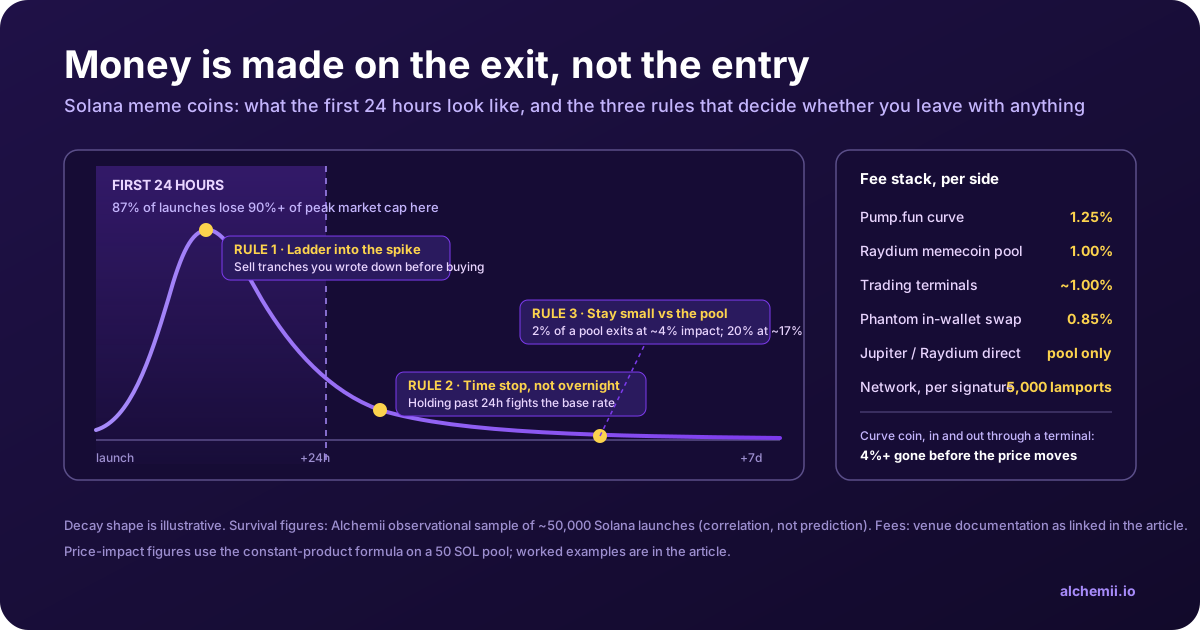
The short answer to how to take profits on Solana meme coins: decide the exit before the entry, and make it mechanical. That means a written ladder of price triggers with a fixed percentage sold at each, starting with a tranche that returns your original SOL; a time stop that closes the rest by a set hour instead of holding overnight; and a position size small enough relative to the pool that selling does not move the price against you. The rest of this article is the arithmetic behind each of those three rules — the survival base rates, the fee stack per venue, and constant-product price impact worked out in full — so you can set your own levels rather than borrow ours.
This is the exit-side companion to how to trade Solana meme coins, which covers venues, the five-step swap and the pre-buy rug checklist. If your question is how meme coins pay their creators, that is a different fee flow and has its own honest breakdown.
Quick Facts
Three of those numbers set the frame for everything below. The 87% figure is the decay curve; the sub-100 SOL median volume is why most positions get exactly one exit window; and the per-side fees are the toll paid at both ends of that window. None of them are predictions for a specific coin. All of them are what a plan has to survive.
Why the exit is where the money is
A meme coin position has two decisions, and traders spend almost all of their attention on the wrong one. The entry — which coin, which minute — feels like the skill. But in a market where the typical token gives back most of its peak inside a day, the entry only decides if a window opens at all. The exit decides what you take out of it.
Our launch dataset makes the asymmetry concrete. Of roughly 50,000 Solana launches we observed, 87% lost 90% or more of their peak market cap within 24 hours. The median token in that group did under 100 SOL of volume across its entire life — which means for most positions there is no second wave, no "it'll come back", no later exit at a better price. There is the spike, and then there is the decay.
Two consequences follow, and they are the spine of every rule in this article:
- Unrealised gains in a meme coin are not gains. They are a claim on a pool that may not have the SOL to pay you, at a price that is already falling by the time you decide.
- "Hold and see" is not a neutral default. On this curve it is a directional bet against the base rate, taken without noticing.
The multipliers in the same dataset tell you which coins are likelier to give you a usable window at all: tokens with revoked mint authority survived their first 24 hours at roughly 4.2 times the rate of tokens that kept it, tokens whose LP was burned at minute zero at about 5.7 times, and tokens whose project account was 30 or more days old at launch at about 2.7 times. Those are correlations in past launches, not causes, and none of them turn a lottery ticket into an investment. But they are the difference between a coin where a written exit plan can execute and a coin where the creator can freeze your account before you sell. The Solana rug checker reads mint authority, freeze authority and LP status for any mint address; using it before the buy is what makes the exit rules below possible.
Rule 1: write the ladder before the buy
The single most valuable habit in meme coin profit-taking is deciding the sell levels while you still have nothing at stake. Once you hold the coin, every level you set is bargaining with a position; before you hold it, every level is just arithmetic.
A ladder has three properties that matter more than the specific numbers:
- The first tranche pays back your cost. Selling half at 2× returns your original SOL. From that point the position cannot lose your money, only the pool's — and the emotional pressure that produces late exits mostly disappears.
- Later tranches are fixed percentages, not "some". A plan that says "sell some at 4×" is not a plan; it is a decision deferred to the worst moment to make it.
- The plan ends at a time, not at a target. The last line of the ladder is a clock, not a price. It fires whether or not the higher levels arrive.
Here is one worked ladder for a 1 SOL entry. The levels are an example of the shape, not a recommendation.
Read the last row twice. If the coin never reaches 2× — which, on the base rates above, is the common case — the time stop still closes the position at 24 hours at whatever the market pays. The ladder is not a promise of 3.2 SOL. It is a rule set that produces 3.2 SOL if the spike comes, and a bounded loss if it does not, with no decision required from you in either case.
Two practical notes on executing a ladder on Solana. First, fills are not free: each leg is a separate swap paying the venue fee and a network fee, so a five-leg ladder on a 0.3 SOL position spends a meaningful share of the position on fees. Below about half a SOL, two legs are usually the sensible maximum. Second, Jupiter offers limit-style orders that execute a swap when a price condition is met, which lets you pre-place the upper legs of a ladder rather than watching a chart; whether that suits a particular coin depends on the pool's depth at the trigger price, which is Rule 3.
Rule 2: a time stop, not an overnight hold
On a market where the median launch decays inside a day, the most expensive default is the one that feels like patience. "I'll check it in the morning" is, on the 87% curve, usually a decision to sell the bottom.
A time stop is the simplest rule in this article: pick an hour count before you buy — 6, 12, 24 — and close whatever remains when it arrives, regardless of price. It converts an open-ended bet into a bounded one, and it is the only rule that still protects you when the ladder never triggers because the spike never came.
The right length depends on the coin's stage:
| Coin stage | What the clock is measuring | Reasonable time stop | Why |
|---|---|---|---|
| Pump.fun curve, pre-graduation | Whether it reaches the graduation threshold at all | Hours, not days | About 1 in 15 launches graduate; most that do peak on graduation day |
| Freshly graduated / new pool | Whether volume survives the first sellers | Inside the first 24 hours | The 87% decay window is exactly this period |
| Pooled, days old, still trading | Whether it holds a range | Reassess daily against volume | It has already escaped the median outcome; the rule shifts to volume |
| Anything with freeze authority live | Whether you can sell at all | Not a time question | Check before entering; a frozen account has no exit |
Graduation deserves a specific word, because it is the most misread signal in Solana meme coins. When a pump.fun coin crosses its bonding-curve threshold and its liquidity migrates to a pool, the event looks like a beginning — a real market, a DEX listing, a chart on DexScreener. In our tracking it more often behaves like a peak: about 1 in 15 launches graduate, and of those, most hit their high on graduation day and declined from there. For a holder who bought on the curve, graduation is a reasonable place to fire a tranche, not a reason to extend the time stop.
Rule 3: stay small against the pool
The third rule is the one the chart hides. A price on a screen is the pool's marginal price — what the last small trade paid. It is not what you will receive for your whole position, because your own sale moves the price as it executes. On a constant-product pool the arithmetic is fixed and you can do it before you buy.
For a pool holding R_sol SOL and R_tok tokens, selling s tokens returns:
SOL out = R_sol − (R_sol × R_tok) ÷ (R_tok + s)
before the pool fee. Take a pool of 50 SOL and 50,000,000 tokens — a spot price of 0.000001 SOL per token, and a small but not unusual memecoin pool. You hold 2,000,000 tokens, which the chart values at 2.0 SOL. Selling all of it: the token reserve becomes 52,000,000, the SOL reserve falls to 50 × 50M ÷ 52M = 48.08, and you receive 1.92 SOL — a 3.8% price impact before the 1% pool fee. Hold 10,000,000 tokens instead (spot 10 SOL) and sell them in one go: reserve 60M, SOL falls to 41.67, you receive 8.33 SOL. That is 16.7% of the position's screen value gone to impact alone, before any fee.
Now put the same positions into a pool ten times deeper.
The lesson is not "only trade deep pools" — deep pools are where the spike has usually already happened. It is that position size is a function of pool depth, not of conviction. A practical cap many experienced traders use is to hold no more than about 2% of the pool's token side; at that size, impact on a full exit stays in the low single digits and the ladder's upper legs can actually fill. If you find yourself needing 20% slippage to sell, the pool is too thin for the position you took — sell smaller pieces, sooner, and treat the setting as a red flag rather than a fix. Sandwich bots read a public high-slippage transaction as an invitation.
You can read any pool's reserves directly on Solscan or from the pair page on DexScreener before you enter. Thirty seconds of arithmetic there is worth more than any indicator on the chart.
The fee stack on the way out
Every rule above is executed through a swap, and every swap pays the venue. The fees are small individually and brutal in aggregate, because a meme coin round trip pays them at least twice — and a ladder pays them once per leg.
| Venue | Per-side fee | On top of the pool fee? | Where it applies |
|---|---|---|---|
| Pump.fun bonding curve | 1.25% | n/a — the curve is the venue | Pre-graduation coins only |
| Raydium memecoin pool (1% tier) | 1% | Is the pool fee | Most Solana meme pools |
| Raydium standard pool (0.25% tier) | 0.25% | Is the pool fee | SOL/USDC-style pairs |
| Trading terminals (Photon, Axiom, BullX) | ~1% | Yes | Any pooled coin routed through them |
| Phantom in-wallet swap | 0.85% | Yes | Any coin swapped inside the wallet |
| Jupiter or Raydium directly | 0% venue fee | n/a — pays pool fee only | Any pooled coin |
| Solana network, every transaction | 5,000 lamports per signature + optional priority fee | Always | Every leg of every trade |
Two things fall out of the table. First, the route you exit through is a cost you choose: a pooled coin sold through Jupiter or Raydium pays the pool's 1% and nothing else, while the same sale through a terminal or the wallet's built-in swapper pays roughly double. Speed tooling is worth paying for on the entry to a moving coin; it is rarely worth paying for on a planned exit you set up in advance. Second, the ladder's leg count has a floor set by fees — which is why the sub-0.5 SOL guidance above is two legs, not five.
The network fee itself is negligible — 5,000 lamports is fractions of a cent — but the priority fee attached to it is not, on a congested launch minute. Solana's own fee documentation explains how the two combine; the practical point is that a sell placed in the same second everyone else is selling pays more to land, and a pre-placed exit does not.
What "taking profits" looks like for creators
Everything so far is the buyer's side. It is worth one section on the other side of the same trades, because the fee flow runs in the opposite direction there — and because a trader who keeps spotting good formats a few minutes late is often looking at a different job.
When a meme coin trades, the venue and the pool collect the fees in the table above. Where a creator sits in that flow depends on the venue: pump.fun shares a portion of curve revenue with creators of coins launched there, and a creator who seeds a Raydium pool and keeps the LP tokens earns a share of that pool's fee tier on every trade through it. How meme coin creators make money works those mechanisms out with current numbers, including the volume it takes to clear 10 SOL in creator fees — which is a lot more than most launches ever do. The same 87% base rate hangs over a creator's launch as over a trader's position; the difference is which end of the fee flow you are on, and who controls the timing.
That timing control is the substantive point. A creator decides when the token exists, what its trust signals are — set on the meme coin creator before anyone else can trade — — mint authority revoked at creation, freeze authority never set, LP burned at minute zero, the three fields the survival multipliers above are built on — and whether their own opening buy is bundled into the launch. A trader inherits all of those decisions from someone else and can only react.
Copy a coin that's already running. Mint an address that ends in pump.
- One-click Copy Coin —
- hit Copy Coin on the live Pump.fun board and this form reopens with that coin's name, image and memecoin settings already filled in. No extension to install, and the launch ends in a pool you own.
- The pump address, without the bonding curve —
- tick Pumpfun Token and your mint ends in pump on a launch you own outright, with nothing skimmed off every trade afterwards. How it works.
Alchemii's Trending board exists for exactly the trader who keeps arriving late. The Copy Coin button takes a live pump.fun coin's name, image and memecoin settings and prefills the Solana token creator with them — mint authority revoke on by default — so a spotted format becomes your own launch in one click, in-flow rather than through a browser extension, and it ends in a real Raydium pool you own rather than on a bonding curve you do not. The launch costs a flat service fee of 0.2 SOL, about 0.22 SOL all-in for a standard launch and roughly 0.32 SOL with mint authority revoked, charged once, with no cut of trading volume. Seed liquidity is separate and yours to size — open the Raydium pool in the same sitting, and burn the LP if you want the 5.7× trust signal on your own token. None of that guarantees the format catches — nothing does — but it moves you from reacting to a curve to setting one.
A pre-entry checklist for the exit
The rules above only work if the exit is possible. Run this before any buy; it takes about a minute and it is all free.
- Mint authority revoked? If not, the creator can print supply into your exit. Check on Solscan or with the rug checker.
- Freeze authority revoked (or never set)? If not, the creator can freeze your token account and no setting on your side will let you sell. This is an instant skip.
- LP burned or locked? If not, the pool can vanish between your buy and your first tranche. Read the pair page on DexScreener; it shows liquidity and, for many pools, lock status.
- Pool depth in SOL, and your position as a share of it. Do the constant-product arithmetic from Rule 3 for a full exit. If the impact is above the low single digits, size down.
- Ladder written, with percentages. First tranche returns cost. Every later tranche is a fixed share of the remainder.
- Time stop set. An hour count, chosen now, that closes whatever remains.
- Exit route chosen. Jupiter or Raydium directly for a pooled coin unless speed on the exit is genuinely worth a second fee.
- Trading wallet separate from any launch wallet. Never sell from a wallet that also holds authority over a token you created.
If a coin fails 1, 2 or 3, no exit rule saves the position — the creator holds the exit. That is the whole reason the checklist comes first.
Limitations
The 87% / 50,000-launch figure and the 4.2×, 5.7× and 2.7× survival multipliers are Alchemii's own observational dataset, described in our launch-data methodology. They are correlations in past launches over a specific observation window. They are not causal claims, not predictions for any individual coin, and not stable over time — a change in launchpad mechanics or bot behaviour would move them. The "about 1 in 15 graduate" figure for pump.fun is from our own tracking and is a base rate, not a ceiling or floor for any launch.
The price-impact examples use the constant-product formula on idealised pools with round reserves and no concurrent trades. Real pools on Raydium and PumpSwap have fee tiers, concentrated-liquidity variants and other traders moving the reserves between your quote and your fill; treat the worked numbers as the shape of the effect, not a quote. Fee percentages are as documented by each venue at the time of writing and change; the venue's own documentation, linked in the references, takes precedence over this page.
The example ladder is an illustration of a pre-committed plan's structure. It is not financial advice and its levels are not a recommendation. Selling a token is a taxable event in most jurisdictions; keep your transaction history (Solscan exports it) and take local advice.
FAQ
How do you take profits on Solana meme coins?
Write the sell plan before the buy, then execute it mechanically. The plan has three parts: a ladder of price triggers with a fixed percentage to sell at each (the first tranche recovering your cost), a time stop that closes whatever is left by a set hour rather than holding overnight, and a position cap that keeps your holding small relative to the pool so the exit does not move the price against you. Selling happens on the same venue you bought on — Jupiter or Raydium for a pooled coin, pump.fun's curve for a pre-graduation coin — and every leg pays that venue's fee.
When should you sell a meme coin on Solana?
Earlier than feels natural, and on a schedule you set before entering. In Alchemii's observational sample of roughly 50,000 Solana launches, 87% of meme coins lost 90% or more of their peak market cap within 24 hours, and the median launch in that group did under 100 SOL of volume in its whole life. That is a correlation in past launches, not a forecast for any coin, but it means the default of holding overnight is fighting the base rate. A pre-written ladder sells into strength; a time stop sells the remainder regardless.
What is a good meme coin exit strategy?
One you can follow without deciding anything in the moment. The example ladder in this article sells 50% at 2× to recover the stake, 25% at 4×, 15% at 8×, and closes the final 10% at a 24-hour time stop whether or not the higher triggers arrive. The exact levels matter less than three properties: the first tranche pays back your cost, every later tranche is a fixed share of what remains, and the plan ends at a time, not at a hope.
How much profit should you take on a meme coin?
Take your cost back first, then treat the rest as the pool's money. Selling half at 2× returns your original SOL and leaves a position you cannot lose money on, which removes the emotional pressure that causes late exits. Beyond that, size each remaining tranche against pool depth: in a 50 SOL pool, a 10 SOL position loses about 17% of its value to price impact when sold in one go, before the 1% pool fee. If a coin needs 20% slippage to fill, the pool is too thin for the position, and that is the signal to sell smaller and sooner.
Why can't I sell my Solana meme coin?
Three causes cover almost every case. The pool is too thin for your size, so the swap fails at your slippage setting — raise the slippage in small steps, or sell in smaller pieces. The creator kept freeze authority and froze your token account, which no setting fixes; Alchemii's free Solana rug checker reads freeze and mint authority for any mint address before you buy. Or the creator pulled the liquidity, in which case there is no pool to sell into; a burned or locked LP is what protects against that, and it is the second thing to check.
Is it better to trade meme coins or launch your own?
They are different games under the same 87% base rate. A trader pays the fee stack on both sides of every position, competes with bots on speed, and exits on someone else's timeline. A creator pays a flat launch cost once (about 0.22 SOL all-in on Alchemii, roughly 0.32 SOL with mint authority revoked, plus any seed liquidity), controls the token's trust signals, and holds the format directly — with no guarantee the format catches, and the same decay curve waiting. If you keep spotting formats early but entering late, Alchemii's Trending board has a Copy Coin button that turns a spotted format into your own prefilled launch in one click.
References
- Solana fee documentation: base fee per signature and prioritization fees
- Solana rent documentation: rent-exempt minimums for token accounts
- Pump.fun official documentation: live fee schedule
- Raydium docs: CPMM trade fees and distribution
- Raydium docs: creating a CPMM pool and fee tiers
- Jupiter: Solana swap aggregator and order products
- DexScreener: Solana pairs, liquidity and lock display
- Solscan: token, holder and pool account reads
- Phantom wallet
- CoinGecko: Solana meme coins category
- DefiLlama: pump.fun protocol fees and volume
- CoinDesk: Pump.fun launches SOL revenue sharing for coin creators (May 13, 2025)
- SPL Token Program: mint, freeze and supply mechanics
- Alchemii: launch-data methodology behind the survival figures
Create your Solana token
Choose your token name, symbol, supply and image. Review the authority options and creation fee, then confirm the transaction in your wallet. Liquidity is a separate step.
Related Topics
More guides to Solana token creation, authorities, liquidity, and meme coin launches.
How to Trade Solana Meme Coins: Buy, Sell, Survive (2026)
How to buy and trade Solana meme coins in 2026: where to buy, the five-step swap, the pre-buy rug checklist, real fee math, and the survival stats nobody prints.
Pump.fun Callouts Explained: How to Use Them & Check Rewards
What Pump's Callout Rewards terms really say: the Activity Metric is confidential, rewards are discretionary, and only the on-chain transfer counts as payment.
What Is the FOMO App? Legit Check, Fees & Chains (2026)
Is the FOMO app legit? fomo.family explained: six chains, official Solana fee tiers, and why a 4 USDC order costs 2.5%, not 0.5%. Checked September 12, 2026.
How Many Meme Coins Are Created Every Day? 35,700+ (2026)
We counted 1,048 Solana launches in 42 minutes — a new meme coin every 2.4 seconds, about 35,705 a day. Who makes them, what they earn, and what we got wrong.
Crypto FOMO in Memecoins: The Price of Waiting for Proof
Crypto FOMO has a price you can calculate. The median pump.fun winner graduates in 4.4 minutes — and $2,210 of buying takes 56% of the cheap supply.
Is It Legal to Create a Meme Coin? US, UK & EU Rules (2026)
Creating a meme coin is legal in the US, and the SEC says most aren't securities. What gets prosecuted is fraud. The line, with the 2026 cases and rules.