Copy Trade Meme Coins: Profit Math, Wallets & Creator Options
Can you make money copy trading meme coins? Learn wallet checks, profit math and settings, then compare following trades with creating your own Solana token.

Have your own meme idea? Create its token Set your name, ticker, image and supply on the homepage. Review the setup before connecting your wallet.
You can make money copy trading meme coins only when your own buys and sells remain profitable after costs. Following a profitable wallet does not reproduce its entry price, exit price or returns. On a fast-moving Solana token, those differences can decide the entire outcome.
The appeal is obvious: find someone who spots good coins early, follow their trades, and spend less time staring at charts. The practical question is whether their opportunity still exists by the time your order arrives.
There is another path for readers whose strength is finding memes, creating content or bringing a community together: launch a token around an idea of your own. Open Alchemii's homepage and create your token → You can inspect the no-code form before connecting a wallet.
We build Alchemii, so the creator option below describes our product. The trading examples are hypothetical arithmetic, not measured returns or a recommendation to follow a particular wallet.
How does meme coin copy trading work on Solana?
Meme coin copy trading uses another wallet's activity as a signal for trades in your own account. An automated tool monitors a target address, detects supported transactions, and submits orders according to your rules.
Those rules matter. You might copy buys at a fixed SOL amount, mirror a proportion of the trader's position, copy sells, or use separate exit conditions. Trojan's official feature guide documents configurable buy amounts, sell behavior and execution settings. Source: Trojan copy trading.
Think of it as a sequence:
- The target wallet trades.
- Your tool detects and evaluates the transaction.
- It submits an order using your size and limits.
- Your transaction succeeds or fails under the conditions then available.
Each step can change the result. An alert is not a fill, and a submitted sell is not a completed exit. For the underlying swap mechanics, see our guide to trading Solana meme coins.
Is meme coin copy trading profitable? Calculate your own result
For a completely closed position, the useful calculation is:
Net trading profit = actual sale proceeds − actual purchase cost − costs not already included in those amounts.
Use executed amounts. Slippage and price impact are already reflected in what you actually receive; subtracting an estimated slippage percentage again would double-count them. Likewise, check whether your reporting tool includes exchange fees before subtracting them separately.
Consider a fictional token and two traders who each spend 1 SOL on tokens before separately counted costs:
| Result | Target wallet | Follower |
|---|---|---|
| Average buy price | 0.000010 SOL | 0.000012 SOL |
| Tokens acquired | 100,000 | About 83,333 |
| Average sell price | 0.000013 SOL | 0.0000115 SOL |
| Sale proceeds | 1.3000 SOL | About 0.9583 SOL |
| Additional round-trip costs | 0.0200 SOL | 0.0200 SOL |
| Net profit or loss | +0.2800 SOL | About −0.0617 SOL |
The follower bought the same token after the source and sold after the source. The target made 28%; the follower lost approximately 6.17%. These prices and costs are invented to isolate execution differences, not to describe a typical trade or a platform fee schedule.
This is why a screenshot of someone else's winning trade cannot answer whether copying them makes money. You need your own entry, exit, missed trades, failed attempts and remaining inventory. Keep results in a consistent unit: a profit measured in SOL can still be a loss measured in dollars if SOL falls enough.
How to find profitable Solana wallets to copy
Start with a candidate wallet's public transactions, then test whether its apparent performance survives closer inspection. A large profit number is a reason to investigate, not a complete selection method.
Use this worksheet when reviewing a wallet:
| What to inspect | What it tells you |
|---|---|
| Realized gains alongside unsold positions | Whether winning exits hide a collection of losing holdings |
| Purchases versus incoming token transfers | Whether the reported entry cost reflects an actual market purchase |
| Results with the biggest winner removed | Whether one exceptional token explains the whole record |
| Typical holding time | Whether the strategy leaves time for a follower to enter and exit |
| Order size relative to available liquidity | Whether your intended trade size is plausible at similar prices |
| Repeat buys and partial sells | How exposure changes after the first copied transaction |
| Results across several periods | Whether the record depends on a brief favorable market |
An incoming token transfer is not automatically suspicious, but it needs an explanation. It could be a transfer from another wallet the trader owns, a payment or an allocation. None establishes a purchase price you could have obtained.
Next, construct hypothetical follower entries using prices available after detection, plus estimated costs. Include skipped and failed trades rather than keeping only the attractive examples. A paper record can expose an implausible setup, although it cannot establish how real orders will fill.
Also check execution compatibility. Trojan's bot documentation explicitly describes limits around snipers and custom trading programs. A wallet can be visible on-chain without being suitable for that tool to copy. Source: Trojan Copy Trade limitations.
What are the best meme coin copy trading settings?
There is no universal profitable preset. Settings define what your tool is allowed to do; they do not make a weak signal profitable.
Evaluate these controls against the strategy you are observing:
| Control | What to verify before enabling it |
|---|---|
| Buy size | Whether a fixed amount or proportional order fits your total budget |
| Repeated buys | Whether the source can trigger multiple purchases of the same token |
| Exposure limits | Whether a limit applies to each transaction, each token or the whole account |
| Liquidity filter | Whether there is sufficient depth for the intended entry and exit |
| Slippage tolerance | The maximum execution deterioration you permit relative to the quote |
| Priority fees and tips | Their cost across both successful trades and unsuccessful attempts |
| Sell behavior | Whether partial sells are mirrored and whether your tool copies buys only |
| Pause and exit controls | What happens to open holdings when you stop copying |
For example, Trojan's documented maximum buy amount applies per transaction when using percentage sizing. That is different from a ceiling on total exposure to one token. Check the exact semantics in the tool you choose. Source: Trojan advanced copy settings.
Slippage is the difference between a quoted price and final execution; price impact describes how a trade moves the market. Deeper liquidity generally accommodates larger trades with less impact. Source: Jupiter's swap guide.
A higher slippage tolerance allows a worse fill. It may help an order execute, but that order can succeed technically while failing economically. Exit automation has limits too: a stop condition cannot guarantee a particular sale price or create liquidity where none exists.
Why am I losing money copy trading a profitable wallet?
Trace a losing copy from signal to settlement. Four explanations deserve attention before changing settings:
Your entry arrived after the opportunity. The source's buy and subsequent activity may already have moved the market. Compare executed prices, not chart screenshots captured at different moments.
You copied the buys but missed the exits. Check unsupported transactions, partial sells, insufficient funds for transaction costs and the actual sell configuration. A successful entry does not confirm a working round trip.
Your costs are large relative to your position. Suppose a hypothetical round trip costs 0.004 SOL before any price loss. On a 0.05 SOL position, that is an 8% hurdle; on 0.2 SOL, it is 2%. This illustrates cost sensitivity, not a reason to increase your position size.
The historical record was unusually favorable. A wallet selected after one spectacular winner may never repeat it. Review losses and open inventory alongside realized winners.
If your question is whether meme coin copy trading works with a small budget, start with that cost calculation. A tool accepting a tiny order does not mean the order has attractive economics. Watching and recording hypothetical trades can be more informative than repeatedly paying to test an unexamined setup.
Copy trading vs creating a meme coin: where do your skills fit?
Studying meme coins can teach you more than which wallet bought first. You may notice a joke people keep adapting, a visual style that travels well, or a community asking for a shared token.
If you already have that idea and an audience you can reach, token creation gives you a concrete next step. You choose the setup and do the work of making the project worth following.
| Decision | Copy trading | Creating your own meme coin |
|---|---|---|
| Main activity | Evaluate wallets and execute following trades | Develop the concept, token setup and community |
| What you control | Position size, filters and exit rules | Name, ticker, supply, initial allocation and launch preparation |
| Potential financial outcome | Gains or losses on your executed trades | Gains or losses on holdings; possible fees from an eligible LP position |
| Capital required | Trading budget and execution costs | Creation costs, promotion and separately funded liquidity |
| What you must establish | Whether the signal remains useful at your fill prices | Whether people want to participate in your project |
Creating a token is a different undertaking with its own costs. It is not evidence of a better expected return. Its practical advantage is control over the project you build: the concept, presentation and community work are yours to shape.
Have a meme people already respond to? Put the token details together now. Open the homepage, choose the name and ticker, upload your artwork, and review the setup before committing funds.
Can your own meme coin earn trading fees?
A real on-chain example shows that creator-fee income exists. On October 22, 2026 at 04:19 UTC, a successful Pump.fun transaction distributed 110.019209855 SOL in creator fees and executed a social-fee claim. We checked the transaction's successful result, program logs and exact transfer amount through Solana's public getTransaction RPC.
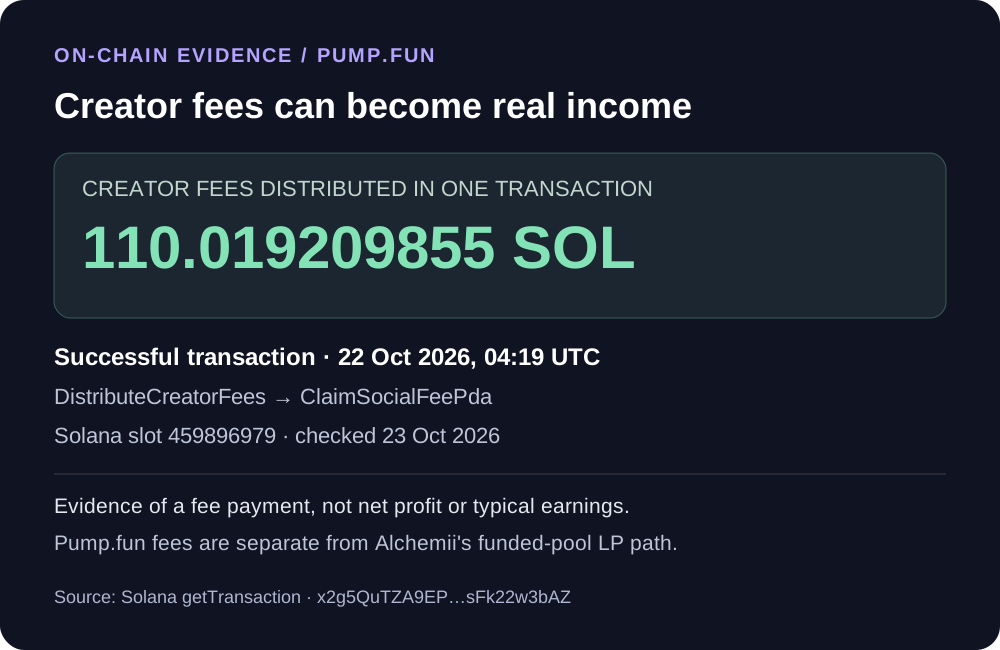
An editorial visualization of a verified public transaction, not a wallet screenshot. Inspect the transaction on Solscan or read the recorded RPC evidence. One payment does not establish the recipient's identity, total project costs, net profit or typical earnings.
This example uses Pump.fun's creator-fee system. An Alchemii token does not inherit those fees. For a direct launch on Alchemii, the income path discussed here is providing liquidity to your own token's trading pool.
A creator can also be a liquidity provider, but those roles are separate. Creating a token alone does not activate a revenue stream. LP fee income requires a funded trading pool, actual swaps through that pool and a liquidity position entitled to the relevant fees.
For illustration, Raydium documents an 84% LP share of CPMM swap fees. At a 0.25% swap fee, $10,000 of volume through that pool would allocate $21 in gross fee value to LPs collectively. A constant 50% LP share would account for $10.50. Source: Raydium protocol fees.
That is a hypothetical gross-fee calculation, not a profit forecast. Changes in the liquidity position's value can outweigh fees, and creation and operating expenses still count. For the full mechanism, read how to earn trading fees from your own meme coin.
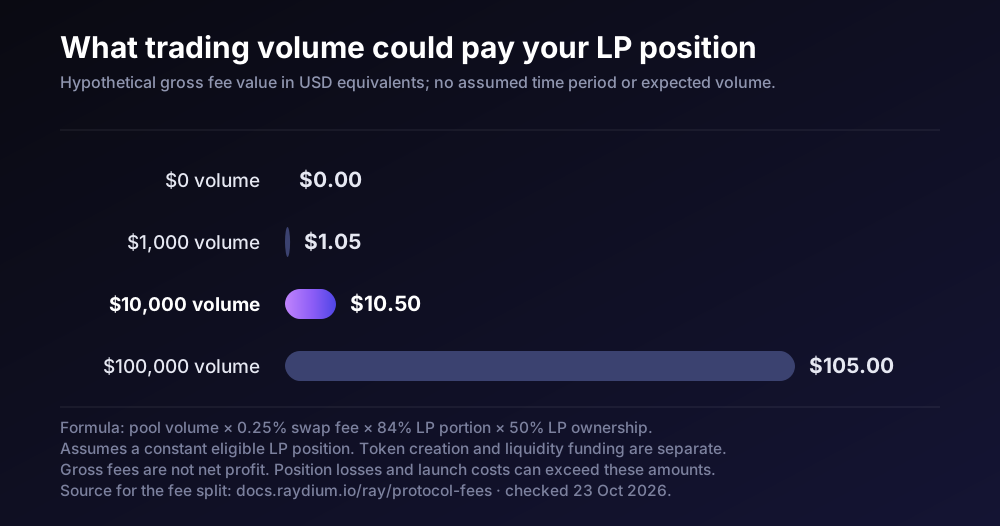
The same formula at four volume levels, including zero. These are scenarios without an assumed time period, not customer earnings or a volume forecast. The 0.25% fee tier and 50% LP share are assumptions; Raydium documents the 84% LP portion.
Ready to build your own project? Create your Solana token on Alchemii → Then plan its liquidity and community so the token has a market people can participate in.
Create your Solana meme coin without coding
Alchemii's homepage contains the creation form, so you can move directly from an idea to configuring your token:
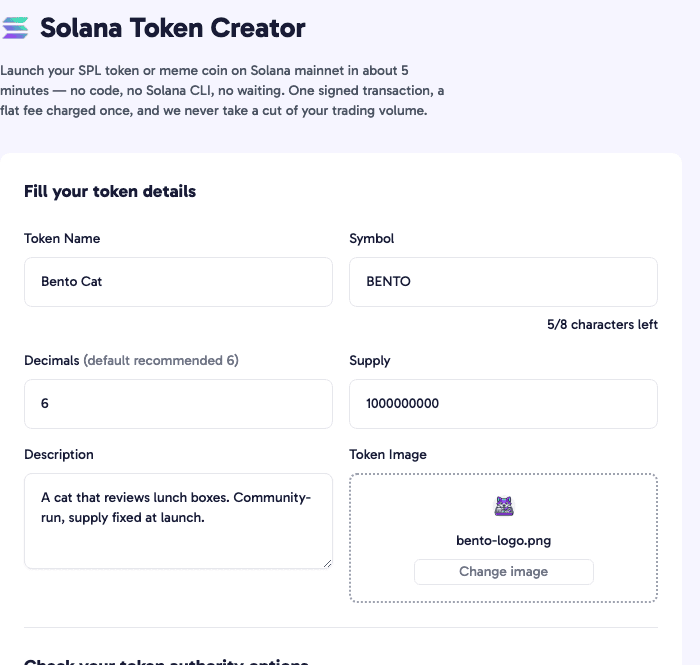
A real Alchemii form with example token details. This demonstrates the creation setup, not a deployed token or an earnings result. Open the homepage and create your token →
- Open the homepage token creator. Start with the name, ticker and concept you want your community to recognize.
- Add your artwork and description. Include your own social links so visitors can find the project behind the token.
- Set supply and decimals. Review these choices alongside your intended allocation before creation.
- Review authorities and the price. The base service fee is 0.2 SOL plus approximately 0.02 SOL in estimated network and account costs. Optional mint-authority revocation adds 0.1 SOL. Other selected extras can increase the total.
- Connect your Solana wallet and approve creation. Review the current form and wallet transaction before signing. Your initial supply is sent to the connected wallet after confirmation.
The approximately 0.22 SOL base estimate covers creation before optional extras. Pool setup and liquidity deposits are additional. For a complete preparation sequence, use the Solana memecoin launch checklist.
Need a starting format? Alchemii's Trending Coins board has a Copy Coin action that opens the homepage with editable token details. Customize the name, artwork, description and links to make the project your own.
Copy Coin and copy trading are different features. Copy Coin loads a creation draft. It does not buy the original token, follow its developer's wallet, or inherit its holders, price, liquidity or fee income. Loading the draft spends no SOL; approving creation does.
Frequently asked questions
Can you make money copy trading meme coins?
It is possible, but your own executed buys and sells must produce a profit after all fees. A target wallet's returns do not establish what followers earn. Entry delays, different position sizes, slippage and missed exits can turn a profitable source trade into a losing copy.
How do you find profitable Solana wallets to copy?
Inspect transaction history and realized results across multiple periods. Separate purchases from token transfers, include losing positions, check whether one outlier drives the result, and compare holding times with your execution delay. Then evaluate hypothetical follower entries rather than assuming the original wallet's prices were available to you.
What are the best settings for meme coin copy trading?
There is no universal profitable preset. Review position size, repeated buys, total token exposure, liquidity filters, slippage tolerance, transaction fees and sell behavior. Verify which limits apply per trade rather than per token. A higher slippage limit permits worse execution; it does not create a trading edge.
Can you copy trade meme coins with a small budget?
Some tools allow small orders, but fixed transaction costs can consume a large share of a small trade. Calculate round-trip costs relative to position size, including failed attempts. If costs erase the modeled gain, a lower minimum order does not make the setup viable.
Does Alchemii copy other wallets' trades?
No. Alchemii's homepage creates Solana tokens. Its Copy Coin feature prefills an editable token creation form from a trending coin; it does not mirror trades or transfer that coin's holders, liquidity, price or revenue.
Is creating a meme coin more profitable than copy trading?
There is no general evidence that it is. Creation gives you control over the token's setup and community work, but requires a launch budget and real demand. LP fee income requires a separately funded pool and an eligible liquidity position; losses can exceed fees.
Your meme idea deserves a concrete next step
If researching wallets has helped you spot a concept you want to build around, turn that research into a token setup. Bring your name, ticker and artwork to Alchemii, choose your supply, and review the creation estimate.
No coding required. Inspect the form before connecting your wallet, then approve creation when your setup is ready.
Turn your meme research into a project of your own
Bring your idea and artwork to Alchemii's homepage. Configure your Solana token without coding, review the creation estimate, and approve it in your wallet when ready. Pool setup and liquidity are separate.
Related Topics
More guides to Solana token creation, authorities, liquidity, and meme coin launches.
How to Earn Trading Fees From Your Own Meme Coin
Create a Solana meme coin, fund a pool, and earn a share of trading fees. See the income math, launch costs, and one-click trending coin setup.
How to Make Money on Pump.fun: Creator Rewards
How to make money on pump.fun by creating a coin: creator rewards pay 0.30% to 0.95% of every trade. See Sept 2026 payouts, Holder Rewards, and how to withdraw.
How Do Meme Coin Creators Make Money? 4 Real Ways (2026)
How meme coin creators can make money through creator fees, Raydium LP fee share, disclosed allocation, and appreciation — with current 2026 fee math.
Is Meme Coin Trading Profitable? 2026 Data
Is meme coin trading profitable? We tracked 921 new pump.fun coins and 11,070 wallets: 20.5% made money, and creators beat traders 2 to 1. See the data.
Why Is Solana Going Up? SOL Market Update (Sept 2026)
Why is Solana going up? SOL hit $122 on 250ms blocks, ETF inflows, record stablecoins and meme coin fees. The data, the price levels, and how to launch now.
Jup Studio: Fees, Graduation & How to Launch (2026)
Jup Studio explained: Jupiter Studio's 1% fee split, anti-sniper window, 15K USDC graduation, measured launch cost, and when a direct Solana mint wins.