Why Is Solana Going Up? SOL Market Update (Sept 2026)
Why is Solana going up? SOL hit $122 on 250ms blocks, ETF inflows, record stablecoins and meme coin fees. The data, the price levels, and how to launch now.

Ready to create your Solana token? Enter your token details, choose your authority options, and confirm in your wallet.
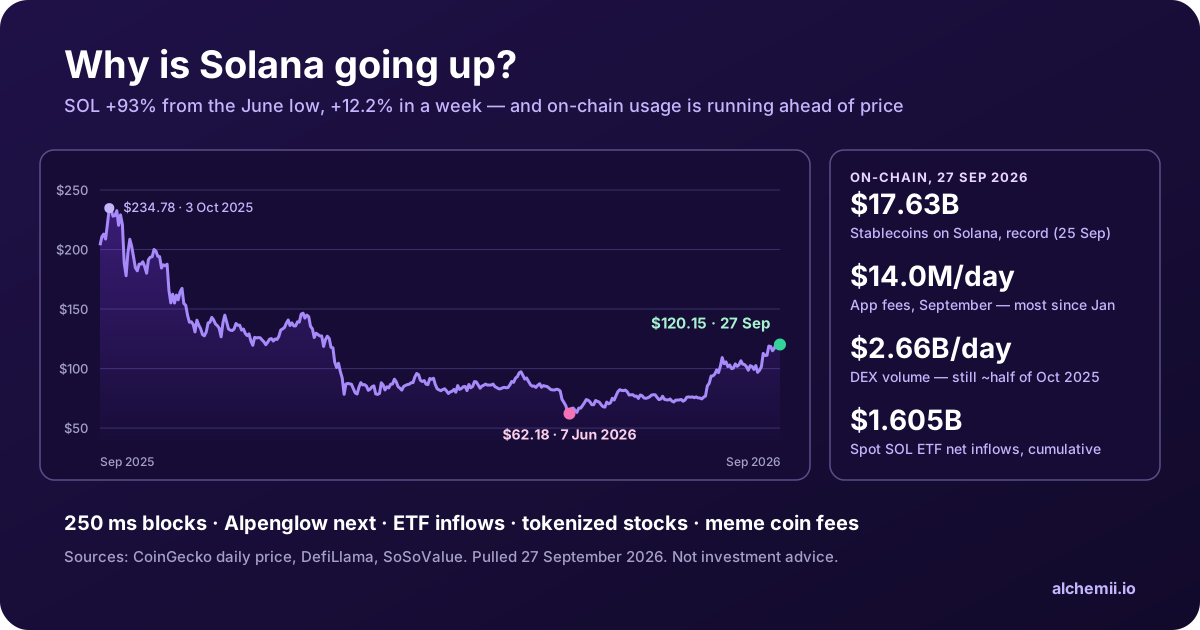
Why is Solana going up? Because four network and market catalysts arrived inside the same fortnight, and on-chain money was already waiting. Between 17 and 25 September 2026 Solana cut its block time to 250 ms, shipped the Alpenglow consensus code ahead of mainnet activation, drew $86.67M into spot SOL ETFs in a single day, and gained a US legal framework for tokenized-stock trading. SOL answered with a 12.2% week — to $120.15 on 27 September, 93% above its June low. This Solana market update puts every number on a chart: price, fees, DEX volume, stablecoins, ETF flows, and a fresh census of the Solana meme coin market. It also shows where the rally is thin. SOL is still 59% under its January 2025 high, and trading volume has recovered only half of what it lost.
Every figure was pulled on the morning of 27 September 2026 from CoinGecko, DefiLlama and SoSoValue, or measured by us with the pump.fun census method described in how many meme coins are created every day. Disclosure: we build Alchemii, a Solana token creator, so we have a stake in the meme coin market this article describes. Nothing here is investment advice.
Quick Facts
Read the six tiles as three pairs. Price and the June low tell you the move is large. The distance from the all-time high tells you it started from deep in the hole. Stablecoins, fees and ETF flows tell you this time the move has something under it besides borrowed money, which was not true of the short squeezes earlier in the year.
Why is Solana going up? Five catalysts behind the September rally
A rally with one cause is fragile. This one has several, and they sit on different layers: the protocol, the regulator, institutional money, and projects choosing where to live. Here they are in the order they hit, with what each one actually changes.
| Date (2026) | Event | What changed | SOL price that day |
|---|---|---|---|
| 6 Sep | StonkFun moves launches onto Raydium LaunchLab | New stock-paired launchpad; its fees go from $1.3M in August to $23.4M in September | $103.2 |
| 9 Sep | Transaction V1 format scheduled | A 3.3× larger transaction size limit for complex swaps and programs | $103.4 |
| 17 Sep | SEC issues the Innovation Exemption | Five-year conditional relief for trading tokenized US stocks through AMM pools | $98.5 |
| 18 Sep | 250 ms slots go live (SIMD-0525, epoch 1037) | Block time cut 17%, from 300 ms to 250 ms; Agave v4.3 ships Alpenglow code, inactive | $101.6 |
| 19–22 Sep | Break above $110, then $117 | Bitcoin crosses $84,000 and short positions are liquidated market-wide; SOL reaches its highest level since January | $112.7 → $118.9 |
| 20 Sep | ZetaChain Proposal 68 passes | 99.4% vote to wind down its L1 and move ZETA to Solana as an SPL token | $111.0 |
| 25 Sep | Spot SOL ETFs take in $86.67M in one day | Cumulative net inflows reach $1.605B; stablecoins on Solana hit $17.63B | $117.0 |
| 28 Sep | Anza resumes mainnet feature activation | Alpenglow (150 ms finality target) can start moving through feature gates; no fixed switch-on date | — |
1. Solana 250 ms block time: blocks got 17% faster
On 18 September at 05:06 UTC, mainnet crossed the epoch 1037 boundary and slot time dropped from 300 ms to 250 ms. That is the fourth of five steps in SIMD-0525, a staged cut from 400 ms toward 200 ms, as Solana Compass tracked. The network now produces four blocks a second. Per-block compute limits dropped to 37.5M units to match, so total throughput is the same. What changes is latency. A swap lands sooner, and on a volatile token the price you signed for is fresher. The Solana Foundation's reduced slot times page lays out the full schedule. No date has been set for the final 200 ms step.
2. The Solana Alpenglow upgrade is next in line
Alpenglow is the larger change. It replaces TowerBFT with a protocol called Votor that targets about 150 ms to finality instead of roughly 12.8 seconds. It also lifts fault tolerance from one third of stake to 40% and moves validator votes out of blocks entirely. Agave v4.3 has carried the code, switched off, on mainnet since 18 September. Anza resumes feature activation from 28 September. Be precise about what that date means. It is when feature-gate work restarts, not a promised Alpenglow switch-on, because gates take effect at epoch boundaries and the order is not fixed. Markets trade upgrades before they arrive, so part of this week's bid is anticipation.
3. Solana ETF inflows came back hard
Institutional flows have been anything but smooth. In the week to 4 September, net inflows into the nine US spot SOL funds fell 96%, from $153.87M to $6.18M. Three weeks later the same funds took in $86.67M on a single day, 25 September, led by Bitwise's BSOL at $55.73M. That took cumulative net inflows to $1.605B and net assets to $1.964B, per SoSoValue data. Bitwise CEO Hunter Horsley said BSOL alone drew over $110M that week. Bitcoin funds did the same thing at larger scale: The Block reported a $2.4B weekly inflow that turned 2026 net positive for spot BTC ETFs.
4. Tokenized stocks got a legal lane
On 17 September the SEC issued its Innovation Exemption. It grants two five-year, conditional exemptions: Tokenized Securities Venues are exempted from the definition of an exchange, and liquidity providers in AMM pools from the definition of a dealer, so tokenized US stocks can trade through liquidity pools within symbol limits and volume caps. The order is not Solana-specific. But Solana already hosts about $465M of tokenized equities by one count, and AMM pools are what it does best. SOL was at $98.5 that day and $112.7 two days later.
5. Projects are moving to Solana
On 20 September ZetaChain holders passed Proposal 68 with 99.4% in favour and 58% turnout. It authorises winding down the ZetaChain L1 and moving ZETA to Solana as an SPL token at 1:1. It is an authorisation rather than a migration date, and a second vote has to pass before anything moves. As a signal, though, a whole Layer 1 choosing to become a Solana token is hard to ignore. Add Bitcoin clearing $84,000, when CoinGlass counted $262M of shorts liquidated in an hour, and you have the full September Solana news stack.
Solana price analysis: the 12-month chart and the levels to watch
The quickest way to understand this rally is to see what came before it. SOL spent nine months falling from above $200 to $62, and only broke back above $100 on 27 August.
The shape has three phases. From October 2025 to February 2026 SOL made lower highs, losing $200, then $150, then $100. From February to May it went sideways between roughly $79 and $96 and never held a breakout. Then came the June flush to $62.18, the capitulation low, and a steady climb from there. The September leg took SOL to its highest price since January.
How SOL compares with Bitcoin and Ethereum
| Asset | Price (27 Sep) | 7 days | 30 days | 1 year | From all-time high |
|---|---|---|---|---|---|
| Solana (SOL) | $120.15 | +12.2% | +13.2% | −40.8% | −59.0% |
| Bitcoin (BTC) | $84,301 | +5.1% | +5.6% | −22.9% | −33.1% |
| Ethereum (ETH) | $2,691.64 | +4.9% | +8.2% | −32.8% | −45.6% |
| BNB | $770.65 | +3.2% | +9.0% | −19.8% | −43.7% |
| XRP | $1.51 | +10.6% | +5.6% | −45.5% | −58.7% |
This table is the most honest single view of where Solana stands. SOL led every large cap over the week and the month, which is what you would expect from a higher-beta asset in a risk-on tape. It is also the furthest below its high of any of them and the second-worst over a year. That is not a contradiction: leadership off a low is exactly what a high-beta coin does. Treat it as evidence of momentum, not of relative strength.
Is Solana going up from here? The levels in play
| Level | Why traders watch it | Distance from $120.15 |
|---|---|---|
| $132 | Next target cited by 24/7 Wall St. after a clean break of $119–123 | +9.9% |
| $123 | First upside target in the same analysis; just above the 26 Sep close of $122.08 | +2.4% |
| $119–120 | Resistance that rejected SOL twice this month (CoinDCX weekly note) | ~0% |
| $110 | First support; the 19–21 Sep breakout base | −8.4% |
| $100 | Round number SOL reclaimed on 27 Aug after six months below it | −16.8% |
| $94 | Deeper support cited by 24/7 Wall St.; the mid-September dip reached about $97 | −21.8% |
| $200 | Last touched 27 Oct 2025; needs a +66% move | +66.5% |
The $119–120 zone matters because it has already rejected price twice this month, as CoinDCX's weekly note flagged. SOL printed $122.08 on 26 September and sat at $120.15 the next morning, so it is testing that level right now. A daily close above $123 would put the $132 target cited by 24/7 Wall St. in play. A close back below $110, the base of the 19–21 September breakout, would say the move was a squeeze and not a trend. We publish these levels because other traders watch them. None of them is a forecast.
Solana on-chain data: usage is running ahead of price
The strongest argument that this Solana rally is more than a squeeze sits in the on-chain data. Put the chain's key numbers side by side at three points: close to the last high, at the June low, and now.
| Metric | 6 Oct 2025 (near the cycle's last high) | 7 Jun 2026 (the low) | Late Sep 2026 (now) | Now vs Oct 2025 |
|---|---|---|---|---|
| SOL price | $228.52 | $62.18 | $120.15 | −47% |
| TVL in USD | $12.74B | $4.71B | $6.64B | −48% |
| TVL measured in SOL | 55.8M SOL | 75.8M SOL | 54.4M SOL | −3% |
| Stablecoin supply | $15.10B | $15.29B | $17.63B (25 Sep) | +17% |
| DEX volume per day (monthly avg) | $5.43B (Oct) | $2.27B (Jun) | $2.66B (1–25 Sep) | −51% |
| App fees per day (monthly avg) | $15.6M (Oct) | $7.1M (Jun) | $14.0M (1–25 Sep) | −10% |
The TVL "collapse" was mostly the SOL price
In dollars, Solana TVL halved from $12.74B to $6.64B, and that is the number most dashboards show. Divide by the SOL price and the story changes: 55.8M SOL then, 54.4M SOL now, a drop of about 3%. Capital did not leave. The collateral got cheaper. At the June low, TVL measured in SOL actually rose to 75.8M, because the stablecoin part of TVL buys more SOL when SOL is cheap.
Solana stablecoin supply hit a record during the rally
Stablecoins are the cleanest read of dry powder on a chain, because they are dollars that have been bridged or minted there on purpose. DefiLlama shows Solana's supply reached an all-time high of $17.63B on 25 September 2026, up from $13.72B a year earlier. It held between $13B and $16B through the whole drawdown, then broke out in September. When SOL fell 47%, the dollars stayed.
Solana DEX volume: recovering, not recovered
This is where the bull case runs thin, so it gets its own chart. Toggle between the three views.
Fees per day are back within 10% of October 2025. DEX volume per day is not: $2.66B in September against $5.43B last October. The third view explains the gap. Solana apps now collect 52.7 basis points per dollar traded, almost double the 28.8 bps of a year ago. The ratio is approximate, because fees include terminals and other non-DEX apps, but the direction is not in doubt. The trading mix has shifted toward venues that charge more per trade: bonding curves, memecoin pools with 1% fee tiers, and trading terminals. That says who is back. It is the meme coin trader, not yet the large SOL/USDC flow that made up last year's volume.
The Solana meme coin market in September 2026
If fees tell you meme trading is back, the fee leaderboard tells you exactly where.
PumpSwap, pump.fun, Axiom, StonkFun and fomo together earned roughly $227M of the top eight's $308M in the 30 days to 27 September. The chain itself earned $24.13M in base and priority fees in the same window. DefiLlama's chain fee data puts Ethereum at $12.76M. For the Solana meme coin market, that is the whole story in one bar chart: speculative launches are the chain's biggest paying customers again.
StonkFun is the launchpad story of the month
The newcomer on that list went from $1.3M in fees in August to $23.4M in September. StonkFun lets creators pair a new coin with a tokenized stock, an ETF or another crypto asset, rather than only with SOL. It moved its launches onto Raydium's LaunchLab on 6 September, and its STONK token jumped more than 250% to a roughly $140M market cap. It is also the first place where the tokenized-stock theme and meme coins overlap. If the SEC exemption brings more tokenized stocks on-chain, the pairing menu gets longer.
How many meme coins are launching now
We re-ran the census we first published in how many meme coins are created every day, pulling pump.fun's public listing page by page and deduplicating by mint.
| pump.fun cohort | 4 Sep 2026 (Thu, 21:50 UTC) | 27 Sep 2026 (Sat, 03:56 UTC) |
|---|---|---|
| Tokens counted | 1,048 in 42.3 min | 1,047 in 55.4 min |
| Launches per minute | 24.79 | 18.89 |
| Daily pace at that rate | 35,705 | 27,198 |
| Finished the bonding curve (20 min+ old) | 3.09% | 3.58% |
| Traded above the curve start | 27.96% | 36.10% |
| Wallets that launched only once | — | 70.6% |
| pump.fun fees per day, month to date | $1.55M (Aug avg) | $1.41M (1–25 Sep) |
The raw launch rate is lower, 18.89 a minute against 24.79, but the two samples ran at different hours. The first was a Thursday US afternoon; the second was a Saturday before dawn in New York. The comparable numbers are quality, not quantity, and both improved. 3.58% of maturity-adjusted launches finished the bonding curve, up from 3.09%, and 36.1% traded above their starting price, up from 28.0%. At today's SOL price a completed pump.fun curve, about 411 SOL of market cap, is worth roughly $49,400; at $62 in June it was worth about $25,500. A rising SOL price inflates every meme coin's dollar market cap without anyone buying more of it.
Daily pump.fun fees tell the same story. They averaged $0.79M in June, $1.55M in August and $1.41M from 1–25 September, per DefiLlama. The venue has not reached January's peak, but it is well off the lows. For the long history, see how much money pump.fun makes.
Will Solana hit $200 again? What would have to be true
It is the first "People also ask" question on every Solana price search we checked, so here is the arithmetic. SOL last traded at $200 on 27 October 2025. From $120.15 it needs +66.5%. SOL has done that before: it rose 93% from the June low in under four months. The question is whether the conditions that would carry it there are in place.
What the bull case needs, and where each input stands:
- Volume has to catch up to fees. Daily fees have made back more than 80% of what they lost from October to the spring low; daily volume has made back about a quarter. A move to $200 without volume would be a margin-driven move, and those unwind.
- ETF flows have to stay steady. The funds have reportedly taken in money for 12 straight weeks, but the size swings from $6.18M in one week to $86.67M in one day. Steady weekly inflows would matter more than one big print.
- Alpenglow has to ship cleanly. The upgrade is priced as a positive. A delay or a bad activation would take that premium out quickly.
- Bitcoin has to hold. SOL has moved with more beta than BTC in both directions all year. If BTC gives back $84,000, SOL's 7-day lead flips into a 7-day lag.
The bear case is not hypothetical. In August, when SOL was still under $90, an Investing.com analysis argued that network growth and token value had come apart. The usage table above supports half of that argument: usage is up and price has lagged. The other half, whether usage ever flows through to SOL holders, is still open. Solana's chain fees are partly burned and the rest go to validators, while app fees go to the apps, so app revenue does not reach SOL holders directly. For a longer view of how meme coins behaved the last time the market turned, see our crypto bear market meme coin analysis.
Is now a good time to create a Solana meme coin?
Here is the practical part for creators. A rally does not make a meme good. It does change who is watching. When SOL runs, traders return to DexScreener, Birdeye and new-pair feeds looking for tickers that exist today. September's data backs that up: more launches traded above their start and more finished the curve. That is the window. Whether your coin uses it depends on the meme, the audience and the liquidity, not on SOL's chart.
If you have those three, the fastest way to create a Solana memecoin that you control from the first block is a direct launch:
- Open the Alchemii token creator and connect a wallet. Name, symbol, image, 1 billion supply and 6 decimals are pre-filled for a meme launch.
- Revoke mint authority in the same transaction. Traders check this first, and our free Solana rug checker shows them exactly what they will see.
- Sign once. The token is minted to Solana mainnet with Metaplex metadata attached, for about 0.22 SOL all-in, or roughly 0.32 SOL with the revoke.
- Open your own Raydium pool. Use the create liquidity tool to set the opening price. Budget about 0.4 SOL of pool rent on top of the seed liquidity, and burn the LP if you want the strongest trust signal.
- Post the contract address where your audience already is. Distribution matters more than launch timing.
Direct launch or bonding curve during a rally?
| Launch path | Up-front cost | Trading fee on your coin | Who owns the pool | When it becomes tradeable on a DEX |
|---|---|---|---|---|
| Alchemii direct launch | ~0.22 SOL (~0.32 with mint revoke) + your seed liquidity | Pool tier you choose, 0% to Alchemii | You | As soon as you seed the Raydium pool |
| pump.fun bonding curve | 0 SOL to create (first buy ~0.02 SOL) | 1.25% per buy and per sell on the curve | Nobody until graduation | After 85 SOL fills the curve (~$49K cap at $120 SOL) |
In a rally both paths get more traffic. The difference is who keeps it. A curve launch rents pump.fun's audience and pays 1.25% on every trade until it graduates, which only 3.58% of our cohort did. A direct launch pays a flat fee once and needs you to bring your own buyers. If you already have a community, the flat fee breaks even against curve fees after about 9 SOL of trading volume. If you do not, no launch path will fix that. And if you want to create a meme coin from a format that is already trending, the Trending board prefills the creator from a live pump.fun coin in one click. For the exit side, read how to take profits on Solana meme coins before you buy anything.
Limitations
Price data is CoinGecko's 00:00 UTC daily value, not an exchange close. DefiLlama's September fee and volume figures stop at 25 September because the last two days were still filling in when we pulled them, so September is compared on a daily average. The fee-per-volume ratio divides all app fees by DEX volume and is a directional indicator, not a precise take rate. The pump.fun census is two one-hour samples at different times of day; rates vary by hour and weekday, and the quality ratios are more comparable than the raw rate. ETF figures are from SoSoValue as reported by the outlets linked. The Alpenglow date is a scheduled start of feature-gate work, not a confirmed activation. None of this is investment advice. The raw responses behind every chart are kept with our research files.
FAQ
Why is Solana going up right now?
Five things landed inside two weeks. Solana cut its block time 17% to 250 ms on 18 September, Anza scheduled the Alpenglow finality upgrade to start moving through mainnet feature gates from 28 September, spot SOL ETFs took in $86.67M on 25 September alone, the SEC's 17 September Innovation Exemption opened a legal path for tokenized-stock trading, and ZetaChain voted to move its token to Solana. Bitcoin's push past $84,000 added a market-wide tailwind. SOL rose 12.2% in the week to 27 September, ahead of Bitcoin, Ethereum, BNB and XRP.
Will Solana hit $200 again?
It would need a 66% rise from $120.15, and SOL last traded at $200 on 27 October 2025. The on-chain case exists: app fees are back to $14.0M a day and stablecoins on Solana reached a record $17.63B on 25 September. But DEX volume is still about half its October 2025 pace and ETF flows have swung from $153.87M a week to $6.18M and back within a month. A return to $200 needs volume to follow fees, which has not happened yet. This is analysis, not a price prediction.
Is Solana going up this week?
Nobody can tell you that reliably, and anyone who claims to is guessing. What the data shows is the setup: SOL closed near $122 on 26 September after twice failing at $119–120 earlier in the month, so $120 is now the line traders watch. Analysts cite $123 and $132 above, and $110 and $100 below. A daily close back under $110 would undo the breakout; holding above $120 keeps it intact.
What is the Solana Alpenglow upgrade?
Alpenglow replaces Solana's TowerBFT consensus with a new protocol, Votor, targeting about 150 milliseconds to finality instead of roughly 12.8 seconds. It also raises fault tolerance from one third to 40% of stake and moves validator votes off the ledger. The code shipped inactive in Agave v4.3 on 18 September; Anza resumes mainnet feature activation from 28 September, but feature gates flip at epoch boundaries and no fixed switch-on date has been confirmed.
Is the Solana meme coin market back?
Partly. Fee-heavy meme activity is back: PumpSwap, pump.fun, Axiom and StonkFun together earned about $216M in fees in the 30 days to 27 September, and Solana apps now collect 52.7 basis points per dollar traded, nearly double a year ago. Our 27 September pump.fun census counted 18.89 launches a minute, with 3.58% finishing the bonding curve versus 3.09% on 4 September. Total DEX volume, though, is still half of October 2025.
Is now a good time to create a Solana meme coin?
A rally helps discovery, because more traders are scanning new-pair feeds, but it does not make a weak launch work. Create one only if you have a distinct meme, a way to reach an audience, seed liquidity and a budget you can lose. On Alchemii a standard launch costs about 0.22 SOL all-in, roughly 0.32 SOL with mint authority revoked, plus your own Raydium pool liquidity. Most launches fail in every market.
Why did Solana TVL fall if the price is recovering?
It mostly did not fall. DefiLlama's Solana TVL went from $12.74B on 6 October 2025 to $6.64B on 26 September 2026, but SOL's price fell from $228.52 to about $122 over the same span. Measured in SOL, TVL moved from 55.8M to 54.4M SOL, a drop of about 3%. The dollar decline was the price of the collateral, not capital leaving the chain.
References
Data sources
- Solana price, market data and history — CoinGecko (accessed 2026-09-27)
- Solana chain: TVL, DEX volume and fees — DefiLlama (accessed 2026-09-27)
- Stablecoins on Solana — DefiLlama (accessed 2026-09-27)
- SEC Issues Innovation Exemption to Facilitate the Trading of Tokenized NMS Stock — U.S. Securities and Exchange Commission (accessed 2026-09-27)
- Reduced slot times — Solana Foundation (accessed 2026-09-27)
- U.S. SEC: Innovation Exemption for tokenized NMS stock (press release 2026-90)
- Solana Compass: 250 ms slot time goes live at epoch 1037
- Solana Compass: Alpenglow and the 28 September feature-gate restart
- Solana Foundation: Reduced slot times
- KuCoin News (SoSoValue data): SOL spot ETFs record $86.67M net inflow on 25 September
- Yahoo Finance / 24/7 Wall St.: Solana ETF inflows fell 96% in a week
- 24/7 Wall St.: Why is Solana rising today? (levels and tokenized-equity figure)
- The Block: STONK surges 250% as StonkFun moves to Raydium LaunchLab
- The Block: Bitcoin ETFs turn positive for 2026 with $2.4B weekly inflow
- Solana Compass: ZetaChain Proposal 68 passes with 99.4% support
- Investing.com: Solana rally exposes the gap between network growth and token value
- CoinDCX: Solana weekly price note ($120 rejected twice)
- DefiLlama: Solana chain dashboard and pump.fun fees
- CoinGecko: Solana price and history
- Alchemii: How many meme coins are created every day (census methodology)
Create your Solana token
Choose your token name, symbol, supply and image. Review the authority options and creation fee, then confirm the transaction in your wallet. Liquidity is a separate step.
Related Topics
More guides to Solana token creation, authorities, liquidity, and meme coin launches.
Jup Studio: Fees, Graduation & How to Launch (2026)
Jup Studio explained: Jupiter Studio's 1% fee split, anti-sniper window, 15K USDC graduation, measured launch cost, and when a direct Solana mint wins.
How to Take Profits on Solana Meme Coins: Exit Rules (2026)
How to take profits on Solana meme coins: a pre-written sell ladder, a 24-hour time stop, a pool-depth cap, the fee stack per venue, and the base rates behind each rule.
Pump.fun Callouts Explained: How to Use Them & Check Rewards
What Pump's Callout Rewards terms really say: the Activity Metric is confidential, rewards are discretionary, and only the on-chain transfer counts as payment.
What Is the FOMO App? Legit Check, Fees & Chains (2026)
Is the FOMO app legit? fomo.family explained: six chains, official Solana fee tiers, and why a 4 USDC order costs 2.5%, not 0.5%. Checked September 12, 2026.
How Many Meme Coins Are Created Every Day? 35,700+ (2026)
We counted 1,048 Solana launches in 42 minutes — a new meme coin every 2.4 seconds, about 35,705 a day. Who makes them, what they earn, and what we got wrong.
Crypto FOMO in Memecoins: The Price of Waiting for Proof
Crypto FOMO has a price you can calculate. The median pump.fun winner graduates in 4.4 minutes — and $2,210 of buying takes 56% of the cheap supply.