Free Mint on Solana: The Real Lamport Cost (2026)
"Free mint" isn't $0 on Solana. Rent-exemption requires ~0.0191 SOL minimum across three accounts. Exact lamport math, byte by byte.

Ready to create your Solana token? Configure your token and review the creation fee. Liquidity is a separate step.
"Free mint" on Solana is not literally zero SOL. Rent-exemption is a protocol-level requirement, and no platform, free or paid, can waive it. Minting a bare SPL token needs about 0.0035 SOL in refundable rent. Add the Metaplex metadata account that gives your token a name and logo instead of "Unknown Token," and the real floor is roughly 0.0191 SOL: ~0.0091 SOL of refundable rent across three accounts, plus a non-refundable 0.01 SOL Metaplex protocol fee, plus a few thousand lamports of network fees. Tools advertising "free mint" almost always mean zero service fee, not zero rent. You still pay the floor from your own wallet, whether the platform tells you or not.
Quick Facts
| Spec | Value |
|---|---|
| Rent-exempt floor (mint + ATA only, no metadata) | ~0.0035 SOL |
| Rent-exempt floor (mint + ATA + Metaplex metadata) | ~0.0191 SOL |
| Rent formula | (bytes + 128) × 3,480 lamports/byte-year × 2 years |
| MintTo instruction cost | ~5,000 lamports (0.000005 SOL) |
| Metaplex protocol create fee | 0.01 SOL, non-refundable |
| Is rent refundable? | Yes, via CloseAccount, at zero supply/balance |
| Network | Solana mainnet-beta |
Most explainers stop at "it costs about 0.02 SOL, don't worry about it." Fair enough for a budget line. Not fair enough if you're trying to understand why a platform's "free mint" button still deducts SOL from your wallet, or why one tool's total is 0.06 SOL and another's is 0.41 SOL for what looks like the same button. Below is the byte-level version. What each account actually costs, why it costs that, and which parts of a "free mint" claim are true.
What "Free Mint" Actually Means (And Why It's Misleading)
The phrase "free mint" comes from NFT drops, where a collection's mint price (the amount paid to the project itself) was set to zero. Buyers still paid Solana's network fee and rent; the collection just didn't add a markup on top. SPL token tools borrowed the phrase wholesale, and the ambiguity survived the trip. When a token-creator site says "free mint," it means the same thing NFT projects meant: no markup, not no cost.
That distinction matters because the underlying protocol cost hasn't changed. Every SPL token needs, at minimum, a mint account (82 bytes, defined in the SPL Token Program) and usually an associated token account (165 bytes, from the ATA program) to hold the initial supply somewhere. Both require rent-exempt deposits under Solana's account model. Neither fee goes to the platform. Both go to the protocol, as a refundable deposit that keeps the account alive without Solana needing to charge ongoing storage rent.
We've seen "free mint" used to describe three genuinely different things: zero service fee (the honest version), zero upfront fee with cost recovered later through a trading tax (pump.fun's model), and, rarer but it happens, a custodial flow where the platform fronts the rent and holds mint authority until you pay to unlock it. Only the first one is what most searchers expect. The preview: the real floor sits around 0.0191 SOL, not $0, and we'll show exactly where that number comes from.
Mint vs. Create vs. Deploy: Getting the Vocabulary Right
"Deploy," "create," and "mint" get used interchangeably in tutorials, and that sloppiness is exactly what makes "free mint" claims easy to misread. They're three different instructions with three different costs.
Deploy means uploading new program bytecode to the chain. SPL tokens never do this. Every token you create runs on the same shared Token Program, already deployed once by Solana Labs. You're not deploying anything; you're calling instructions on a program that's been live since mainnet launch.
Create means CreateAccount (allocate space, fund rent-exemption), followed by InitializeMint, which writes the Mint struct's fields (decimals, mint authority, freeze authority) into that space. This is the step that actually costs money, because CreateAccount is where the 1,461,600-lamport rent deposit gets paid.
Mint, the actual MintTo instruction, is cheap. It writes a supply number into a token account that's already been created and is already rent-exempt. No new account, no new rent. Just a signature fee: 5,000 lamports (0.000005 SOL) per the Solana fee schedule. Platforms that advertise "free mint" aren't lying about the mint step specifically. MintTo really is nearly free. The ambiguity is that "mint" in marketing copy usually means the whole sequence, not the one cheap instruction.
sequenceDiagram
    participant User
    participant Token Program
    participant System Program
    User->>System Program: CreateAccount (82 bytes)
    System Program-->>Token Program: Rent deposit 1,461,600 lamports
    User->>Token Program: InitializeMint (~5,000 lamports fee)
    User->>System Program: CreateAccount (ATA, 165 bytes)
    System Program-->>Token Program: Rent deposit 2,039,280 lamports
    User->>Token Program: MintTo (~5,000 lamports fee)
    Note over User,Token Program: Only MintTo is cheap, the rent already happened
Worth saying plainly: nobody's being deceptive by calling all of this "minting a token." It's the industry's shorthand. But if you're auditing whether "free" is real, know that the rent gets paid two steps before the instruction actually named MintTo ever runs.
Why Zero SOL Is Physically Impossible on Solana
Solana doesn't charge ongoing storage rent the way a cloud provider bills monthly. Instead it uses a one-time rent-exemption deposit: pay enough upfront and the account never gets charged again, for as long as it exists. That deposit is calculated with a fixed formula, documented at solana.com/docs/core/rent:
flowchart LR
    A["Account size in bytes"] --> B["+ 128 bytes\n(fixed header overhead)"]
    B --> C["× 3,480 lamports\nper byte-year"]
    C --> D["× 2 years\n(exemption threshold)"]
    D --> E["Rent-exempt deposit\n(lamports)"]
The 128-byte constant applies to every account on the network, no matter how little data it stores. That's fixed overhead for the account header itself. Even a hypothetical zero-data account still needs 128 × 3,480 × 2 = 890,880 lamports (~0.00089 SOL) just to exist rent-free. There's no way to create an on-chain account, of any kind, for fewer lamports than that.
This deposit isn't a fee in the sense of being consumed. It's a balance the account holds. USDC's own mint account (6 decimals, 11B+ circulating supply, the parity benchmark every stablecoin gets compared to) carries exactly this kind of reserve, sitting untouched since the account was created. Circle didn't pay a fee to Solana that vanished; they funded a deposit that's still sitting in that account's lamport balance today, and it would be refunded if the account were ever closed. It won't be. USDC's mint is permanent infrastructure.
That's the mechanical reason "$0" can't happen. A platform can waive its own markup. It cannot waive a deposit the Solana runtime itself enforces before it will let an account exist. (First-person aside: we tested this ourselves in an early Alchemii build, trying to skip the ATA pre-funding step to save a UI click. The transaction simulated fine locally and failed on mainnet every time, because the runtime rejects any account creation that doesn't clear the rent-exempt minimum. There's no soft mode.)
The Exact Lamport Math: What Minting One Token Costs
Here's the account-by-account breakdown, using the formula above and the byte sizes defined in the SPL Token Program source and Metaplex's Token Metadata program.
| Account | Size (bytes) | Rent-exempt lamports | SOL | Refundable? |
|---|---|---|---|---|
| Mint account | 82 | 1,461,600 | ~0.00146 | Yes, via CloseAccount at zero supply |
| Associated Token Account | 165 | 2,039,280 | ~0.00204 | Yes, via CloseAccount at zero balance |
| Metaplex metadata account | 679 | 5,616,720 | ~0.0056 | Yes, if update authority retained |
| Metaplex protocol create fee | n/a | 10,000,000 | 0.01 | No, consumed as a fee, not rent |
| Network fees (3 signatures) | n/a | 15,000 | ~0.000015 | No, consumed |
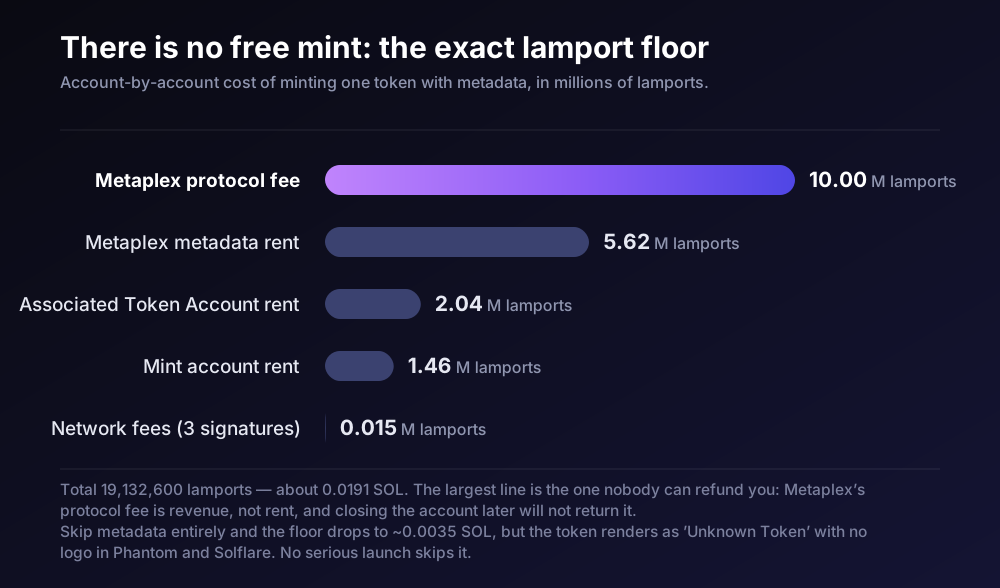
| Total | 19,132,600 | ~0.0191 SOL | Mixed |
Most cost guides, ours included, round this to "about 0.02 SOL" and move on. Run the exact formula and it's 0.0191 SOL, and that gap between "about" and "exact" is the whole reason this article exists.
Two line items deserve unpacking, since they're the ones almost every cost guide flattens into one number. First: the Metaplex metadata account itself is up to 679 bytes, big enough for a name, symbol, URI, and creator fields, so its rent-exempt deposit runs (679 + 128) × 3,480 × 2 = 5,616,720 lamports, about 0.0056 SOL. That part is refundable rent, same mechanics as the mint and ATA. Second, separately, Metaplex's Token Metadata program charges its own non-refundable protocol fee of 0.01 SOL per Metaplex's published fee schedule. This is not rent at all; it's revenue for the Metaplex protocol, and closing the metadata account later won't get it back. Combined, that's ~0.0156 SOL for "metadata" — the single line that summary tables elsewhere on this site, including our cost breakdown guide, report as one rounded "metadata" charge instead of splitting into refundable rent and non-refundable fee.
Skip metadata entirely and the floor drops to mint plus ATA plus a signature fee: about 0.0035 SOL. But per the SPL Token docs, a token without metadata shows up as "Unknown Token" with no logo in Phantom and Solflare. No serious launch skips it. Realistically, ~0.0191 SOL is the floor that matters here. Summary-depth pages such as our cost guide and the free-creator comparison quote a rounder ~0.0191 SOL protocol floor built from a single consolidated Metaplex line. The itemization above separates Metaplex's refundable metadata rent from its non-refundable create fee and lands higher. Same accounts, different granularity — and when you're funding a wallet, budget with the higher number.
What IS Genuinely Free on Solana
A few things really do cost zero, and it's worth separating those from the ~0.0191 SOL floor above so "free mint" claims can be checked against something concrete.
- Devnet minting. Solana devnet SOL comes from public faucets at no cost, and you can run the exact same CreateAccount → InitializeMint → MintTo sequence there for $0. The catch: devnet tokens don't trade on mainnet and have no economic value. Useful for testing the spl-token CLI flow, useless for shipping.
- Keypair generation. Creating a wallet keypair costs nothing. It's local math, no on-chain transaction involved, until you fund and use it.
- Reclaiming rent you already paid. Close a mint account at zero supply, or an ATA at zero balance, and
CloseAccountrefunds 100% of the original rent-exempt deposit. This is the one place "free" is literally accurate: you get lamports back, not a discount. - Jupiter Strict List and Phantom's default token list. Getting your token recognized with a verified logo across Jupiter's aggregator and Phantom's default view is free, but takes 1-2 weeks of manual review, not instant and not guaranteed.
- IPFS pinning on free tiers. Services like Pinata offer free tiers sufficient for a single token logo and metadata JSON, which covers the off-chain half of what the Metaplex metadata account points to.
None of these touch the on-chain rent floor. They're either off-chain (keypairs, IPFS), retroactive (closing accounts you already funded), or isolated from mainnet economics entirely (devnet).
Calculate Your Exact Mint Floor
Run the formula yourself with your own inputs. The base equation, restated:
Rent-exempt deposit = (account bytes + 128) × 3,480 lamports/byte-year × 2 years
Three worked scenarios, at $100/SOL (CoinGecko's rate on 2 September 2026) and $200/SOL (check the live rate on CoinGecko's SOL page before you fund the wallet — every USD figure below moves with it):
- Mint-only, no metadata: (82+128)×3,480×2 = 1,461,600 lamports + ATA's 2,039,280 + ~5,000 network = ~3,505,880 lamports ≈ 0.0035 SOL ≈ $0.35-$0.70.
- Mint + ATA + Metaplex metadata (typical launch): 1,461,600 + 2,039,280 + 5,616,720 + 10,000,000 (Metaplex fee) + 15,000 (network) = 19,132,600 lamports ≈ 0.0191 SOL ≈ $1.91-$3.82.
- Add authority revocations (mint, freeze, update, 3 extra signatures): +15,000 lamports on top of the above ≈ 0.0193 SOL ≈ $1.93-$3.86.
For a live version that runs this math against the current SOL/USD price instead of a static table, use the Solana token cost calculator, which plugs your chosen tier and price into the same constants documented above.
How "Free Mint" Platforms Actually Cover the Floor
Every platform that lets you "mint free" still has to pay this floor from somewhere. The difference between tools is where that cost gets absorbed and whether it's disclosed upfront. For scale: individual mints are rounding errors next to what the chain collects in aggregate — DefiLlama's Solana chain page tracks daily network fee totals in the millions of dollars, which is exactly why a platform can afford to eat a 0.02 SOL floor as marketing and recover it elsewhere.
| Platform | Advertises "free"? | Who pays the floor | Where the real cost hides |
|---|---|---|---|
| Raw spl-token CLI | No | You, directly | Nowhere; you sign every rent transaction yourself, ~0.0035-0.0191 SOL depending on metadata |
| Pump.fun | Effectively yes (0 SOL to create (about 0.02 SOL for the first buy)) | You upfront, platform later | 1.25% fee on every trade, recovered from trading volume, not from you at mint time |
| alchemii | No, transparent flat fee | You, all at once | Nowhere hidden; ~0.22 SOL all-in for a standard launch, itemized on the form before you connect a wallet, no per-trade cut |
| Smithii (smithii.io) | Ranks in search for "free mint" | You, via a higher flat fee | Page-level marketing uses "free" loosely; per our alchemii vs Smithii comparison, the actual flow charges a flat fee well above the protocol floor |
Smithii is worth calling out specifically since it ranks in search for this exact term without, as far as we can find, ever publishing the lamport-level math above. That's not an accusation of dishonesty. It's a gap. "Free mint" without a floor number attached is technically defensible (no platform markup) and practically misleading (a wallet still gets debited).
Pump.fun is the closest thing to genuinely free-upfront in this list. Its ~0.02 SOL first-buy entry cost is close to the true metadata-inclusive floor, and it recovers margin later through the 1.25% trading fee instead of a bigger charge at mint time. That's an honest trade for a low-volume experiment, expensive for anything that actually trades. The alchemii memecoin flow sits at the other end: no per-trade cut, cost fixed at signing, which comes out ahead once cumulative volume passes roughly 11 SOL (per our cost-to-create-solana-token breakdown).
One more honest caveat, since we build one of these tools: we don't think "free mint" is a claim any no-code platform should make without a footnote. Ours doesn't say free. It quotes ~0.22 SOL all-in for a standard launch, itemized before you connect a wallet, and it never takes a percentage of your trades afterwards. If a competitor's landing page says free and the wallet still debits ~0.02 SOL of protocol cost, that gap is the whole story of this article.
Limitations
- This is a token-creation cost model, not a full launch budget. Liquidity pool seeding (5-25 SOL for a real memecoin) isn't covered here; see Cost to create a Solana token for the full launch-tier breakdown.
- Token-2022 extensions aren't modeled. Transfer-fee, interest-bearing, and other Token-2022 extensions change account sizes and rent math; out of scope for this SPL-only breakdown.
- Authority revocation costs are noted but not itemized per-authority. Each of mint, freeze, and update authority revocation is its own ~5,000-lamport transaction; see What is mint authority on Solana for the full mechanics.
- Not financial or legal advice. This article covers protocol-level costs only, not tax treatment, securities classification, or investment guidance.
- Priority fees during network congestion aren't included in the ~0.0191 SOL floor. That figure assumes base-fee mainnet conditions, not a congestion spike.
FAQ
Is minting a token on Solana actually free?
No. Rent-exemption is a protocol requirement, not a platform fee. Minting a bare SPL token (mint account plus one associated token account) needs about 0.0035 SOL in refundable rent deposits plus a tiny network fee. Add Metaplex metadata, required for the token to show a name and symbol plus a logo instead of "Unknown Token," and the floor rises to roughly 0.0191 SOL, split between refundable rent and a non-refundable 0.01 SOL Metaplex protocol fee.
What is Solana's rent-exemption formula?
(account size in bytes + 128) × 3,480 lamports per byte-year × 2 years. The 128-byte constant is fixed account-header overhead every account pays regardless of its own data. A mint account (82 bytes) needs 1,461,600 lamports (~0.0015 SOL); an associated token account (165 bytes) needs 2,039,280 lamports (~0.0020 SOL). Full formula and constants are documented at solana.com/docs/core/rent.
Is Solana rent refundable?
Yes, for the accounts you're allowed to close. Closing a mint account (only possible at zero supply) or an associated token account (only at zero balance) returns 100% of the lamports deposited for rent-exemption via the CloseAccount instruction. The Metaplex protocol create fee is different: it's a one-time non-refundable charge, not rent, so closing the metadata account later only refunds the metadata account's own rent, not the original 0.01 SOL fee.
What's the difference between minting, creating, and deploying a Solana token?
Deploying uploads new program bytecode to the chain. SPL tokens never do this, since they all run on the same shared Token Program. Creating means CreateAccount plus InitializeMint, which allocates and rent-funds a new 82-byte Mint struct. Minting (MintTo) is the cheap step: writing a supply number into an already-created, already-rent-exempt token account, which costs about 5,000 lamports (0.000005 SOL) in signature fees and nothing in rent.
Why do 'free mint' platforms still cost SOL?
Because the floor is set by the Solana protocol, not the platform. When a tool advertises "free mint," it almost always means zero service fee: you still pay the rent-exemption deposits and Metaplex fee directly from your own wallet. Pump.fun genuinely gets closest to free-upfront (about 0.02 SOL) by recovering its margin later through a 1.25% fee on every trade instead of a bigger creation charge.
References
- Solana Docs: Rent. Rent-exemption formula, 2-year threshold, lamports-per-byte-year constant.
- Solana Docs: Fees. 5,000-lamport base signature fee, prioritization fees.
- Solana Docs: Accounts. Account model, 128-byte header overhead.
- SPL Token Program. 82-byte Mint struct, InitializeMint, MintTo instructions.
- SPL Associated Token Account Program. 165-byte ATA structure.
- Metaplex Token Metadata Program. Metadata account structure, up to 679 bytes.
- Metaplex Protocol Fees. 0.01 SOL non-refundable create fee.
- Solana Explorer: Token Program. Live Token Program account.
- Solscan: USDC mint. Real 82-byte mint account example, 11B+ circulating supply.
- Pinata: Pin File to IPFS. Free IPFS pinning tier.
- Solana Program Library: Mint struct source. LEN constant for the 82-byte Mint account.
- Jupiter Strict List guide. Free token-list inclusion, 1-2 week review.
- CoinGecko: Solana (SOL) live price. SOL/USD rate behind every dollar conversion in this article.
- DefiLlama: Solana chain fees and volume. Aggregate network-fee context for the platform-economics section.
You've seen the exact lamport math. Now run it against your own token. Open the Solana Token Creator and watch the itemized cost at signing, not after. For memecoin launches specifically, the cheap-tier flow uses the same mint math with memecoin defaults pre-filled, and if you need to lock down authorities afterward, revoke mint authority is its own ~5,000-lamport transaction, not a new mint.
Create your Solana token
Choose your token name, symbol, supply and image. Review the authority options and creation fee, then confirm the transaction in your wallet. Liquidity is a separate step.
Related Topics
More guides to Solana token creation, authorities, liquidity, and meme coin launches.
Free Solana Token Creator? 0.0191 SOL Floor (2026)
No Solana token creator is free — the protocol floor is ~0.0191 SOL and no tool can waive it. Every no-code creator's real 2026 price, compared in SOL.
Solana Token Name, Symbol & Image Rules: Byte Limits (2026)
The real limits: 32 bytes for name, 10 for symbol, 200 for the URI — enforced in bytes, not characters. Plus the logo sizes wallets and listers expect.
How to Launch a Token on Solana That Isn't a Memecoin
Launch a Solana token built to last: authority strategy, decimals, supply, vesting and liquidity for game, governance, loyalty and creator tokens in 2026.
Get a Pump Suffix Token Without Pump.fun (2026)
Create a Solana token ending in pump for 0.1 SOL. Gain memecoin-native recognition, keep direct-launch control, and preserve more creator upside.
What Happens When You Clone a Solana Token? (2026)
Cloning a Solana token copies name, symbol and image — nothing else. New mint address, no liquidity, no holders, no price. Exactly what transfers.
Transfer Mint Authority on Solana: Move vs Revoke
Transfer Solana SPL mint authority to a multisig instead of revoking — when each is right, SetAuthority mechanics, common pitfalls.