What Is a Bonding Curve? Pump.fun Formula & Calculator (2026)
A bonding curve prices a token by formula. We read pump.fun's live curve on-chain: 30 SOL virtual reserve, 85 SOL to graduate. Try the calculator.

Skip the 85 SOL bonding curve. Set your own launch price. Create your meme coin on the homepage, then open a pool at the price you choose.
A bonding curve is a pricing formula that sells a token straight from a smart contract: every buy pushes the price up, every sell pushes it down, and nobody has to deposit liquidity first. On pump.fun, the curve opens every standard coin at a market cap of about 28 SOL and completes at about 411 SOL, after roughly 85 SOL of buys. Then the coin "bonds" and its liquidity moves into a PumpSwap pool. We read those numbers from Solana mainnet on 3 November 2026, and the calculator below runs the same math.
Bonding curves made launching a meme coin free. They also took the two decisions that matter most at launch, the opening price and how much supply each early buyer gets, out of the creator's hands. If you would rather make those calls yourself, create your meme coin on Alchemii's homepage → and open its pool at the price you choose.
We build Alchemii, a direct-launch token creator, so we have a side in the curve-versus-pool question. That is why every pump.fun figure below comes from the program's own accounts, with the raw reads published as JSON.
What is a bonding curve?
A bonding curve is a smart contract that acts as the market maker for its own token. It does not match buyers with sellers or draw on a pool someone funded. It quotes a price from a formula tied to how many tokens have been sold. When you buy, the contract issues tokens at the current price and moves up the curve. When you sell, it takes the tokens back, pays you from the SOL it has collected, and moves back down.
Three properties follow from that design:
- There is always a price. No order book can run dry. The contract quotes any size, although a large order pays a worse average price than a small one.
- Nobody seeds liquidity. The creator does not deposit SOL to make the token tradable. Buyers' SOL becomes the reserve.
- Pricing is deterministic. Anyone can calculate the price at any fill level in advance, and nothing is negotiated.
The idea predates meme coins. Simon de la Rouviere described "curved token bonding" for curation markets in 2017 (source), and token engineers have since used linear, exponential and S-shaped curves for community tokens and fundraising (source). Meme coin launchpads made the concept mainstream because it solves their exact problem: tens of thousands of creators a day with an idea, an image and no liquidity.
| Curve shape | How the price moves | Where you meet it |
|---|---|---|
| Linear | Rises by a fixed step per token sold | Teaching examples, some community tokens |
| Exponential | Rises faster the more supply sells | Fundraising designs that reward the earliest buyers |
| Constant product (x × y = k) | Each SOL buys fewer tokens than the one before | pump.fun, and AMM pools such as Uniswap v2, Raydium and PumpSwap |
How does pump.fun's bonding curve work?
pump.fun applies the constant-product formula from Uniswap v2 to synthetic reserves. Its program documentation says the curve "is based on Uniswap V2 and uses synthetic x and y reserves to ensure that there is liquidity for the coin" (source). Uniswap's own documentation explains the underlying x × y = k rule (source).
In practice, every standard coin starts as if its pool held 30 SOL and 1,073,000,000 tokens. Nobody deposited that 30 SOL. It exists only in the math, so that the first buyer meets a finite price. As people trade, the product of the two reserves stays fixed:
(30 + SOL raised) × virtual tokens = 30 × 1,073,000,000 = 32.19 billion
The spot price is therefore (30 + SOL raised)² ÷ 32.19 billion SOL per token. The market cap pump.fun displays is that price multiplied by the 1 billion supply. We read every parameter from the program's Global account (Solscan) at slot 465,094,771 on 3 November 2026, using Solana's standard account reads (source).
Quick Facts: pump.fun's bonding curve in numbers
Only 793.1 million of the 1 billion tokens are sold on the curve. The other 206.9 million are reserved. When the last curve token sells, those reserved tokens enter a PumpSwap pool together with the SOL the curve collected, so the pool opens at the price where the curve stopped: about 4.11 × 10⁻⁷ SOL per token. The program charges a 0.015 SOL migration fee and burns the LP tokens from the new pool.
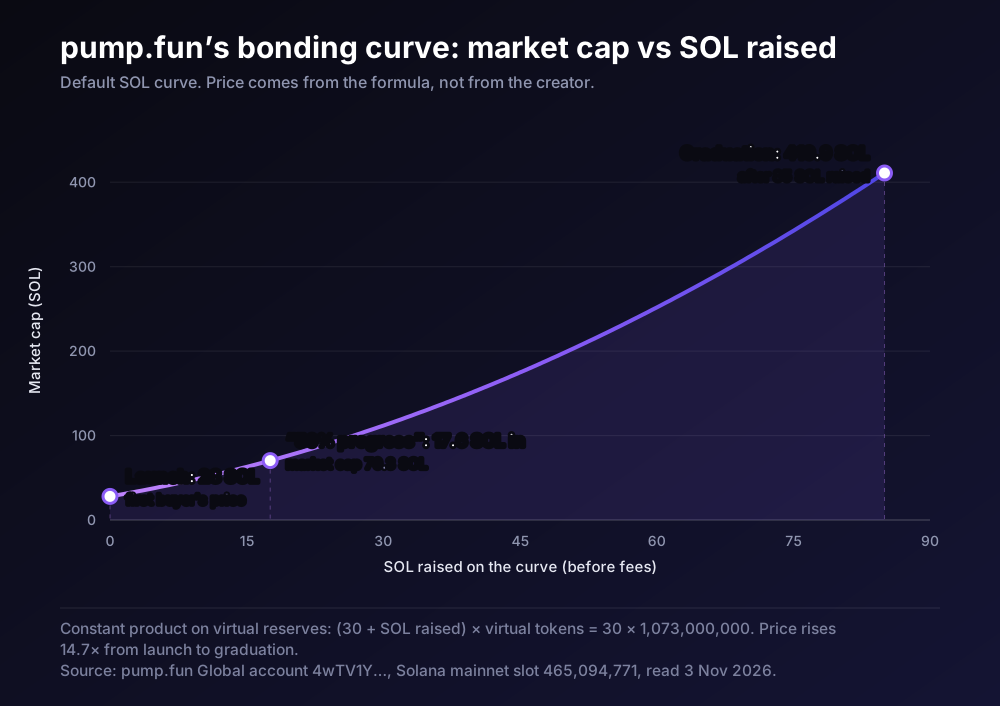
Plotted from the Global account constants, not sketched. The curve steepens as it fills, which is why late buyers pay far more per token than early ones.
Each buy and each sell also pays a trading fee on top of the curve price. At curve market caps the fee is 1.25%: 0.95% to the protocol, which the Global account stores as 95 basis points, and 0.30% to the coin's creator. pump.fun sets these rates by market-cap tier through a separate fee program, so the split can change as a coin grows (source).
Bonding curve calculator: what does a buy get you?
Set how much SOL is already in the curve, or tap a preset, then enter a buy size. The calculator applies the constants above and shows the 1.25% fee on top, the way pump.fun charges it.
What does a buy get you on pump.fun's curve?
Default SOL curve: 30 SOL virtual reserve, 793.1M tokens sold before graduation at 85 SOL. Read from mainnet 3 Nov 2026.
- Tokens you receive
- 34.61M
- Share of total supply
- 3.46%
- Average price per token
- 2.889e-8 SOL
- Trading fee on top (1.25%)
- 0.0125 SOL
- Market cap after your buy
- 29.9 SOL
- Curve progress after your buy
- 4.4%
Launching your own coin? On a direct launch you set the opening price instead of the curve.
Create my meme coinEstimates use floating-point math; the program uses integer lamports and rounds each trade. Mayhem Mode and non-SOL pairs use different curves.
Try 1 SOL on a fresh launch, then the same 1 SOL at 80% progress. The first returns 34.61 million tokens. The second returns 5.89 million. You spend the same SOL and get about a sixth of the tokens, and that gap is the whole economics of a bonding curve.
Why bonding curve progress counts tokens, not SOL
The progress bar traders watch reports the share of the 793.1 million curve tokens that have sold. Every SOL buys fewer tokens than the one before, so that bar races ahead of the money:
| Progress shown | SOL in the curve | Share of the 85 SOL | Market cap (SOL) | Market cap (USD) |
|---|---|---|---|---|
| 0% (launch) | 0 | 0% | 28.0 | $2,594 |
| 10% | 2.4 | 2.8% | 32.6 | $3,025 |
| 25% | 6.8 | 8.0% | 42.1 | $3,903 |
| 50% | 17.6 | 20.7% | 70.3 | $6,527 |
| 75% | 37.3 | 43.9% | 140.8 | $13,062 |
| 79.3% | 42.5 | 50.0% | 163.3 | $15,150 |
| 90% | 59.6 | 70.1% | 249.5 | $23,146 |
| 100% (graduation) | 85.0 | 100% | 410.9 | $38,121 |
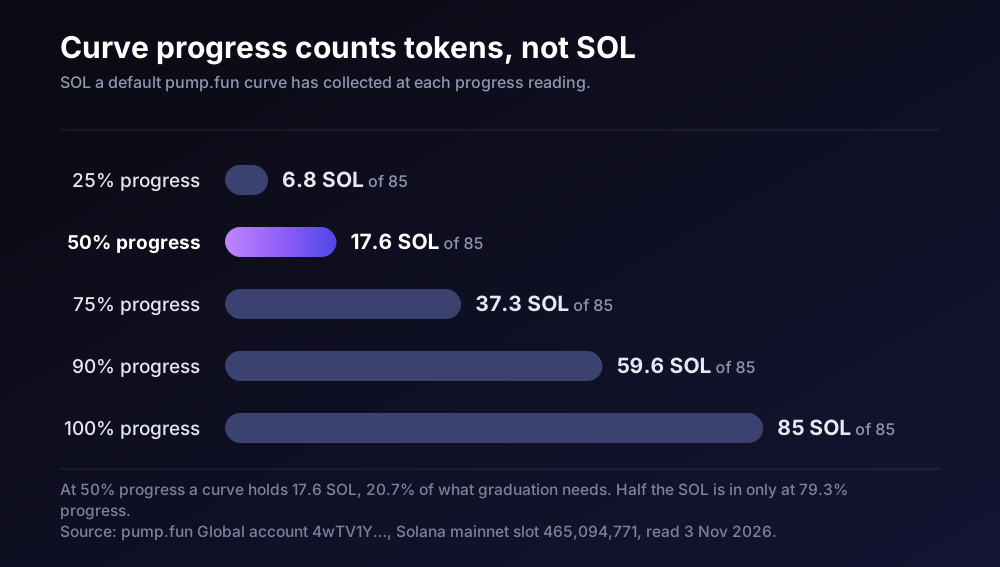
A coin showing 50% progress has collected 17.6 SOL, only 20.7% of what graduation needs. The curve is not halfway in SOL until progress reads 79.3%. We saw this on a live account: curve 7HzeeLKS… showed 78.3% progress while holding 41.2 SOL.
For a trader, a coin at "90%" still needs about 25.4 SOL of net buying, roughly 30% of the total. For a creator, the last stretch of the bar is where most of the money has to come from. It arrives just when early buyers can lock in a profit: at 75% progress, anyone who bought at the launch price is up about 5x on paper and can sell straight back into the curve.
The first SOL buys 14 times more than the last
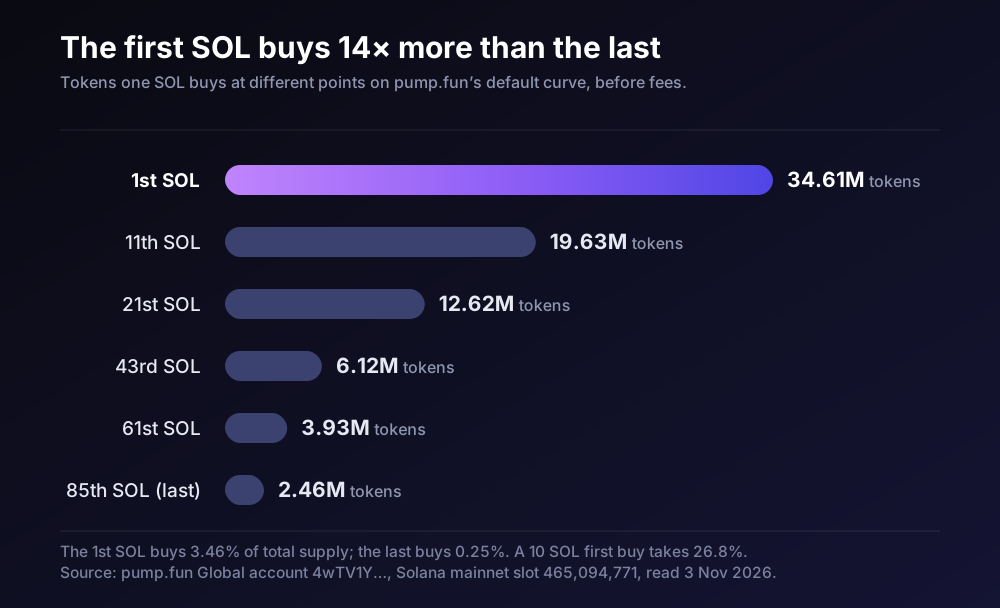
The first SOL into a fresh curve buys 34.61 million tokens, 3.46% of total supply. The 85th buys 2.46 million, 0.25%. That gradient explains why the first seconds of a pump.fun launch are crowded with bots, and why "dev buys" matter so much. A creator or sniper who puts 10 SOL in first ends up with 26.8% of the supply at an average of 3.73 × 10⁻⁸ SOL per token. The curve's last buyer pays 4.11 × 10⁻⁷, eleven times more.
Concentration is the cost the curve hides. One wallet holding a quarter of supply is the first thing careful buyers look for on a holder list, and our guide to verifying a Solana token shows where to check.
What does "bonded" mean? Graduation explained
A coin has bonded, or graduated, when its curve sells out. All 793.1 million curve tokens are gone, and the program sets the account's complete flag. Anyone can then call migrate, which moves the reserves into a PumpSwap pool and burns the LP tokens. From that point, the price comes from the pool, which trades like any Solana AMM. See what PumpSwap is and how its pools work for the post-graduation side (source).
Two details most explainers miss:
- The last buy has no size limit. With pump.fun's v3 buy instructions, the buy that empties the curve keeps going. It takes everything left on the curve, then buys from the tokens bound for the pool at the price the pool would charge. pump.fun calls this a synthetic migration (source).
- Graduation is rare. Of the 246,544 pump.fun coins created 20–26 September 2026, 7,803 graduated within a week: 3.17%. Coins from wallets that launched only one coin that week graduated 9.51% of the time (full data).
The other 96.83% were still on their curves a week later. A coin that never bonds never reaches a DEX pool, so it never trades anywhere except its own curve.
Not every pump.fun coin uses the 30 SOL curve
The constants above describe the default curve, and they are not universal. We decoded every bonding-curve account touched by a sample of pump.fun transactions on 3 November 2026: 28 accounts, 27 of them still open.
| Curve type in our sample | Open curves | Starts from 30 virtual SOL? |
|---|---|---|
| Standard SOL-paired | 14 | Yes, all 14 |
| Mayhem Mode coins | 9 | No, different quote-side reserves |
| Paired against another token | 4 | No, priced in that token |
All 14 standard SOL-paired curves started from exactly 30 virtual SOL. The 9 Mayhem Mode coins and the 4 coins paired against another token did not, because their prices run on different quote-side reserves. pump.fun's program README documents the is_mayhem_mode and quote_mint fields that tell them apart. If you are reading one of those charts, the numbers in this article do not apply; check that coin's own curve account.
Bonding curve vs liquidity pool: what changes for a creator
Both are constant-product formulas. The difference is who sets the reserves. On pump.fun, the program pads them with 30 virtual SOL and decides how much supply is for sale. In your own pool, the reserves are real: the SOL and tokens you deposit. That one difference decides the price, the supply distribution and the cost.
| pump.fun bonding curve | Direct launch: your token, your pool | |
|---|---|---|
| Who sets the opening price | The formula: ≈28 SOL market cap for every standard coin | You, through the SOL and tokens you deposit |
| Supply and decimals | Fixed: 1B supply, 6 decimals | Your choice (Alchemii defaults to 1B and 6) |
| Where the supply sits at launch | 793.1M on the curve, 206.9M reserved for the pool | 100% minted to your wallet; you choose how much goes into the pool |
| Cost to start | Free to create; the first buy is optional | ≈0.22 SOL to create, plus pool costs and your liquidity |
| Liquidity at the start | Virtual reserves; nobody deposits | Real SOL you deposit |
| Trading fee | 1.25% per buy and per sell on the curve, 0.30% of it to the creator | Your pool's fee: PumpSwap's schedule, or Raydium CPMM at 0.25% or 1% |
| Route to a DEX pool | Only after ≈85 SOL of buys (3.17% of coins in our September week) | From the first minute |
| LP tokens | Burned automatically at migration | Yours: hold them, or burn them when you choose |
| Best fit | No budget, testing an idea, relying on pump.fun's audience | An existing community, a planned launch, full control |
Raydium documents its CPMM pool setup and fee tiers in its own docs (source). The curve is cheaper to start and comes with pump.fun's audience. A pool gives you every decision in the right-hand column.
Already have the community and the artwork? Then the curve is making decisions you could make yourself. Put your token together on the homepage and set the opening price when you open its pool.
How to launch a meme coin without a bonding curve
A direct launch has two steps: create the token, then open its market. You can do both on Alchemii without writing code.
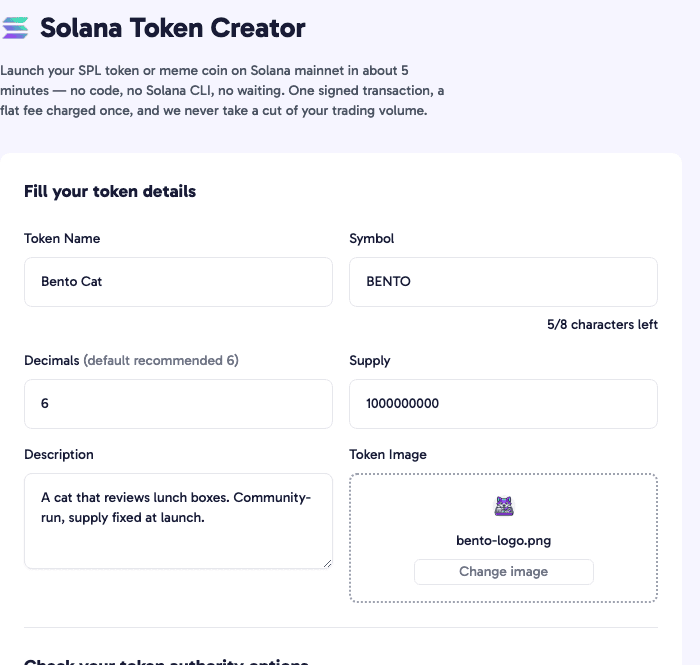
The real homepage form with example details, not a deployed token. Open it and create your meme coin →
- Open the Solana meme coin creator on the homepage. Enter the name, ticker, image and description. Supply defaults to 1 billion with 6 decimals, the same shape traders know from pump.fun, and you can change both.
- Settle the authorities. Alchemii never sets a freeze authority on the mint. Tick Revoke Mint (+0.1 SOL) to make the supply permanent in the same transaction, because buyers check it first (why it matters).
- Want the familiar
…pumpaddress? Tick the Pumpfun option (+0.1 SOL) and your mint address ends inpump, without launching on the curve. Open the form with it pre-selected. - Review the total and sign. Creation is a 0.2 SOL service fee plus about 0.02 SOL of network and account costs: about 0.22 SOL in all, or about 0.32 SOL with the mint revoke. The whole supply is minted to your wallet.
- Open your pool. Choose a PumpSwap pool or a Raydium CPMM pool at the 0.25% or 1% fee tier. Your deposit sets the opening price: 500 million tokens against 5 SOL opens at 1 × 10⁻⁸ SOL per token, a 10 SOL market cap. Keep at least 0.4 SOL free for the pool's own costs, on top of the deposit.
- Decide what happens to the LP. Burning it locks the liquidity for good, which is what pump.fun does at graduation. Holding it keeps your share of pool fees (how to burn LP tokens; how LP fees work).
A pool is also a constant-product curve, just with real reserves, so thin liquidity moves fast. In that 5 SOL example, a 5 SOL buy takes half of the pooled tokens. Deeper liquidity costs more SOL up front and moves the price more slowly. On a direct launch, that trade-off is yours to make instead of the launchpad's.
Want a starting point that is already working? Copy Coin on the Trending board loads a trending pump.fun coin's name, image and memecoin settings into the same homepage form. Make the identity your own, review the fee, and sign when you are ready.
When a bonding curve is the better choice
A curve beats a direct launch in three situations:
- You have no budget and no audience yet. Creating on pump.fun costs nothing, while a direct launch costs about 0.22 SOL plus the liquidity you deposit. If you want to test an idea for free, the curve is the cheaper first shot.
- You want pump.fun's discovery. Coins on the curve appear on pump.fun's board, where traders already look. A direct launch has to bring its own first buyers.
- You want a fair-launch story. On a curve without a dev buy, nobody holds supply before the first public trade.
A direct launch wins when people are already waiting for your token, when you want to set the price, when you need an allocation outside the pool (an airdrop, a marketing wallet, a team share), or when a fixed 1B, 6-decimal shape does not fit the project. Other curve launchpads follow the same principle with different constants: Jupiter Studio runs Meteora's dynamic bonding curve with a 1% fee on every trade for the token's life, and Pons on Robinhood Chain graduates at 4.2 ETH. For a full side-by-side on Solana, see pump.fun vs Raydium.
Ready to launch on your own terms? Create your Solana meme coin on the homepage → It takes one signed transaction, and you can review every field and the total before you connect a wallet.
Limitations
- Small sample. The 28 curve accounts come from a few seconds of pump.fun activity on 3 November 2026. They show which curve configurations exist, not each configuration's share of all launches.
- Variants not decoded further. We identified Mayhem Mode and non-SOL curves by their account fields, but we did not model their pricing.
- Rounding. The calculator and charts use floating-point math. The program uses integer lamports and rounds each trade, so on-chain results differ in the last digits.
- Fees and constants can change. The trading fee comes from pump.fun's published tiers, and the Global account can be updated by pump.fun's authority. Re-read it before relying on these numbers. Our chart generator refuses to run if the constants change.
- Dollar figures move. USD values use SOL at $92.78 on 3 November 2026. The SOL figures do not depend on the price.
- Graduation rate is one week. The 3.17% rate covers coins created 20–26 September 2026 and moves with the market.
FAQ
What is a bonding curve in crypto?
A bonding curve is a smart contract that sells and buys back a token at a price set by a formula. Every buy moves the price up and every sell moves it down, so the token is tradable from its first second without anyone depositing liquidity. Meme coin launchpads such as pump.fun, Jupiter Studio and Pons use bonding curves to let anyone launch for little or nothing.
What bonding curve does pump.fun use?
pump.fun uses the Uniswap v2 constant-product formula on synthetic reserves. A standard SOL-paired coin starts as if its pool held 30 SOL and 1,073,000,000 tokens, and the product of the two stays fixed as people trade. 793.1 million tokens are sold on the curve; the other 206.9 million go into the PumpSwap pool at graduation. We read these values from the program's Global account on 3 November 2026.
How much SOL does it take to complete a pump.fun bonding curve?
About 85 SOL of net buying, before fees: 85.005 SOL on the default curve. That takes the market cap from about 28 SOL at launch to about 411 SOL at graduation, roughly $2,594 to $38,121 at a SOL price of $92.78. Each buy and sell also pays a 1.25% trading fee on the curve.
What does it mean when a coin has bonded?
A coin has bonded, or graduated, when every token for sale on its bonding curve has been bought. The curve is marked complete, its SOL and the reserved tokens migrate into a PumpSwap pool, and the pool's LP tokens are burned. From then on the price comes from that pool. In our count of 246,544 pump.fun coins created 20-26 September 2026, 3.17% bonded within a week.
Why does bonding curve progress move faster than the SOL raised?
Progress counts the share of the 793.1 million curve tokens that have been sold, and every SOL buys fewer tokens than the one before. So a pump.fun coin at 50% progress has raised only 17.6 SOL, about a fifth of the 85 SOL graduation needs. The curve is not halfway in SOL until progress reads 79.3%.
Is a bonding curve the same as a liquidity pool?
They use the same constant-product math, but a bonding curve runs on virtual reserves set by the launchpad, while a liquidity pool holds real SOL and tokens that someone deposited. On a curve the program sets the opening price and how much supply is for sale. In your own pool, your deposit sets both, and you decide what happens to the LP tokens.
Can I launch a meme coin without a bonding curve?
Yes. Create the token directly, then open your own pool. On Alchemii's homepage you set the name, ticker, image and supply and sign one transaction for about 0.22 SOL, with the whole supply minted to your wallet. You then open a PumpSwap or Raydium pool, where the SOL and tokens you deposit set the opening price.
References
- pump.fun, Pump program README: curve formula, Global and BondingCurve account fields, migration. Read 3 November 2026.
- pump.fun, Synthetic migration: how the buy that completes a curve continues into the pool.
- pump.fun, Fee program README: market-cap fee tiers for curve and pool trades.
- pump.fun, PumpSwap README: the AMM graduated coins migrate into.
- Solscan, pump.fun Global account 4wTV1Ymi…jaxnjf.
- Uniswap, How Uniswap works: the constant-product formula.
- Token Engineering Community, A technical introduction to bonding curves.
- Simon de la Rouviere, Tokens 2.0: Curved Token Bonding in Curation Markets (2017).
- Solana, Accounts: how program accounts store state.
- Raydium, Create a CPMM pool.
- CoinGecko, Solana (SOL) price: $92.78 on 3 November 2026.
- Alchemii, Raw curve reads for this article and How many meme coins are created every day.
Your coin, your price, no curve to climb
On pump.fun's curve the formula sets the opening price, and a 10 SOL first buyer takes 26.8% of supply. On a direct launch you decide both the price and how much supply goes into the pool. Create your Solana meme coin on the homepage for about 0.22 SOL, with 100% of the supply minted to your wallet.
Related Topics
More guides to Solana token creation, authorities, liquidity, and meme coin launches.
What Is Pump.fun? The Complete Platform Guide (2026)
Pump.fun Solana bonding-curve launchpad: free to create, 1.25% per trade, auto-LP at the 85-SOL (~$41K) graduation. How it works, who it's for.
Jup Studio: Fees, Graduation & How to Launch (2026)
Jup Studio explained: Jupiter Studio's 1% fee split, anti-sniper window, 15K USDC graduation, measured launch cost, and when a direct Solana mint wins.
How Many Meme Coins Are Created Every Day? 77,000 (2026)
About 77,000 a day: we counted every coin on pump.fun, four.meme, Flap.sh and Pons for a week. Most come from bots; one-coin creators graduate 7.8× as often.
How to Make Money on Pump.fun: Creator Rewards
How to make money on pump.fun by creating a coin: creator rewards pay 0.30% to 0.95% of every trade. See Sept 2026 payouts, Holder Rewards, and how to withdraw.
Meme Coin Market Cap 2026: $36B by Coin & Chain
The meme coin market cap is $36.45B, 76% below its record, yet launchpad fees just hit $10.3M a day. See the data by coin and chain, then launch your own.
Pump.fun Callouts Explained: How to Use Them & Check Rewards
What Pump's Callout Rewards terms really say: the Activity Metric is confidential, rewards are discretionary, and only the on-chain transfer counts as payment.